Multi Language Support: A Guide for Short-Term Rental Hosts
Discover how multi language support in guest guides boosts reviews and cuts support messages. Practical tips for hosts.
You've probably seen the same pattern: a guest arrives, scans the welcome guide, and finds the Wi-Fi password, checkout instructions, and appliance notes written only in English. They manage most of the stay, but every unclear detail creates another message for you to answer. Multi language support can close those small gaps, but only when it covers the complete guest experience, not just the words on a page.
A useful multilingual guide combines clear source content, accurate translation, thoughtful localization, accessible design, and a reliable way to reach the information. That matters for hosts because the internet serves a linguistically diverse world. There are approximately 7,000 languages and dialects spoken worldwide, while more than 75% of internet users access the web in only 10 languages, as summarized in this overview of languages used on the internet. The opportunity is broad, but the practical work starts with the details guests need most.
Table of Contents
- The Moment a Translation Gap Costs You a Five-Star Review
- What Multi Language Support Really Means for a Guest Guide
- Why Hosts Win When Guests Read in Their Own Language
- How ScanStay Delivers Multi Language Support in Practice
- Translation Quality and Localization Best Practices
- Setting Up Multi Language Support in Your Own Listing
- Common Pitfalls That Break the Multilingual Experience
- Your Short Checklist Before You Go Live
The Moment a Translation Gap Costs You a Five-Star Review
At 11 p.m., a guest sends a message: “Sorry, how do we connect to the Wi-Fi?” You check the welcome materials and realize the router name and password are printed only in English. You reply, the guest connects, and the immediate problem disappears.
The next morning brings another message. The espresso machine is in the kitchen, but its instructions are still in English, so the guest isn't sure which button starts the cleaning cycle. Later, they ask whether checkout means leaving the keys inside or placing them in the lockbox. None of these questions is dramatic, yet each one interrupts your evening, extends a message thread, and makes the stay feel less effortless.
A guest may still praise the apartment, the location, and the comfortable bed. But reviews often reflect how easy the property was to use, not just how attractive it looked. When guests have to decode basic instructions, they may leave with the impression that the home was prepared for the host's convenience rather than theirs.
Host reality: A translation gap rarely appears as one large failure. It shows up as a chain of small clarifications.
The fix isn't necessarily a full professionally translated manual. Start with the information that controls arrival, safety, comfort, and departure:
- Arrival details: Explain the entrance, keys, lockbox, elevator, and parking instructions in language the guest can follow quickly.
- Connectivity: Display the Wi-Fi name and password clearly, with labels that don't depend on English vocabulary.
- Appliances: Add short steps for the coffee machine, heating, air conditioning, washing machine, and other equipment guests are likely to use.
- House rules: State what guests need to do, rather than relying on idioms or indirect wording.
- Local recommendations: Describe why a restaurant, shop, or attraction suits the guest, not just its name.
That's what multi language support should accomplish. It should remove avoidable questions while preserving a welcoming, trustworthy experience.
What Multi Language Support Really Means for a Guest Guide
Multi language support is more than placing a translation toggle beside an English page. A guest experiences several systems at once: the original writing, the translation process, the interface, the device, and the way the guide remains available when conditions aren't perfect.
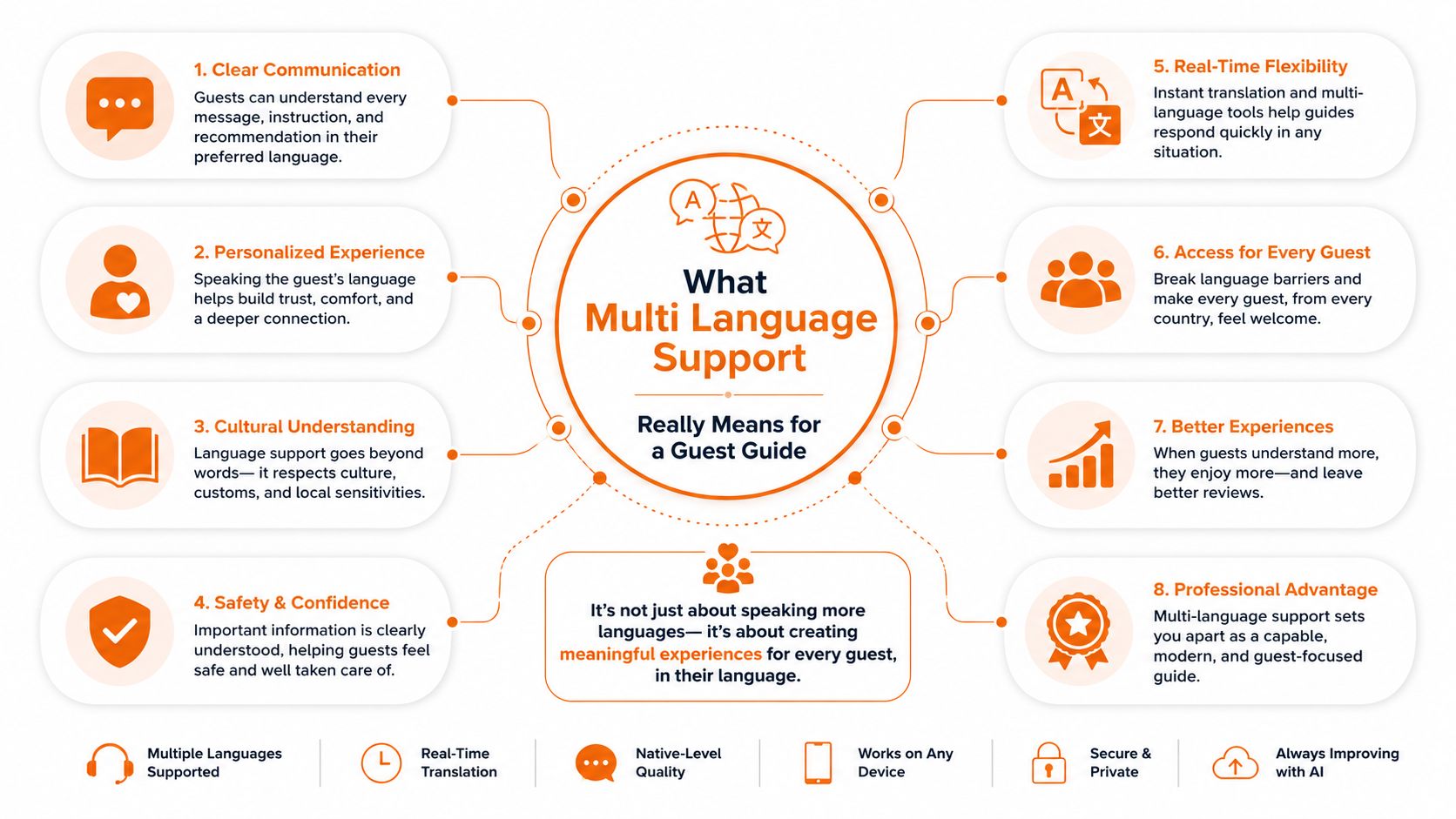
The four layers guests actually use
First, start with the source copy. If your English instructions are vague, overly long, or full of local slang, an automated system has to guess what you mean. “Make yourself at home” may sound friendly, but “Please turn off the heating before opening the windows” gives a translation engine a much clearer instruction.
Second, choose the translation workflow. AI translation can create broad coverage quickly, while human review catches awkward phrasing, ambiguous safety instructions, and property-specific terms. Large multilingual resources illustrate why quality translation is not built from a small collection of phrase substitutions. One multilingual parallel corpus supports 18 language pairs and more than 96 million aligned sentence pairs, with roughly 1.4 billion English tokens, according to this overview of multilingual support and translation resources. The operational lesson is simple: translation quality depends on language data, context, review, and ongoing corrections.
Third, check how the guide renders. Text can expand, wrap differently, or require a different reading direction. The W3C internationalization test pages exist to compare browser implementations of internationalization-related specifications, which reinforces an important point: internationalization testing is a functional quality check. A translated sentence that looks fine in an editor can become difficult to scan on a phone, especially in right-to-left languages.
Fourth, plan for reachability. A guest guide should open without an app or complicated login, and it should have a physical fallback. A QR code near the entrance can help guests find the digital version, while a printed sheet preserves access if the guest's connection is unreliable.
Localization adds another layer. Translation asks, “What do these words mean in another language?” Localization asks, “What would make this instruction natural and useful for this guest?” That may affect tone, measurements, examples, icons, and the order of information. A digital welcome book works best when its content is structured around the guest's task, not around the host's original document.
Why Hosts Win When Guests Read in Their Own Language
The host benefit begins with fewer preventable questions. A guest who can understand the heating instructions, Wi-Fi details, and checkout steps without asking for help is less likely to start a late-night conversation. That gives you more control over response time and reduces the number of interruptions that come from information the property should already provide.
Clear language also prevents avoidable operational problems. A guest who misunderstands the thermostat may call a technician unnecessarily. A guest who doesn't understand the key-return process may delay the cleaner or create a difficult handoff. A guest who can read a direct explanation of a blocked drain, rubbish collection point, or appliance setting has a better chance of solving the issue correctly.
The effect reaches beyond support. Guests judge the effort required to use a property, and a guide that feels considerate can support a smoother stay. Localized descriptions can also make optional services easier to understand. An early check-in offer, airport transfer, or equipment rental needs a clear explanation of timing, price, and value. Fluency helps, but the offer still needs to be relevant and easy to act on.
| Capability | Host pain point it solves | Metric affected |
|---|---|---|
| Clear translated arrival steps | Repeated questions during check-in | Message volume and response time |
| Localized appliance instructions | Incorrect use and unnecessary interventions | Operational interruptions |
| Accessible house rules | Disputes caused by unclear expectations | Complaints and review sentiment |
| Native-language service offers | Guests overlook extras they might value | Ancillary revenue |
| Consistent language structure | Guests spend less time searching | Guide engagement and task completion |
Non-English support also deserves its own measurement plan. Recent AI-support coverage reports that resolution rates in non-English conversations can be 5 to 10 points lower on average, even when customer satisfaction is similar or only slightly lower, as discussed in this analysis of multilingual AI support. For a host, that means language coverage shouldn't be judged by the number of available languages alone.
Track which languages guests select, which sections they open, and which questions continue to arrive afterward. If guests can read the Wi-Fi page but still message you about checkout, the issue may be the instruction itself, the page layout, or the fallback language. Multi language support becomes useful when it changes those practical outcomes.
How ScanStay Delivers Multi Language Support in Practice
A host can think of a multilingual digital guide as three connected layers. The first is content management, the second is language selection, and the third is delivery inside the property.
One source, multiple language versions
ScanStay lets a host create the guide in one source language, English by default, and send that content through an AI translation engine that produces 18 output languages. The supported set includes right-to-left options such as Arabic and Hebrew, which means language coverage needs to include interface behavior as well as translated words.
The advantage of a single source is consistency. If you update a checkout time, appliance instruction, or house rule, you can edit the source content and re-translate in bulk rather than copying changes manually across separate documents or spreadsheets. That workflow helps keep the available language versions aligned, although hosts should still review the passages where a misunderstanding could affect safety, access, or a guest's departure.
A QR code that meets guests at the property
The second layer is the printable A5 QR poster. Place it near the entrance, on an entry shelf, or on the kitchen counter so guests see it when they arrive. They scan it with their phone and open the guide in a mobile browser, without installing an app.
The landing page can detect the browser language and fall back to English when the preferred language isn't available. Guests don't need to wait for you to assign a language manually, and hosts don't need to create a separate link for every reservation. The poster remains the same even when the digital content changes, which is more practical than reprinting a complete welcome book each time you revise a sentence.
Icons, maps, and visual checkout timers can remain language-neutral, while house rules, Wi-Fi credentials, appliance steps, and local recommendations appear in the selected language. For local context, a guide might also point guests toward resources such as Basque language tips for travelers, especially when a few respectful local words can make an interaction feel more natural.
The important trade-off is scope. AI translation gives a host broad reach and a manageable update process, but it isn't a substitute for human judgment in every sentence. Review priority languages and critical instructions first, then use guest behavior and support questions to decide where deeper localization is worth the effort.
Translation Quality and Localization Best Practices
A multilingual guide is only as helpful as its least clear critical instruction. You don't need to rewrite every sentence in an ornate style, but you do need a source document that gives the translation process enough context to work accurately.
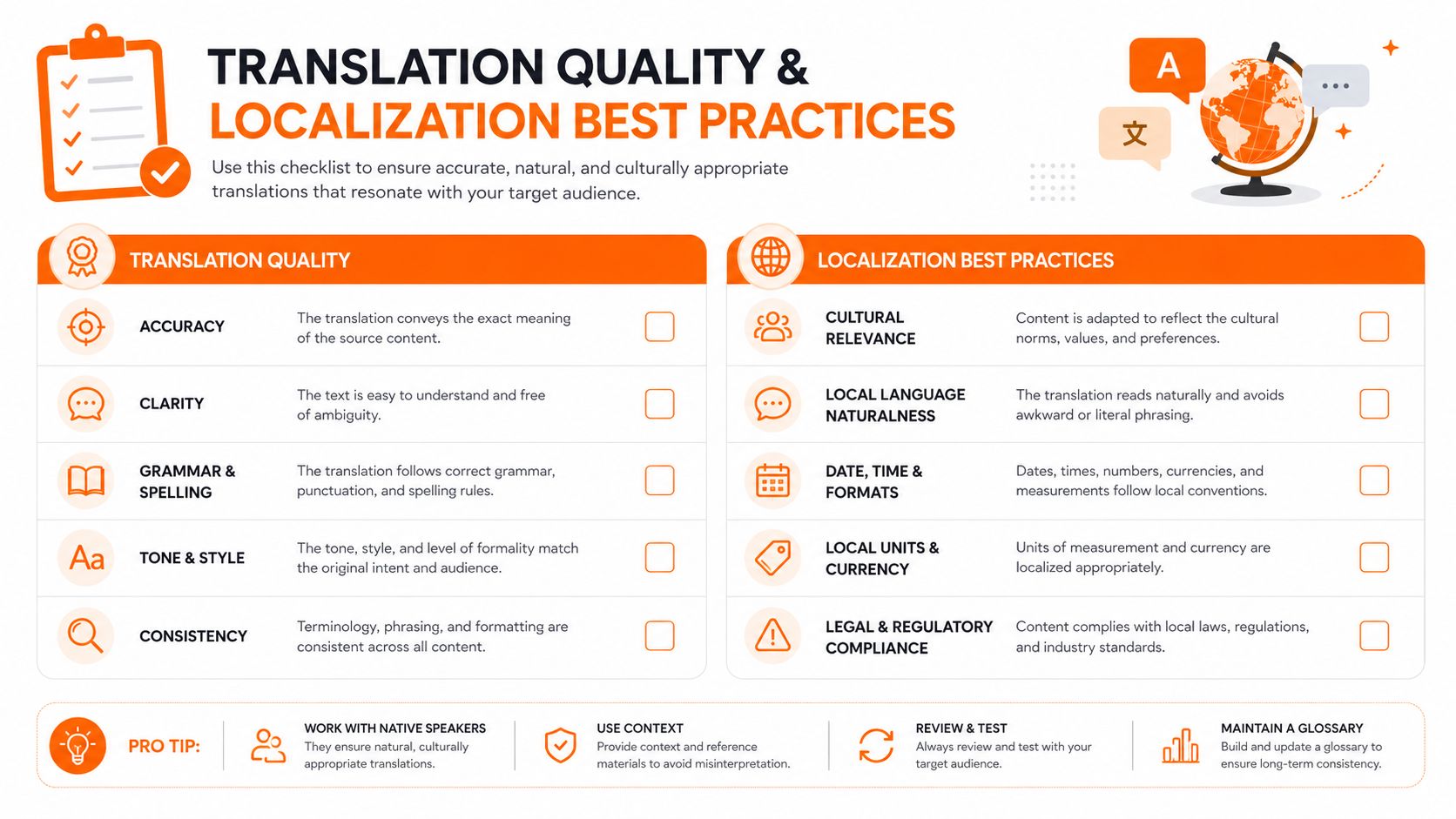
Write for translation before you translate
Use short sentences with one action per line. Replace “make yourself at home” with “Please keep the windows closed while the heating is on.” Explain terms that may be unfamiliar outside your market, such as “boiler,” “RCD,” or “ring doorbell.”
A translation engine can't reliably resolve an unclear source. If “the switch by the door” could mean two different switches, the translated version may preserve the ambiguity. Add labels, photos, or icons where the physical environment could confuse a tired guest.
Localize the task, not just the sentence
Literal translation can produce readable text that still gives poor instructions. Measurements, temperature units, plug types, emergency details, currency, and local customs need to match the guest's context. A guide should tell guests what they can do in the property, not force them to convert unfamiliar information while standing in the hallway.
Tone matters as well. A formal French guide may need “vous” rather than “tu,” and a German guide may need formal pronouns unless the property clearly uses a casual style. Even a simple phrase such as goodbye can carry different levels of warmth and formality, so a real Spanish goodbye translation guide can be useful when refining guest-facing language.
Keep the visual path stable
Guests should find Wi-Fi, checkout, and emergency information in the same place regardless of language. Keep section names, step numbers, icons, maps, and QR instructions consistent across versions. If someone changes from Polish to Korean, the guide should feel familiar rather than newly organized.
Right-to-left languages require particular care. Test text alignment, icon placement, directional arrows, and mixed-script content on an actual phone. Internationalization guidance treats browser behavior, text shaping, bidirectional rendering, and locale-sensitive formatting as functional concerns, not cosmetic details. You can also review the broader distinction between translation and adaptation in this guide to what language localization means.
Review priority: Have a native speaker check the two or three languages that represent your largest guest share, and give extra attention to safety, access, checkout, and complaint-handling content.
Setting Up Multi Language Support in Your Own Listing
A single-property host can build a useful multilingual guide in one focused sitting if the work follows the property rather than the software menu. Begin by listing the information guests need.
Inventory the stay. Write down the Wi-Fi details, arrival route, checkout process, appliance quirks, rubbish instructions, parking information, and the local recommendations you want guests to use. Thin source content creates thin translations, so include the details that normally trigger questions.
Draft the source guide clearly. Build the English version in ScanStay and group related information into named sections. Keep Wi-Fi, arrival, house rules, appliances, local recommendations, and checkout separate so guests can scan instead of reading a long page.
Translate the complete set. Trigger the AI translation for all 18 languages, then review the languages that match your guest origins first. Edit awkward phrasing directly in the editor, especially where your property uses local names or unusual equipment.
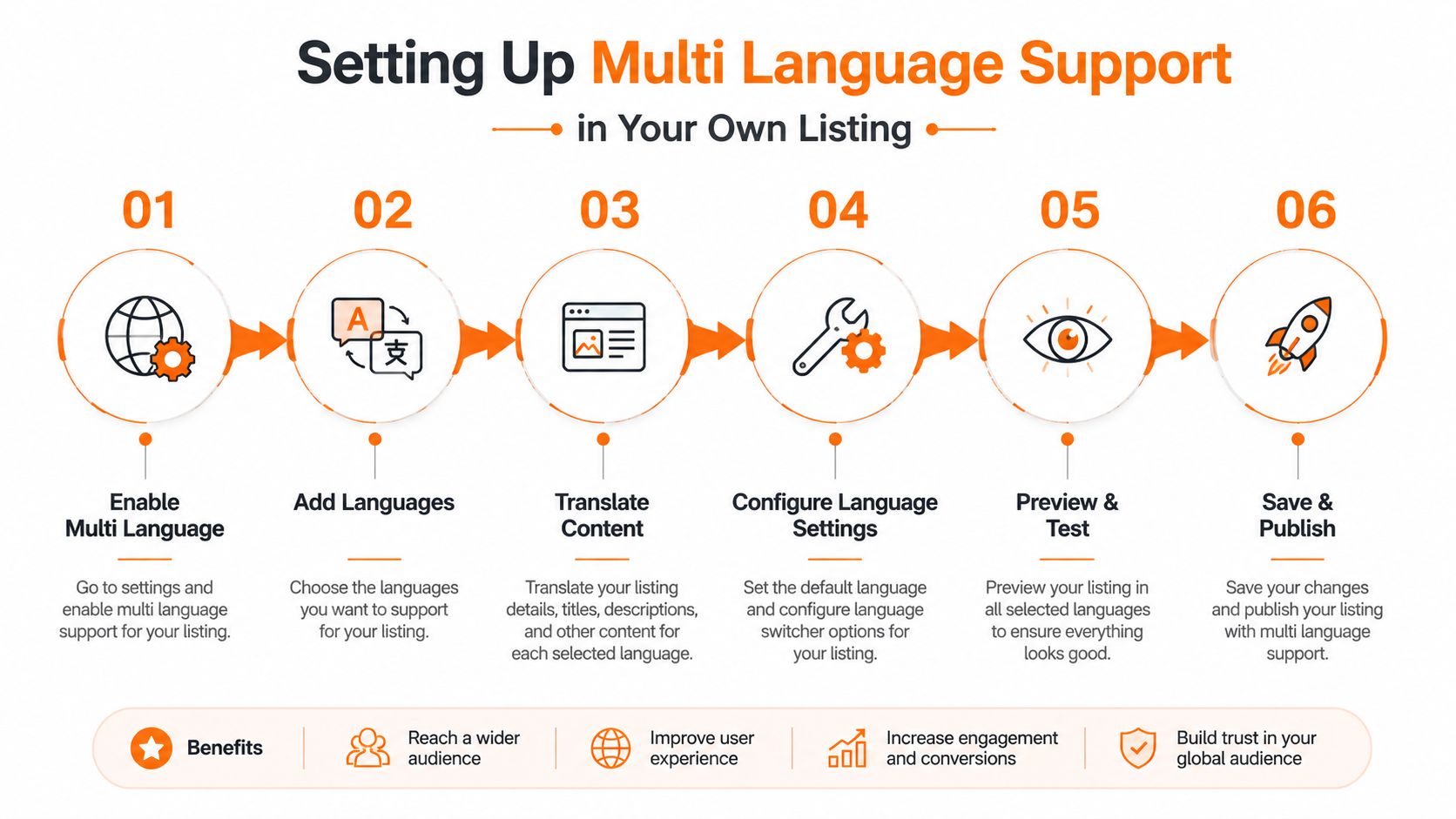
Create the physical entry point. Generate the printable A5 QR poster and place it where arriving guests will notice it, such as an entry shelf, fridge, or bedside table. Add the same QR code to your pre-arrival message so guests can open the guide before travel.
Make language choice obvious. Include a short note in the booking confirmation telling non-English-speaking guests that they can switch languages from the guide's landing page. Don't assume guests will hunt for the control.
Reuse the structure across properties. Multi-property hosts can keep a shared template, replace unit-specific details, and use a consistent poster design. A clear multilingual content management workflow reduces the risk of one property receiving an update while another keeps outdated instructions.
Review the guide whenever a check-in method, appliance, neighborhood policy, or recommendation changes. Translation is part of the content update, not a separate project you postpone until the next busy season.
Common Pitfalls That Break the Multilingual Experience
The most common mistake is treating machine output as finished copy. AI translation can provide useful coverage, but safety warnings, access instructions, checkout requirements, and language that could create liability deserve human review. Pair speed with judgment instead of asking one tool to make every decision.
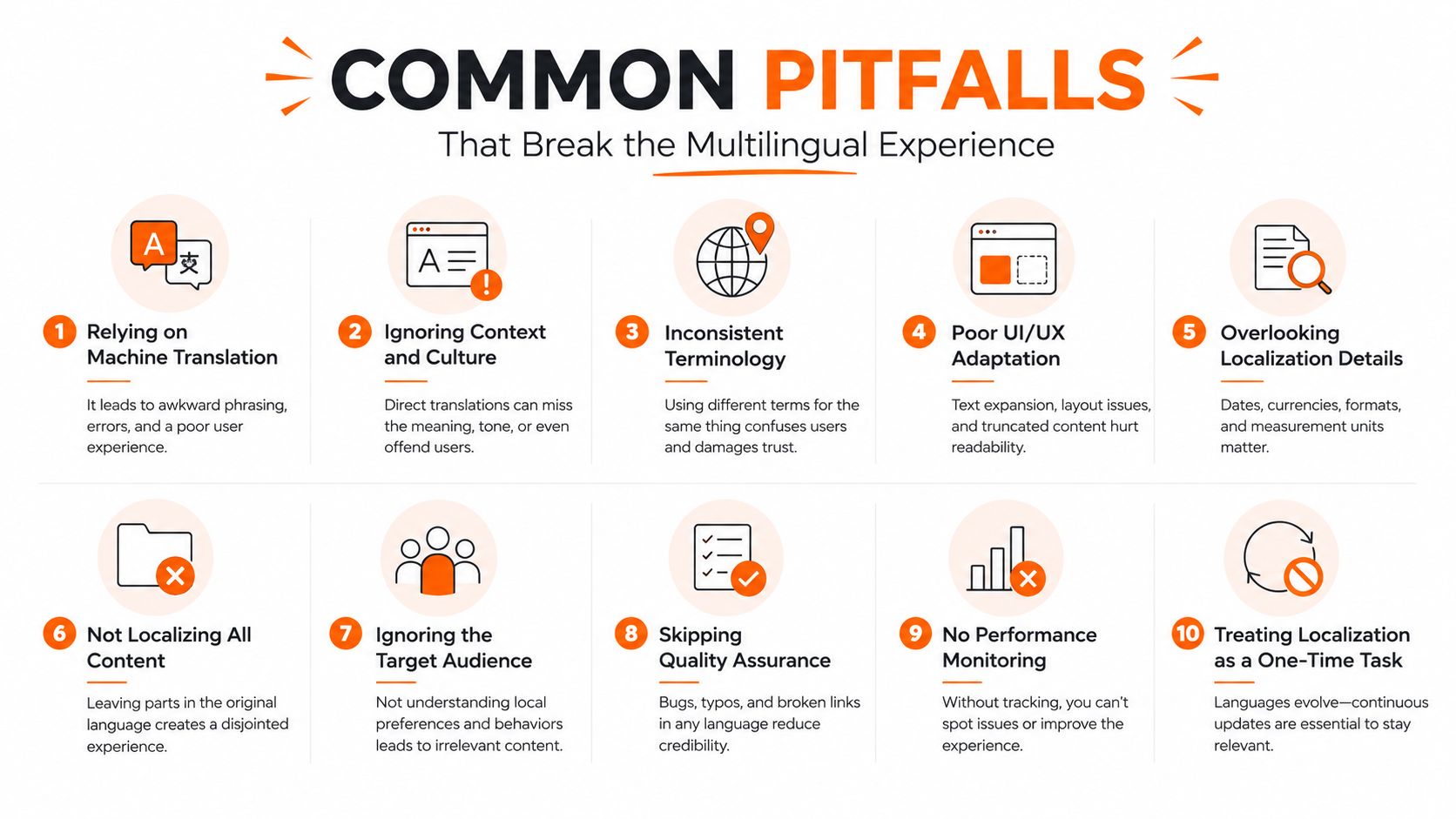
Right-to-left scripts create another blind spot. Arabic and Hebrew interfaces may need mirrored layouts, carefully aligned icons, and directional cues that still make sense when the reading order changes. Test the actual rendered guide, not only the translated text.
Hosts also overpromise language coverage. A partially translated Spanish guide can undermine trust if the arrival page is translated but the house rules and checkout instructions suddenly return to English. It's better to provide a coherent experience in priority languages than to advertise options that the property can't support consistently.
Other failures are less obvious but just as frustrating:
- Literal conversion: Adapt measurements, plug types, hot-water labels, and local rules instead of translating every word.
- Hidden switching: Put the language selector on the first screen, not behind an obscure menu.
- Digital-only access: Keep a printed A5 fallback available because a guest may have poor connectivity or a low battery.
- Unstable structure: Keep icons, section order, and step numbering consistent so guests don't have to relearn the guide.
- Unreviewed updates: Recheck translated content after changing a lockbox code, check-in time, or appliance instruction.
A multilingual guide earns trust when the guest can complete a task without wondering whether an important detail was left untranslated.
Your Short Checklist Before You Go Live
Use this final check before sharing the guide with guests:
- Language access: Confirm the switcher appears on first load and works without a login.
- Priority coverage: Make sure your top guest languages are complete rather than partly translated.
- Critical instructions: Spot-check Wi-Fi, safety, arrival, and checkout content in every active language.
- QR testing: Scan the printed A5 poster from different phone orientations and viewing angles.
- Local adaptation: Verify measurements, plug types, emergency details, and house rules fit the guest context.
- RTL rendering: Test Arabic and Hebrew layouts, including icons, alignment, and directional elements.
- Physical fallback: Keep printed copies in the dominant guest languages near the entrance.
- Ongoing review: Check which languages guests select and update the guide whenever property information changes.
Start with the information that prevents the most friction, then improve the experience using real guest questions rather than guesses.
ScanStay lets short-term rental hosts create one digital welcome guide, translate it into 18 languages with AI, and share it through a printable A5 QR poster. Build your guide around Wi-Fi, arrival, house rules, local recommendations, and checkout, then visit ScanStay to make the multilingual experience available from one mobile-friendly link.