What Is an Aparthotel and How It Compares to Hotels
What is an aparthotel? Learn how it blends apartment living with hotel services, pricing, pros and cons, and tips for guests and hosts.

An aparthotel is an apartment-hotel hybrid with a full kitchen and separate living area, plus hotel services such as housekeeping and reception, making it suitable for both short and extended stays. It gives you more room and independence than a typical hotel without removing the support you expect from professional hospitality.
You may be facing that choice right now. A hotel offers a familiar front desk and regular service, but the room feels restrictive after several nights. A vacation rental provides a kitchen and living room, yet check-in, cleaning, and support may be less predictable. An aparthotel sits between those options, but the label can still be confusing.
The useful question isn't only “What is an aparthotel?” It's “What kind of stay does this property provide?” Kitchen equipment, housekeeping frequency, reception coverage, included utilities, and the expected length of stay can vary widely. This guide uses those practical details to separate aparthotels from hotels, serviced apartments, and vacation rentals, then turns the comparison into a booking and operating checklist.
Table of Contents
- Introduction to Aparthotels and Why They Matter Now
- What Makes an Aparthotel Different at Its Core
- How Aparthotels Compare to Hotels Serviced Apartments and Vacation Rentals
- Pricing Booking Models and Market Growth Behind the Trend
- Who Stays in Aparthotels and When They Shine
- Practical Tips for Hosts and Operators Running an Aparthotel Experience
- Key Takeaways and How to Choose Your Next Stay
Introduction to Aparthotels and Why They Matter Now
An aparthotel, also called a serviced apartment or apartment hotel, combines the residential feel of an apartment with hotel-style services. Those services commonly include housekeeping, concierge or reception support, Wi-Fi, and utilities. Grand View Research describes the serviced-apartment category as serving both short-stay and extended-stay travelers, including business travelers, families, and people relocating.
That combination solves a familiar travel problem. A consultant may need a quiet desk and a place to prepare breakfast during a work assignment. A family may want separate sleeping and living areas, laundry access, and somewhere to store food. A couple on a city break may prefer the privacy of an apartment but still want help when a key, maintenance issue, or local recommendation requires staff assistance.
The category has also moved beyond its earlier image as a narrow long-stay product. One historical market dataset places the serviced-apartment sector at USD 42.1 billion in 2019 and USD 62.8 billion in 2025, with a 6.4% compound annual growth rate over that recovery period and average annual growth of 6.8% across 2019 to 2025. Those figures come from MarketIntelo's serviced-apartment market analysis, and they help explain why travelers now encounter apartment-style lodging across more locations and price bands.
The simple mental model: an aparthotel is a home-like unit supported by a hotel-like operating system.
The rest of the decision comes down to details. Does the unit have a real cooking setup or only a microwave? Is cleaning daily, scheduled, or available for an added fee? Can you reach reception at any time, or do you rely on a host message? Once you answer those questions, the marketing label becomes much less important.
What Makes an Aparthotel Different at Its Core
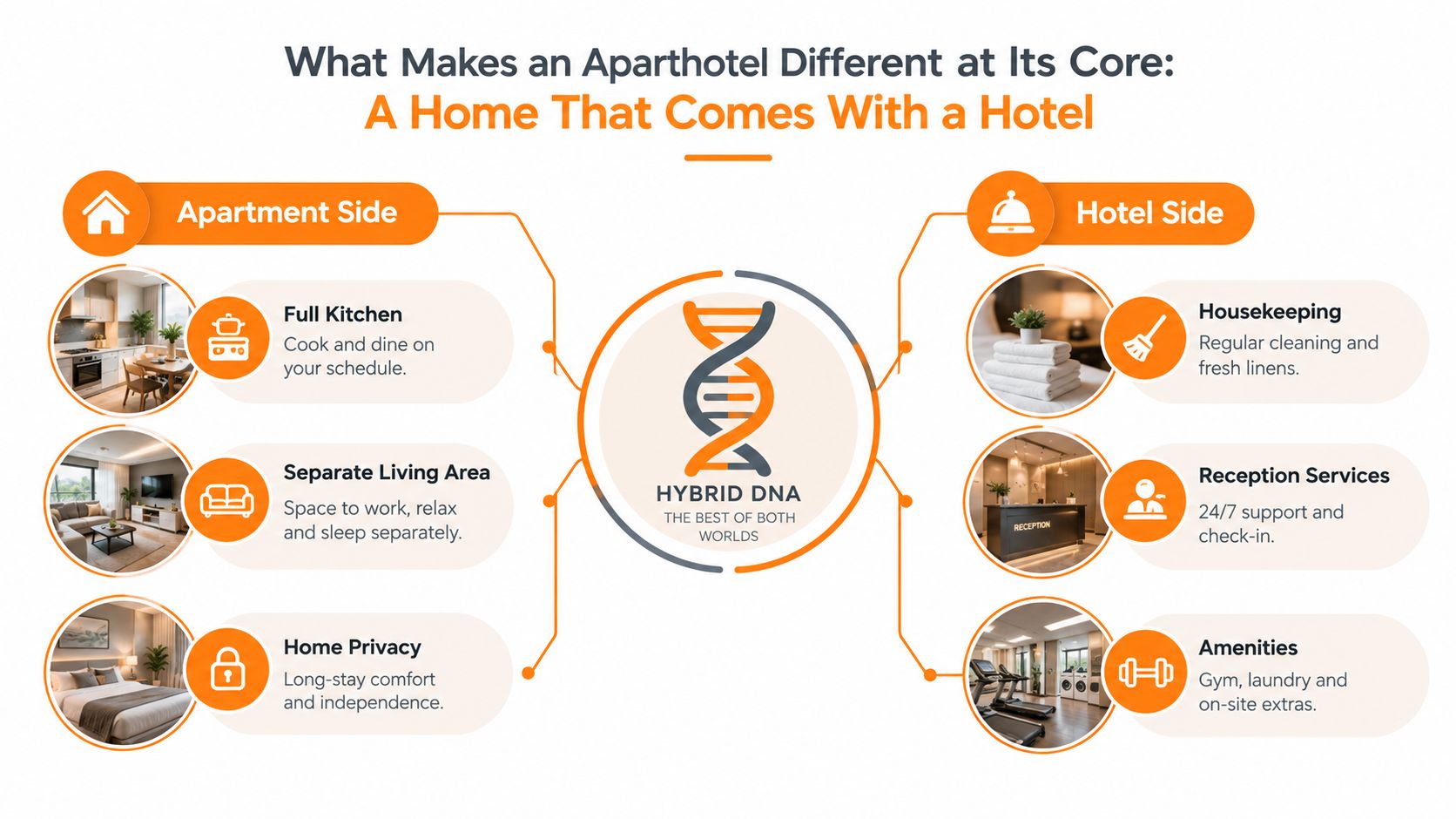
The easiest way to understand an aparthotel is to combine two familiar experiences. The apartment side gives you space, privacy, and self-catering. The hotel side provides organized arrival, housekeeping, support, and shared amenities. Think of it as a home that comes with a front desk.
The apartment side
Kitchen provision is the defining practical feature. An independent aparthotel glossary describes the unit as having at least two hotplates, a sink, and a refrigerator, along with living and sleeping areas that are functionally separate. The Apartmentservice glossary definition provides a useful baseline, although individual properties may add an oven, dishwasher, cookware, coffee machine, or dining space.
That layout changes how guests use the room. You can prepare a meal around your work schedule, keep breakfast supplies cold, or separate a child's bedtime from the evening activities of other guests. A studio may place the bed and sofa in one open room, while a larger unit may offer a distinct bedroom, living room, and dining area. Always check the floor plan and equipment list, because “kitchen” can describe very different setups.
The hotel side
An aparthotel still operates as hospitality accommodation rather than as an ordinary private home. Housekeeping, linen changes, reception, maintenance, Wi-Fi, and utilities may be organized by the property. Some properties also provide breakfast, meeting rooms, fitness facilities, wellness areas, laundry, or other shared amenities. Apartdays' hospitality classification overview places aparthotels closer to full-service hotel operations than to basic serviced apartments when those additional services are present.
Self-catering can reduce a guest's reliance on restaurants and on-site food-and-beverage outlets, but it doesn't eliminate service expectations. Guests still need clear arrival instructions, reliable maintenance, clean common areas, and a way to request help. For operators, the kitchen introduces another housekeeping responsibility, including cookware checks, appliance maintenance, and replenishment of basic supplies.
The strongest aparthotel experience makes the two sides feel coherent. Guests shouldn't have to choose between independence and assistance. They should be able to cook privately, then contact reception when they need a replacement towel, a repair, or local guidance.
The following video offers a visual introduction to the hybrid model:
How Aparthotels Compare to Hotels Serviced Apartments and Vacation Rentals
The labels overlap because the accommodation industry doesn't use one globally standardized legal definition for every model. A property may describe itself as an aparthotel, while another uses serviced apartment, residence hotel, extended-stay hotel, or apartment hotel for a similar product. Compare the actual guest experience instead.
| Feature | Aparthotel | Hotel | Serviced Apartment | Vacation Rental |
|---|---|---|---|---|
| Kitchen setup | Usually a dedicated kitchenette or kitchen, with cooking facilities and refrigeration | Often absent, or limited to a kitchenette in selected rooms | Commonly includes a kitchen or kitchenette | Usually includes a kitchen, but equipment and quality vary |
| Living space | Living and sleeping areas are functionally separate, depending on unit type | Often centered on one bedroom or sleeping room | Apartment-style space is central to the product | Usually a whole apartment, house, or private unit |
| Reception | Commonly available through a managed property, with coverage varying by operator | Usually a formal reception operation | May have a reception desk, staffed office, or managed support | Often self-check-in or host messaging, with no conventional front desk |
| Housekeeping | Scheduled according to property policy, with hotel-style service expectations | Often frequent and clearly defined in the rate | May be scheduled less frequently or included under a stay policy | Usually arranged between stays, with mid-stay cleaning varying by host |
| Stay pattern | Works for short breaks, business trips, relocations, and extended stays | Often strongest for short leisure or business stays | Particularly suited to longer stays | Flexible, from short visits to longer occupancy |
| Amenities | May include breakfast, laundry, fitness, meeting, or wellness facilities | Often offers a broad hotel amenity package | Usually emphasizes practical residential facilities | Depends on the individual property and local rules |
A hotel typically prioritizes room service, reception, and a predictable service rhythm over self-catering. A serviced apartment usually prioritizes residential space and longer occupancy, though it may provide fewer hotel-style facilities. An aparthotel is the overlap, with apartment features supported by a more structured hospitality operation.
A vacation rental can offer the most privacy and the broadest range of property types, but the guest must verify what “fully equipped” means. Read the listing for cookware, laundry, check-in method, cleaning schedule, and support hours. For broader guidance on how short-term rentals are defined, see this explanation of what is considered a short-term rental.
Operators should also remember that the physical environment communicates the service promise. Clear supplies, usable cookware, labeled controls, and well-presented guest essentials matter as much as the room description. Resources such as these hotel supplies UK tips can help properties think through practical guest-facing provisions without confusing a residential unit with a standard hotel room.
Booking rule: choose by kitchen, cleaning, and support details first, then use the property label as a shortcut.
If you need daily service, a staffed reception, and minimal planning, a hotel may suit you better. If you want a private home with limited intervention, a vacation rental may be the better fit. If you want cooking space and a managed hospitality experience, an aparthotel deserves closer attention.
Pricing Booking Models and Market Growth Behind the Trend
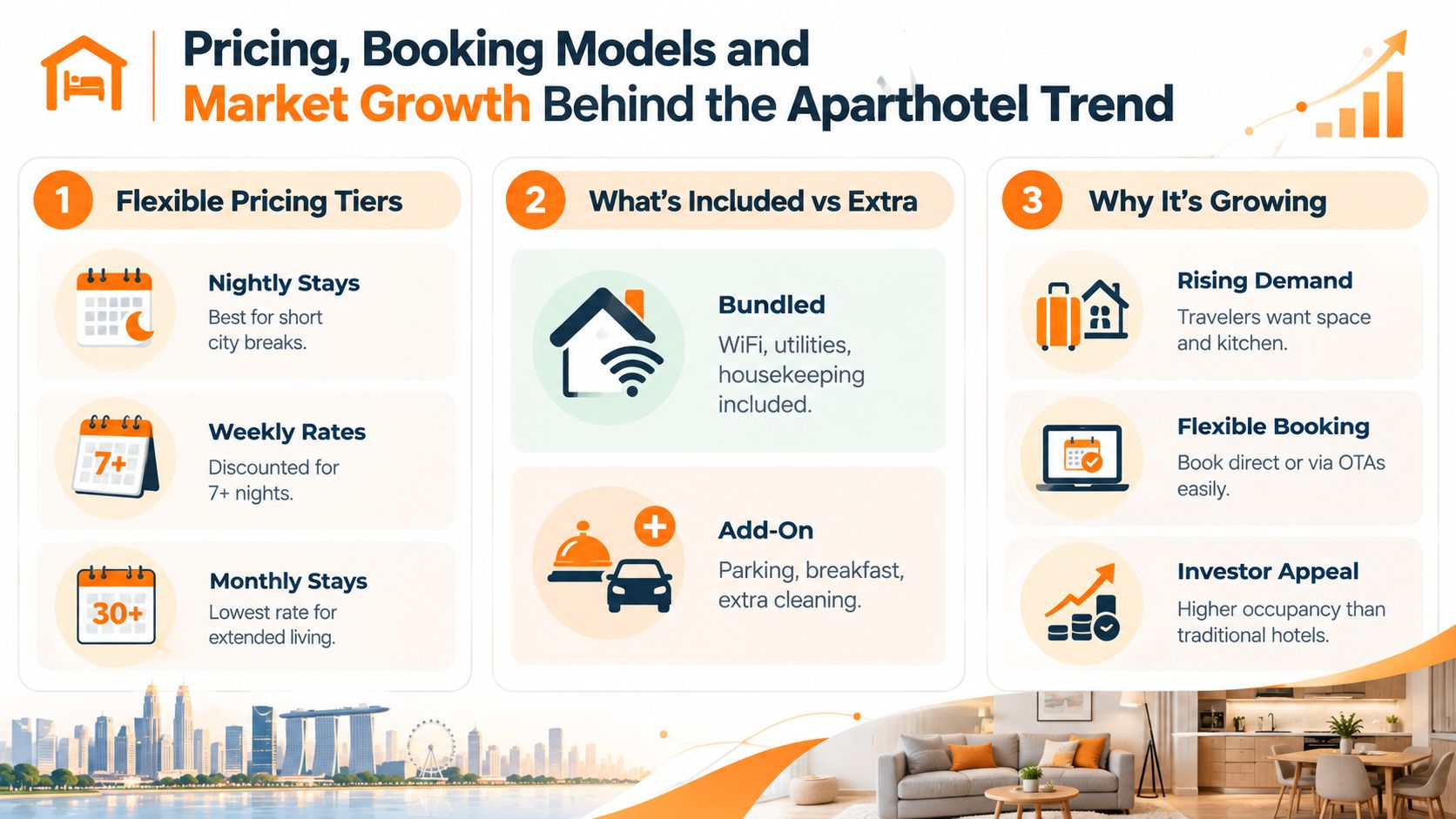
Aparthotel pricing usually follows the shape of the stay. A guest may see a standard nightly rate, a weekly offer, or a monthly rate for extended occupancy. Longer bookings can change more than the price, so check what cleaning, utilities, linen, parking, breakfast, and cancellation terms include.
The base rate may cover Wi-Fi, utilities, basic housekeeping, and shared facilities. Parking, breakfast, extra cleaning, pet accommodation, laundry, and late checkout may cost more. Compare the complete stay, not only the first figure shown in a search result. A lower nightly rate can become less attractive once required services and fees are added.
Rate cards also reflect operating decisions. A weekly booking may include fewer scheduled cleanings than a short stay, while a monthly arrangement may use a separate housekeeping schedule and different cancellation conditions. Ask for the full inclusions before comparing properties.
Guests can book through a property website, corporate travel channel, relocation partner, or online travel agency. Direct booking may make it easier to discuss an assignment or extended stay. An online travel agency can simplify comparison across locations. Before confirming, ask whether the rate changes for additional occupants, whether housekeeping is automatic, and whether the kitchen has the equipment you need.
A dynamic hotel pricing guide explains why the same accommodation type can show different rates across dates and demand periods.
Why demand is expanding
Grand View Research estimates that the global serviced-apartments market was worth USD 121.3 billion in 2024 and projects it to reach USD 248.9 billion by 2030. The useful lesson for booking decisions is not the forecast alone. It is the growing range of stay formats that properties must price and manage.
Aparthotels can accept a short visit while keeping rate plans for weekly work assignments, relocations, and other extended stays. That requires clear rules for cleaning frequency, utility coverage, linen changes, deposits, and cancellation windows. Guests should match the rate plan to how they will use the space, rather than assume every “weekly” or “monthly” offer includes the same service.
The model connects apartment-style flexibility with organized hospitality. For operators, that means building booking options around stay length and service cadence. For guests, it means comparing the total arrangement against the purpose of the trip, the kitchen setup, and the support they expect.
Who Stays in Aparthotels and When They Shine
Aparthotels work best when the room needs to support more than sleeping. The guest may need to work, cook, store food, wash clothes, host a colleague informally, or maintain a family routine. Those needs can arise during a short trip, but they become much more noticeable as the stay extends.
Business and relocation guests
A business traveler on an assignment often needs a desk, dependable Wi-Fi, quiet evenings, and a kitchen that reduces the need to eat out. The separate living area creates a useful boundary between work and rest. Corporate relocations benefit from the same layout because the guest can settle into a temporary home while searching for permanent housing.
Families relocating to a new city may value a refrigerator, cooking facilities, laundry access, and separate sleeping arrangements. Parents can preserve familiar routines while still receiving housekeeping and property support. The accommodation functions as a bridge between a hotel booking and a permanent residence.
Flexible workers and leisure groups
Remote workers may choose an aparthotel when a conventional hotel room lacks a comfortable place to work. A group of friends or a family may prefer a shared living area rather than gathering on beds or occupying a hotel lobby. A kitchen can also make meal timing easier when different travelers follow different schedules.

The wider demand pattern includes longer stays, flexible work, and corporate relocation. Recent industry reporting also points to growing investment attention. WiseGuyReports' serviced-apartment market coverage reports European serviced-apartment transaction volumes of about €1.2 billion in 2025, representing roughly 5% of total hospitality investment, and connects demand with corporate relocations.
When a hotel is the smarter choice
An aparthotel isn't automatically better. A hotel may suit a one-night stop when you want a fast arrival, daily room servicing, a restaurant, and no responsibility for food preparation. It may also be preferable when you'll spend nearly all your time outside the property and don't need extra living space.
Choose an aparthotel when the unit itself will support your trip. Choose a hotel when service speed and simplicity matter more than residential comfort. For either option, confirm the practical details before booking, especially housekeeping, reception hours, cooking equipment, and the total price.
Practical Tips for Hosts and Operators Running an Aparthotel Experience
Hosts can deliver an aparthotel-style stay without copying every feature of a large hotel. The operating principle is simple: give guests apartment independence, then remove uncertainty through clear systems and responsive support.
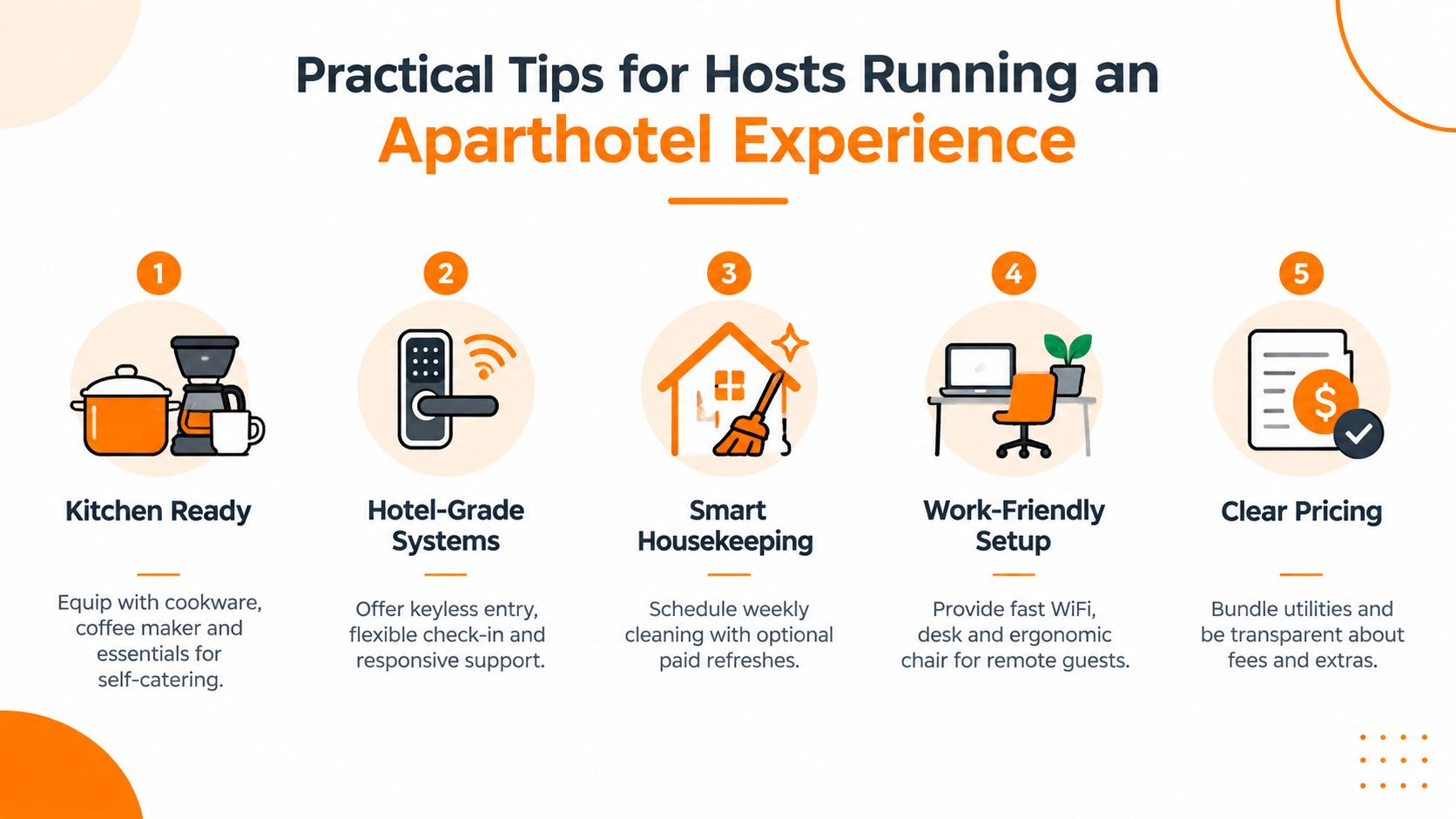
Start with the unit. A functional kitchen needs cookware, utensils, plates, glasses, basic preparation tools, and a working coffee maker. Test each appliance between stays, label unfamiliar controls, and explain waste disposal and ventilation. Guests judge the kitchen by whether they can use it immediately, not by the number of appliances listed in the description.
Build a low-friction arrival system
Use keyless entry where appropriate, provide arrival instructions before the guest travels, and keep support available through a channel someone monitors. A QR code beside the entrance can open a mobile welcome book containing Wi-Fi details, check-in and checkout instructions, house rules, appliance guides, local recommendations, and emergency contacts.
A platform such as ScanStay can consolidate those details in a browser-based digital welcome book accessed through one QR code. It also supports branded content, local recommendations, service upsells, reusable content across properties, and multilingual information, which can reduce repeated arrival questions for operators managing several units.
Make housekeeping predictable
Publish the cleaning cadence before arrival. Some guests expect hotel-style daily service, while others prefer privacy and a scheduled weekly refresh. Offer optional paid cleaning or linen changes when the operating model allows it, and state exactly what the base rate includes.
Turn clarity into a service advantage
A strong guest guide should answer questions before they become messages. Include appliance videos, parking instructions, noise expectations, checkout steps, and instructions for reporting maintenance issues. Use the same approved content across similar units, then add property-specific details where needed.
For larger operations, a hotel PMS meaning guide can help clarify how property-management systems organize reservations, room status, guest information, and operational tasks. The tool won't replace good instructions, but it can help teams coordinate them.
Operational principle: contactless service shouldn't mean invisible service. Guests need independence at arrival and a clear human response when something goes wrong.
Finally, present extras transparently. Late checkout, airport transfers, equipment rentals, parking, and additional cleaning can be offered as optional services, provided the price and fulfillment process are clear. A polished aparthotel experience feels easy because the host has answered the practical questions in advance.
Key Takeaways and How to Choose Your Next Stay
An aparthotel combines an apartment-style unit with hotel-style support. The strongest indicators are a usable kitchen, a separate living area, organized housekeeping, reception or guest support, and a property designed to handle both short and extended stays.
Use this decision checklist before booking:
- Stay purpose: Choose an aparthotel for work assignments, relocations, family trips, or any visit where the room needs to function as living space.
- Cooking requirement: Confirm whether the property has hotplates, a sink, refrigerator, cookware, and the other equipment you'll use.
- Service expectation: Ask how often housekeeping occurs, how linen changes work, and whether reception is staffed or contactless.
- Length and value: Compare the complete cost across nightly, weekly, or monthly options, including utilities, cleaning, parking, and breakfast.
- Privacy versus convenience: Select a hotel when you want intensive service and minimal planning. Select a vacation rental when private space matters most and host support is acceptable. Select an aparthotel when you want both residential independence and managed hospitality.
For operators, the same framework works in reverse. Equip the apartment properly, communicate every essential detail through an accessible guest guide, keep cleaning consistent, and offer support without forcing guests into unnecessary contact. The result is not a room with a kitchenette. It's a reliable temporary home with hotel discipline behind it.
If you're preparing an aparthotel or rental for guests, visit ScanStay to create a QR-accessed digital welcome book with Wi-Fi details, check-in guidance, house rules, local recommendations, and optional service upsells. Set up reusable guest information for one property or a wider portfolio, then give every arrival a clearer, more self-directed experience.