Compliance Documentation for Short-Term Rentals: A Host
Learn how to manage compliance documentation for short-term rentals. This host guide covers essential rules and best practices for 2026.
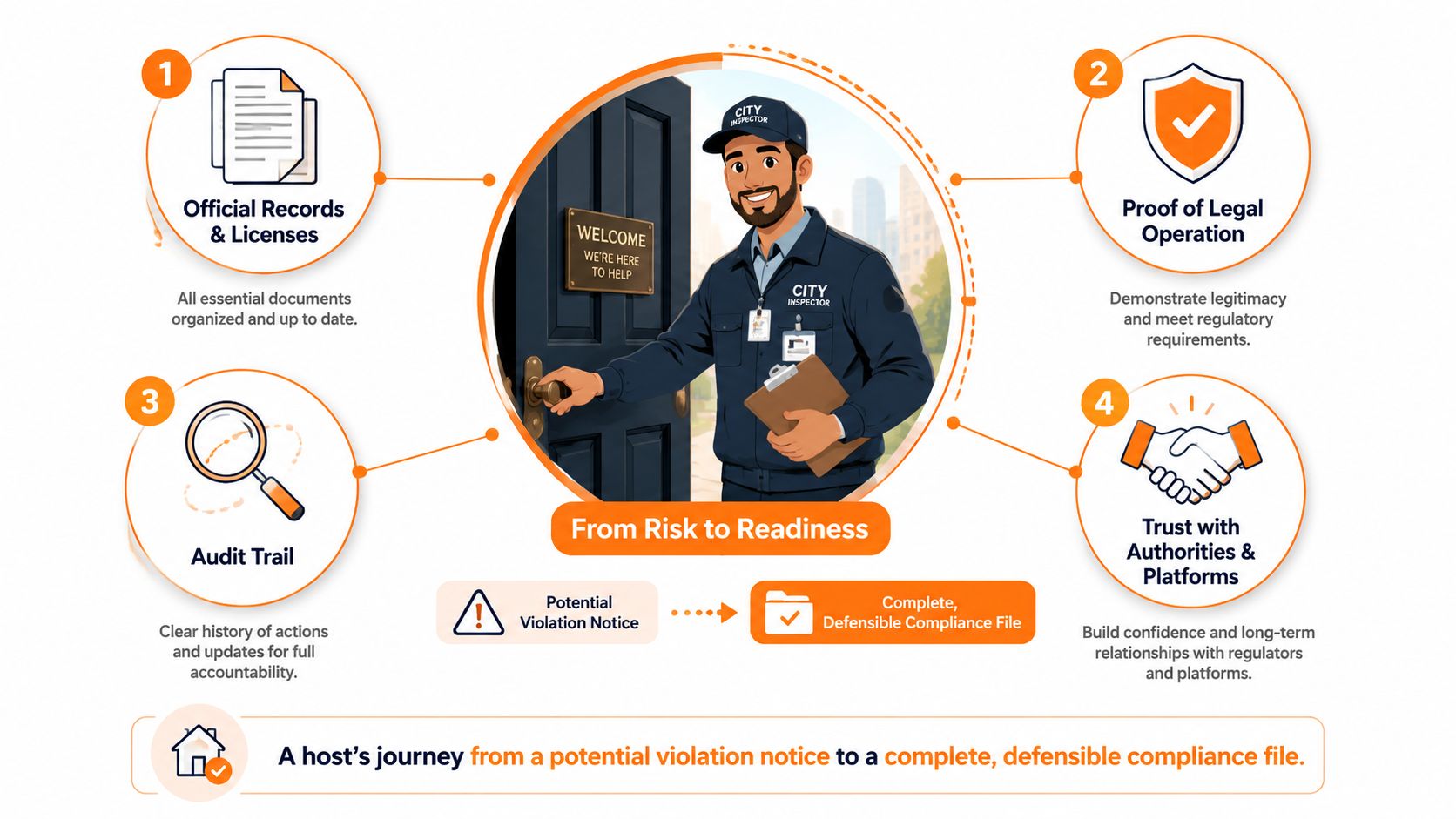
The inspector doesn't care that your permit PDF is somewhere in an email thread. They care whether you can produce the current permit, show which property it covers, prove that taxes and safety obligations were handled, and explain what happened when something went wrong. A platform asking for a tax registration number creates the same pressure, especially when your records are spread across a laptop, paper binder, accountant's inbox, and several booking platforms.
Compliance documentation for short-term rentals is the evidence system behind lawful operation. It connects each obligation to a document, a responsible person, a retention rule, and a retrieval path. The objective isn't to collect every possible file. It's to prove, quickly and clearly, that the controls affecting your property operate.
Table of Contents
- Why Compliance Documentation Matters for Hosts Right Now
- The Document Categories Every Host Needs
- Building Reusable Templates for Recurring Records
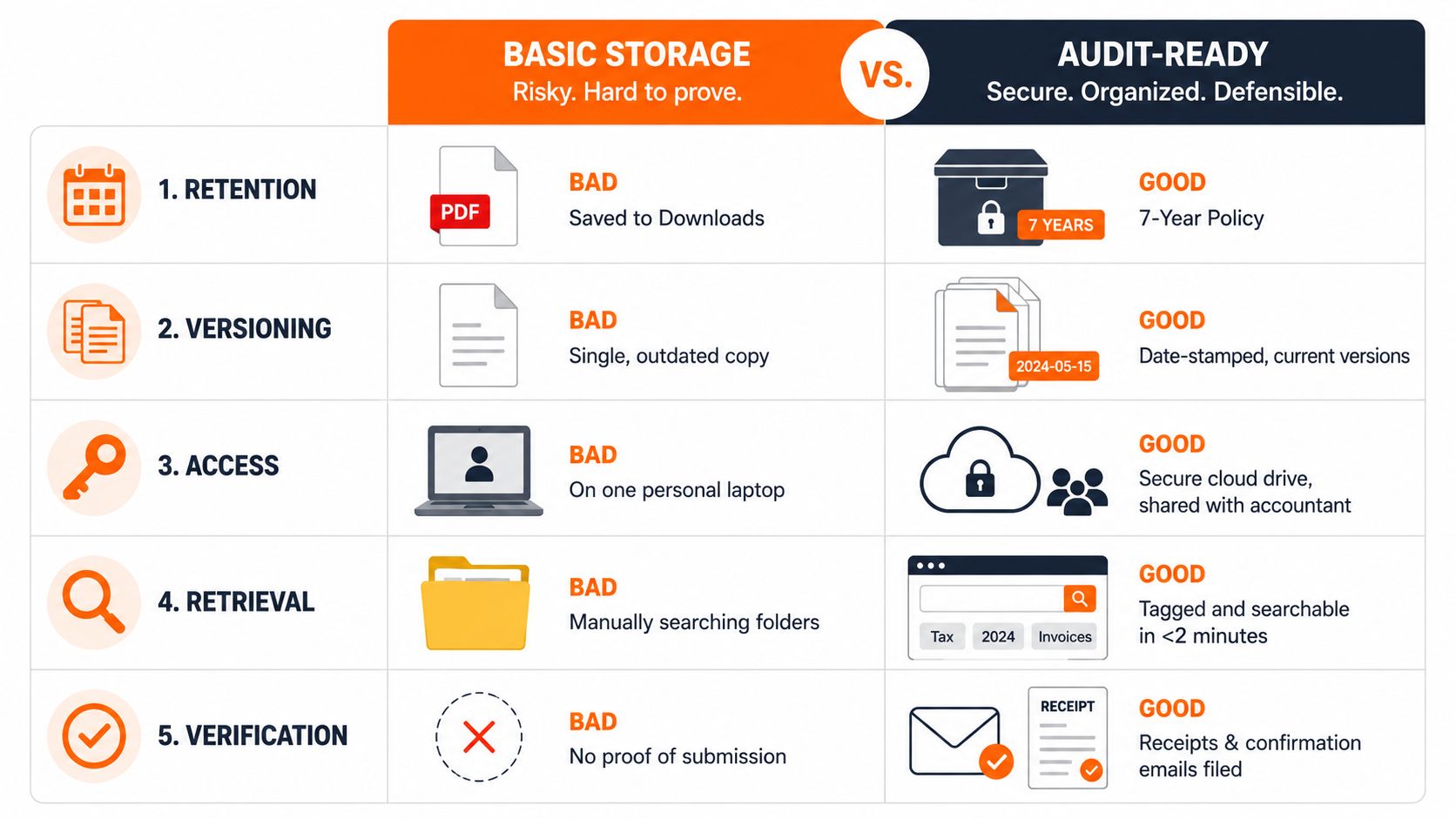
- The Five Controls That Make Documentation Audit-Ready
- Secure Digital Storage and Retention Policies
- Presenting Documentation to Authorities and Auditors
- Surfacing Documents Through a Digital Welcome Book
Why Compliance Documentation Matters for Hosts Right Now
A short-term rental audit can begin with an ordinary request: produce the current permit, confirm occupancy details, or verify registration information. Trouble follows when the host has a license but cannot show its renewal history, has tax filings without supporting summaries, or keeps safety certificates that do not clearly identify the property.
Compliance documentation for short-term rentals is an operating evidence system. Each obligation should connect to a document, a responsible person, a retention rule, and a retrieval path. The objective is to prove, quickly and clearly, that the controls affecting the property operate. Collecting unrelated files only makes that proof harder to find.
Authorities need evidence of operation. A house-rules document shows that rules were written. Stronger records show when guests received them, whether acknowledgment was required, and which version applied after local requirements changed. A cleaning checklist carries more weight when it identifies the property, date, responsible person, exceptions, and related safety observations.
The same principle applies across the file. A permit should connect to its renewal record. A tax return should connect to payment confirmation and the period covered. An incident report should point to the response taken, the person responsible, and any follow-up inspection. That structure lets a host answer a request without reconstructing events from email threads and booking platforms.
Compliance records also have a long legal history. In the United States, customs recordkeeping traces back to the Act of July 31, 1789, which required arriving vessels' masters to provide copies of manifests. Later legislation strengthened import recordkeeping obligations. Modern U.S. customs rules impose a five-year retention period for many import records, illustrating the broader need to show what happened, when it happened, and which evidence supports it. U.S. Customs and Border Protection's recordkeeping guidance provides that historical context.
The operational pressure is real. A 2026 compliance benchmark summary reported that 97% of organizations conducted at least two compliance audits per year, while 35% of enterprise organizations conducted six or more audits or assessments annually. It also reported that 64% of large companies use enhanced evidence mapping for overlapping frameworks. BrightDefense's compliance statistics resource explains why a scattered archive creates avoidable work and inconsistent answers.
Practical rule: Every important document should answer four questions immediately: which property does it cover, which control does it prove, who created or approved it, and when must it be reviewed again?
The bizbe due diligence guide offers a useful framework for treating documentation as an evidence trail. For hosts, permits, tax records, safety checks, guest records, insurance, and incident reports should form one connected control surface.
The Document Categories Every Host Needs
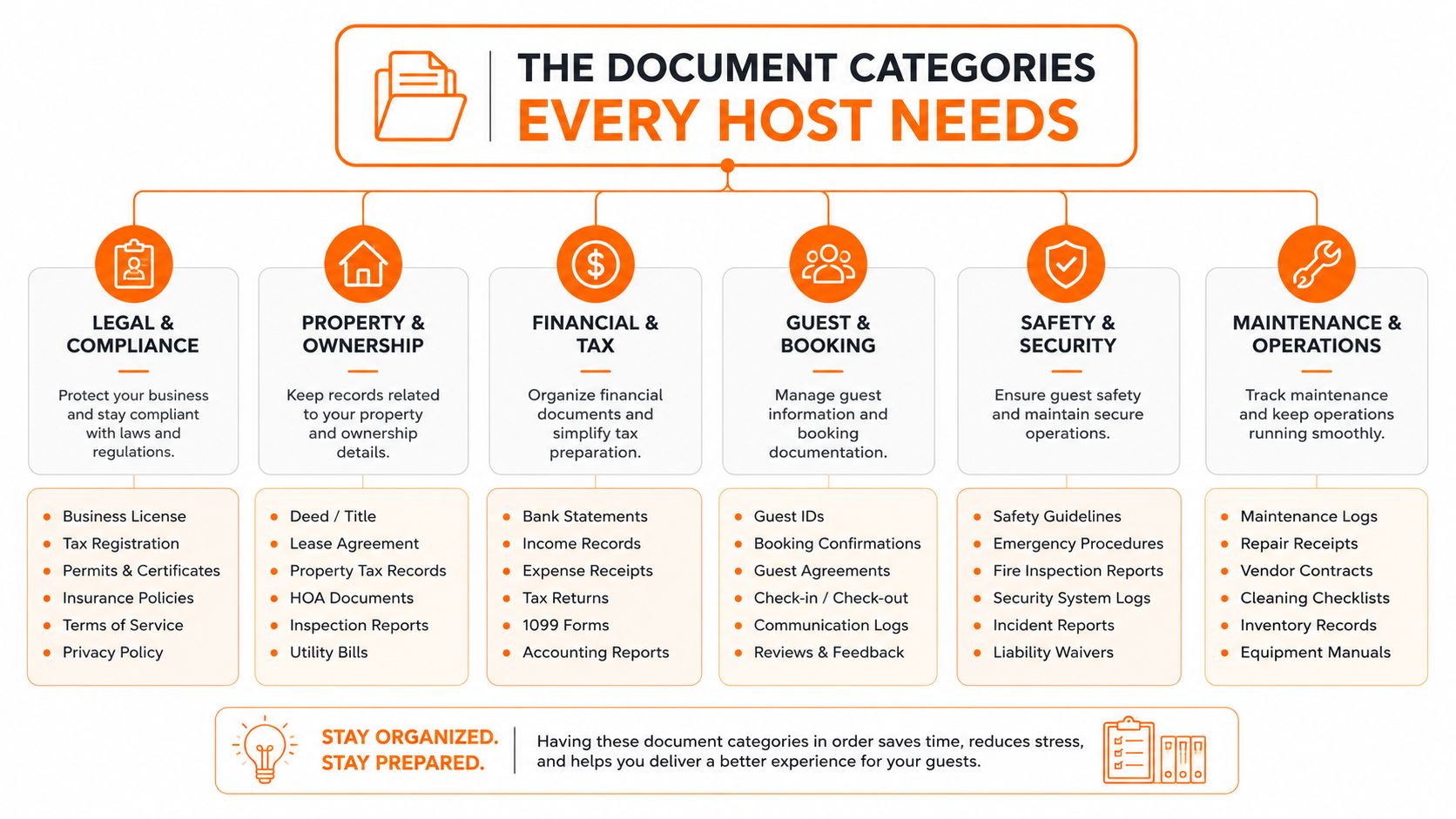
Start with categories, not individual files. Your property's document matrix should show what applies, who issues it, how often it changes, and what lawful operation it demonstrates.
Local operating permits and licenses
This is the foundation of the file. Collect the short-term rental permit, business license, registration certificate, zoning approval, landlord or condominium authorization where relevant, and any exemption evidence. The issuing authority may be a city, municipality, province, state, or building administrator.
Retain the current document and its history, including applications, approvals, renewal notices, correspondence, and receipts. The control is not just “permit exists.” It's “this property was authorized to operate during the relevant period.”
Local rules can require highly specific supporting material. In British Columbia, registration requirements can include evidence relating to principal residence, identity, insurance, utility records, tenancy, and fractional ownership exemptions. The British Columbia regulation also shows why a static global checklist isn't enough. Build a jurisdiction-specific record for each property.
Tax registrations and remittance records
Keep tax account registrations, platform tax statements, returns, payment confirmations, accountant workpapers, monthly or quarterly summaries, and correspondence with tax authorities. Your file should reconcile booking revenue, taxable nights or stays where applicable, exemptions, collected tax, remitted tax, and adjustments.
Retain the source data behind each submission, not only the final return. If a platform files on your behalf, preserve the platform statement and any confirmation showing what it filed or collected. For hosts expanding into another market, business structure and registration work may overlap with local company obligations, so a resource such as Goodhand's guide to how to start a UAE company can help separate entity records from property-level compliance records.
Safety certificates and inspection evidence
Fire, gas, electrical, alarm, pool, elevator, and equipment records may apply depending on the property and jurisdiction. Store certificates, inspection reports, invoices, technician credentials where supplied, repair confirmations, and follow-up evidence for failed items.
A certificate proves an inspection occurred. A repair invoice and completion note prove that a deficiency was addressed. Keep both, linked to the same control and property.
Guest identification and stay logs
Guest records may include registration forms, required identification fields, occupancy dates, acknowledgments, signatures, and communications required by local law. Avoid collecting information just because it might be useful. Define the required fields first, then restrict access to people who need them.
Your vacation rental contracts resource can support the relationship between booking terms, guest acknowledgments, and the records you retain. The retention period must reflect local law and data protection obligations, with deletion or anonymization handled deliberately rather than through casual folder cleanup.
Insurance and incident records
Keep active policies, endorsements, renewal notices, certificates of insurance, claim correspondence, photographs, police or emergency reports where relevant, and repair documentation. An incident report should identify the date, property, people involved, facts known at the time, immediate action, notification decisions, and closure evidence.
Avalara's lodging survey illustrates why property type matters. 34% of short-term rental respondents reported receiving an audit notice in the last five years, compared with 60% of hotel-sector respondents. The figures are from the Avalara Lodging Survey. Whatever your exposure, incomplete records can force an authority to reconstruct events from fragments.
Building Reusable Templates for Recurring Records
Multi-property operators lose time when every booking starts with a blank document. A reusable template fixes that, but only if each field has a reason. Empty forms create the appearance of control without proving that anyone completed the control.
Create a master property profile first. Include the legal address, unit identifier, owner or operating entity, permit numbers, tax registrations, insurance policy references, safety systems, emergency contacts, responsible manager, and jurisdiction. Keep one profile per property, with a change log for renovations, ownership changes, permit updates, and new equipment.
A guest registration template should contain only the fields required for your market. Add arrival and departure dates, property, booking reference, required guest details, acknowledgment fields, collection method, and access restrictions. A completed record should show who entered the data and whether a required field was unavailable or corrected.
For incidents and damage, use structured prompts rather than a blank narrative:
- Event details: Record the property, date, time, discoverer, and booking reference.
- Observed facts: Separate what was seen from assumptions about cause.
- Immediate response: Note guest contact, safety action, maintenance dispatch, and escalation.
- Evidence: Link photographs, messages, invoices, reports, and insurer correspondence.
- Closure: Record the decision, responsible person, completion date, and unresolved items.
A monthly tax summary should pull from the same source data every time. Include gross booking activity, cancellations or refunds, taxable amounts, collected amounts, remitted amounts, platform statements, payment confirmations, and reviewer approval. Don't overwrite prior months. Save a final version and preserve the source export used to create it.
Turnover checklists can double as safety evidence when they include smoke and carbon monoxide alarm observations, emergency exit access, fire extinguisher presence, visible hazards, appliance condition, and maintenance exceptions. They shouldn't replace formal inspections, but they create a consistent operational record between inspections.
Store templates in a controlled master folder. Clone them by property and reporting period, then update the master only after a rule or process review. Version labels should make it obvious which template was active when a record was created.
The Five Controls That Make Documentation Audit-Ready
An audit-ready permit carries context, history, access restrictions, and a retrieval path. Build those qualities into every record through five controls.
Retention
Assign each document category a retention rule. Record the starting point, such as the filing date, incident closure, permit expiration, or guest departure, and define what happens when the period ends. A generic cloud-cleanup routine should never decide what to delete.
Versioning
Keep the previous policy when publishing a replacement. Each version needs a number, effective date, change summary, approver, and archived copy. If a guest asks which house rules applied during a stay, you should identify the correct version without guessing.
Exception logging
A failed inspection, missing identification field, late tax payment, broken alarm, or unavailable certificate belongs in an exception log. Record the issue, risk, temporary measure, owner, due date, supporting evidence, and closure approval. An honest exception record gives an auditor a clear explanation for the gap and shows how it was handled.
Evidence traceability
Map every record to a specific control. “Fire safety” is too broad. Use a description such as “alarm inspection completed and deficiencies resolved,” then connect the inspection report, repair evidence, checklist, and reviewer sign-off.
IOSCO-style retention expectations offer a useful level of detail. Written records can include market data, methodology changes, deviations from procedures, and the names of people involved in a determination, with records kept for five years. The Florida Hotels and Restaurants annual report lists 4,816 cases issued and 591 cases in one reporting period, showing that hospitality enforcement remains active.
Access governance
Set permissions for viewing, editing, downloading, and deleting records. Guest identification requires tighter controls than a public house-rules page. Accountants can receive access to tax folders, maintenance vendors to assigned work orders, and managers to the property records they operate.
If you can't identify the record's owner, effective date, source, and control mapping, you're storing information, not managing evidence.
Traceability receives the least attention in many host filing systems. Topic-based folders leave the auditor to infer how each file proves compliance, which slows review and creates unanswered questions. A control register should connect the obligation, evidence, owner, and review point.
Secure Digital Storage and Retention Policies
Paper binders are useful during a doorstep visit, but they're a poor primary archive. They don't provide reliable search, access history, version control, or protection against loss. Use a secure cloud repository as the source of truth, then keep a compact inspection-ready printout for documents an authority may request immediately.
A practical folder structure looks like this:
- Property profile: Legal identity, address, permit matrix, contacts, and jurisdiction notes.
- Licenses and permits: Applications, approvals, renewals, correspondence, and receipts.
- Tax: Registrations, source exports, calculations, filings, payments, and confirmations.
- Safety: Certificates, inspection reports, maintenance evidence, and checklists.
- Guests: Required registration records, acknowledgments, and deletion or anonymization logs.
- Insurance and incidents: Policies, claims, photographs, reports, and closure notes.
- Control register: The mapping table connecting each obligation to evidence, owner, and review date.
Use a consistent filename such as Property_DocumentType_Date_Version. Avoid names like final.pdf or new permit.pdf. Apply encryption and restricted permissions to guest ID records, and maintain an offsite backup that isn't dependent on the same device or account.
Starter retention matrix for short-term rental hosts
| Document Category | Typical Retention | Storage Note |
|---|---|---|
| Permits and licenses | Current term plus historical renewal trail | Keep approvals, applications, correspondence, and receipts together |
| Tax registrations and remittance records | Follow the applicable tax authority rule | Preserve source data behind each filing |
| Safety certificates | Current certificate plus prior inspection and repair evidence | Link deficiencies to completion records |
| Guest identification and stay logs | Follow local retention and data protection rules | Restrict access and document deletion or anonymization |
| Insurance policies and incident records | Keep the policy history and claim trail for as long as operational or claim exposure requires | Preserve photographs, notifications, invoices, and closure decisions |
| Policies and templates | Current version plus superseded versions | Record effective dates, changes, and approvals |
The five-year period used for many U.S. customs import records is a useful compliance-design reference, not a universal STR rule. Apply the strictest relevant local requirement, tax rule, insurance need, contractual obligation, or legal hold. Never shorten a retention period because a file looks old.
Automate reminders for permit renewals, certificate expirations, insurance dates, and control reviews. Automation should surface records for action, not remove them.
Presenting Documentation to Authorities and Auditors
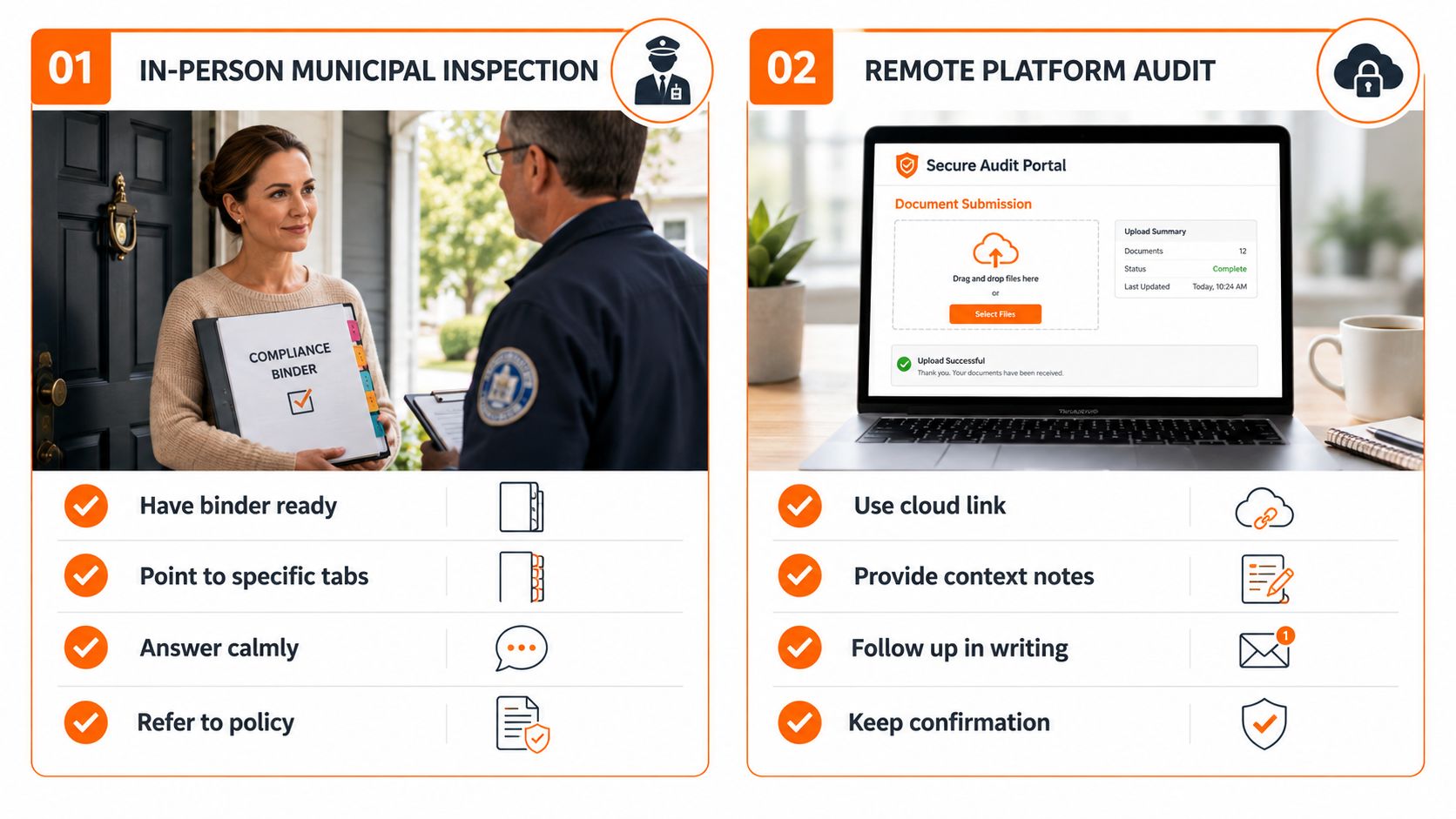
A municipal inspector arrives and asks for the operating permit, safety evidence, and occupancy information. A calm host doesn't open every folder. They open the property's evidence index, select the requested records, and explain what each one proves.
Keep a shared inspection folder with the current permit, property profile, emergency information, safety certificates, insurance certificate, local rule summary, and contact details for the responsible manager. The folder should contain copies or links, not unrestricted access to guest identification files.
The doorstep checklist
- Confirm identity and scope. Ask for the inspector's name, agency, and the records or areas requested.
- Open the property index. Point to the relevant document category and control mapping.
- Answer narrowly. State the property, document date, issuing body, and current status.
- Show exceptions transparently. Explain the issue, temporary action, owner, and closure evidence.
- Protect guest privacy. Redact unnecessary identification details and share only what the request requires.
- Log the exchange. Record the date, request, documents shown, documents copied, recipient, and follow-up date.
Remote platform or tax audits need the same discipline. Send a controlled folder or approved upload, add a context note describing the file set, and retain the submission receipt or confirmation message. Don't send a disorganized export and expect the reviewer to infer your process.
A tax evidence pack may need registration details, booking summaries, platform statements, payment confirmations, calculations, filings, and correspondence. For broader preparation principles, consult this tax document preparation UAE guide, then adapt the evidence list to the authority and property involved.
The guest registration guidance is also useful when reviewing what should be collected, who can access it, and how the record connects to a specific stay.
A short training video can help managers rehearse the difference between being helpful and oversharing:
Be polite, be specific, and never volunteer unrelated records. A clean index lets you cooperate without surrendering control of the entire archive.
Surfacing Documents Through a Digital Welcome Book
Compliance documentation can support guests without exposing confidential records. A digital welcome book can present house rules, emergency instructions, check-in requirements, local permit information where disclosure is appropriate, and links to policies guests may need to reread. The private evidence register remains restricted, while the guest-facing layer proves what information was made available.
A QR-based system is especially practical for recurring operations. Place one code at the property, in arrival messages, and in the reservation workflow. Guests can access the current rules and instructions from a mobile browser, while the host maintains the controlled source and records content changes.
The digital welcome book guide offers a useful model for organizing guest-facing information. A host can separate public content from sensitive records, preserve version history, and maintain a clear relationship between the rules shown and the policies stored internally.
Use a simple 30-day rollout:
- Days 1 to 7: Build the property profile, document matrix, folder structure, and retention assignments.
- Days 8 to 14: Upload current permits, tax records, safety evidence, insurance, and approved templates.
- Days 15 to 21: Publish guest-facing rules, emergency information, check-in instructions, and required acknowledgments.
- Days 22 to 30: Run a mock inspection, test permissions, retrieve a sample evidence pack, and correct gaps.
This approach keeps compliance visible when guests need guidance and private when authorities need controlled evidence.
ScanStay gives hosts a QR-based digital welcome book for check-in details, Wi-Fi, house rules, local guidance, and reusable guest information across properties. Visit ScanStay to centralize the guest-facing layer while you build a controlled, audit-ready documentation system behind it.