What Is White Label Software and How Does It Work
What Is White Label Software. Learn what white label software is, how it works, and why hospitality hosts and agencies use it. Covers benefits, comparisons

A property manager opens her guest dashboard and sees another company's logo in the corner. The tools work, but the experience feels borrowed. She starts wondering whether she can place her own name on the login screen, send guests to a branded domain, and offer the software as part of her own hospitality service.
That question leads to a business model many hosts encounter without fully understanding. White label software lets one company build and operate a finished product while another company rebrands and sells it as its own. The reseller can own the guest-facing relationship without owning the underlying code.
For a short-term rental host, agency, or boutique accommodation operator, the appeal is straightforward. You can offer a polished digital experience without hiring a development team to build, host, secure, and maintain the platform from scratch. The trade-off is equally important: your brand may be visible to the customer, but the vendor may still control the technology, infrastructure, updates, and much of the operational risk.
Table of Contents
- What White Label Software Really Means for Your Business
- How White Label Software Works Behind the Scenes
- White Label Versus Private Label, OEM, and SaaS Reselling
- Real Benefits and Honest Drawbacks of Going White Label
- Hospitality Use Cases From Welcome Books to Portfolio Dashboards
- Vendor Evaluation Checklist for Hosts and Agencies
- Implementation Steps and Clear Next Moves for Your Situation
What White Label Software Really Means for Your Business
White label software is a finished software product created by one company and rebranded by another. The original developer removes or hides its own branding, allowing the reseller to apply its logo, colors, domain, and customer-facing identity. The reseller then markets the product, sells access, and usually manages the customer relationship, while the developer retains the intellectual property and continues developing the platform. The Computer Society's explanation of white label software describes this arrangement as a lease or license model rather than a transfer of ownership.
The distinction matters because subscribing to a tool doesn't make you a white-label reseller. If you use a booking system under the vendor's name, you're a customer. If you can present that system under your own identity and offer it to your own clients or guests, you're using a white-label arrangement.
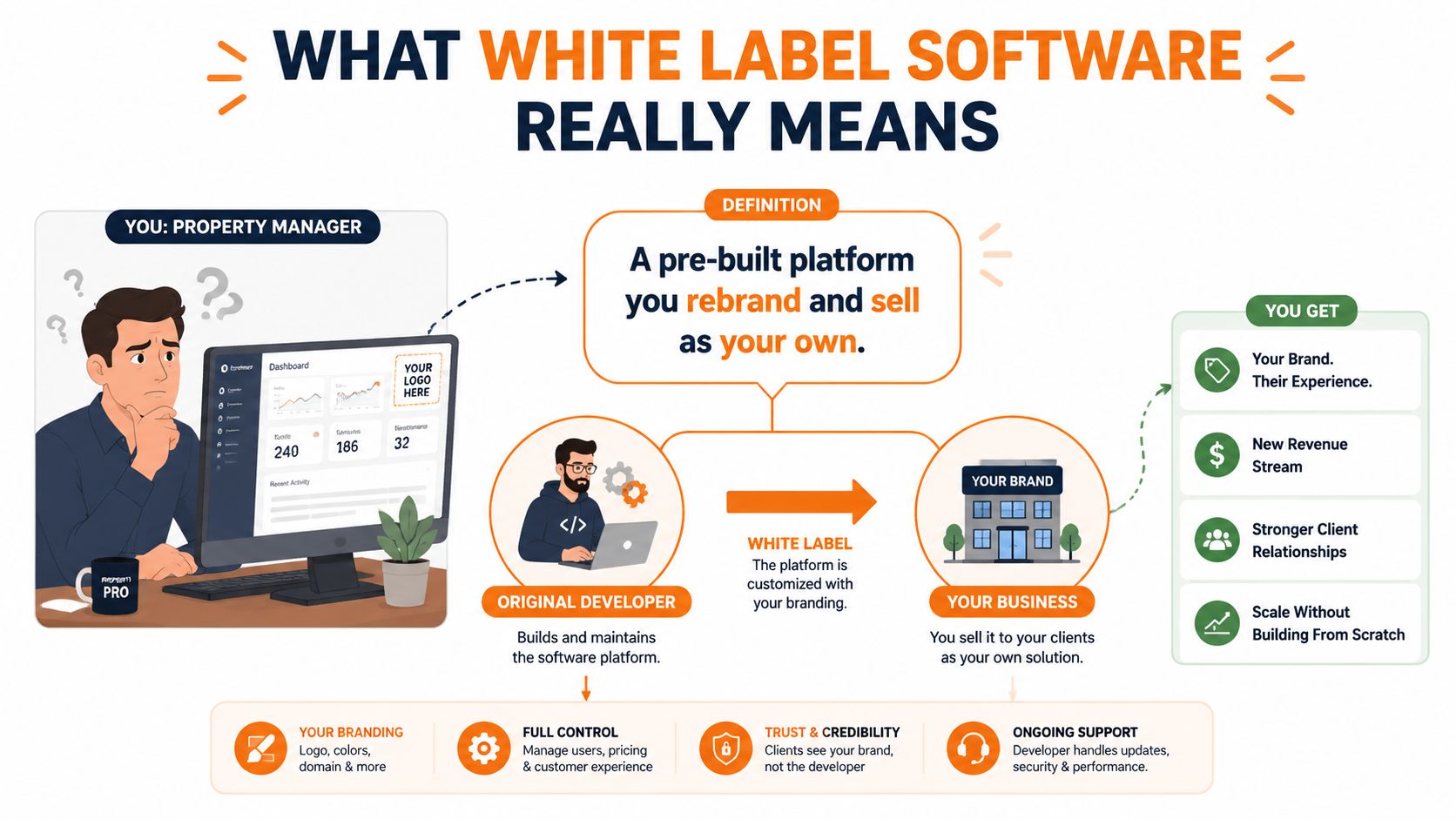
The four ownership questions to ask
A host looking at a branded guest guide should ask four questions before signing:
- Who owns the source code? In most white-label agreements, the original developer owns the code and licenses its use.
- Who owns the customer and guest data? The contract should identify who controls the data, who can export it, and what happens after cancellation.
- Who answers support requests? Your guests may contact your business first, even if the vendor handles technical troubleshooting behind the scenes.
- Whose logo appears in the experience? Check the login page, guest pages, transactional emails, mobile screens, help documentation, and printable materials.
Practical rule: If the customer sees your brand but expects you to solve every problem, support obligations are part of the product you're buying.
That arrangement can suit a property manager who wants to package technology with onboarding, guest communication, and local recommendations. A hospitality agency might combine a branded welcome book with a customizable survey and test maker to collect arrival preferences or post-stay feedback, then keep the entire interaction under its own identity.
The broader vacation rental management software landscape shows why this model attracts operators. Businesses increasingly want a connected guest journey rather than a collection of unrelated vendor screens. White labeling helps the operator make technology feel like part of the service, while the developer carries the development burden in the background.
How White Label Software Works Behind the Scenes
A guest scans a QR code at a vacation rental and opens a welcome book with Wi-Fi details, check-in instructions, house rules, and local recommendations. The page carries the host's name and visual identity, yet the software underneath may involve several different owners and responsibilities. Following that flow makes the business model easier to evaluate.
Step one starts with the vendor
The original vendor develops the application, manages its architecture, and hosts the service on shared or dedicated infrastructure. It usually keeps the source code proprietary and handles core development, maintenance, security work, and platform improvements.
Many white-label products use a multi-tenant architecture. One codebase serves multiple customers while separating each tenant's users, data, settings, and branding. Tenant-scoped queries, middleware, and row-level security can keep one operator's information separate from another's, as described in this multi-tenant architecture guide for white-label partners.
The vendor therefore owns and maintains the technical foundation, while the operator builds the customer-facing service around it.
Step two creates your branded layer
You sign an agreement that sets out resale rights and operational duties. In the administration area, you may upload a logo, select brand colors, configure a custom domain, edit terminology, and prepare guest-facing templates.
Control varies sharply by provider. One may allow only a logo and color palette. Another may support branded emails, custom domains, mobile experiences, and separate client workspaces. Ask which screens, messages, and settings you can change. “White label” does not automatically mean a complete redesign.
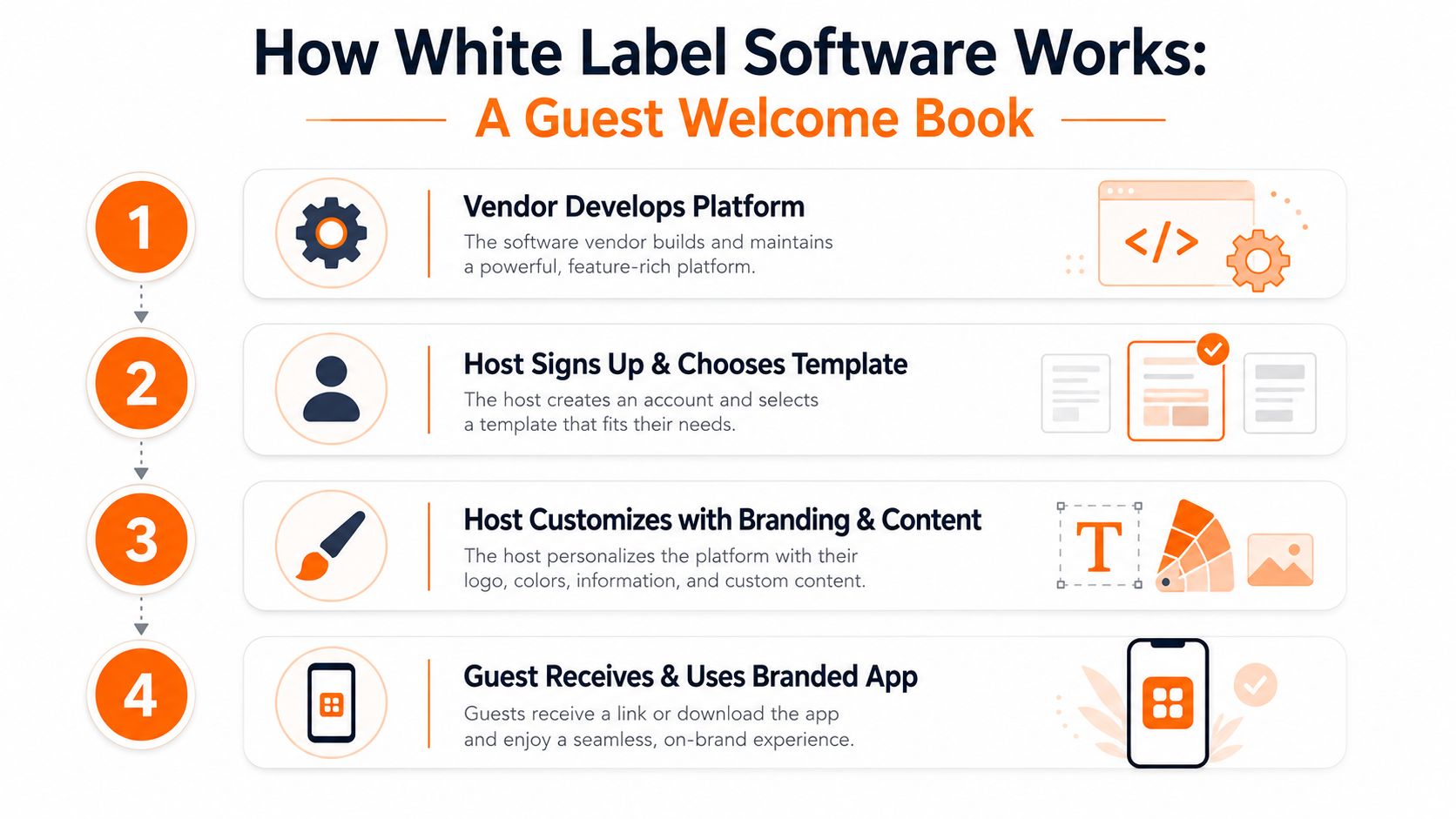
Step three hides the original vendor
The guest opens the link and sees your name, colors, and content. The underlying provider may remain invisible throughout the experience. That separation lets a host present one consistent service while another company operates the technical platform.
Step four passes responsibility through an agreement
The vendor may handle infrastructure, patches, monitoring, and technical support. You may manage content, first-line guest assistance, billing, and account administration. Service-level agreements should specify uptime commitments, incident communication, response times, and escalation paths.
Pricing may use a flat license, a fee tied to active properties, or revenue sharing. Assess more than the subscription price. Include content preparation, guest support, client onboarding, billing administration, and work required when the vendor changes its product. Those details show who owns each part of the experience and whether the arrangement suits your operation.
White Label Versus Private Label, OEM, and SaaS Reselling
These terms overlap in casual conversation, but they describe different relationships between the technology creator, the seller, and the end customer. The easiest way to separate them is to ask how visible the underlying product is and how much control the reseller receives.
| Model | Code Ownership | Branding Control | Exclusivity | Typical Hospitality Fit |
|---|---|---|---|---|
| White label | Original developer usually retains the code and licenses access | Broad customer-facing rebranding, depending on the agreement | Usually shared, not automatically exclusive | Branded welcome books, guest messaging, agency portals |
| Private label | Third-party manufacturer owns or produces the underlying item | Retailer usually controls the outward product identity and may request deeper changes | Often associated with a retailer-specific product arrangement | More common in physical hospitality goods than software |
| OEM | Technology creator owns the embedded component | Limited visibility of the underlying component | Defined by the commercial agreement | A channel manager or booking component embedded inside a PMS |
| SaaS reselling | SaaS vendor owns the application | Often limited to referral or partner branding | Usually non-exclusive unless stated otherwise | Booking-site referrals, subscription brokerage, partner sales |
White label is about the experience
A white-label digital welcome book may use the vendor's infrastructure while displaying the agency's name, colors, domain, and guest content. The reseller sells a branded outcome, not merely access to another company's subscription.
Private label is a closer cousin, but the phrase is more strongly associated with physical products made by one manufacturer and sold under a retailer's exclusive brand. In software conversations, people sometimes use the term loosely, so the contract matters more than the label.
OEM is usually beneath the surface
An OEM relationship places a component inside a broader product. A hospitality operator might use a property management system that contains a booking engine or channel management technology supplied by another company. The end user may never encounter the component's original brand.
SaaS reselling is lighter-touch. An agency might refer a host to a booking tool, earn a commission, or manage the subscription without receiving deep control over the interface. The customer generally knows which vendor supplies the software.
For hospitality buyers, the practical question is simple: are you selling access, embedding a component, or presenting a complete product under your own identity? Welcome-book platforms such as ScanStay fit the white-label category when the reseller controls the guest-facing brand. A channel manager inside a PMS is closer to OEM, while a plain booking-site referral is closer to SaaS reselling.
Real Benefits and Honest Drawbacks of Going White Label
White labeling solves a specific business problem. You want to launch a software-enabled service, but software development isn't your core business. Buying a ready platform can reduce the development burden and shorten the path from idea to customer offer, a point also emphasized in the overview of white-label software's business model.
Why operators choose it
A solo host may want a branded digital welcome book without learning application development, arranging hosting, or maintaining security patches. An agency may want to give every property owner a consistent portal while reusing templates, processes, and onboarding materials.
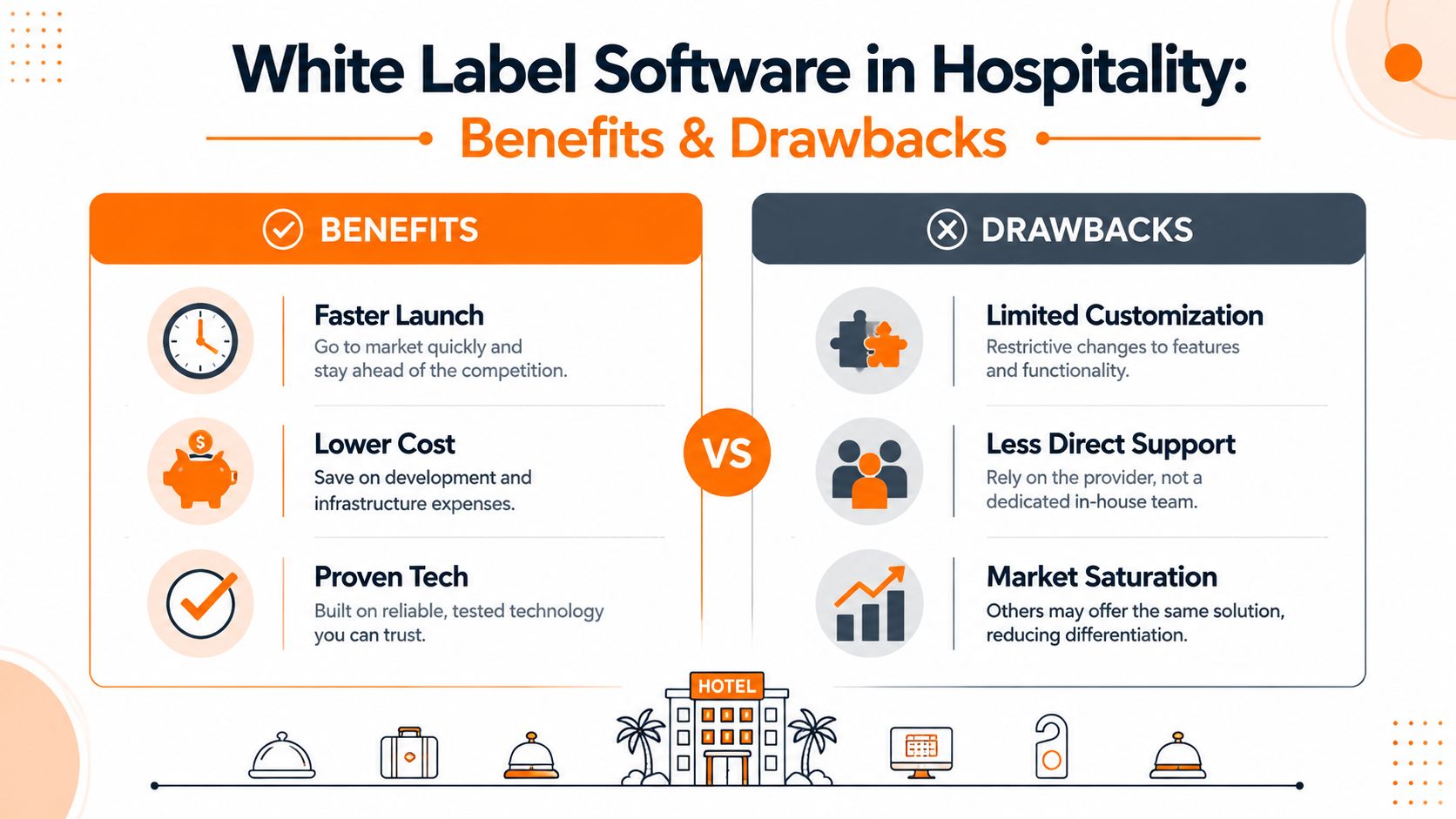
The benefits usually include:
- Faster launch: You start with an existing product instead of commissioning every foundational feature.
- Lower development burden: The vendor handles the underlying code, infrastructure, and ongoing platform work.
- Consistent presentation: Guests and property owners encounter one recognizable brand across the service.
- Operational efficiency: You can focus on hospitality, content, sales, and client relationships rather than platform maintenance.
- Recurring commercial potential: A reseller can package software into a broader managed service or subscription offer, subject to the agreement.
The commercial context is significant. A 2026 industry article cites a market report estimating the global white-label SaaS market at $235.9 billion in 2025 and projecting $278 billion by 2026, an implied 16.2% year-over-year increase over that period, as reported by OnGraph's discussion of the white-label SaaS market. The figures are an industry estimate, not a guarantee for any individual hospitality business.
Where the model strains
White-label software doesn't give you unlimited control. The vendor's roadmap determines which features arrive, how the interface changes, and which integrations receive attention. If your guests or property-owner clients need a workflow the platform doesn't support, you may have to accept a workaround or request a change.
Data portability deserves equal attention. A vendor should explain how you export guest content, property records, branding assets, and account information. Support can also become your responsibility by default. Guests don't care which company owns the code when a Wi-Fi instruction is wrong or a page won't load. They contact the brand they recognize.
The lower the technical burden, the more carefully you need to inspect the commercial and support burden.
For a solo host, limited customization may be acceptable if the tool launches quickly and handles the essential guest information. For an agency, the same limitation can become a contract risk. The agency may need client-level permissions, separate billing, reliable exports, documented service levels, and a clear escalation route.
A deal-breaker is anything that threatens guest trust or prevents you from leaving. A tolerable constraint is a feature you don't need today and can manage through a documented process. Separate those categories before comparing vendors.
Hospitality Use Cases From Welcome Books to Portfolio Dashboards
A host replaces a paper binder with a QR code beside the entrance. Guests scan it and reach a branded mobile page containing Wi-Fi credentials, check-in and check-out details, house rules, local recommendations, and video instructions. The host controls the content and the visible identity, while the software vendor operates the platform underneath.

That same pattern works at portfolio level. A property management agency can create a standard content framework, then adapt directions, access details, recommendations, and policies for each home. The agency presents one service to property owners rather than asking each owner to manage a separate vendor account.
A property management dashboard adds another layer. The operator can use a central workspace to organize multiple properties, reuse suitable content, and keep the guest experience consistent while preserving property-specific information.
Other practical applications
- Guest messaging platforms: An agency can offer automated pre-arrival and in-stay communication under its own service identity.
- Upsell marketplaces: A host can present late checkout, transfers, equipment rental, or local experiences as part of the branded stay journey.
- Review-request tools: A hospitality business can ask for feedback through an interface that matches its own identity rather than sending guests to an unfamiliar provider.
- Channel management add-ons: A software company may package distribution features with its own hospitality service, although embedded channel functionality is often closer to an OEM arrangement.
The white-label layer matters most when guests interact with the product directly. A hidden vendor can be useful, but hiding the name doesn't remove responsibility for accurate content, accessible instructions, or prompt assistance.
A practical test is to follow the entire guest journey. Open the link on a phone, check the domain, inspect emails, look for vendor language, submit a support request, and ask what happens when the subscription ends. The visible experience and the operational reality should match what your sales team promises.
The following video can help hospitality operators think through the role of digital guest information in the stay experience.
Vendor Evaluation Checklist for Hosts and Agencies
Treat a vendor demo like a procurement meeting, not a design tour. A polished sample account can hide restrictions that only appear when you add multiple properties, invite staff, export data, or cancel a plan.
Brand depth
Start with the guest-facing details. Ask whether you can use your own logo and colors, whether the vendor name appears anywhere, and whether a custom domain is included or priced separately. Check transactional emails, QR posters, login pages, mobile layouts, help screens, and app listings.
Record the answer to each question in your scorecard:
- Brand surface: Which screens, emails, documents, and notifications can carry your identity?
- Domain control: Can guests open a branded domain, and who manages the renewal?
- Content flexibility: Can you customize terminology, templates, languages, and property-level content?
Integrations and workflow
A welcome book may sit beside a PMS, channel manager, payment processor, or messaging system. Ask which integrations are live, what data moves automatically, and what happens when a connection fails.
The property management systems guide can help you think about the wider software environment before you judge one white-label component in isolation.
- Connection scope: Does the integration sync reservations, property details, guest details, or only selected fields?
- Permissions: Can different staff members, owners, and properties see only the information they need?
- Failure handling: Who notices a failed sync, and how will your team correct it?
Pricing and service commitments
Ask the vendor to map every charge to a real operating event. Pricing might depend on properties, users, usage, features, or reseller volume. Request examples for adding a property, removing one, exceeding a limit, and keeping data after cancellation.
Then read the service-level agreement. Look for uptime commitments, response expectations, support channels, maintenance notices, and escalation procedures. If you provide first-line support, ask whether the vendor offers an internal support route that you can use without exposing the vendor brand.
Data, IP, and exit rights
The contract should state who owns guest-submitted information, property content, uploaded media, and branding assets. It should also explain retention, deletion, export format, subcontractors, and access after termination.
Before you sign, ask the cancellation question in plain language: “If we leave, what can we download, when can we download it, and who helps us complete the transition?”
Finally, examine the reseller agreement. Check contract length, renewal terms, territory, exclusivity, resale rights, support liability, indemnity, and restrictions on modifying the product. A tool that looks flexible in a demo may be commercially rigid in the contract.
Implementation Steps and Clear Next Moves for Your Situation
The right rollout depends on what you're trying to sell. A solo host needs a clean guest journey. A growing portfolio needs repeatable content and controlled permissions. An agency needs a commercial operating model that separates vendor duties from client promises.
For a solo host
Start with a short audit. List every place guests currently find Wi-Fi details, access instructions, house rules, appliance guidance, emergency information, and local recommendations. Remove contradictions before moving the content into a new platform.
Then prepare the assets the vendor will request:
- Collect the brand basics: Use the approved logo, colors, business name, and contact details.
- Prepare the domain: Decide whether guests will use a vendor-hosted address or a custom domain, and confirm who manages the domain connection.
- Build the first property: Enter only the information guests need during arrival and the stay.
- Test the journey: Scan the QR code on a phone, review every link, and ask someone unfamiliar with the property to follow the instructions.
- Launch and monitor: Place the printed sign where guests will notice it, then review questions and corrections from early stays.
Your next moves are to audit current guest messages, request a white-label demo, and compare the vendor's export and support terms with your time and budget limits. Choose custom development only if you need control the platform cannot provide. Choose off-the-shelf software if your own brand isn't central. Choose white label if branding and speed matter more than owning the code.
For a growing portfolio
Pilot the system with one building or a small group of similar properties. Use the pilot to standardize naming, arrival instructions, emergency language, image rules, and content ownership before you copy anything across the portfolio.
Collect structured guest feedback about clarity, missing information, and ease of use. Then refine the templates, document who approves changes, and establish a process for property-specific exceptions. Once actual usage supports a broader rollout, discuss volume pricing and account permissions with the vendor.
Your immediate actions are to select the pilot, define the content standard, and create a support escalation map. White label is appropriate when you want a reusable branded layer across properties. Off-the-shelf may be enough when each owner operates independently. Custom development deserves consideration only when your operating process is unique and the portfolio can support the maintenance burden.
For an agency
An agency should design the reseller operation before selling the tool. Define onboarding, billing, client permissions, first-line support, technical escalation, data ownership, and termination rights. Give each property owner a written explanation of what the agency provides and what the underlying vendor provides.
Create support tiers so routine content changes don't compete with technical incidents. Decide whether the agency or the property owner controls guest data, who approves upsell content, and how accounts are transferred when an owner leaves the portfolio.
Your next steps are to negotiate the reseller agreement, model multi-tenant billing, and create a client-facing service schedule. Select white label when the branded experience is part of your agency's value. Select SaaS reselling when referral economics and lighter customization are sufficient. Select custom development only after confirming that the required differentiation justifies long-term code, hosting, security, and support ownership.
Implementation success depends as much on rollout discipline as on the software itself. A clear content owner, tested guest journey, documented support path, and workable exit plan will protect the brand you're putting in front of guests.
ScanStay provides digital welcome books that let short-term rental operators replace paper binders and repetitive messages with a QR-accessed mobile experience for Wi-Fi details, house rules, check-in guidance, local recommendations, and video how-tos. Review the white-label and hospitality options by visiting ScanStay and compare them with your branding, support, integration, and exit requirements.