Rental Management: The Ultimate Guide for Hosts in 2026
Master rental management with our ultimate guide. Learn day-to-day operations, automation, legal best practices, and scaling tips to boost your STR income.
You're probably in the phase where hosting still looks simple from the outside, but your phone says otherwise. A guest wants the Wi‑Fi password even though it's in the check-in message. Your cleaner is asking whether the late checkout was approved. Someone can't find the blender. A light bulb went out. A booking request just came in for dates you thought were blocked. By the end of the week, you've spent more time answering routine questions than improving the property.
That's the point where rental management stops being a side task and starts becoming a business system. Good hosts don't just react well. They build a setup that makes the stay smoother, the operation calmer, and the income more predictable.
Table of Contents
- What Is Rental Management and Why It Matters Now
- The Five Pillars of Modern Rental Management
- Streamlining Your Day-to-Day Operations with SOPs
- From Saving Time to Generating Revenue with Tech
- Managing Your Finances and Staying Legally Compliant
- Key KPIs to Track for Scaling Your Portfolio
- Your Actionable Rental Management Checklist
What Is Rental Management and Why It Matters Now
Most new hosts think rental management means replying to guests, booking cleaners, and fixing things when they break. That's part of it, but it's not the job in full. Rental management is the system behind the stay. It covers guest communication, pricing, turnovers, maintenance, compliance, cash flow, and the standards that keep all of that consistent.
When hosts don't have a system, every booking feels custom. They rewrite the same message, solve the same confusion, and make decisions from memory. That works for a while. Then one busy month exposes the weak spots. A missed restock turns into a complaint. A delayed cleaner creates check-in stress. A preventable question arrives at midnight because the information wasn't easy to find.
Professional operators treat rental management differently. They build repeatable processes, document expectations, and make the guest journey easier to follow without direct intervention every time. That's what creates margin, not just in time, but in revenue and review quality.
Practical rule: If a task happens more than once, it shouldn't live only in your head.
The opportunity is large enough that this shift matters. The global vacation rental market was valued at US$82.63 billion in 2022 and is projected to reach US$119.01 billion by 2030, according to DoorLoop's vacation rental market summary. That same analysis points to increasingly data-driven, technology-enabled operations and a larger role for professionalized management.
That trend shows up on the ground in a simple way. Casual hosting can still earn money. Structured rental management is what makes the business durable.
Why hosts get stuck
The usual failure point isn't effort. It's fragmentation. Hosts often manage their rental through a patchwork of inboxes, notes, text messages, memory, and last-minute problem solving.
A property starts feeling easier when you can answer these questions clearly:
- Guest flow: What does a guest receive after booking, before arrival, during the stay, and after checkout?
- Operational ownership: Who handles cleaning, inspections, urgent maintenance, and supply checks?
- Decision rules: When do you approve a refund, waive a fee, or offer a recovery gesture?
- Visibility: Where do you see bookings, tasks, expenses, and issues in one place?
If those answers are loose, the business is loose. If those answers are documented, rental management becomes manageable.
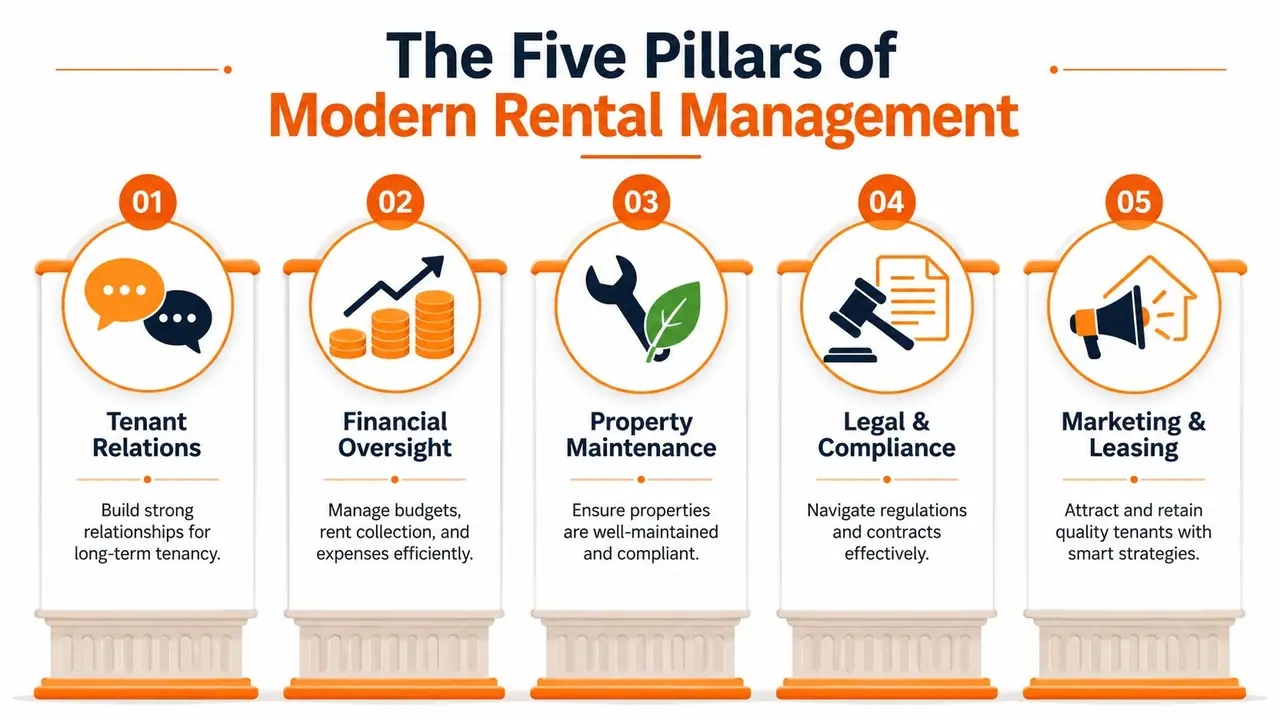
The Five Pillars of Modern Rental Management
A lot of hosts feel overwhelmed because they treat every responsibility as a separate fire. It's easier to run the business when you group the work into five pillars. That gives you a clear map of what needs attention and what can be standardized.
Guest experience and communication
Guests judge your operation long before they enter the property. They notice response speed, clarity, tone, and whether basic questions are easy to resolve. This pillar includes inquiry handling, booking confirmation, pre-arrival instructions, in-stay support, issue resolution, and review follow-up.
What works is proactive communication. Send less, but make each message complete. Guests don't want six separate updates. They want one clear path: how to arrive, how to enter, how to use the property, and what to do if something goes wrong.
Operations and maintenance
Many hosts lose consistency in operations, which covers turnovers, inspections, laundry, restocking, vendor coordination, preventive maintenance, and emergency response. It also includes small details that directly affect reviews, like whether batteries are fresh, drains are clear, and the coffee setup is complete.
Strong operations aren't flashy. They're boring in the best way. The property is ready on time, every time.
A good operator knows the difference between:
- Recurring tasks: Cleaning, linen resets, amenities, trash, exterior checks
- Preventive tasks: HVAC servicing, appliance checks, leak detection, pest control
- Reactive tasks: Guest-reported issues, lockouts, breakages, weather-related damage
Marketing and booking management
This pillar covers listing quality, photography, calendar accuracy, pricing, channel management, minimum stay rules, and occupancy strategy. Many hosts think marketing ends once the listing is live. It doesn't. A rental needs regular refinement based on seasonality, stay patterns, and the kind of guest you want to attract.
High-performing listings usually do three things well:
- They reduce uncertainty: The photos match reality, and the description answers common objections.
- They set expectations: Guests know what the space is for, and what it isn't.
- They protect operations: House rules, stay restrictions, and booking settings support the kind of occupancy you can handle well.
Financial and legal administration
This pillar is less visible to guests, but it protects the entire business. It includes rent or booking collection, owner reporting, expense tracking, tax prep, contract storage, licensing, insurance review, and regulation monitoring.
Hosts often enjoy the hospitality side and postpone this part. That's a mistake. A rental that looks busy can still underperform if expenses are scattered, fees are poorly tracked, or compliance is handled casually.
Strategy and growth
This last pillar is where hosts become operators. Strategy means deciding whether to raise rates, add services, improve furnishings, change your minimum stay, adjust guest targeting, or expand into another property.
A host manages what's happening today. An operator also manages what should happen next quarter.
Not every property should scale. Some should be tightened up, repositioned, or simplified first. Growth makes weak systems louder. It doesn't fix them.
Streamlining Your Day-to-Day Operations with SOPs
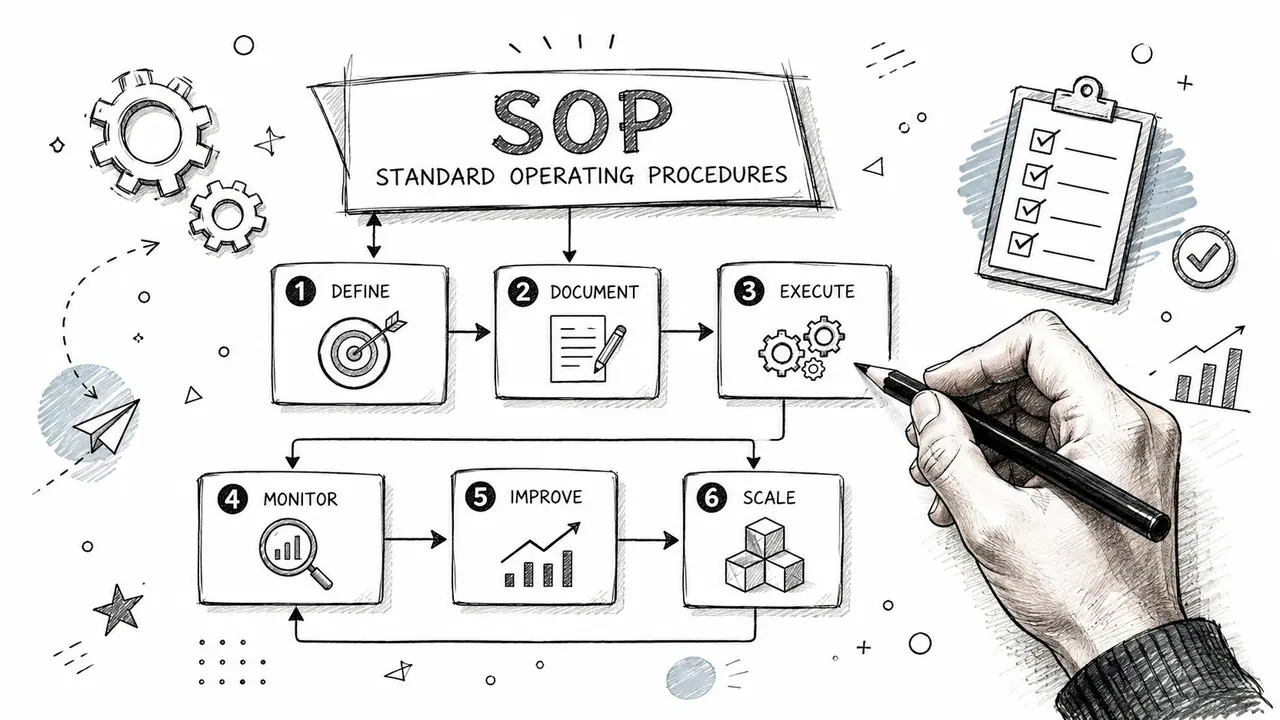
The fastest way to reduce stress in rental management is to stop relying on memory. Standard operating procedures, or SOPs, turn repeated work into documented work. That matters whether you manage one unit yourself or coordinate a team across multiple properties.
If you've ever texted your cleaner the same special instruction three different times, or forgotten whether a guest received the parking details, you already have the signal that an SOP is needed.
The SOPs that matter first
Start with the workflows that break most often or consume the most attention. For most short-term rentals, that's communication, turnovers, check-in, and maintenance.
A practical SOP stack looks like this:
Pre-arrival communication SOP
Include booking confirmation, arrival instructions, parking details, access timing, property quirks, and the support contact path. Write the sequence once. Use the same structure every stay.Turnover SOP for cleaners
This should be a checklist, not a paragraph. Break it room by room. Require photos of high-risk areas such as the kitchen, bathroom, remote controls, under beds, and entryway. If consumables need restocking, list exact par levels instead of saying “restock as needed.”Check-in and checkout SOP
Cover lock testing, thermostat setting, lights, welcome setup, trash instructions, and departure tasks. If a guest can misunderstand a step, rewrite that step.Maintenance request SOP
Decide how issues are classified. Some problems need same-day action. Others can wait for the next vendor run. The key is to define response rules before a message arrives.
The best SOP is the one a new assistant or cleaner can follow without calling you for clarification.
How to document an SOP so others can actually use it
Most SOPs fail because they're written for the owner who already knows the property. Write them for someone who has never seen the unit before.
Use this format:
- Purpose: What outcome this SOP is meant to produce
- Trigger: What event starts the procedure
- Steps: In exact order
- Photos or screenshots: For locks, supplies, appliance settings, and staging
- Escalation rule: When the person should stop and contact you
- Completion proof: Checklist, timestamp, photos, or notes
For setup-heavy properties, furnishing decisions also benefit from system thinking. If you're standardizing a new unit or refreshing an existing one, Gates Home Furnishings' furnishing guide is a useful reference for building out rooms intentionally instead of buying piece by piece under pressure.
Here's where hosts usually overcomplicate things. They try to create a master manual for everything. Don't start there. Build one SOP each time a task goes wrong twice.
A simple operating standard that works
Use short, specific language. “Replace all used towels and inspect for stains” is usable. “Ensure soft goods meet guest-ready expectations” is not.
Then review your SOPs after real failures, not on a random schedule. If a guest couldn't find the parking spot, your arrival SOP needs a better photo or a clearer sentence. If your cleaner missed a cracked mug, your turnover SOP needs a cabinet check, not a reminder to “be more thorough.”
That's how rental management gets lighter. Not because there's less to do, but because fewer tasks depend on your personal attention.
From Saving Time to Generating Revenue with Tech
Most hosts buy technology for one reason. They want fewer interruptions. That's fair. Smart locks reduce handoffs. Channel managers reduce calendar mistakes. Automated messaging reduces repetitive typing.
But there's a better question to ask. Can a tool turn routine support into additional revenue?
The support message to revenue conversion gap
Most hosts treat guest questions as a cost center. A message comes in. You answer it. Time is spent, and the best outcome is that the issue disappears. That model is incomplete.
There's a documented gap in how the industry thinks about guest support. As described in Innowave Studio's analysis of the support-message conversion gap, a single QR code can turn a routine support interaction into a revenue moment. The same analysis notes that few resources quantify the “revenue per message saved” metric, and that reducing 10 nightly messages could generate $150+ weekly in upsells like equipment rentals or late checkout fees.
That changes how you should evaluate tools. If a guest asks where the blender is, the usual goal is to stop the question. A stronger setup answers the question and presents a relevant next action. Need the blender? Here's where it is, here's how to use it, and here's how to request an extra kitchen appliance or add-on service if needed.
Where the upsell should appear
The timing matters more than the offer itself. Guests rarely buy extras because they saw a generic promotion in a long pre-arrival message. They buy when the offer appears at the point of need.
That's why digital guidebooks, QR-based house manuals, and mobile guest guides are more than convenience tools when they're built correctly. They can place the offer inside the support moment.
Good examples include:
- Late checkout offers shown beside checkout instructions
- Mid-stay cleaning placed in the house guide, where guests look for linen or housekeeping information
- Equipment rentals displayed near appliance instructions or amenity explanations
- Transport or local add-ons listed where guests check arrival and area guidance
If you're comparing tools that support this kind of operational setup, this overview of affordable property management software options is a useful starting point.
A saved message is good. A saved message that produces additional spend is better.
The practical shift is simple. Stop asking only, “Will this software save me time?” Also ask, “Where in the guest journey can this software present the next paid convenience?”
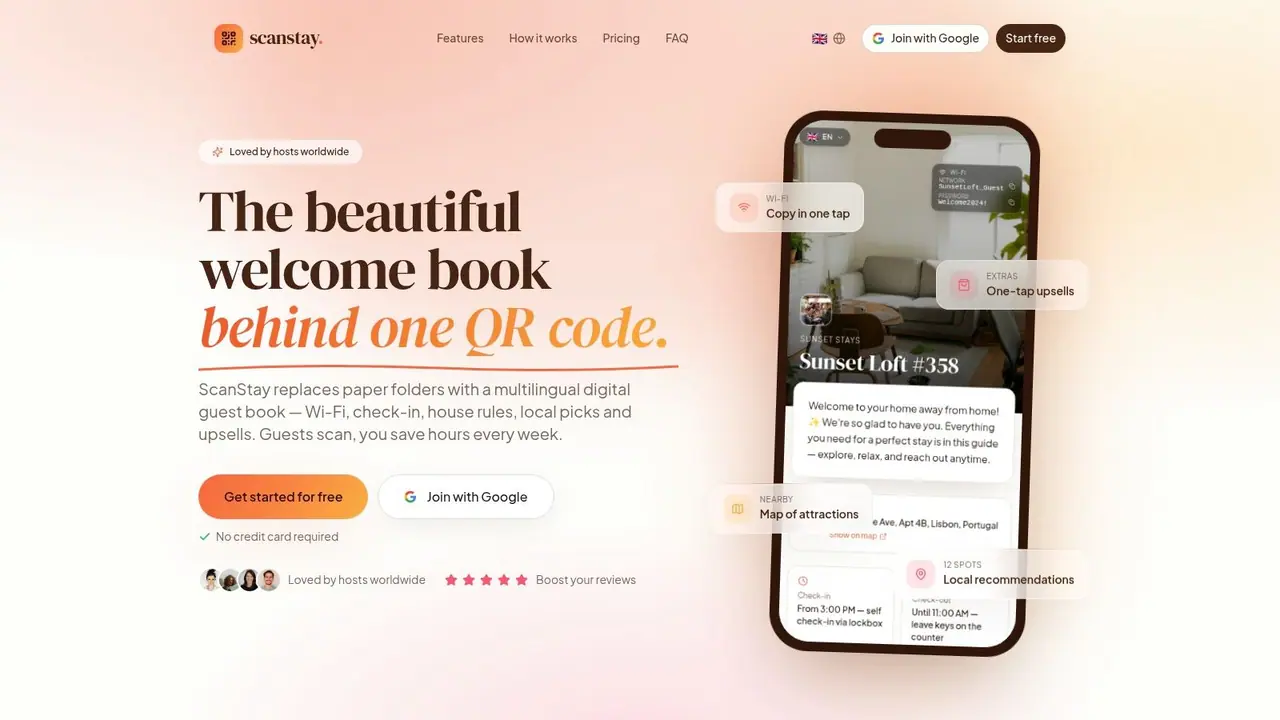
A digital guidebook can answer Wi‑Fi, check-in, checkout, house rules, appliance instructions, and local recommendations in one place. It can also host service upgrades without adding friction. The host doesn't need to force a sales pitch. The system just needs to make relevant add-ons visible when the guest is already looking for help.
This short demo shows what that kind of guest-facing setup looks like in practice.
What doesn't work
Three common mistakes kill the revenue side of hospitality tech:
- Burying information in PDFs or long messages: Guests won't hunt for what they need.
- Offering irrelevant extras: An upsell that doesn't match the moment feels pushy.
- Separating support from service design: If your support flow lives in one place and your upsells live somewhere else, guests won't connect them.
The goal isn't more software. It's fewer dead-end interactions.
Managing Your Finances and Staying Legally Compliant
The hospitality side of rental management gets attention because it's visible. Financial control and compliance work are quieter, but they decide whether the business is stable. Sloppy books, unclear agreements, and weak insurance can undo a strong booking calendar fast.
The scale of the industry shows why professional habits matter. The U.S. Property Management industry generated $139.9 billion in revenue through 2026, and the global property management software market is projected to grow from USD 26.49 billion in 2024 to USD 50.87 billion by 2032, according to IBISWorld's property management industry data. That points to a broader shift toward software-supported tracking, reporting, and compliance.
Financial habits that keep a rental healthy
Start with separation. Use a dedicated business bank account and a clean system for income and expense categorization. If personal spending and property spending mix together, you'll waste time every month and create avoidable risk at tax time.
Then track profitability beyond payout notifications. Booking revenue is not profit. You need visibility into cleaning, repairs, consumables, platform fees, utilities, subscriptions, and replacement costs.
A basic monthly review should answer:
- Revenue quality: Which stays were profitable, not just booked
- Expense drift: Which costs are creeping up without adding guest value
- Operational leakage: Which repeat issues are generating refunds, replacements, or extra labor
- Reserve readiness: Whether you have cash set aside for maintenance and downtime
Compliance work that can't be improvised
Every market has its own rules, and short-term rental operators get in trouble when they assume platform approval equals legal compliance. It doesn't. You need to verify your local licensing, occupancy, zoning, safety, tax, and contract requirements directly.
Insurance is another place where hosts cut corners. Platform protections may help in some situations, but they are not a substitute for proper coverage designed for your rental activity.
For the legal side, build a file with your registration documents, permits, insurance records, house rules, vendor agreements, and guest contract terms. If you need a refresher on guest agreement basics, this guide to vacation rental contracts is a practical reference point.
For a wider operational checklist, essential property compliance is helpful as a reminder of the kinds of obligations landlords and property operators need to keep current.
If a rule affects safety, occupancy, money handling, or guest rights, document it. Don't rely on memory or old templates.
Hosts often want a universal compliance checklist. There isn't one. The better approach is to build your own local file and review it any time regulations, property use, or amenities change.
Key KPIs to Track for Scaling Your Portfolio
A rental can feel busy and still be underperforming. That's why scaling without KPIs is risky. You need a small set of metrics that show pricing strength, occupancy efficiency, stay pattern quality, and actual operating performance.
Many hosts look only at gross booking totals. That number can hide weak pricing, excessive gaps, poor stay length mix, or costs that are rising faster than revenue.
The KPI table to review every month
Use a simple dashboard. Don't make it fancy before you make it useful.
| KPI | Formula | What It Tells You |
|---|---|---|
| Occupancy Rate | Booked nights ÷ available nights | How much of your calendar you're filling |
| Average Daily Rate | Total room revenue ÷ booked nights | What guests pay on booked nights |
| RevPAR | Total room revenue ÷ available nights | How pricing and occupancy perform together |
| Average Length of Stay | Total booked nights ÷ number of reservations | Whether your stay pattern creates turnover strain or efficiency |
| Net Operating Income | Revenue minus operating expenses | What the property produces before financing and owner-level tax considerations |
These are standard management metrics, and they work because each one answers a different question. Occupancy alone can mislead you. A full calendar at weak rates isn't a strong business. ADR alone can mislead you too. High nightly prices don't help if your calendar sits open.
If you want a deeper look at how hosts use data to evaluate booking performance, this guide to vacation rental analytics is a useful companion.
How to use KPIs to make decisions
Treat KPIs as decision tools, not reporting ornaments.
For example:
- High occupancy and weak ADR can mean you're priced too low or attracting the wrong stay pattern.
- Strong ADR and weak occupancy can mean your listing is overpriced, too restrictive, or not converting views efficiently.
- Low average length of stay can raise cleaning and coordination load, even when top-line revenue looks healthy.
- Soft NOI despite healthy booking volume usually points to expense leakage or operational inefficiency.
Watch KPI trends together, not in isolation. A single number rarely tells the whole story.
New hosts often make the wrong move. They add another property because the first one feels active. Activity is not the same as control. Expand when your metrics show repeatable performance and your operating systems can absorb more volume without lowering standards.
A useful habit is to review KPIs alongside actual guest friction. If revenue is fine but support volume is chaotic, the property may be earning despite weak systems. That's not a stable base for growth.
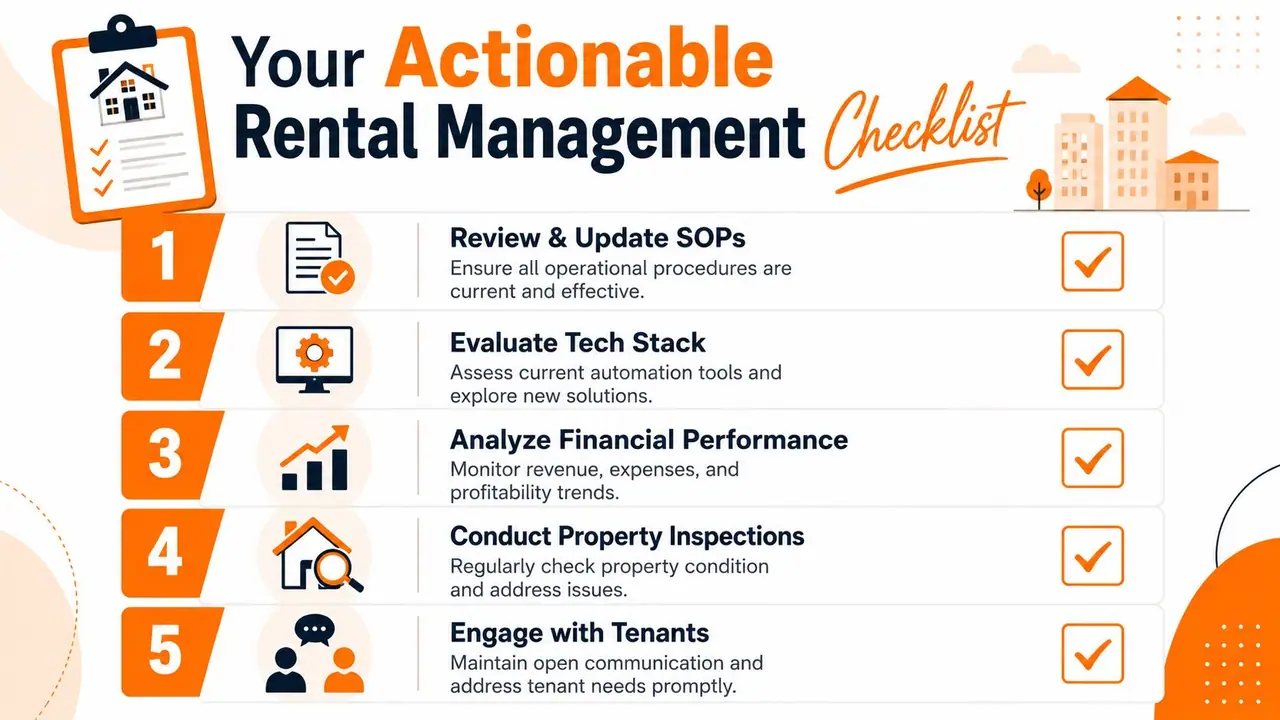
Your Actionable Rental Management Checklist
Good rental management gets easier when you stop trying to improve everything at once. Pick the highest-friction parts of the business and tighten them first. The checklist below works well for hosts with one property and still holds up as a portfolio grows.
What to do this week
Guest experience
Create one clear source of truth for guests. Include access, Wi‑Fi, house rules, appliance help, checkout steps, and local guidance. If guests keep asking the same question, fix the information path instead of answering faster.Operations
Write or update your turnover SOP. Add photos, exact restock standards, and a rule for reporting damage. Then test it with someone other than yourself.Marketing and booking management
Review your listing for friction. Tighten the first photo set, clarify who the property is best for, and make sure your rules match the stay experience you can deliver reliably.Financial and legal administration Separate accounts, categorize expenses, and make sure key documents are organized. Confirm that your insurance, permits, and rental terms still match how the property is being used.
Strategy and growth
Choose one KPI set to review every month. Then choose one guest support point that could become an upsell moment instead of a dead-end message.
The biggest mistake hosts make is treating rental management as a collection of chores. It works better as a designed system. When communication is documented, operations are repeatable, finances are visible, and guest support is connected to revenue opportunities, the business becomes easier to run and more worth running.
If you want a simpler way to replace repetitive guest messages with a QR-based digital guide that can also surface paid extras like late checkout, equipment rentals, or transport, ScanStay is built for exactly that use case. It gives hosts one mobile-friendly place to organize guest information and turn routine support into a smoother, revenue-generating stay experience.