Dynamic Hotel Pricing: Boost Your Rental Revenue
Master dynamic hotel pricing for Airbnb & short-term rentals in 2026. Discover key drivers, effective methods, and a framework to boost your revenue.

You're probably looking at your calendar right now and seeing something frustrating. A few weekends are booked fast at rates that now feel too cheap. A few midweek gaps are still sitting there at a price that looked reasonable when you set it a month ago. Meanwhile, a nearby listing seems to change rates constantly, and you can't tell whether that host is smart, reckless, or just using software you don't have.
That tension is exactly where dynamic hotel pricing matters. Not as a buzzword. As a practical habit: charge more when the market gives you room to charge more, and protect demand when the market softens. If you run one or two properties, you do not need an enterprise revenue stack to start doing this well. You need a repeatable process, clear rate guardrails, and the discipline to stop treating every night like it has the same value.
Table of Contents
- What Is Dynamic Pricing and Why It Matters Now
- The Five Core Drivers Behind Price Fluctuations
- Common Pricing Methods From Simple Rules to Smart AI
- A Manual Dynamic Pricing Framework for Solo Hosts
- Common Pitfalls and How to Avoid Them
- Integrating Pricing with Your Guest Experience
- Key Metrics to Track for Success
What Is Dynamic Pricing and Why It Matters Now
If you've ever watched airline fares change between Monday and Thursday, you already understand the basic idea. Dynamic pricing means your nightly rate changes based on current conditions instead of staying fixed because “that's the summer price” or “that's the weekend price.”
For hosts, that means the same apartment can be worth very different amounts on different nights. A rainy Tuesday with lots of local supply isn't the same product as a Saturday during a citywide event. Static pricing treats them as equal. Dynamic hotel pricing does not.
What's changed is that this approach is no longer limited to major brands with large revenue teams. Dynamic pricing accounts for 45% of all online hotel bookings globally according to WorldMetrics' online hotel booking statistics. That matters because it means guests already expect rates to move. They're shopping in a market where prices shift with demand, seasonality, and competitor activity.
What this looks like in real life
A host using static pricing usually sets rates by season and leaves them alone. That's simple, but it misses two things:
- Strong nights get sold too cheaply
- Weak nights stay overpriced too long
A host using dynamic pricing reviews the calendar and asks a better question: what is this specific night worth right now?
That's the same mindset behind solid vacation rental revenue management. It's not about making prices unpredictable. It's about matching price to actual demand.
Practical rule: If your rates never change after you publish them, you're not really pricing. You're guessing once and hoping the market agrees.
The hosts who improve fastest usually stop searching for the perfect number and start building a better adjustment process. That's where the rest of this gets practical.
The Five Core Drivers Behind Price Fluctuations
Rate changes often look random from the outside. They aren't. In practice, most pricing moves come from a handful of signals that show whether a night is getting stronger or weaker.
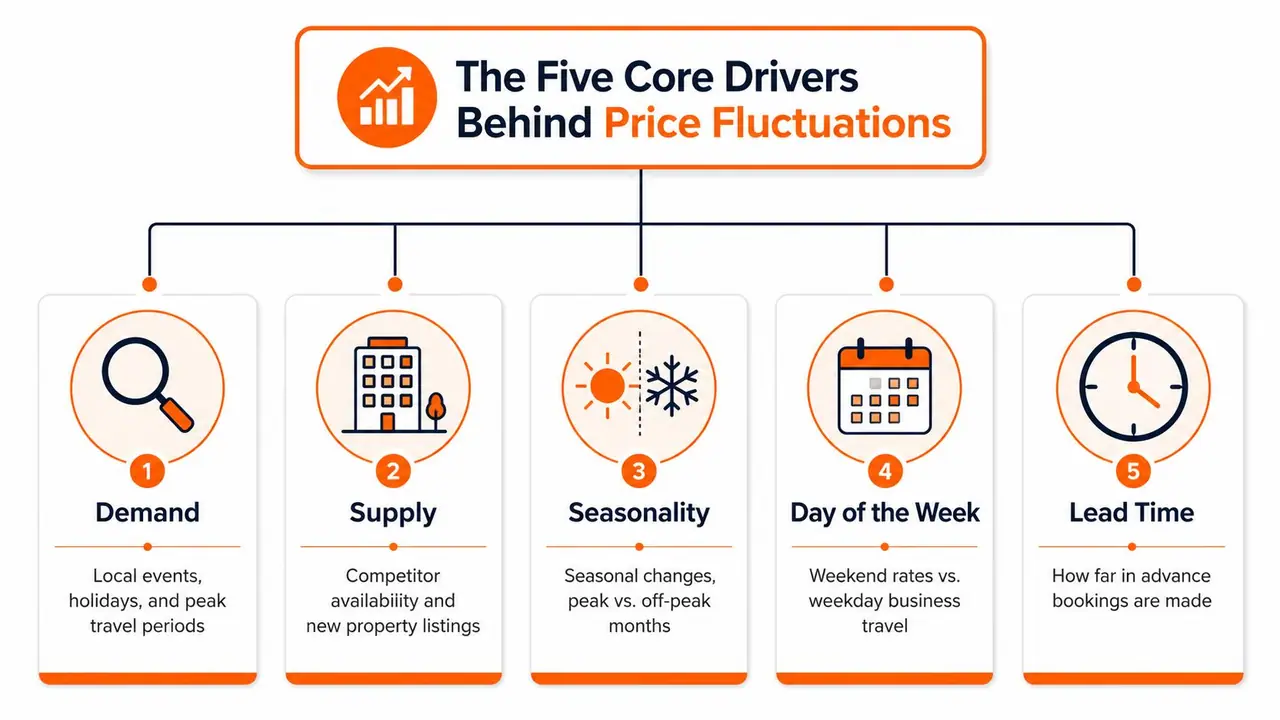
Demand and booking pace
Start with your own calendar. Are upcoming dates booking earlier than usual, later than usual, or not at all?
Booking pace tells you whether demand is building. If three weekends in the next month disappear quickly, the remaining comparable weekends usually deserve a second look. If an entire stretch is still open close to arrival, your asking price may be ahead of the market.
This doesn't require advanced software. A spreadsheet with dates, rate, booking date, and lead time already gives you a useful signal.
Seasonality and pattern shifts
Every market has recurring rhythms. Beach towns have one pattern. Business districts have another. University cities often swing around term dates, graduations, and event weekends.
Seasonality is not just “high season” and “low season.” It also includes shoulder periods, weather sensitivity, school breaks, and local travel habits. Hosts often lose money by applying broad seasonal pricing to narrow demand windows that behave very differently.
Length of stay
A one-night booking and a longer booking don't create the same value.
A longer stay can reduce cleaning turnover, smooth occupancy, and protect weak nights on either side of a strong date. But it can also block premium short stays if you discount too heavily. The trick is not to assume longer always means cheaper. Sometimes a stay that fills awkward gaps deserves flexibility. Sometimes peak nights should stay protected.
Local events and demand shocks
Concerts, conferences, sports fixtures, graduations, weddings, and ferry disruptions can all shift demand fast. Solo hosts often underestimate this because they think only “major events” matter.
In small markets, one meaningful event can tighten availability enough to justify a rate move. In urban markets, several mid-sized events can stack together and create pressure across a neighborhood. The host who notices early has options. The host who notices after booking out cheaply does not.
Watch your city calendar the way a retailer watches holidays. Demand often changes before guests start calling it busy.
Competitor rates and visible supply
Competitor shopping matters, but not in the simplistic “always be cheapest” way. What matters more is positioning.
Check a small comp set of properties that compete with yours. Similar size. Similar location. Similar finish level. Then ask:
- Are competitors still available? If many comparable listings are gone, your remaining nights become more valuable.
- Are they raising rates? That can confirm strengthening demand.
- Are they discounting? That can signal soft conditions or overpricing in the market.
- Are new listings entering the market? More visible supply can change guest expectations quickly.
A lot of hosts look at one nearby listing and overreact. A better habit is to watch a handful and look for direction, not noise.
Common Pricing Methods From Simple Rules to Smart AI
Not every pricing system works the same way. Some hosts use fixed rules. Some use demand-based adjustments. Large hotel groups often layer in machine learning tools that react faster and across far more variables.
For most Airbnb hosts, the main question isn't “What is the most advanced method?” It's “What can I use consistently without losing control?”
Rule-based pricing
This is the most practical starting point for a solo host. You set a base rate, define floor and ceiling limits, and create rules for weekends, seasons, lead time, and occupancy.
A rule-based setup might say: raise premium nights when nearby supply tightens, hold price on healthy dates, and discount weak dates only when they reach a certain point in the booking window. It's manual, but it's understandable. You can explain every move you make.
Demand-based pricing
Demand-based pricing reacts more directly to live market signals. Instead of following a fixed calendar alone, you adjust rates based on booking pace, event pressure, local availability, and how far out the stay date is.
This is closer to how experienced revenue managers think. You aren't just applying a rate card. You're reading the market and deciding whether the night is getting stronger or weaker.
AI and machine-led pricing
Commercial tools offer significant utility. These systems ingest market data, apply pricing logic at scale, and update rates frequently. They're valuable when you manage multiple properties or when your market changes too quickly for manual review.
But advanced software doesn't rescue bad strategy. If your floor is too low, your ceilings are timid, or your listing underperforms on quality, automation can help you make poor decisions faster.
Research on nearly 1,000 hotels across eight European capital cities found that dynamic pricing intensity strengthens markedly during the final days of the booking period, and that higher-quality hotels actively manage prices throughout the booking window, while lower-tier hotels show a much smaller propensity to change online prices in the European hotel pricing study published via IRIS. That lines up with what many small hosts see in practice: stronger properties tend to be more confident about changing price, especially close to arrival.
Comparison of Dynamic Pricing Methods
| Method | How It Works | Best For | Complexity |
|---|---|---|---|
| Rule-based | Uses preset manual rules tied to season, day type, and lead time | Solo hosts and new operators | Low |
| Demand-based | Adjusts rates from live signals like booking pace, events, and local availability | Hosts who review pricing regularly | Medium |
| AI-driven | Uses software models to update rates automatically across many variables | Multi-property managers and larger operators | High |
A lot of hosts skip straight to software shopping. That's usually backward. First decide how you want to price. Then decide what tool supports that approach. If you're comparing systems, this shortlist of short-term rental apps is useful as a starting point, but the method matters more than the app logo.
Good pricing tools save time. They don't replace judgment about your market, your guest, or your brand.
A Manual Dynamic Pricing Framework for Solo Hosts
Most advice on dynamic pricing assumes you have an RMS connected to a PMS and a channel manager. Most solo hosts don't. That's why so many people either freeze rates for months or make random changes with no framework.
There's a real gap here. The industry often recommends automation, but offers very little for hosts who need a low-tech process. That gap is highlighted in Lighthouse's discussion of hotel dynamic pricing, which notes the need for a manual checklist rather than another software-first explanation.

Step one, set your three anchor rates
Before you change anything dynamically, define three prices for each unit type or listing:
Base rate
This is your normal, fair-market rate for an ordinary night.Floor rate
This is the lowest rate you'll accept without regretting the booking. It protects your margins and your brand.Ceiling rate
This is the highest credible rate for high-pressure nights when demand is clearly stronger.
If you skip this step, every price change becomes emotional. You start discounting because a date feels exposed, or raising because a date feels hot. Guardrails make your adjustments deliberate.
Step two, build a simple demand calendar
Use a spreadsheet or calendar view. Mark each upcoming date with basic tags:
- Day type such as weekday, weekend, holiday-adjacent
- Season signal such as low, shoulder, peak
- Event status such as none, possible, confirmed
- Current occupancy for your month view
- Competitor check from a small comp set
You don't need perfect market data. You need a repeatable habit. Check the same competitor group. Review the same future windows each week. Note when demand appears to be accelerating or fading.
Step three, apply lead-time rules
Lead time is where manual pricing becomes manageable. Instead of rethinking every date from scratch, assign decisions by how close the stay is.
A practical version looks like this:
- Far out
Keep rates around your base unless you already know demand will be strong. - Mid-window
Review whether weekends and event dates are pacing ahead or behind. - Close in
Get more active. Increase rates on nights with clear demand pressure. Lower selectively on weak nights that still need pickup.
The key is consistency. Check the same windows every week, then more often as arrival gets closer.
Step four, use occupancy thresholds carefully
Your own booked nights are useful signals, but don't turn them into blunt triggers. Occupancy should inform price, not control it blindly.
A practical approach:
- If an upcoming period is booking faster than usual, hold or raise.
- If a period is patchy and quiet, review whether your rate is ahead of the market.
- If premium nights are already selling, protect the remaining inventory instead of rushing to fill every gap.
Many hosts go wrong. They see open nights and cut rates before the market has softened.
A date that is still open is not automatically overpriced. It may simply not be in its main booking window yet.
Step five, review by exception, not by panic
You do not need to touch every date every day. Create a routine around exceptions:
| Calendar signal | Manual response |
|---|---|
| Comparable listings are disappearing | Test a higher rate on remaining nights |
| Event demand becomes visible | Move toward your ceiling, then recheck |
| Weak midweek dates remain open | Consider controlled discounts or stay rules |
| A premium weekend books too fast | Raise remaining adjacent or similar dates |
That's the manual version of dynamic hotel pricing. It's slower than a machine, but it's still effective because it gives you structure.
Step six, keep a pricing log
Most hosts skip this and then learn nothing from their own pricing. Keep a simple record of:
- Date changed
- Old rate and new rate
- Why you changed it
- Whether the booking pace improved
After a few months, patterns become obvious. You'll spot where you discount too early, where you hesitate too long, and which nights can carry more rate than you assumed.
Manual pricing works best when it becomes a weekly operating discipline, not a reaction to anxiety.
Common Pitfalls and How to Avoid Them
The biggest pricing mistake I see from small operators is simple: they chase full occupancy as if every sold night is automatically a win. It isn't.
The more useful target is profitable occupancy, not perfect occupancy. According to the YouTube source discussing RevPAR and occupancy strategy, the misconception that 100% occupancy is optimal often leads to underselling, and independent properties should target 65–75% occupancy to maximize revenue per available room rather than volume alone. That idea makes some hosts uncomfortable because an empty night feels like failure. In revenue terms, a cheaply sold night can be the bigger mistake.
The 100 percent occupancy myth
If you sell out too often at modest rates, you're sending yourself a message: demand was stronger than your pricing.
A full calendar looks satisfying, but it can hide weak rate discipline. If your strongest nights disappear first every single time, you probably haven't built enough room into your ceiling rates. Some intentional vacancy on premium dates is healthy because it gives you room to capture higher-paying demand later.
Empty inventory is not always a pricing failure. Sometimes it's the cost of holding rate discipline.
Price wars with the wrong competitors
Hosts often undercut properties that don't compete with them. A budget studio with basic furnishing shouldn't dictate the pricing of a polished two-bedroom with parking and strong reviews.
Avoid the trap of checking the market and immediately dropping below the cheapest visible option. Guests don't compare only on price. They compare on trust, presentation, location, convenience, and whether the listing feels worth the ask.
Over-adjusting and confusing guests
Frequent changes can help, but erratic changes can hurt. If your rates jump around with no visible logic, returning guests may question fairness.
A better approach is controlled movement inside clear boundaries. Raise prices when demand justifies it. Lower prices when pace is weak. Don't swing wildly because one nearby host changed their listing overnight.
Discounting before fixing the product
Sometimes the rate isn't the primary issue. Weak photos, unclear house rules, poor review language, clunky check-in details, and thin amenities can all suppress conversion.
Before you conclude that price is too high, test the full booking experience. Dynamic pricing works best when the product is already credible. Revenue management cannot rescue a listing that looks inconvenient or forgettable.
Integrating Pricing with Your Guest Experience
Pricing doesn't stop at the booking confirmation. A strong rate strategy gets the room sold at the right value. A strong guest experience increases what that booking is worth after the sale.
That matters because not every revenue gain has to come from the nightly rate. Sometimes the better move is to hold a confident room price and improve total booking value with add-ons that feel useful to the guest.

Use the stay itself to support your rate
Guests accept premium pricing more easily when the stay feels organized and thoughtful. Clear arrival instructions, local recommendations that are relevant, and fast answers to common questions all improve perceived value.
That's especially important for hosts who don't want to race to the bottom on room price. If the stay feels polished, your rate has more support.
Upsells work best when they solve a real need
The best ancillary offers don't feel like sales tactics. They feel like convenience.
Examples include:
- Late checkout for guests with evening travel
- Airport transfer information for arrivals after dark
- Equipment rentals when your location supports them
- Local add-ons that fit the trip, not just your revenue goal
The lesson here is strategic. If your dynamic hotel pricing protects your room value, post-booking offers can grow revenue without forcing all margin into the nightly rate.
Keep the experience aligned with the positioning
A host can't market a premium stay, charge premium rates, and then deliver confusing instructions and generic recommendations. Pricing, communication, and upsells have to point in the same direction.
When those pieces match, rate resistance drops. Guests may still compare, but they're comparing a stronger offer.
Key Metrics to Track for Success
If you only track occupancy, you'll make pricing decisions that feel busy rather than profitable. A small dashboard is enough, but it has to include the right metrics.
Occupancy
Occupancy tells you how much of your inventory sold. Useful, but incomplete.
Read it with caution. High occupancy can mean strong demand, but it can also mean you priced too low. Low occupancy can mean weak demand, but it can also mean you are holding rate correctly on the wrong nights or waiting too long on the right ones.
ADR
Average Daily Rate shows the average price paid for sold nights. This tells you whether your rate strategy is strengthening.
If ADR rises while your calendar still books at a healthy pace, that's usually a good sign. If ADR falls because you're discounting reactively, you need to know whether those discounts improved the outcome.
RevPAR
Revenue Per Available Room combines rate and occupancy into one view. For many hosts, this is the cleaner check on whether pricing is working.
A calendar that is slightly less full can still be healthier if the sold nights carry better value. That's why RevPAR matters.
Booking window
Your booking window tells you how far in advance guests book. This metric helps you decide when to hold rate and when to intervene.
Track it over time. If guests usually book a specific date type late, early discounting is often just impatience. If you want a simple finance refresher to avoid common revenue mistakes, that resource helps clarify what your top-line numbers are telling you. For hosts who want a better reporting habit, this guide to vacation rental analytics is a useful next read.
If you want your pricing strategy to go further after the booking is made, ScanStay helps you turn guest communication into a cleaner, more profitable experience. Hosts use it to replace paper binders and repetitive messages with a digital welcome book that gives guests instant access to check-in details, Wi-Fi, house rules, local recommendations, and one-tap upsells like late checkout or transfers. That means less friction for guests, fewer repetitive questions for you, and more ways to support premium positioning without adding operational chaos.