Airbnb Smart Pricing: A Host's Complete Guide for 2026
Unlock the potential of Airbnb Smart Pricing. Our guide explains how it works, the pros and cons, and how to set it up for maximum revenue in 2026.

You're staring at the calendar again. The weekend dates look too cheap, the slow midweek nights feel too high, and next month's holiday pricing is still a guess. That's the exact pressure Airbnb Smart Pricing was built to reduce, but the main question isn't whether to turn it on. It's when to trust it, when to override it, and how much control you're willing to trade for convenience.
Airbnb introduced Smart Pricing in 2015 as an automated feature that adjusts nightly rates using hundreds of factors, while still letting hosts set minimum and maximum price bounds through the help center guidance on the feature Airbnb Help Center. Used well, it can save hours and keep your calendar moving. Used blindly, it can smooth over the very market shifts that make a listing profitable in the first place.
Table of Contents
- The Constant Challenge of Setting the Right Price
- What Is Airbnb Smart Pricing
- How the Algorithm Calculates Your Nightly Rate
- The Real Benefits and Limitations for Hosts
- Setting Up and Configuring Smart Pricing Correctly
- Advanced Strategies to Optimize Performance
- Alternatives and Complementary Pricing Tools
- Frequently Asked Questions About Smart Pricing
The Constant Challenge of Setting the Right Price
A host can spend an hour on one calendar and still miss the mark. Set prices too high and the calendar sits empty. Set them too low and the booking comes in fast, but the month closes with money left on the table. That balancing act gets worse when you're reacting to weekends, holidays, school breaks, and local events at the same time.
Airbnb Smart Pricing exists because manual pricing breaks down when you're trying to keep up with demand shifts across a live market. Airbnb says the system uses hundreds of factors tied to the listing, the local area, and guest demand, and hosts can still protect their floor and ceiling by setting minimum and maximum rates in the tool Airbnb Help Center. That makes it more than an “auto-discount” switch. It's an automated pricing layer that tries to keep a listing in range while still responding to demand.
Practical rule: if you're adjusting prices every time you feel uncertain, you don't have a pricing strategy yet. You have a reaction loop.
The value of Smart Pricing comes from reducing that loop. A host doesn't need to stare at the calendar all day just to stay competitive. But the trade-off is simple, the less control you want to exercise, the more important it becomes to set the right guardrails up front.
This guide keeps the focus on that trade-off. You'll see what Smart Pricing is designed to do, how it arrives at a rate, where it helps, where it falls short, and how to decide when the algorithm should lead versus when you should step in.
What Is Airbnb Smart Pricing
Airbnb Smart Pricing is easiest to understand if you compare it with airlines and hotels. They don't price rooms and seats from a static rate card and leave it there. They adjust prices as demand changes, as availability tightens, and as booking behavior shifts. Airbnb applies that same logic to short-term rental listings.
The core idea is not solely to fill a vacancy. It's to find a price that balances occupancy and nightly rate so the listing can earn more over time than it would with a rigid flat price. That distinction matters because a lower nightly rate can still produce better overall results if it attracts more booked nights, but only if the drop isn't too steep.
Airbnb describes its pricing system as a three-stage model, starting with a binary classifier that predicts booking probability, then a regression model that finds the optimal price, and finally a personalization layer for the recommendation Airbnb Smart Pricing Overview. In plain language, the system isn't just asking, “What's the cheapest way to get a booking?” It's asking, “At what price is this listing most likely to convert without sacrificing more revenue than necessary?”
Why that distinction matters
That's why hosts get mixed results when they treat Smart Pricing like a blunt discount tool. If your market supports strong rates, the model may still recommend a number that feels conservative. If your calendar is thin, it may push lower to improve booking odds. Either way, the algorithm is trying to balance probability and payout, not just occupancy for its own sake.
Smart Pricing works best when you treat it as a revenue-management assistant, not as a replacement for judgment.
For hosts comparing approaches, a useful mental model is cost-plus pricing in reverse. Cost-plus starts from your costs and adds margin, while Smart Pricing starts from market response and searches for the price most likely to convert. If you want a contrast with that mindset, understanding cost plus pricing is a useful reference point.
How the Algorithm Calculates Your Nightly Rate
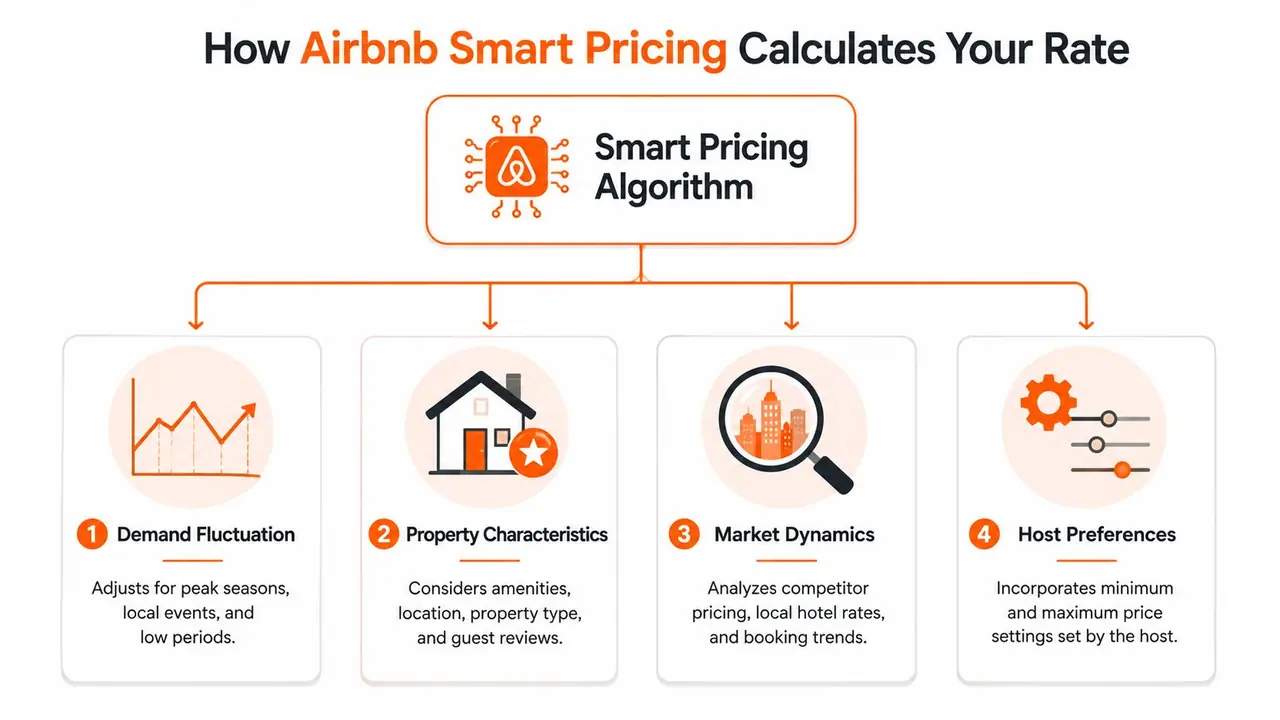
Airbnb's public explanation points to a model driven by listing details, local area signals, and guest demand, and the broader system description shows a three-stage process that first predicts booking likelihood, then chooses a price, then personalizes the recommendation Airbnb Smart Pricing Overview. The practical result is simple. Your nightly rate isn't coming from one rule. It's coming from a stack of signals the system thinks are connected to conversion.
The inputs the model is trying to read
Think of the algorithm as reading four broad categories at once.
- Demand fluctuation. Busy weekends, quiet weekdays, seasonal swings, and local events can all change booking appetite.
- Property characteristics. The property type, amenities, location, and review profile shape how the listing competes.
- Market dynamics. Nearby comparable listings and broader booking behavior affect the recommended number.
- Host preferences. Your min and max bounds still matter, because they constrain how far the model can move.
That's why two similar listings can see different recommendations. A host with a tighter floor, a stronger review profile, or a different calendar pattern will not get the same answer as a neighbor just because the zip code matches.
Why the model is not live in the way many hosts assume
The serving stack is designed for scale, not constant live recalculation. One system-design write-up describes an event-driven microservices architecture with pricing calculations produced through a data pipeline and served from cache, while another case study says Smart Pricing is updated through daily batch retraining and overnight recommendations Airbnb pricing system design. That means the model is built to reprice periodically, not on every minute-by-minute market move.
For a host, that has a direct consequence. If a concert is announced, or a competitor drops rates midday, Smart Pricing may not fully react until the next batch run. If your calendar, availability, or minimum-stay rules are wrong when that batch runs, the recommendation can miss the mark.
To see how revenue logic compares across pricing systems, a helpful cross-reference is dynamic hotel pricing, since the same supply-and-demand logic shows up in hospitality more broadly.
The Real Benefits and Limitations for Hosts
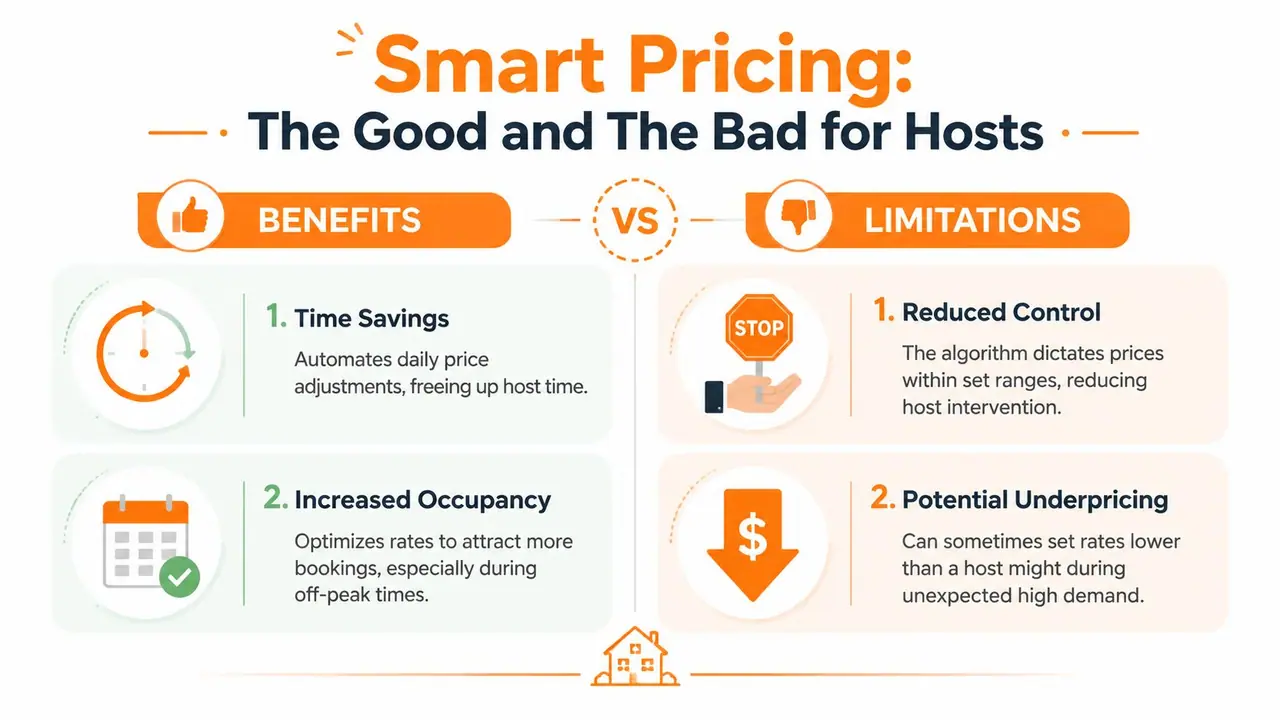
The biggest appeal of Smart Pricing is that it removes a lot of day-to-day guesswork. Instead of manually checking every weekday, weekend, and shoulder season date, the host lets the system do the first pass. That creates time savings, but the more interesting benefit is that the tool can help a host stop overreacting to each booking gap.
Where it helps
A 2021 study reported that hosts who adopted Smart Pricing saw about a 9% increase in overall revenue Phys.org summary of the study. That same research found especially strong effects for Black hosts, with the tool helping close the racial revenue gap by 71%, and increasing nightly earnings by an average of $13.92 compared with $5.22 for white hosts Phys.org summary of the study. Those are important signals because they show Smart Pricing can affect more than occupancy. It can change competitive outcomes across host groups.
The Carnegie Mellon web appendix also analyzed 9,396 properties, found 2,118 adopters, and reported a positive and significant effect on daily revenue in the matched sample Airbnb Smart Pricing Help Center. In practical terms, the feature can lift performance even when the nightly rate itself moves down.
Where it can frustrate hosts
The trade-off is control. The system can recommend a rate that feels too soft on a busy date, especially when it doesn't fully price in a local surge fast enough. Hosts also lose some granular decision-making, because the algorithm is designed to optimize the full pattern of rates, not your individual preferences for every date.
There's also a market-wide concern. In crowded areas, automated repricing can create downward pressure if everyone leans on the same logic. That's why Smart Pricing should be treated as a guided tool, not a pass to ignore your market.
Bottom line: Smart Pricing can improve revenue, but only if your floor is realistic and your expectations are aligned with what the model is actually optimizing.
Setting Up and Configuring Smart Pricing Correctly
The setup itself is straightforward. The strategy behind the setup is where hosts usually get it wrong. The first step is to switch the feature on in Airbnb's hosting settings, then define the ranges the model is allowed to work within. Airbnb confirms that hosts can set both minimum and maximum price bounds Airbnb Help Center.
Set the floor before you chase occupancy
The minimum price is not a formality. It's your protection against letting the algorithm fill nights that don't make sense for your business. If the floor is too low, you'll get bookings that look productive but don't support the property's economics.
A good rule is to treat the floor as a firm minimum. If you're tempted to lower it “just to keep the calendar moving,” you're really asking the system to solve a margin problem it can't solve for you.
Use the ceiling as a real ceiling
A maximum price that's absurdly high doesn't help much. The system can only use the space you give it, so the ceiling should still reflect the kind of rate you'd accept on your best dates. If the range is too wide, you may get recommendations that are hard to trust. If the range is too tight, you trap the tool and prevent it from responding to stronger demand.
Make the listing data clean before the overnight run
Smart Pricing models are typically updated through daily batch retraining, not real-time changes, so your calendar and stay rules need to be correct well in advance Airbnb pricing system design. Last-minute edits may not appear in the recommendation until the next batch job runs.
A practical setup sequence looks like this:
- Confirm availability. Closed dates, blocked dates, and open dates should all be current.
- Check minimum-stay rules. If they're wrong, the model may price against a false booking pattern.
- Set a defensible floor. Base it on what the listing can sustain.
- Choose a ceiling you'd stand behind. Don't make it theoretical.
If you manage more than one listing, the short-term rental app workflow can help you think about how pricing, guest info, and operations fit into one system instead of being handled separately.
Advanced Strategies to Optimize Performance
Smart Pricing gets better when the host manages the inputs around it. If the calendar is stale, the minimum-stay rules are off, or the listing description doesn't match the property anymore, the model is working from bad signals. That's how hosts end up blaming the tool for problems created upstream.
Override the algorithm with intent, not emotion
The strongest use case for manual override is a known event that matters to your local market. A major festival, a conference that fills nearby hotels, or a citywide sports weekend can justify stepping in when you already know demand will behave differently. The point isn't to outguess the model every day. It's to recognize the few dates where your local knowledge is sharper than a batch-updated system.
Another useful rule is to review your pricing whenever something material changes in the listing itself. A better amenity set, a refreshed photo set, or a newly improved guest review profile can justify a different pricing posture. If the model is still pricing you like the old version of the property, you're underusing your own upgrades.
Manage the manager, not just the listing
The best hosts don't obsess over every recommendation. They audit patterns. If the tool keeps pulling too low on high-intent dates, widen the ceiling only where it makes sense. If it's too conservative on quieter weekdays, adjust the floor rather than abandoning automation altogether.
Practical rule: use manual overrides for exceptional dates, and use configuration changes for repeated patterns.
The broader revenue-management mindset matters here. Vacation rental revenue management is not just about setting a rate. It's about making sure your pricing logic, availability, and guest demand signals all point in the same direction.
A host who keeps the system fed with accurate data can usually trust it more. A host who leaves stale calendars, inconsistent stay rules, or outdated listing details in place should expect weaker output. Smart Pricing is automated, but it's not indifferent to bad inputs.
Alternatives and Complementary Pricing Tools
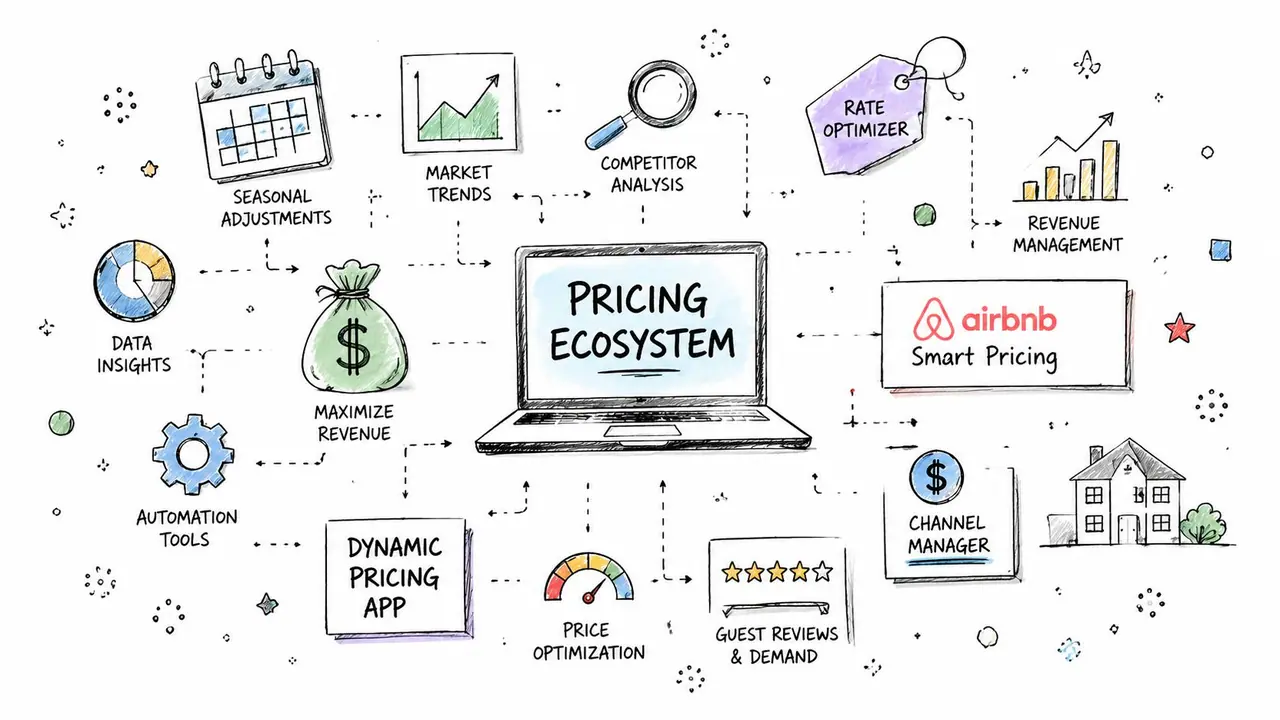
Airbnb Smart Pricing is convenient because it lives inside the platform you already use. That convenience is its strength, and also its main limitation. Third-party tools like PriceLabs, Wheelhouse, and Beyond are built for hosts who want deeper customization, broader market context, and more control over rule sets.
The trade-off is straightforward. Airbnb's built-in option keeps things simple. External tools usually give you more knobs to turn, but they also add another system to maintain. If you run a multi-property operation, that extra control can be worth it. If you manage one or two listings and want a lighter workflow, Smart Pricing may be enough.
A useful lens is cost structure. If you're evaluating whether the more hands-on approach is worth the monthly cost, it helps to understand understanding cost plus pricing first, because it clarifies how price floors and margin assumptions shape every pricing decision.
For hosts who want cleaner guest communication to match their pricing operations, this short-term rental app perspective also shows how the operational stack matters, not just the rate engine. Pricing, guest messaging, and on-site information work better when they're coordinated.
Frequently Asked Questions About Smart Pricing
How often do the prices update
Smart Pricing is typically updated through daily batch retraining, not in real time Airbnb pricing system design. That means changes in the market can take time to show up in recommendations.
Can I use it for only certain dates
Yes, hosts can keep control through minimum and maximum bounds, and they can apply judgment to specific dates rather than treating every night the same Airbnb Help Center. Many hosts use the tool for baseline automation and override obvious exceptions.
Does Smart Pricing affect search ranking
Airbnb publicly describes Smart Pricing as a pricing feature, not as a ranking feature Airbnb Help Center. The safer assumption is that it affects booking behavior through price and availability, not by acting as a separate visibility lever.
Is it better than third-party tools for a portfolio
For a small portfolio, the built-in simplicity can be enough. For a larger portfolio, third-party tools often win on customization and cross-listing control, while Smart Pricing wins on convenience and lower operational overhead. The right choice depends on whether you want fewer decisions or more precision.
If you're trying to make Airbnb pricing easier without losing control, ScanStay helps you clean up the guest-side operations that sit around every booking. Visit ScanStay to see how a digital welcome book can reduce repetitive questions, improve guest clarity, and give you a smoother hospitality workflow alongside smarter pricing decisions.