What Is a Rental Management Company & Do You Need One?
Explore what a rental management company does, its fees, and how it compares to self-management. A complete guide for short-term rental owners in 2026.
Your rental looked simple when it was one listing. A cleaner, a smart lock, a few guest messages, and some calendar juggling. Then bookings picked up. Now your phone lights up at night with lockout questions, the cleaner texts because a guest left late, a faucet starts leaking on turnover day, and you're still supposed to update pricing before the weekend rush.
That's usually the moment owners start asking about a rental management company.
Not because the property is failing. Usually it's the opposite. The place is doing well enough that the owner has accidentally built themselves a job. A profitable one, maybe. But still a job.
I've seen the same pattern over and over. Owners start with control, pride, and a plan to keep more of the income by handling everything themselves. Then the workload shows up. Guest communication isn't hard until it becomes constant. Maintenance isn't a problem until it happens during a same-day turnover. Pricing feels manageable until local demand shifts and your stale nightly rate leaves money on the table.
A rental management company can solve that. It can also create new costs, reduce your control, and lock you into a service model that may or may not fit how you run your property. The right answer depends less on whether management is “good” and more on whether the math, the workload, and your tolerance for chaos still line up.
Table of Contents
- Introduction From Thriving Host to Burnt-Out Operator
- What a Rental Management Company Actually Does
- Decoding Fee Structures and Hidden Costs
- Full Service vs Self Management A Head-to-Head Comparison
- Calculating Your Potential ROI with a Manager
- How to Vet and Choose the Right Provider
- The Hybrid Approach Enhancing Management with Digital Tools
Introduction From Thriving Host to Burnt-Out Operator
The shift from “host” to “operator” is a subtle one.
At first, you answer every guest message yourself because it feels smart. You know the property better than anyone. You know which breaker trips, which parking spot works best for large SUVs, and which restaurant is still good after a management change. Guests like the personal touch, reviews stay strong, and the listing grows.
Then volume changes the equation.
One unit becomes two. Or one high-performing vacation home starts producing enough stays that turnovers blur together. Your evening gets split between platform messages, cleaner coordination, supply runs, and checking whether the handyman fixed what he said he fixed. The business still makes money, but your time disappears.
Practical rule: If your rental income depends on your constant availability, you don't own a passive investment. You own an operating role.
That's where many owners start looking at a rental management company. They want relief, but they also worry about what they'll give up. The concern is valid. Some companies are excellent at guest handling and weak on owner communication. Some are strong with systems but poor with property-level details. Others promise “full service” and then outsource half the work to vendors you could have hired yourself.
A lot of frustration comes from expecting a manager to be magic. They're not. They're a service layer. They replace your labor with a system, a team, and a process. If that system is tighter than yours, you gain time and often improve performance. If it's sloppy, you'll pay for the privilege of being annoyed.
The right question isn't just “Do I need help?” It's “Which parts of this business should I keep, which parts should I delegate, and what return do I need from that decision?”
What a Rental Management Company Actually Does
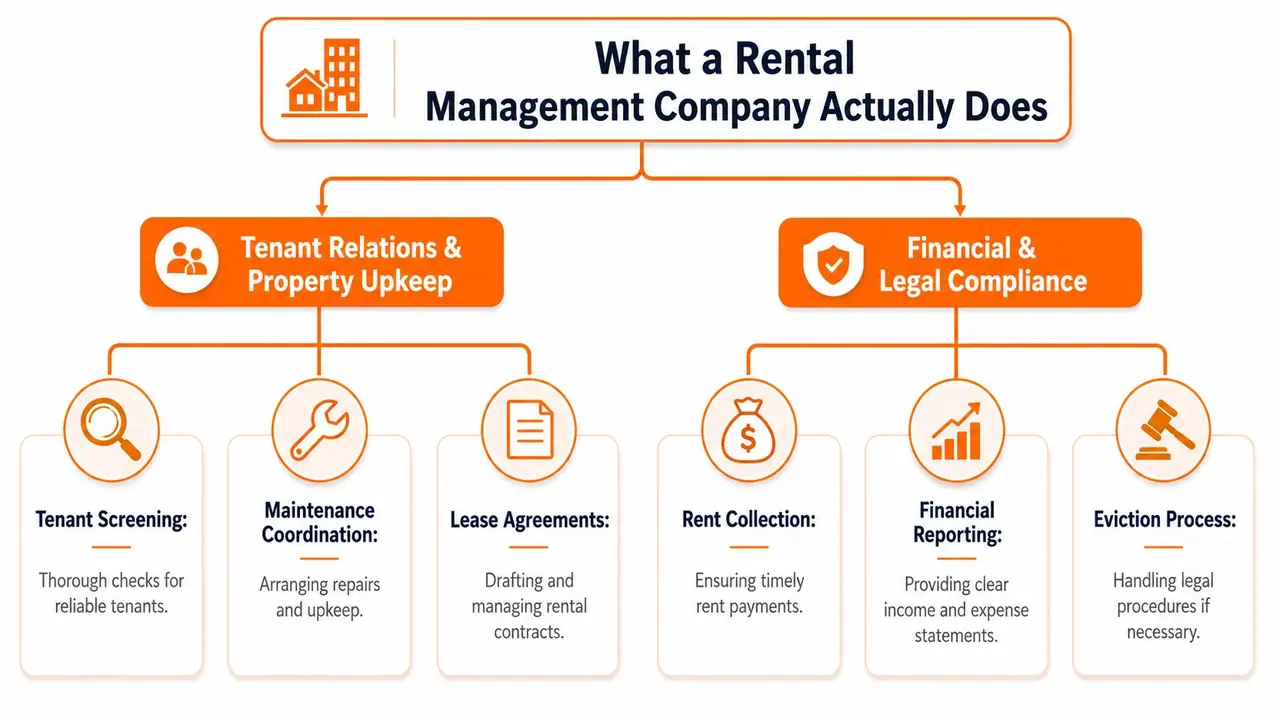
A good rental management company works like a restaurant. Guests only see the front of house. Reservations, communication, arrival, and problem-solving. But the operation only runs because the back of house stays tight. Staffing, maintenance, compliance, and reporting.
That split is the clearest way to understand what you're paying for.
Front of house work
This is the work owners notice first because it never stops.
A manager usually handles listing setup and distribution across booking channels, keeps calendars synced, responds to inquiries, confirms bookings, sends check-in instructions, manages stay issues, and deals with reviews after checkout. If you've ever answered the same Wi-Fi question ten times in one month, you already know why this matters.
The strongest operators also manage pricing actively. They don't just set a rate and leave it alone. They adjust for demand, seasonality, local events, minimum stays, and pacing. That matters because occupancy isn't just a vanity metric. Avantio's property management metrics guide notes that occupancy rate is a core performance measure, that major markets often target more than 90% occupancy, and that a 1% increase in occupancy can lift total revenue by 2% to 3%.
Guest-facing work also includes expectation management. That means tighter house rules, clearer arrival instructions, and faster answers before small annoyances become bad reviews.
Back of house work
In such scenarios, competent management earns its keep.
Back-of-house work includes scheduling cleaners, inspecting turns, restocking supplies, dispatching maintenance vendors, tracking invoices, documenting damage, handling owner statements, and staying on top of legal and operational requirements. For long-term or mixed-use operators, it also includes lease handling, rent collection, and when needed, eviction procedures.
Maintenance deserves special attention because owners often underestimate how much performance runs through it. Stowers Real Estate highlights average response time to maintenance requests as a critical benchmark. A response time over 24 hours raises the risk of lease termination, while response times under 4 hours are associated with a 15% higher lease renewal rate and an 8% to 12% improvement in NOI. They also note managers should track this over a three-month period to establish a useful baseline.
That's one reason I tell owners to look beyond guest messaging and ask hard questions about vendor control. A manager who can't coordinate repairs quickly will undercut the value of everything else.
For owners who still self-manage part of the operation, a solid resource on proactive property maintenance for landlords can help reduce the preventable issues that tend to blow up during turnovers.
If your portfolio leans more heavily into short-term stays, this guide to vacation property management gives a useful broader view of the operating model.
Good management isn't one task done well. It's a chain of small tasks done reliably, with no weak link visible to the guest.
Decoding Fee Structures and Hidden Costs
Most owners focus on the advertised management fee. Fair enough. It's the easiest number to compare. It's also the fastest way to misunderstand what a contract will cost you.
The U.S. property management industry is large enough that you'll find every kind of service model, from lean coordination shops to fully staffed operators. AmeriSave's industry overview says the industry generated about $119.1 billion in revenue in 2024 and is supported by more than 304,000 active businesses, which is exactly why owners need to vet pricing closely rather than assuming all “management” means the same thing.
The three common pricing models
Here's how most rental management company agreements are structured in practice:
| Model | How it works | Best fit | Risk |
|---|---|---|---|
| Commission based | Manager takes a share of booking or rental revenue | Owners who want aligned incentives | Cheap on paper can become expensive if extra fees pile on |
| Flat fee | Fixed monthly amount regardless of performance | Stable properties with predictable workload | Manager may have less incentive to optimize aggressively |
| Hybrid | Lower base fee plus add-on charges or performance components | Owners wanting some flexibility | Harder to compare across providers |
Commission pricing is popular because it feels simple. If revenue drops, the fee drops. The trade-off is that “simple” often only applies to the first line of the proposal.
Flat-fee arrangements can work well when the property is stable, the owner wants predictable budgeting, and the service scope is tightly defined. Hybrid setups can be fair, but only if the contract spells out exactly what triggers extra charges.
Where owners get surprised
The actual cost often sits in the small print.
Look for these pressure points before you sign:
- Onboarding charges that cover setup, photography, listing creation, or lock and inventory installation.
- Maintenance markups where the manager adds margin on vendor invoices or in-house repair calls.
- Supply pass-throughs for linens, consumables, welcome items, or restocking runs.
- Owner-use fees if you block time for personal stays and still want pre-arrival prep or post-stay cleaning.
- Channel or software charges tied to third-party tools, smart devices, or booking platform workflows.
- Vacancy or leasing fees in longer-term arrangements when a unit turns over.
A useful way to pressure-test any proposal is to compare it against a public-facing pricing example like Hen Hideaways pricing details, not because every market should match it, but because seeing how another operator spells out fees helps you spot what your own agreement may be hiding.
If a manager can explain their fee in one sentence but can't explain their invoice in one page, expect friction later.
The cleanest contracts define what's included, who approves repairs, whether markups apply, and how either side can end the relationship. If those points are vague, the “management fee” is only the opening bid.
Full Service vs Self Management A Head-to-Head Comparison
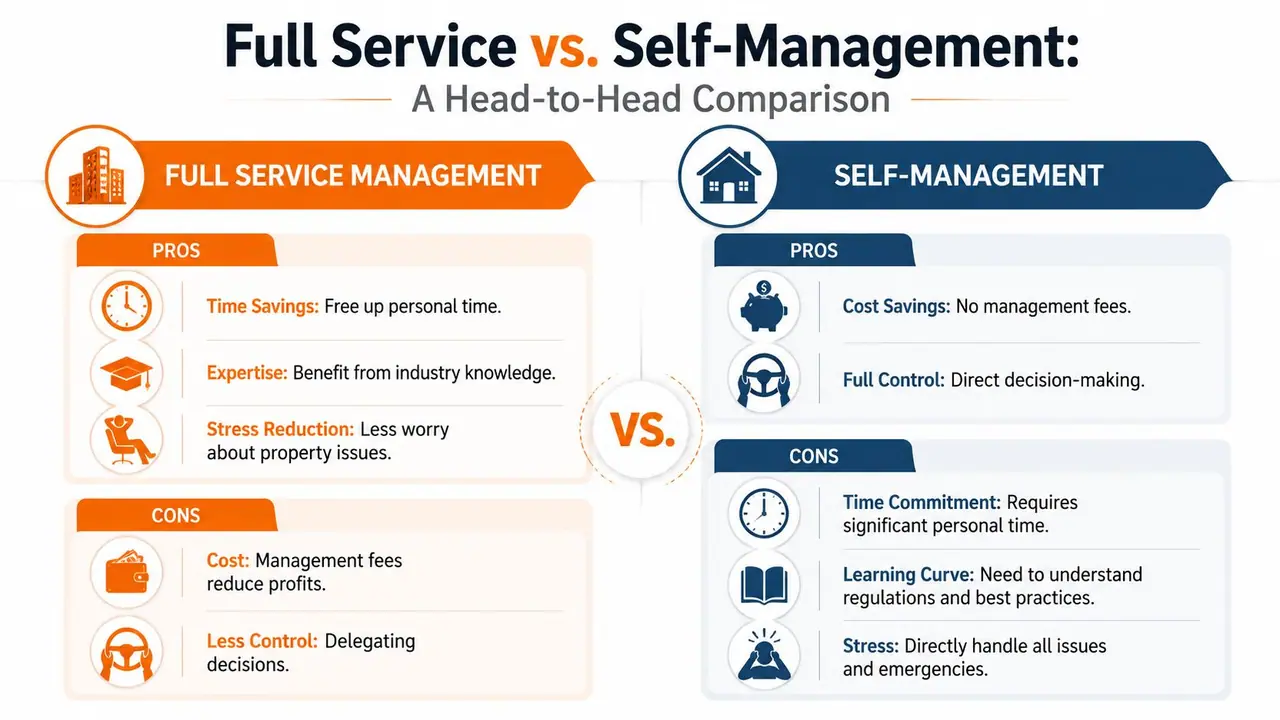
This decision usually gets framed the wrong way. People compare “paying a manager” with “saving the fee.” That's too narrow. You're really comparing two operating models.
One model buys time and process. The other keeps control and asks for your labor.
Where full service wins
Full-service management usually wins when the owner is constrained by time, distance, or portfolio size.
If you live far from the property, run multiple units, or have a demanding primary job, operational consistency matters more than theoretical savings. A manager gives you coverage when guests arrive late, a cleaner cancels, or a maintenance issue shows up right before check-in. You're paying for availability, local coordination, and a team that can absorb interruptions without wrecking your day.
It also helps when your current system depends too heavily on you. Some owners say they're self-managing, but what they've built is a patchwork of texts, reminders, and personal memory. That works until it doesn't.
Where self-management still makes sense
Self-management still makes sense when three conditions are true.
First, you want direct control over pricing, guest standards, and property decisions. Second, you have time to run the operation well. Third, the property is close enough that solving problems doesn't turn into a logistical mess.
Self-management often produces the best results for owners who enjoy hospitality, know their local market, and have already built reliable cleaner and vendor relationships. Those owners aren't just avoiding a fee. They're replacing a company with their own discipline.
Here's the practical comparison:
- Financial cost: Self-management avoids management fees, but your time isn't free. Full service costs more in direct dollars, yet can protect revenue when the operator is stronger than the owner.
- Time burden: Self-management keeps you on call. Full service offloads the interruptions.
- Control: Owners keep every decision under self-management. With a rental management company, control shifts to systems, approvals, and service standards.
- Scalability: One or two units can be manageable solo. Beyond that, cracks usually appear in communication, maintenance, and consistency.
The cheapest model on paper is often the one that quietly consumes your nights and weekends.
A useful gut check is this: if you took a week off with your phone off, would the property run smoothly? If the answer is no, you're not comparing management against “nothing.” You're comparing management against your personal availability.
Neither choice is morally better. Some owners want control and don't mind the work. Others want the asset without the daily noise. Trouble starts when owners choose the wrong model for their actual lifestyle, then act surprised when the business pushes back.
Calculating Your Potential ROI with a Manager
A manager earns their keep in small gains that stack up.
For one owner, that might mean pushing weekends and shoulder nights harder with better pricing. For another, it means fewer refund requests, faster maintenance response, and fewer hours spent answering guest messages at 10:30 p.m. ROI is rarely one dramatic jump. It is usually a mix of revenue lift, fewer operational leaks, and time you get back.
Start with your current numbers, not a manager's sales pitch. Pull the last 12 months and look at occupancy, average nightly or monthly revenue, cleaning and turnover costs, maintenance spend, refund or chargeback issues, and how much owner time the property currently consumes. If you do not know your baseline, you cannot judge whether a 20% management fee is expensive or fair.

A simple condo scenario
Take an urban condo that is already doing decent numbers. The question is not whether the unit can produce income. The question is whether a manager can improve the operation enough to cover their fee and still leave you ahead.
Use a simple three-part test:
- Check occupancy against your market. If the calendar has too many empty nights, there may be room for better pricing, listing quality, or faster inquiry response.
- Check revenue quality, not just booked nights. A full calendar at weak rates can still mean you are underperforming.
- Check operational leakage. Late replies, poor turnover coordination, missed upsells, and slow repairs all chip away at profit.
A manager does not need miracles to justify their fee. A modest lift in booked nights or average rate can be enough if your current operation is leaving money on the table.
If you want a broader owner-side lens before running your numbers, this breakdown of whether Airbnbs are profitable is a useful companion read.
Here is a practical example. Say a condo brings in $60,000 a year gross under self-management. A manager charges 20%, so the fee is $12,000. At first glance, that looks hard to swallow. But if stronger pricing, better calendar management, and tighter guest communication push gross revenue to $72,000 while also reducing refunds and owner workload, the math changes fast. You are paying more, but you may still come out ahead in net income and gain your time back.
The reverse is also true. If your unit is already priced well, reviews are strong, and your systems are tight, the manager may only add a little revenue. In that case, the fee can eat most of the upside. Good owners need to be honest here. Some properties need management. Some are already being run well enough that full service is hard to justify.
A seasonal home scenario
Seasonal homes are a different animal. Peak months can hide a weak operation because demand is doing the heavy lifting.
A beach house or ski cabin often loses money in quieter periods through lazy pricing, rigid minimum stays, slow inquiry follow-up, and preventable maintenance issues. That is where management can show a real return. Not by filling every date, but by improving the shape of the year.
Look at questions like these. Are shoulder-season weekends sitting open too long? Are shorter stays being rejected when they would still be profitable? Are guest questions turning into bookings, or drifting away because replies are slow? Is maintenance being handled early, or after it turns into a bad review and a blocked calendar?
That is also where the hybrid model deserves a hard look. Some owners do not need a full-service company to fix every weakness. They need better systems. A digital welcome book, automated check-in instructions, cleaner guest messaging, and stronger house information can reduce repetitive questions and improve the stay without handing over the whole operation. That third option often works well for owners who want to keep control but stop carrying every task themselves.
This video gives a useful lens on how operators think about growth and cost control in practice.
The core question is simple. Will the added revenue, reduced leakage, and lower time burden exceed the fee and the control you give up?
Use this quick test:
| Question | If yes | If no |
|---|---|---|
| Can better occupancy materially improve revenue? | A manager may have room to earn the fee | Revenue upside may be limited |
| Are maintenance issues handled quickly and consistently now? | Your current system may already be strong | A manager can reduce leakage |
| Is your time better spent elsewhere? | Delegation has real value | Self-management may still be efficient |
Treat management as a margin decision, not just an expense line. If the operator improves pricing, occupancy, guest experience, and issue handling, the fee can be worth paying. If they are only replacing tasks you already handle well, it is overhead.
How to Vet and Choose the Right Provider
Most owners interview managers backwards. They start by asking, “What do you charge?” The better first question is, “How do you run the property day to day?”
A rental management company can look polished in a pitch and still fail in execution. You're not hiring a brochure. You're hiring a system.
What to review before the first call
Do your own homework first.
Check their live listings. Look at photo quality, headline clarity, review patterns, calendar quality, and whether the properties feel consistently presented or randomly assembled. A manager's portfolio tells you more than their sales deck.
Then read guest reviews and owner reviews separately if you can find both. Guests will reveal communication speed, cleanliness consistency, and whether check-in runs smoothly. Owners will reveal billing issues, responsiveness, and whether problems get hidden or handled.
Use this short pre-call checklist:
- Review current listings: Are the photos sharp, the copy specific, and the amenities clearly explained?
- Scan recent reviews: Look for recurring praise or recurring complaints. Patterns matter more than one angry guest.
- Check market fit: A company that excels with urban condos may not be great with large remote vacation homes.
- Look for operating maturity: Do they seem process-driven, or are they just good at selling?
Questions that reveal how they really operate
Once you're on the call, skip generic questions and push into workflow.
Ask how they handle same-day maintenance issues before check-in. Ask who approves repairs and at what threshold the owner gets involved. Ask whether they use in-house cleaners, preferred vendors, or open-market contractors. Ask how owner statements are delivered and what detail is included.
Then ask about failure points. Good operators answer these calmly because they've lived them.
A few questions I'd always use:
- What happens when a guest reports a problem after hours?
- How do you verify cleaner quality before a same-day arrival?
- What kinds of repairs require owner approval?
- How is pricing adjusted during weak demand periods?
- What are the exact termination terms if the fit isn't right?
Don't judge a manager by the promise of “full service.” Judge them by the clarity of their exceptions.
The best providers answer with specifics. They name tools, response expectations, approval flows, and backup plans. Weak providers hide behind phrases like “we take care of everything.” That usually means you won't know how things work until something goes wrong.
Contract exit terms matter more than owners think. If a company underperforms, you need a clean path out, control over listing assets, and no confusion about photos, reviews, guest data, or vendor handoff. If they get slippery on that topic, keep looking.
The Hybrid Approach Enhancing Management with Digital Tools
There's a third option between doing everything yourself and handing the whole operation to a rental management company. For many owners, it's the most practical path.
Keep the decisions that benefit from owner control. Automate or systematize the repetitive parts that drain time.

Where the middle path works best
The hybrid approach works well for owners who don't mind steering the business but are tired of answering the same questions every week. Check-in instructions, parking details, Wi-Fi, trash day, appliance quirks, local recommendations, and checkout steps don't need a custom message every time.
That's where digital guest tools earn their place. They reduce repetitive communication, standardize information delivery, and help co-hosts, cleaners, and guest-facing staff work from the same source of truth. For owners who want a leaner operation without going fully hands-off, that's often enough to remove the worst friction.
If you're exploring software-first ways to reduce management burden, this guide to affordable property management software is a useful place to compare the role of tools versus outsourced service.
Why guest information can also drive revenue
This is the part many managers still miss.
Guest questions aren't just support volume. They're buying signals. A guest asking about late checkout, local experiences, airport transfers, equipment rental, or mid-stay cleaning is telling you what they may pay for if the offer is easy to access.
FirstService Residential's article points to that missed opportunity. It notes that 73% of short-term rental guests are willing to purchase local experiences if access is effortless, and that 68% of hosts now prioritize self-check-in systems. That combination matters because contactless delivery and ancillary revenue fit together naturally.
A good hybrid system doesn't just reduce messages. It turns routine guest intent into a cleaner, more scalable experience.
That's the true middle path. Not more hustle. Better packaging of information, faster delivery of routine answers, and a clearer way to offer extras without adding another layer of manual work.
If you want to keep control of your rental without staying glued to guest messages, ScanStay gives you a practical way to do it. You can replace repetitive check-in texts and paper binders with a single QR-based digital guide, keep property information organized across stays, and present upsells like late checkout or local add-ons in a cleaner format. For owners trying to scale without jumping straight to full-service management, it's a strong operational middle ground.