Quiet Hours Policy: A Host's Guide to Peaceful Stays
Create a quiet hours policy that actually works for your short-term rental. Includes sample wording, guest messaging, and 2026 enforcement best practices.
At 1:40 a.m., a neighbor texts that guests are shouting on the back patio. You message the reservation, check the outdoor camera, and wait for a reply while the complaint grows. By morning, the guest is asking the booking platform for a partial refund, and you're left explaining why the house rules supposedly covered the problem.
That situation is preventable more often than hosts think. A useful quiet hours policy does more than ask guests to be considerate. It sets a clear operating window, defines the spaces and behavior covered, gives your team a response path, and creates a record when someone ignores the rule. It also belongs beside the rest of the guest experience, from check-in instructions to the small details covered in these Avistar guest satisfaction tips.
Table of Contents
- Why Quiet Hours Matter More Than Most Hosts Realize
- Defining Your Quiet Hours Window and Scope
- Sample Quiet Hours Policy Wording You Can Adapt
- Messaging Templates Across the Guest Journey
- An Enforcement Ladder That Actually Holds Up
- Connecting Quiet Hours to Your Full House Rules
- Your Quiet Hours Checklist for This Week
Why Quiet Hours Matter More Than Most Hosts Realize
Noise incidents create three problems at once. First, the neighbor relationship deteriorates quickly, especially where homes, condominiums, and vacation rentals sit close together. A neighbor who receives no response may stop contacting you directly and move straight to a property manager, city office, homeowners association, or platform complaint channel.
Second, noise can affect the guest experience and your reviews. Guests may complain about street sound, parties nearby, or an uncomfortable confrontation, while neighbors may describe your property as disruptive. A host who treats every incident as an isolated message loses the opportunity to identify repeated patterns.
Third, local governments increasingly treat short-term rental noise as an operational issue. A 2026 compilation of open-government complaint data across six U.S. cities identified 23,465 short-term rental complaints from 2015 through mid-2026, demonstrating that nuisance reporting is a persistent concern rather than an occasional edge case (complaint data compilation). Dallas separately reported 3,621 chronic noise complaints in a short-term rental impact analysis covering March 2021 to March 2022 (Dallas complaint analysis reference). Because the same source URL should appear only once, the figures are cited together here.
Practical rule: Treat quiet hours as a control system, not a courtesy sentence.
The host's real objective isn't to write stern language. It's to stop a late-night issue before the neighbor reaches for their phone. That requires a visible rule, repeated at sensible points in the guest journey, plus an escalation ladder that tells you exactly what to do when the first message doesn't work.
Defining Your Quiet Hours Window and Scope
Start with the local rule, not your preferred checkout-book wording. Published guidance commonly places quiet hours around 10:00 p.m. to 7:00 a.m. or 9:00 a.m., although local ordinances can be stricter. Santa Rosa, California, uses a 9:00 p.m. to 8:00 a.m. window, while Escondido, California, uses 10:00 p.m. to 7:00 a.m. (quiet hours guidance for vacation rentals). Your house rule must never promise guests more permissive hours than the municipal code allows.
Then make four drafting decisions:
Set the time window. State the start and end time, including whether weekends differ from weekdays. Avoid “late at night” or “after dinner.” Guests can follow a clock; they can't enforce a mood.
Separate indoor and outdoor areas. Patios, balconies, pool decks, hot tubs, and backyards carry sound toward neighbors. You may allow normal indoor conversation later while ending outdoor gatherings earlier. If the local rule provides a decibel limit, include the applicable limit and measurement location. One municipal example specifies a 63 dB limit for residential-zoned property when measured from adjacent property (municipal noise rule).
Name the covered conduct. Include amplified music, speakers, shouting, parties, moving furniture, and repeated door slamming. “No excessive noise” leaves too much room for disagreement.
Record legitimate exceptions. Infant care, medical needs, shift work, or an approved small gathering may require specific instructions. An exception should change how you communicate, not erase the policy.
A rule that says “quiet hours apply everywhere” may be easy to copy, but it's harder to apply fairly. Define the spaces, the conduct, and the response before the first reservation arrives.
Sample Quiet Hours Policy Wording You Can Adapt
Use these drafts as starting points, then replace the times and legal references with the rules that apply to your property.
Urban condo
Quiet hours are 10:00 p.m. to 7:00 a.m. indoors and 9:00 p.m. to 7:00 a.m. outdoors. During these hours, keep voices low, close doors gently, and don't use amplified music. This includes televisions played through open windows and Bluetooth speakers on balconies or patios. All guests must follow the local noise ordinance and building rules.
The indoor and outdoor distinction gives guests a practical instruction instead of a broad warning. Naming Bluetooth speakers matters because guests may not consider a small portable device “amplified music.”
Suburban home
Quiet hours are 10:00 p.m. to 7:00 a.m. Please keep conversations and television at a level that can't be heard outside the home. The pool, hot tub, patio, and backyard close at 9:00 p.m. No parties, amplified music, shouting, or outdoor gatherings are permitted after that time.
This version protects the spaces most likely to transmit sound. If the property has a nearby neighbor or shared fence, keep the outdoor cutoff aligned with the stricter local requirement.
Rural or event-friendly property
Guests may use the home for approved gatherings during the permitted stay hours, provided occupancy and event conditions are followed. Quiet hours begin at 11:00 p.m. Outdoor music, shouting, and gatherings must stop at that time. After 11:00 p.m., keep all sound indoors and low enough that it isn't audible from neighboring properties. The local ordinance and written event approval always control.
This wording doesn't promise unlimited noise because the property is rural. It also links event permission to separate conditions rather than allowing guests to treat “event-friendly” as an exemption.
Short listing version
Quiet hours: [start time] to [end time]. Outdoor areas close at [time]. No parties, shouting, or amplified music during quiet hours. Please follow all local noise and building rules.
Short-form text belongs in the listing. The fuller version belongs in the booking thread and welcome book, with the applicable municipal citation added where relevant.
Messaging Templates Across the Guest Journey
Guests don't read every house rule at the same moment. They skim during booking, search for logistics before arrival, and pay attention to anything that affects access or comfort at check-in. Repeat the quiet hours policy without changing its meaning.
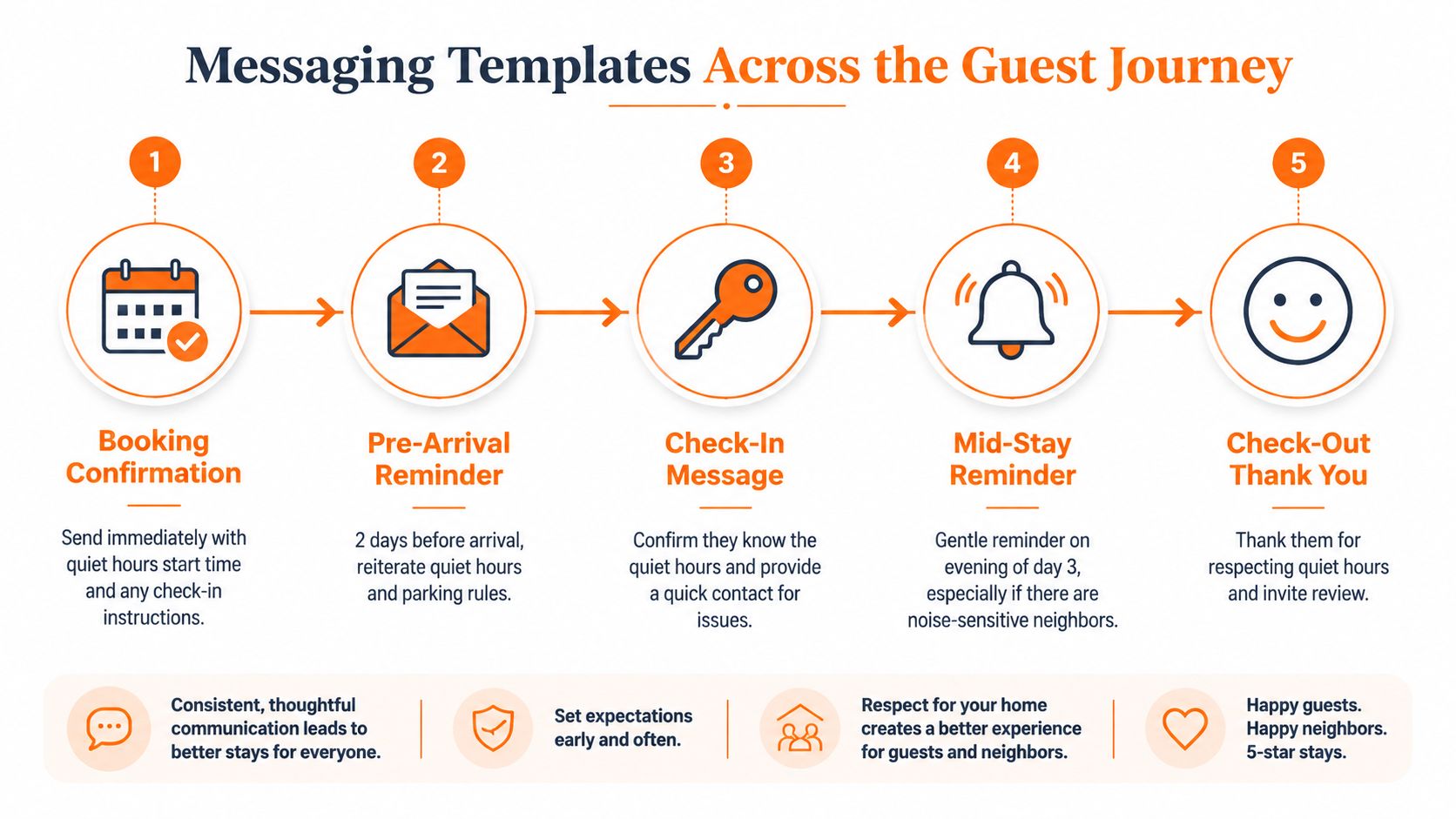
Use this sequence:
Booking confirmation, automated.
Subject: Your reservation details and house rules
“Thanks for booking [property]. Quiet hours are [time] to [time], and outdoor areas close at [time]. You'll find the full house rules in the digital welcome book here: [link].”Pre-arrival reminder, automated.
Subject: Your arrival information for [property]
“Before you travel, please review quiet hours, parking, occupancy limits, and check-in steps. The outdoor quiet window is [time] to [time], so please plan patio, pool, or hot tub use accordingly.”Check-in message, automated or personal.
Subject: You're checked in
“Welcome. The one rule we most need everyone to know tonight is quiet hours, [time] to [time]. If anything is unclear, reply here before settling in. The QR code at the entrance opens the welcome book on your phone.”Mid-stay nudge, automated when appropriate.
Subject: A quick evening reminder
“We hope you're enjoying the stay. A quick reminder that outdoor areas close at [time] and quiet hours begin at [time]. Thanks for helping us keep the property comfortable for nearby residents.”Check-out thank-you, automated.
Subject: Thank you for staying
“Thanks for respecting the house rules, including quiet hours. Safe travels, and please let us know if anything would improve your next visit.”
Airbnb and Vrbo messages should stay concise and platform-friendly. Direct-booking guests can receive the welcome-book link more prominently. Hosts looking for additional wording ideas can review these Airbnb message templates, then adapt the language to the actual property.
The commonly forgotten follow-up is the night-one reminder. Send it only when the reservation profile, group size, nearby residents, or property layout creates a clear risk. A calm reminder before the first evening is easier for guests to accept than a warning after a neighbor has complained.
An Enforcement Ladder That Actually Holds Up
A quiet hours policy fails when the host improvises every response. Use a ladder with a clear trigger, owner, time frame, and record.
First event
A co-host, automated system, or on-call host sends a calm message as soon as the issue is reported or detected:
“Hi [name]. We've received a noise report from the surrounding area. Quiet hours are now in effect. Please bring voices and music indoors, stop amplified sound, and confirm once this is handled.”
Record the time, source of the report, message sent, and guest response. Don't accuse the guest of intent, and don't promise the neighbor an outcome you can't deliver.
Written warning
If the sound continues, send a firmer message with the exact rule:
“This is a formal quiet-hours warning. The report concerns [conduct] at approximately [time]. Your reservation requires compliance with [quiet-hours window] and the property's no-party rule. Stop the activity now. Further reports may be escalated to the booking platform and could result in removal under the reservation terms.”
Attach permitted noise-monitoring records, time-stamped photos of outdoor activity where lawful, neighbor statements, and the message history. A monitor can support a timeline, but it shouldn't be presented as the only proof or used to record private conversations.
Platform escalation
Repeated conduct, refusal to respond, or a serious event warrants co-host or property-manager involvement. Report facts, not conclusions:
“At [time], we sent a quiet-hours instruction. At [time], the issue continued. The attached records show [specific evidence]. The guest has [responded or not responded]. We're requesting guidance under the reservation's house rules.”
A city ordinance may connect quiet hours with occupancy, event, parking, or revocation provisions, so hosts should understand the broader local framework. The South Lake Tahoe vacation rental ordinance reference is useful when comparing how a jurisdiction may structure those related controls.
Request to leave
Removal is the final step, not a threat used casually. Follow the platform's process, local law, lease or building requirements, and any emergency procedures. Keep the language precise:
“We're ending the stay because the documented conduct has continued after written instructions and a formal warning. The platform has been notified, and all further arrangements will follow its resolution process.”
If a dispute reaches Airbnb or Vrbo, “the guest was disrespectful” is weak evidence. “At [time], we sent [message]. At [time], the neighbor reported [conduct]. At [time], the guest acknowledged or failed to address it” is the defensible record.
Connecting Quiet Hours to Your Full House Rules
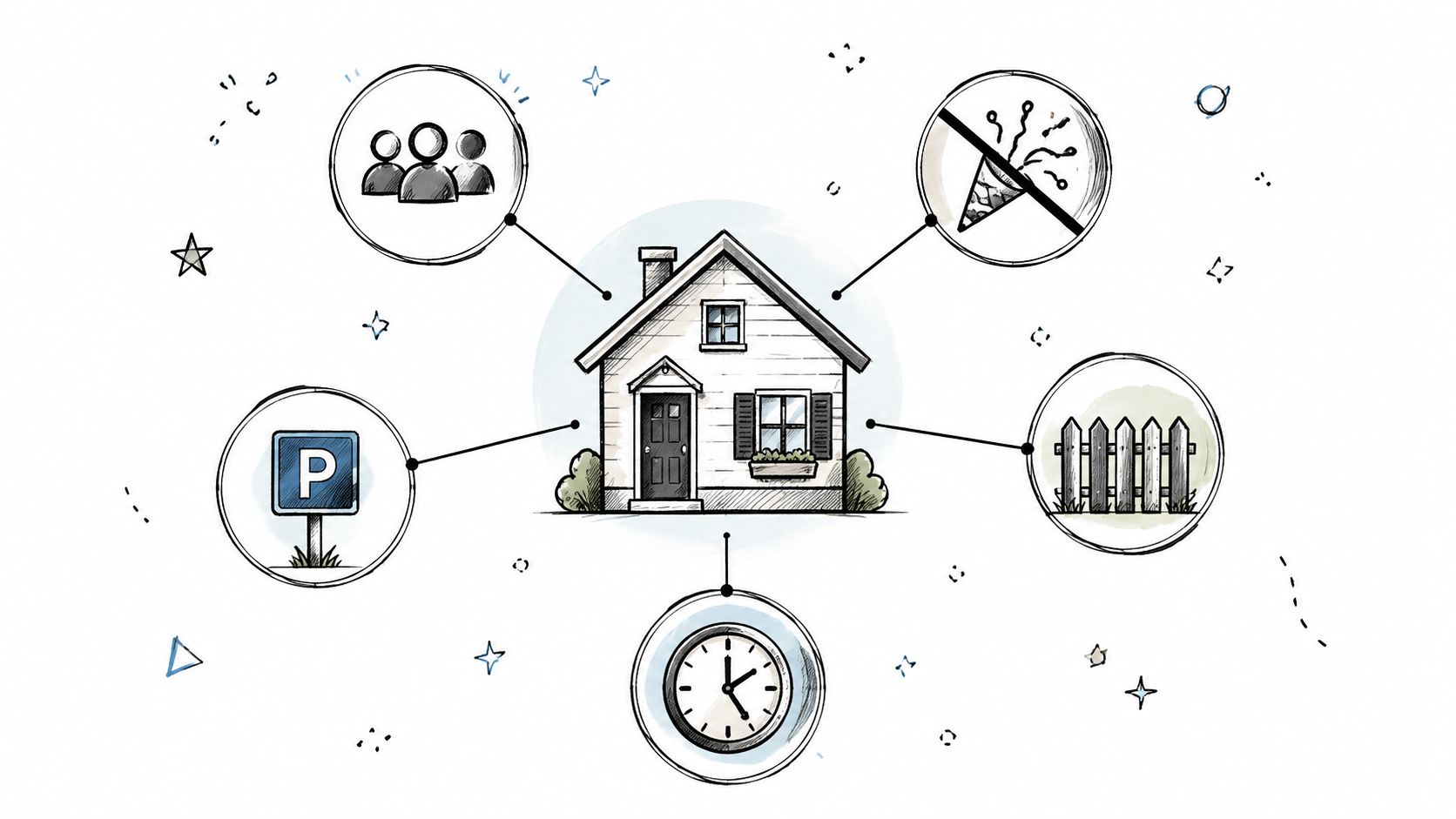
Noise rarely appears by itself. A crowded gathering may also breach occupancy limits, a party ban, parking conditions, and outdoor-space rules. If each rule lives in a different listing field, PDF, text message, and sign, guests may understand each item separately but miss the connection during an incident.
Build one rules bundle around the way a real problem unfolds:
- Occupancy: State who may stay and whether visitors require approval.
- Events: Define whether parties, celebrations, or commercial gatherings are prohibited.
- Outdoor areas: Give separate closing times for patios, pools, hot tubs, balconies, and yards.
- Parking: Explain where vehicles may wait, since late-night arrivals can create both noise and access complaints.
- Departure: Include checkout behavior such as quiet loading, door handling, and trash movement.
A QR-code welcome book gives guests one mobile destination for those rules, local courtesy guidance, check-in steps, and a reporting contact. Put the QR poster where guests enter, while keeping the short quiet-hours reminder in the booking thread so the policy isn't dependent on a physical sign.
Tools such as ScanStay can place quiet hours alongside Wi-Fi, check-in instructions, checkout steps, recommendations, and other house rules in a phone-accessible welcome book. That structure is more useful than scattering instructions across multiple documents because the host can revise the central content and direct every guest touchpoint to the same current version.
For broader guidance on organizing policies, compare these vacation rental house rules best practices with your local requirements. Hosts can also use these house rules samples as a drafting reference, but should still confirm every legal condition locally.
Your Quiet Hours Checklist for This Week
A quiet hours policy produces useful results only when its inputs are controlled. The inputs are the window, wording, messaging, monitoring, and response ownership. The outputs are fewer avoidable complaints, better neighbor communication, and clearer evidence when a guest disputes enforcement.
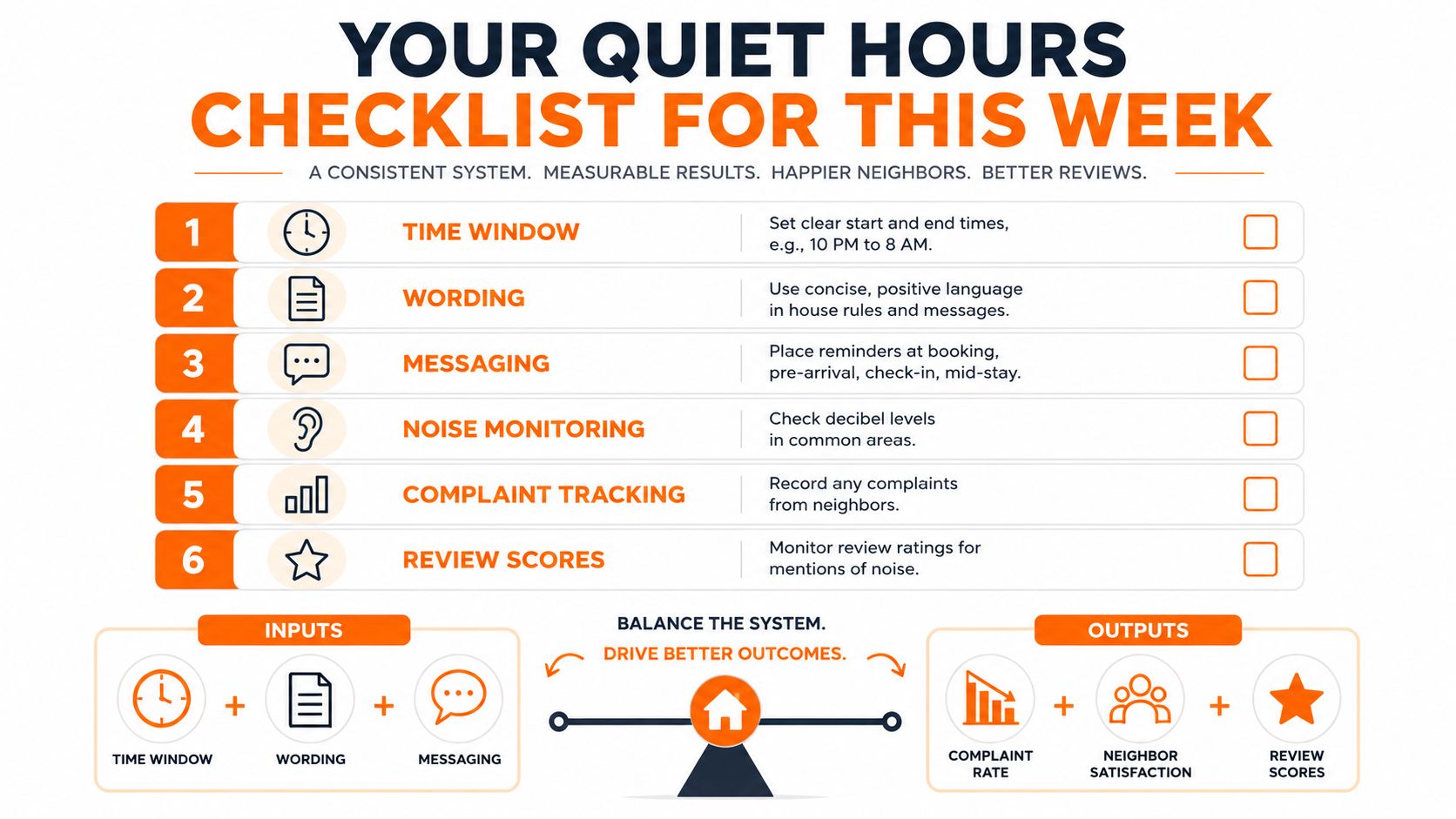
Complete these tasks this week:
- Confirm the ordinance: Check the city, county, building, and homeowners association rules before choosing your times.
- Write the policy: Define indoor and outdoor windows, prohibited conduct, exceptions, and consequences in plain language.
- Consolidate the rules: Put quiet hours beside occupancy, events, parking, outdoor spaces, and checkout instructions in the digital welcome book.
- Schedule the messages: Automate booking, pre-arrival, check-in, and suitable mid-stay reminders. Assign the night-one decision to a person.
- Verify monitoring: Confirm that any noise monitor is placed lawfully and configured to support level and timing checks without recording private conversations.
- Assign escalation: Name the first responder, backup responder, manager, and platform-contact owner.
- Log every incident: Record the report, timestamps, messages, evidence, response, and outcome in one property log.
Run the policy as a 90-day pilot. Compare neighbor complaints before and after the change, review mentions of noise, and note which spaces or times create the most friction. Adjust the wording or window based on those records, not instinct.
ScanStay gives hosts a QR-based digital welcome book for presenting quiet hours beside check-in details, occupancy limits, outdoor rules, and other guest instructions in one mobile page. Visit ScanStay to create a clearer guest journey and replace scattered reminders with one current source of information.