What Is an Amenity Fee: A Guide for STR Hosts 2026
Learn what is an amenity fee, typical costs, and legal rules for your 2026 short-term rental. Understand if and how to charge them.
An amenity fee is a separate charge guests pay for access to specific property features, from pools and gyms to early check-in, meant to cover costs and add revenue. In U.S. housing, these fees commonly run about $30 per month on average or $200 to $500 as a one-time annual fee, while many apartment properties charge $30 to $70 per month for standard shared amenities.
If you're hosting a property with a hot tub, pool, gym access, beach gear, parking, or bundled services, you've probably asked the same question operators ask every season. Should the cost sit inside the nightly rate, or should it appear as a separate line item? That choice affects more than margins. It shapes guest trust, search conversion, review risk, and in some markets, legal exposure.
Hosts often look at amenity fees because operating costs don't stay still. Water treatment, cleaning, repairs, staffing, restocking, and wear on premium features add up fast. A separate fee can help you recover those costs. It can also make a listing feel cheaper at first glance, which is exactly why guests react badly when the fee appears late or feels disconnected from real value.
For newer operators, the best starting point is understanding the fee as a pricing tool, not a shortcut. If you need a broader foundation on structuring a rental business, this short-term rental guide is a useful companion before you change your pricing model.
Table of Contents
- Introduction Understanding Amenity Fees in 2026
- The Core Concept What an Amenity Fee Covers
- The Business Case for Charging an Amenity Fee
- How to Disclose Amenity Fees Legally and Transparently
- Weighing the Pros and Cons for Your STR Business
- Practical Steps to Implement or Avoid Amenity Fees
Introduction Understanding Amenity Fees in 2026
A lot of hosts reach this point after upgrading a property. The hot tub is in. The patio looks sharp. Maybe you've added parking, faster Wi-Fi, or a gear closet guests love. Then the monthly bills arrive, and the question changes from "Will guests like this?" to "How am I supposed to pay for this consistently?"
What is an amenity fee? It's a separate charge tied to access, upkeep, or use of specific features beyond the base stay itself. In apartments and hotels, that model is already familiar. In short-term rentals, it works only when the fee is easy to understand and clearly connected to something guests recognize as valuable.
That distinction matters more now because guests compare listings across platforms in seconds. A host might think a separate charge is a clean way to isolate cost. A guest might see the same charge as a hidden fee if it isn't disclosed early and explained plainly.
Practical rule: If a guest would feel surprised by the charge at checkout, your disclosure started too late.
There's also a brand question behind the pricing question. Some properties feel premium when everything is included. Others do better with a base rate plus optional add-ons. Neither approach is automatically right. The fit depends on your market, the type of traveler you attract, and whether the amenity is special or expected.
The Core Concept What an Amenity Fee Covers
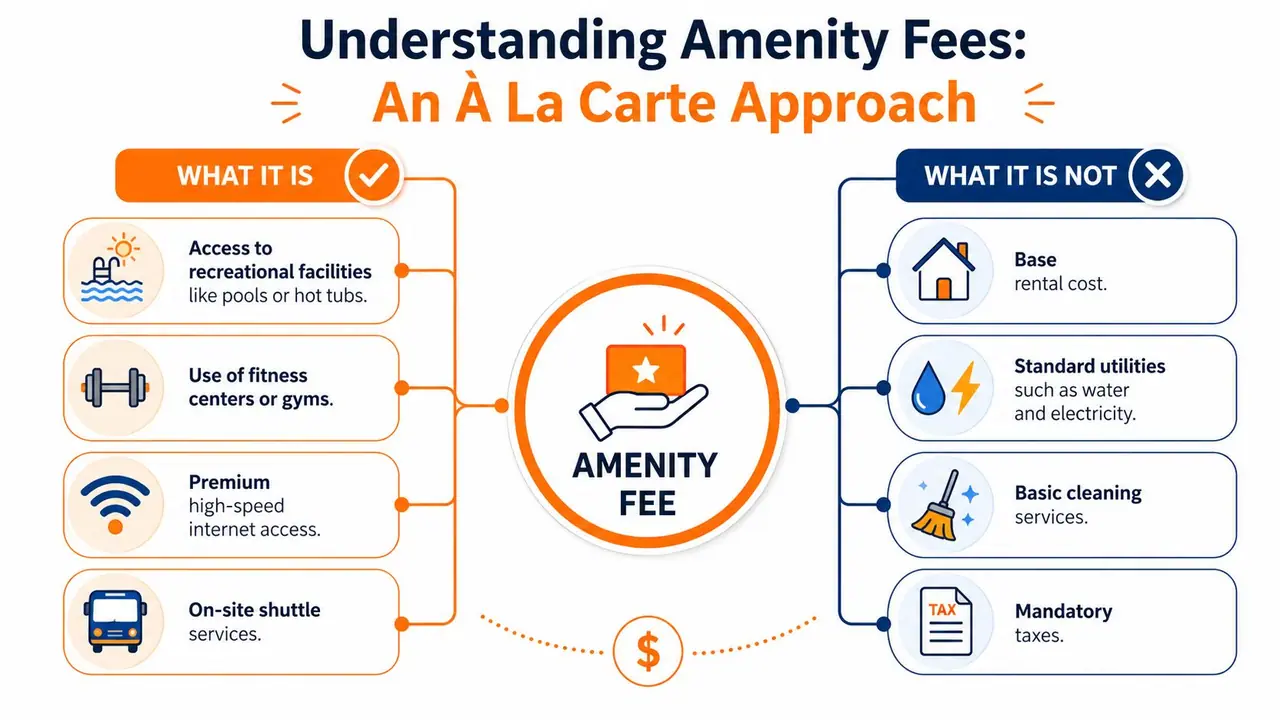
An amenity fee is best understood as an à la carte charge. The base rate pays for the stay itself. The amenity fee pays for access to a feature, service, or bundle outside that core lodging price.
Separate from rent, cleaning, and deposits
Hosts often blur fee categories. A cleaning fee covers turnover labor and supplies. A security deposit is there to address damage, if your platform or contract structure uses one. Taxes are mandatory government charges. None of those are the same thing as an amenity fee.
According to Rent's amenity fee definition, an amenity fee is a supplemental charge added to base rent to offset the cost of shared facilities, can be mandatory or optional, averages around $30 monthly in residential settings, and often runs $200 to $500 as a one-time annual charge.
For hosts, the translation is simple. If you're charging for a feature because it costs money to maintain or because it creates premium value beyond the basic stay, you're in amenity-fee territory.
Mandatory fees versus optional fees
The cleanest way to think about amenity fees is by whether the guest has a choice.
- Mandatory amenity fee: Every guest pays it, whether they use the feature or not. This works only when the charge is disclosed before booking and the covered items are central to the stay.
- Optional amenity fee: Guests choose it. This is easier to defend because the guest connects payment with use.
- Bundled access fee: Several features are grouped together under one charge. This can be efficient, but it creates risk when the bundle includes basics guests assume should already be included.
- Single-feature fee: One amenity, one clear reason. Think hot tub heating, parking access, equipment rental, or late checkout.
A practical host version of this might look like:
- Pool or hot tub upkeep: Water treatment, inspections, cover replacement, and extra cleaning.
- Fitness room access: Equipment servicing and consumables.
- Parking access: Reserved on-site parking in a constrained location.
- Premium internet or entertainment: Faster service tiers or upgraded streaming beyond standard access.
- Gear-based extras: Beach equipment, bikes, golf storage, or ski lockers.
Guests usually accept a fee faster when they can point to the exact thing they're paying for.
What doesn't work is labeling ordinary operating costs as a premium perk. If the charge covers basic Wi-Fi, trash, or standard property access, many guests won't treat it as an amenity. They'll treat it as a price game.
The Business Case for Charging an Amenity Fee
Some hosts charge an amenity fee because the amenity is expensive. Others do it because they want pricing flexibility. Both reasons are valid, but they lead to different guest reactions.

Cost recovery for expensive features
The strongest business argument is cost recoupment. Shared amenities have direct operating costs and indirect wear. In the U.S. apartment market, standard common-area amenity fees typically range from $30 to $70 per month, pool access averages $35 per season, and parking in large cities can reach $150 per month, according to LawDistrict's amenity fee overview.
Those figures come from housing, not short-term rentals, but the operating logic carries over. Pools need chemicals and cleaning. Parking has opportunity cost. Specialty facilities raise insurance, maintenance, and staffing demands.
A separate fee can protect your core rate from absorbing every premium cost. That's especially helpful if only part of your guest base values the amenity.
Revenue strategy and rate positioning
The second reason is commercial. A host may want a more competitive headline rate while monetizing premium access separately. That's common across travel categories. You can see the same pricing logic in niche hospitality examples like hen weekend pricing, where the full cost structure matters more than the top-line starting price.
Here's the trade-off in plain terms:
| Approach | What it does well | What can go wrong |
|---|---|---|
| All-inclusive nightly rate | Feels simple to guests | Can make your listing look expensive in search |
| Separate amenity fee | Keeps the base rate lower | Can feel misleading if disclosed late |
| Optional amenity upsell | Ties payment to guest choice | Adds operational complexity |
If you charge separately, the fee has to map to a real guest benefit. Hosts get into trouble when they use an amenity fee to subtly make up margin rather than clearly price a premium feature.
How to Disclose Amenity Fees Legally and Transparently
Hosts sometimes treat disclosure like a formatting issue. It isn't. It's a trust issue first, and increasingly a compliance issue too.
As of September 1, 2025, Texas requires landlords to clearly disclose fixed, recurring amenity fees in lease quotes, ads, and on the first page of the lease, and hotel-style amenity fees in hospitality commonly range from $10 to $50 per night, according to Texas BMG's summary of the law and fee practices. Short-term rental hosts aren't writing apartment leases in most cases, but the direction of travel is obvious. Regulators and guests both want the total cost surfaced early.

Where hosts should disclose the fee
A fee shouldn't appear once. It should appear wherever a guest makes a pricing decision.
- Listing description: State the fee near the pricing explanation, not buried near the bottom.
- House rules or fee section: Repeat it in plain language.
- Rental agreement: If you use one, spell out the amount, whether it's mandatory, and what it covers. This vacation rental contracts guide is a useful reference point for tightening that language.
- Pre-arrival message: Remind guests before arrival so there are no surprises.
- Digital welcome materials: If access rules, hours, or usage limits apply, include them there too.
A good benchmark for transparency comes from outside lodging as well. This guide to transparent snorkel tour pricing shows the same principle guests respond to everywhere: clear total cost, explained early, with no scavenger hunt required.
Sample wording that reduces disputes
Most hosts overcomplicate fee language. Shorter works better.
The amenity fee is mandatory, covers hot tub access and maintenance, and is charged separately from the nightly rate.
If the fee is optional, say that directly.
Beach gear rental is optional and charged only if selected before arrival.
If the amenity has restrictions, include them before the guest asks for a refund.
- State access rules: "Pool access is seasonal and subject to posted hours."
- Clarify what is included: "Fee covers access to the sauna, fitness room, and reserved parking."
- Avoid vague bundles: Don't write "property services fee" when you mean Wi-Fi, trash, and parking.
- Use the same wording everywhere: Listing, agreement, and guest messages should match.
Clear disclosure doesn't eliminate complaints. It filters out the wrong booking before it becomes a bad review.
Weighing the Pros and Cons for Your STR Business
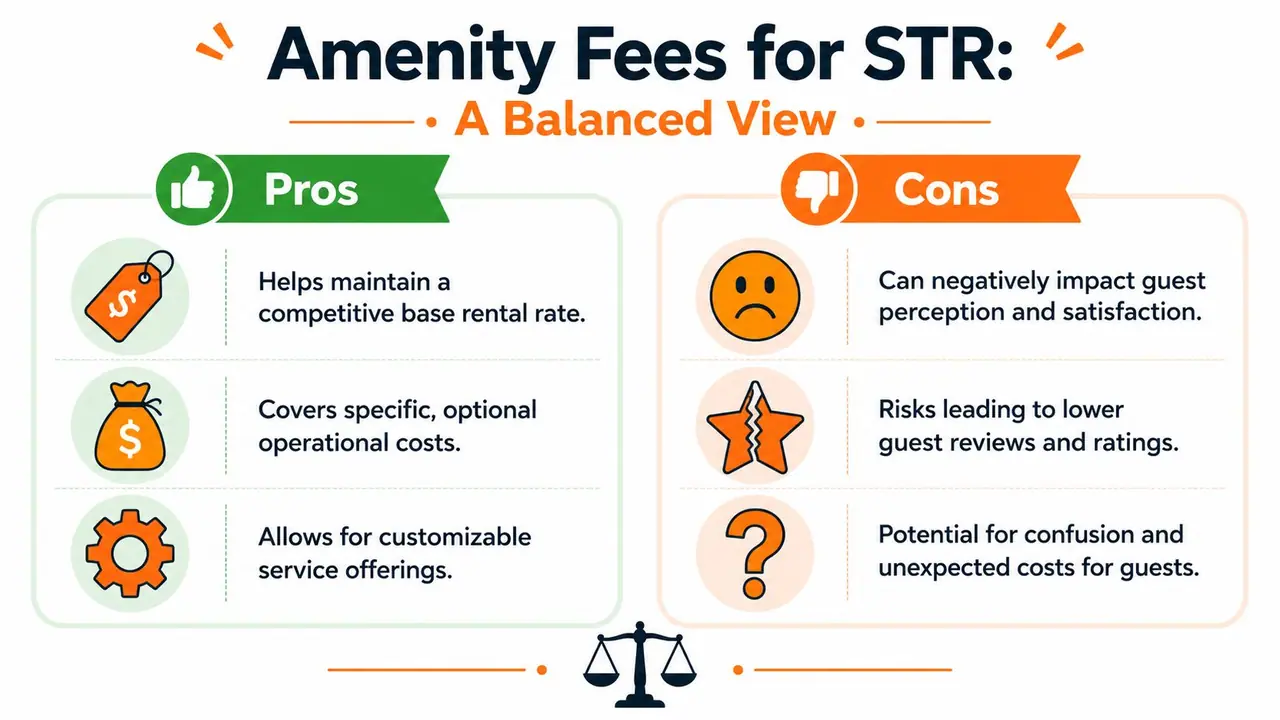
A separate amenity fee can be smart. It can also erode a good property's reputation if the fee feels engineered rather than earned.
Where amenity fees help
For the right property, a fee gives the host tighter control over pricing.
- Lower visible base rate: Your nightly rate can stay cleaner in search results.
- Better cost attribution: You can connect a premium feature directly to its upkeep.
- Cleaner internal tracking: It's easier to see whether a feature pays for itself.
- Flexible packaging: You can keep standard lodging simple and monetize extras separately.
This model works best when the amenity is distinctive. A rooftop plunge pool, private dock, valet parking arrangement, or high-maintenance spa feature is easier to price separately than ordinary Wi-Fi and trash removal.
Where hosts get into trouble
The biggest risk isn't the fee itself. It's the feeling that the host split up the obvious cost of staying at the property just to advertise a lower rate.
That concern gets sharper with bundled charges. A 2024 Reddit report about a $110 monthly amenity fee described minimal bundled services like Wi-Fi and trash and framed the charge as an opaque fee that felt 3x to 4x higher than the value provided. Even though that example came from residential renting, the lesson applies directly to short-term rentals.
If a guest sees a fee tied to essentials, they'll usually ask one question: why isn't this already part of the price?
That is where hosts create review problems for themselves. The listing may technically disclose the charge, but the guest still experiences it as nickel-and-diming.
A useful framing here is basic financial disclosure definition. A disclosure isn't just the act of mentioning something. It's presenting material information clearly enough that the other party can make an informed decision. Hosts should use the same standard.
| Good fit | Bad fit |
|---|---|
| Standout premium feature | Standard utility or ordinary operating cost |
| Guest can identify the value | Guest sees no real difference in experience |
| Fee is obvious before booking | Fee appears late or feels buried |
| Wording is specific | Wording is broad, bundled, or vague |
If you have to spend a full paragraph defending the fee, the pricing model probably needs work.
Practical Steps to Implement or Avoid Amenity Fees
The right answer depends on what kind of property you're running and what guests already expect in your market.
When a fee makes sense
Charge separately when the amenity is costly, visible, and meaningfully optional in the guest's mind. Good candidates are reserved parking, equipment rental, spa access, or a high-maintenance feature that clearly sits outside the basic lodging promise.
Use this checklist before you add the charge:
- Name the amenity plainly. If you can't define it in one sentence, guests won't understand it.
- Test the fairness question. Would a reasonable guest say, "Yes, that seems separate"?
- Write disclosure copy before publishing. If the wording sounds defensive, revise the model.
- Keep the bundle tight. Don't mix premium extras with basics.
When folding costs into the nightly rate is smarter
If your amenities are ordinary for your class of property, rolling cost into the nightly rate is often the cleaner move. Standard Wi-Fi, normal trash service, basic parking, and ordinary common access usually don't feel premium enough to justify separate billing.
You can also split the difference by keeping the stay all-inclusive and offering optional upsells instead. Many hosts find that easier to explain and easier to sell. For operators refining that broader guest experience, this vacation property management resource is a helpful reference.
The main decision rule is simple. If the fee improves clarity, keep it. If it only improves appearance by lowering the headline rate, it's probably not worth the friction.
If you want a cleaner way to present house rules, check-in info, Wi-Fi details, and optional upsells without burying guests in messages, ScanStay gives hosts a digital welcome book they can share with one QR code. It's a practical way to explain property features clearly, reduce repetitive questions, and present extras in a format guests can find and use.