What Is Considered a Short Term Rental? a Host's Guide
Learn what is considered a short term rental, from the 30-day rule to complex tax and legal definitions. Our 2026 guide helps hosts stay compliant and succeed.
A short-term rental is usually any guest stay of less than 30 consecutive days. That's the baseline definition most hosts, cities, and booking platforms work from when deciding what is considered a short term rental.
If you're new to hosting, that sounds simple enough until you start checking your city rules, your platform settings, and your tax treatment and realize they don't all mean the same thing. One document says under 30 days. Another says the host must live there. Your accountant starts talking about average stay length. Suddenly a simple listing starts to feel like a compliance puzzle.
That confusion is normal. In practice, “short-term rental” is not one clean universal label. It's a working definition that changes depending on who is applying it: your city, your insurer, the booking platform, or the IRS.
For hosts, that difference matters because the label changes how you operate. It affects permits, whether you can rent the whole place, how you communicate rules to guests, what kind of insurance you need, and whether your losses are treated the way you expect at tax time. If you're still exploring short-term rental meaning, it helps to start with the legal baseline and then layer on real-world exceptions. For a broader operational overview, this short-term rental guide is a useful companion.
Table of Contents
- Understanding the World of Short Term Rentals
- The 30-Day Rule Defining Short Term Stays
- How Jurisdictions and Platforms Define STRs
- The Critical Tax Definition The IRS 7-Day Rule
- Key Implications for Hosts Insurance and Liability
- Your Host Compliance and Best Practices Checklist
Understanding the World of Short Term Rentals
A new host usually starts in the same place. They furnish a unit, create an Airbnb or Booking.com listing, and assume the main question is nightly pricing. Then they call the city, read a few forum posts, and learn that the fundamental first question is whether the property legally qualifies as a short-term rental at all.
That's where the confusion starts. One authority is focused on zoning. Another is focused on tax treatment. Your insurer is focused on risk. The platform is focused on listing rules and verification. Everyone uses similar language, but they don't always mean the same thing.
Why the term feels simple but isn't
At the street level, hosts use “STR” to mean a furnished place rented for short guest stays. That's fine for conversation. It's not enough for compliance.
Most hosting mistakes don't start with bad intent. They start with assuming one definition covers every situation.
A practical host treats the term like a layered label:
- Local law: Can you rent this property for short stays at all?
- Platform rules: Will Airbnb, Vrbo, or Booking.com let you list it under current local restrictions?
- Tax rules: How is the activity classified when you report income and losses?
- Insurance: Does your policy cover transient guest use?
What hosts need to know first
If you want the simplest working answer to what is considered a short term rental, start with the standard local benchmark of under 30 days, then verify whether your location adds more conditions. Those extra conditions often matter more than the basic definition.
For a new host, this isn't academic. It determines whether you're running a side rental, a regulated hospitality operation, or something that falls into a prohibited gray area.
The 30-Day Rule Defining Short Term Stays
The cleanest baseline definition is this: a short-term rental is a furnished property rented for less than 30 consecutive days. That threshold is recognized in zoning and industry practice, including Denver's zoning approach and Canadian federal data defining STRs as stays between 1 and 28 days, which places them in the same competitive lane as hotels rather than standard residential leasing. You can see that definition discussed in this overview of the 30-day short-term rental benchmark.
Why under 30 days matters
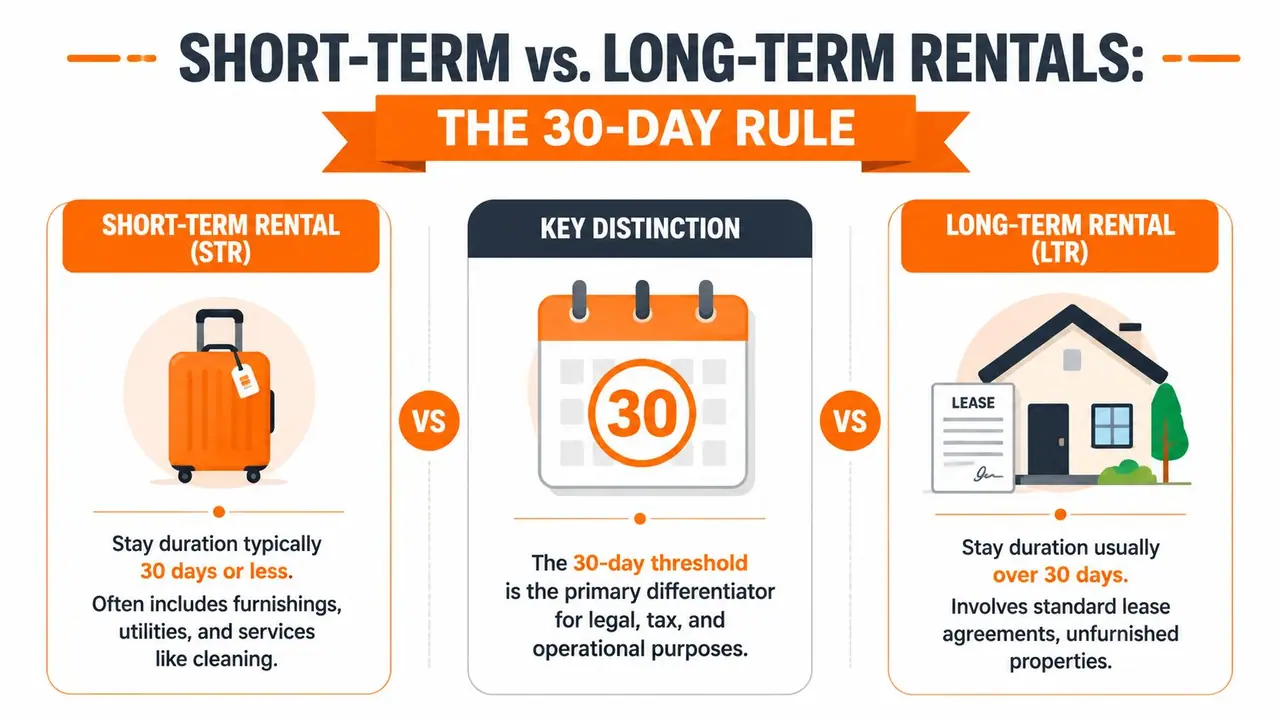
The under-30-day line is more than a calendar detail. It separates two different operating models.
| Rental type | Typical stay pattern | Business style |
|---|---|---|
| Short-term rental | Under 30 days | Hospitality-driven |
| Long-term rental | Monthly or longer | Residential leasing |
With a long-term rental, you're handing over possession for an extended period under a lease. With a short-term rental, you're turning the unit over repeatedly for guest stays. That means different workflows, different guest expectations, and usually a higher need for standardization.
A short-term stay also changes how people use the space. Guests expect instructions, Wi-Fi access, check-in clarity, local recommendations, and fast support. Long-term tenants expect a lease and stable possession. Those are not the same relationship.
Later in the section, this video gives a visual overview of the distinction many hosts struggle with at first.
How operations change when you cross the line
Once a property falls into the under-30-day category, the work starts to resemble hospitality much more than landlording.
- Turnovers become routine: Cleaning, restocking, and inspection happen frequently.
- Maintenance must move faster: A small issue between bookings becomes an immediate guest problem.
- Communication becomes operational: Check-in details, house rules, and emergency info need to be delivered clearly every time.
- The property needs to stay guest-ready: Furnishings, supplies, and presentation matter more because each booking is a fresh first impression.
Practical rule: If your property changes hands every few days instead of every few months, you're operating a hospitality business whether you think of it that way or not.
Here's the video reference mentioned above:
What doesn't work is treating an STR like a normal annual lease with nicer furniture. Hosts who do that usually end up with unclear check-ins, inconsistent standards, and more guest friction than necessary.
How Jurisdictions and Platforms Define STRs
The 30-day rule gives you the starting point. Local enforcement gives you the actual answer.
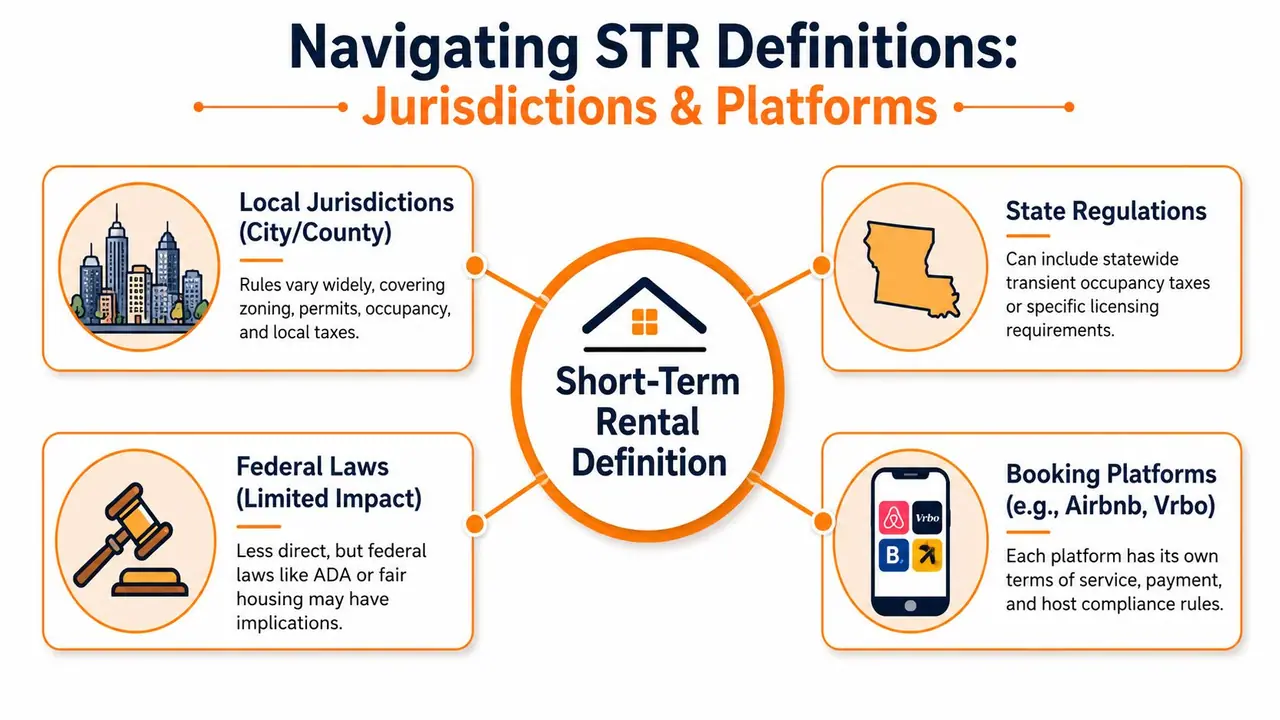
A host can have a listing that fits the basic time-based definition and still be illegal to operate in that form. That happens because cities often add residency, registration, occupancy, or building-level restrictions on top of the basic stay-length rule.
Local law beats platform defaults
Airbnb, Vrbo, and other marketplaces can help collect information, but they do not replace city law. If your city requires registration, host presence, or a specific property type, the platform can't grant permission that local law has denied.
Often, many first-time hosts get tripped up. They assume that if a listing goes live, it must be allowed. That assumption causes problems.
A better approach is to think in this order:
- City and county rules first
- Building or HOA restrictions second
- Platform settings third
Platforms are distribution channels. They are not your zoning department.
When the definition becomes about presence, not just time
Some major markets add a second filter beyond duration. In San Francisco and New York, the definition can be tied to a Permanent Resident standard. In New York City, rentals under 30 days are prohibited unless the host is physically present, which shifts the practical definition for many operators from time-based to presence-based. San Francisco's FAQ lays out that type of framework in its guidance on Permanent Resident short-term rental rules.
That changes the hosting model completely. If you planned to run a full-time, unhosted apartment in one of those markets, the issue isn't only how long guests stay. The issue is whether the host must be there.
A city can agree that your booking length qualifies as short-term and still prohibit the way you intend to operate it.
For solo operators, that distinction matters more than almost anything else. A remote self-check-in setup may work perfectly in one city and fail the legal test in another.
Here's what works in practice when rules vary by market:
- Read municipal FAQs, not just blog summaries: City-issued guidance usually explains edge cases better.
- Check whether the unit must be a primary residence: This often decides whether a listing is viable.
- Confirm whether unhosted stays are allowed: Don't assume they are.
- Review platform compliance prompts carefully: Useful, but never a substitute for the local ordinance.
What doesn't work is copying another host's setup from a different city and assuming the same model applies to yours. STR compliance is local, building-specific, and sometimes even unit-specific.
The Critical Tax Definition The IRS 7-Day Rule
This is the part most hosts miss.
You can be fully compliant under local short-term rental rules and still misunderstand how your activity is treated for tax purposes. Local law usually cares about whether the stay is under 30 days. The IRS tax question is different.
The mistake many new hosts make
For tax purposes, the critical threshold is often whether the average stay is 7 days or less. That distinction matters because hosts who meet that standard may be able to deduct losses without falling under passive activity limitations, as outlined in this explanation of the IRS-style 7-day short-term rental rule.
That means a host can say, truthfully, “I run a short-term rental,” and still have the wrong tax expectations if their average stay is above that threshold.
A common example looks like this:
| Situation | Local view | Tax implication |
|---|---|---|
| Average stays under 30 days | Likely treated as STR locally | Not enough by itself |
| Average stays 7 days or less | Still STR locally | May change loss treatment |
The local definition answers whether you're operating a short-term rental in your city. The tax definition answers a different question entirely.
Why average stay length changes the tax conversation
Hosts need to stop thinking only in terms of listing legality. Your booking pattern matters.
If your average stay is longer than 7 days, you may still be a perfectly legal STR under local rules. But for tax treatment, you may not get the result many hosts expect when they hear people talk about STR deductions.
Compliance with city rules and tax optimization are not the same thing.
That's why experienced operators track more than occupancy calendars. They also track average length of stay, because it affects planning decisions. Minimum-night settings, seasonal strategies, and guest mix can all push that average up or down.
Practical habits that help:
- Pull booking reports regularly: Don't guess at average stay length.
- Review minimum-night policies seasonally: A long minimum can change your annual average.
- Discuss booking patterns with a qualified tax professional: Not just your gross revenue.
- Keep clean records: Tax benefits usually depend on documentation, not memory.
What doesn't work is assuming that because your city calls it a short-term rental, your accountant will treat it the same way automatically. The labels overlap, but they are not interchangeable.
Key Implications for Hosts Insurance and Liability
Once a property is operating as an STR, the legal definition stops being abstract. It starts affecting what happens if something goes wrong.
The U.S. had more than 2.4 million active STR listings across 1.8 million properties in 2024, and many operate with self-service check-in. In that model, where on-site staff isn't present, hosts rely on digital systems to deliver safety information and house rules so guests know how to access the property and respond to issues. That operational reality is discussed in the 2024 STR benchmark report.
Your risk profile changes when you host guests like a business
A standard homeowner mindset usually isn't enough for short-stay operations. Guests are unfamiliar with the property. They arrive at odd hours. They may never meet you in person. They need to know how the lock works, where to park, what's off-limits, and what to do in an emergency.
That creates two practical liability issues:
- Coverage gaps: Hosts need to verify that their insurance covers short-term rental activity.
- Communication gaps: Even good house rules don't help if guests never see them.
A property manager learns quickly that many disputes come from preventable confusion. Not all of them become insurance claims, but they still create risk.
Clear guest communication is part of liability control

Hosts often think of guest communication as a hospitality issue. It's also a protection issue. If you run self-check-in, you need a repeatable way to show guests the same information every time.
That usually includes:
- Arrival details: Access instructions, parking, entry timing
- House rules: Noise, visitors, smoking, pets, quiet hours
- Safety information: Emergency contacts, exits, appliance guidance
- Departure steps: Trash, key return, checkout procedure
A signed agreement can help, and many hosts pair their onboarding with written terms like these vacation rental contracts. But contracts alone don't solve the day-of-stay problem. Guests need practical information in a format they'll use.
The best liability reduction is often boring consistency. Every guest gets the same instructions, the same rules, and the same emergency details.
What doesn't work is relying on a paper binder nobody opens or scattering key instructions across platform messages, texts, and handwritten notes.
Your Host Compliance and Best Practices Checklist
A workable STR setup is part legal review, part tax discipline, and part operating system. Hosts who stay out of trouble usually aren't doing anything flashy. They're reviewing the same basics consistently.
The pressure is increasing in some markets. A stricter host-present rule in New York in 2025 prohibited rentals under 30 days unless the host is on-site, and that change led 65% of NYC listings to drop under-30-day availability, according to this discussion of 2025 host-present rule changes. That's a strong reminder that compliance can change quickly, even after a listing has been running for a while.
A practical checklist you can actually use
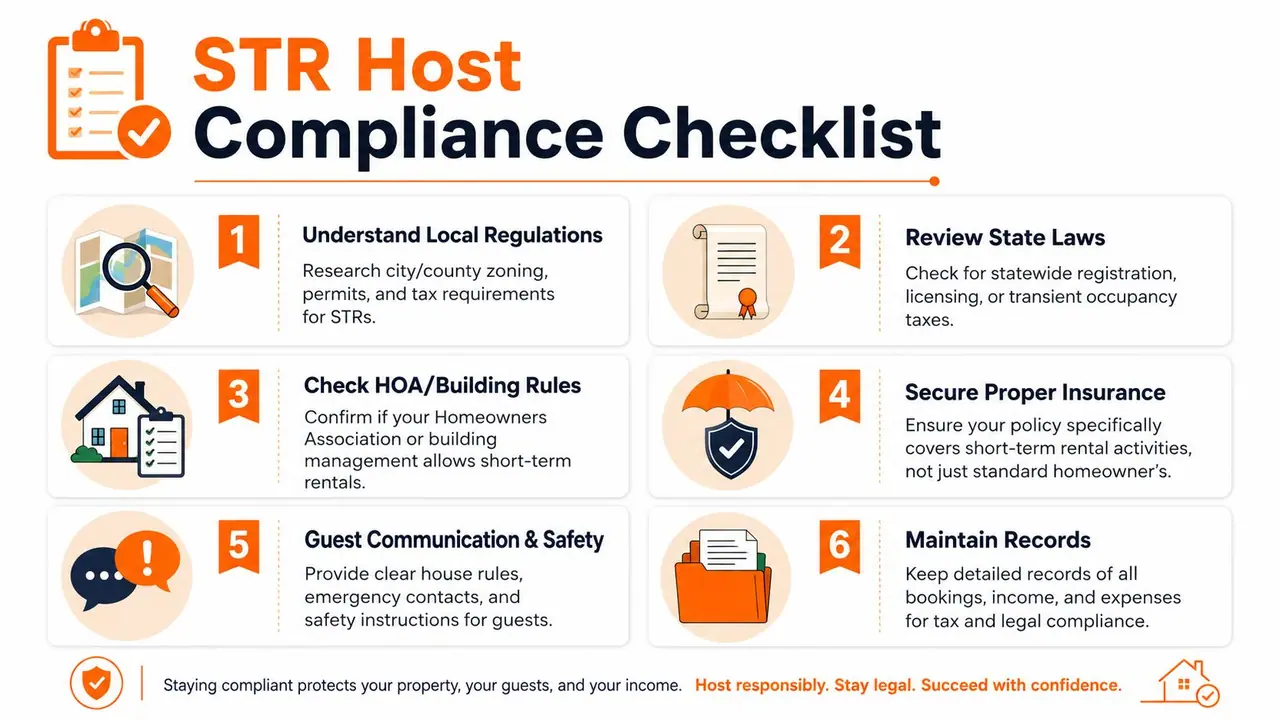
Use this as a recurring review, not a one-time setup task.
Confirm the local definition. Read your city and county rules closely. Check stay-length thresholds, registration requirements, and whether host presence or primary residency rules apply.
Review your building restrictions. Some hosts focus on city law and forget the lease, condo rules, or HOA bylaws. Those private restrictions can shut down a listing just as fast.
Track your average stay length. Herein, legal and tax definitions split. Your calendar data matters.
Check insurance in plain language. Ask whether your current policy covers transient guest use. Don't settle for vague assurances.
Standardize guest communication. Registration steps, arrival instructions, and safety details should be easy to find. If you're refining your process, this guide to registration of guests is a practical starting point.
Keep records that hold up later. Booking logs, expenses, permits, tax records, and communications all matter if questions come up.
What good hosts review regularly
Experienced hosts also keep an eye on the parts of the business that are easy to ignore until they become expensive.
- Tax claims: If you deduct aggressively without documentation, you're creating avoidable risk. This write-up on fraudulent holiday home tax claims is worth reading for the mindset alone.
- Rule changes: Cities update guidance. Platforms update requirements. A setup that worked last year may need changes now.
- Guest-facing information: Check whether your instructions still match the actual property setup.
- Operations after every incident: A lockout, noise complaint, or maintenance issue usually reveals a weak point in the system.
Good hosting systems reduce repeat mistakes. They don't depend on memory, luck, or last-minute messaging.
If you remember one thing, remember this: what is considered a short term rental depends on which rulebook you're reading. Under 30 days is the usual starting point. It isn't the final answer for zoning, taxes, insurance, or enforcement.
If you want a simpler way to deliver house rules, check-in steps, Wi-Fi details, safety info, and local recommendations without repeating yourself in every message, ScanStay helps you turn that information into a digital welcome book guests can open instantly from a QR code. It's a practical fit for hosts who want cleaner communication and a more consistent guest experience across one property or a full portfolio.