Rental Management LLC: A Host's Guide to Liability & Taxes
Forming a rental management LLC? This step-by-step guide covers setup, liability protection, taxes, and compliance for short-term rental hosts.
Your rental business usually feels real long before it looks like a real business on paper. That shift often happens after a good stretch of bookings, a few glowing reviews, and one uncomfortable moment: a guest slips on wet steps, a neighbor complains, a contractor damages something, or a chargeback lands at the worst time. Suddenly you're not thinking like a host. You're thinking like an operator with personal assets exposed.
That's where a Rental Management LLC starts to make sense. Not because filing paperwork magically makes risk disappear, but because it creates a clean line between you and the business you're running. If you treat it properly, that line helps with liability, taxes, banking, contracts, and day-to-day decision-making. If you treat it casually, the LLC becomes expensive stationery.
Table of Contents
- Why Your Growing Rental Business Needs an LLC
- Laying the Legal Foundation for Your LLC
- Activating Your LLC from Paper to Practice
- Managing Money and Mitigating Risk
- Ongoing Compliance and Common Pitfalls to Avoid
- Your Rental Management LLC Launch Checklist
Why Your Growing Rental Business Needs an LLC
A lot of hosts reach the same point. The calendar is healthy, guests are happy, and the money looks good enough that the rental no longer feels like a side project. But the lease, cleaning invoices, repair approvals, and payout trail still run through your personal name and personal accounts. That setup works fine until something goes wrong.
A Rental Management LLC is usually the dividing line between casual hosting and deliberate business ownership. It gives you a separate legal home for agreements, revenue, expenses, and operating decisions. Just as important, it signals that you're building systems around the rental instead of reacting to each issue as it appears.
The bigger picture supports that move. The U.S. property management industry is projected to reach $139.9 billion in revenue in 2026 and include about 340,000 businesses, according to IBISWorld's property management industry outlook. That matters because forming a dedicated entity isn't unusual or overly formal. It's normal business practice inside a large, established industry.
Practical rule: If your rental activity has regular income, recurring vendors, and real guest risk, you need business separation before you need more growth.
Some hosts also outgrow the "everything lives in my head" stage. They need documented workflows, clean guest communication, and repeatable management practices. If that's where you are, it helps to think about the LLC alongside the rest of your operating stack, including your guest process. A practical primer on that side of the business is this vacation property management overview.
If you're in Texas and you're weighing whether one LLC, multiple LLCs, or a series structure fits your portfolio, The Law Office of Bryan Fagan's guide is a useful starting point because it frames entity choice as a structural decision, not just a filing task.
Laying the Legal Foundation for Your LLC
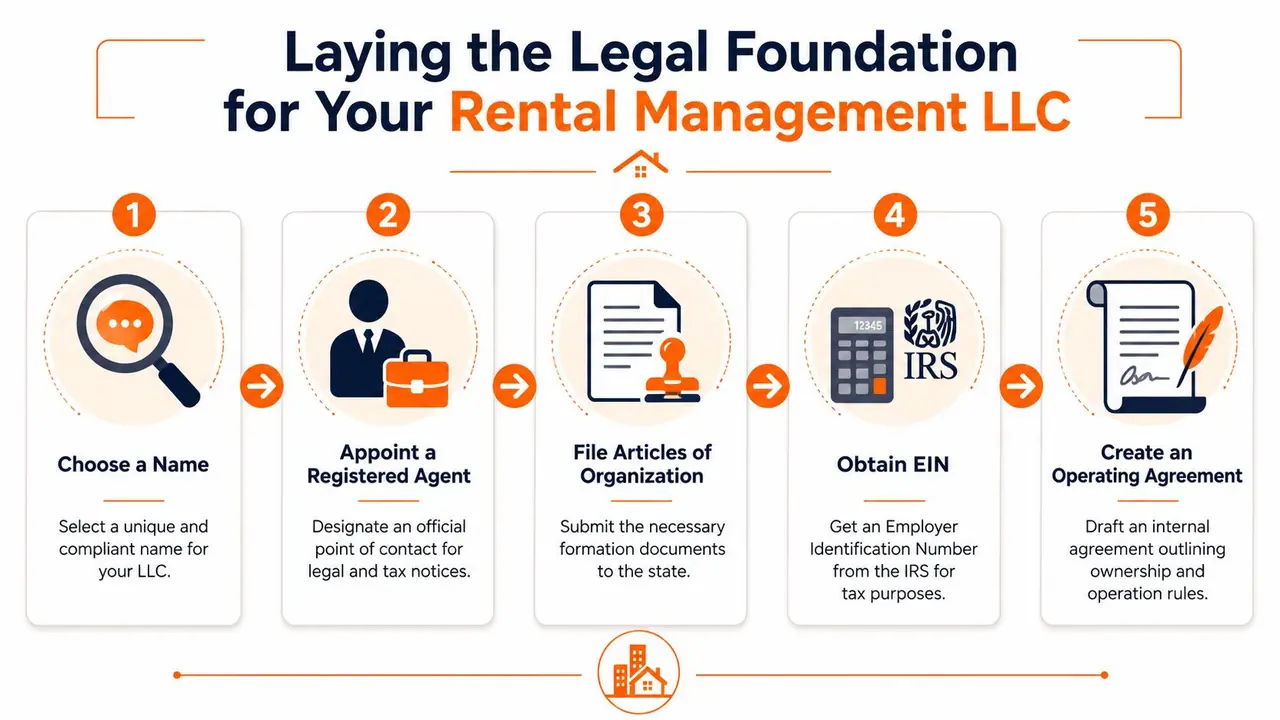
The filing itself isn't hard. What trips people up is treating each step like a formality instead of a control point. A good Rental Management LLC starts with clean inputs, because fixing a sloppy setup later is always more annoying than doing it right the first time.
Start with the name and the owner record
Choose a name that works in three places at once: your state filing system, your bank, and your guest-facing brand. It doesn't need to be clever. It needs to be available, clear, and consistent with how you'll sign contracts and receive payments.
Before you file anything, check your state's business registry and make sure the name is open. Then decide who the members are, who manages the company, and what address you want associated with the entity. If you're using a registered agent service, pick that before filing so your record is clean from the start.
A few naming habits save trouble later:
- Keep the legal name stable: Don't build the company around a trendy property nickname you'll want to change later.
- Match your documents: Your lease template, owner agreement, vendor paperwork, and bank account should all reflect the same legal entity name.
- Think beyond one property: A broad operating name gives you room if you add units or shift from one booking platform to several.
File the state documents correctly
Every state has its own process, but the core filing is usually the Articles of Organization or an equivalent formation document. This is the paper that creates the LLC. You're typically stating the company name, registered agent, management structure, and business address.
Hosts often rush, and it shows. They copy an address incorrectly, list the wrong manager, or use a personal email they'll stop checking. None of that feels serious on filing day. It becomes serious when legal notices, tax mail, or annual report reminders start going to the wrong place.
The state filing creates the LLC. It does not teach you how to operate one.
If the rental already exists in some form, line up your other documents right away. Guest agreements, vendor contracts, cleaner instructions, and house documentation should eventually point back to the LLC, not to you personally. If you're tightening that side of the business, this guide on vacation rental contracts is useful because contract sloppiness is one of the fastest ways hosts undermine their own structure.
Get your EIN and write the operating agreement
After state approval, get an Employer Identification Number, or EIN, from the IRS. Even for a single-member LLC, the EIN matters because banks, payment processors, bookkeeping systems, and tax records often rely on it. Think of it as the business identifier that lets the LLC function in practice.
Then write the operating agreement. Hosts often skip this part because some states don't force them to submit one publicly. That's a mistake. The operating agreement is where you define who owns the business, who can sign, how profits are handled, how decisions get made, and what happens if you bring in a partner or shut the company down.
A simple version should answer these questions:
- Who owns the LLC
- Who manages daily operations
- How money is distributed
- What approvals require written consent
- What happens if a member exits, dies, or wants to sell
- How records are stored and maintained
If you have partners, this document becomes even more important. If you don't have partners, it still matters because it proves that the business has defined rules instead of existing as a loose extension of your personal life.
Activating Your LLC from Paper to Practice
Once the state approves the filing, most hosts feel like they're done. They aren't. A Rental Management LLC only starts working when the business runs through it.
Treat the operating agreement like a working document
The operating agreement shouldn't sit in a folder you never open again. It should reflect how the company really operates. If you manage bookings, approve repairs, hire cleaners, coordinate maintenance, and control distributions, the document should say so.
For single-member LLCs, that may sound excessive. It isn't. A single-member host still needs a written record of authority, bookkeeping expectations, reimbursement rules, and what counts as a business expense. If you ever need to explain how the company functions, this is one of the first papers that shows whether the LLC is real in practice.
A workable operating agreement usually covers:
- Authority: Who can sign leases, vendor agreements, insurance paperwork, and platform-related documents.
- Money movement: How the owner gets paid, how reimbursements happen, and whether profits stay in the business or are distributed.
- Property-specific issues: Whether one LLC manages one property or several, and how records are separated inside the company.
- Exit rules: What happens if the property is sold, the management model changes, or the business stops operating.
Open the accounts and move operations into the LLC
The next step is boring, and that's exactly why it matters. Open a dedicated business checking account in the LLC's name. If your bank allows it and your operation is active enough to justify it, add a business savings account for taxes, reserves, or security deposit handling based on your local legal requirements and accounting method.
Then reroute the business. Platform payouts, direct booking payments, vendor invoices, software subscriptions, cleaning charges, maintenance bills, and supply purchases should move into the LLC workflow. If money still lands in your personal account and you manually sort it out later, you're keeping the legal wall weak.
A separate bank account is not bookkeeping. But without it, bookkeeping turns into guesswork fast.
Hosts who already have live listings often need a short transition plan. That usually means updating payout instructions, revising invoice recipient names, and checking whether existing vendor profiles match the new entity. If a cleaner still invoices "Jane Smith" while the lease says "Lakeview Hosting LLC," you've got a loose end.
Later, when you review operations on a portfolio level, analytics help you see whether the entity is supporting a healthy business or just containing messy activity. A practical framework for that is this vacation rental analytics guide.
Fix the signature problem before it creates one
One of the most common host mistakes is forming the LLC but continuing to sign everything personally. The cleaner agreement, contractor approval, owner statement, lease addendum, or furnished rental contract goes out under an individual name because it's faster. That's exactly the habit that weakens separation.
When you sign, sign as the company representative. Use the company name and your title. Make the same change in email signatures, invoice approvals, and templates. The goal isn't theatrics. The goal is a paper trail that shows the business acted through the business.
Here's a helpful explainer on the mindset behind that shift:
If property title or management rights need to move into the LLC, slow down and check the consequences before changing anything. Deeds, lender consent, insurance updates, local permit registrations, and platform account names don't always move in lockstep. This is one of those areas where hosts create problems by assuming the LLC filing automatically updates every other record.
A good activation checklist looks like this:
| Task | Why it matters |
|---|---|
| Update bank accounts | Creates clean cash separation |
| Revise contract names | Aligns agreements with the entity |
| Update vendor records | Prevents mismatched invoices |
| Check insurance named insured | Makes sure coverage matches operations |
| Review property title and loan terms | Avoids surprises tied to ownership changes |
If you use operating tools to centralize guest information, keep them under the business too. ScanStay, for example, lets hosts deliver check-in details, house rules, Wi-Fi, local recommendations, and guest upsells through a QR-based digital guide, which is easier to manage when your property operations are already organized under one entity and one set of procedures.
Managing Money and Mitigating Risk
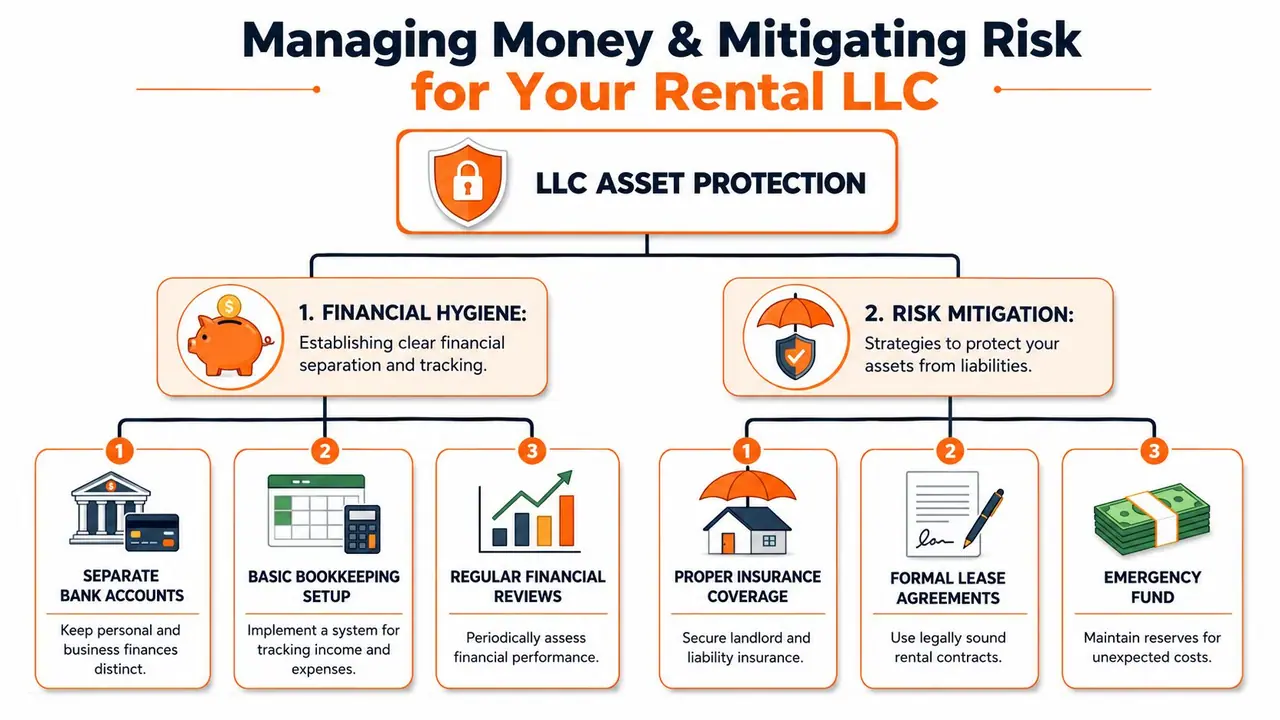
A Rental Management LLC helps most when money and risk are managed together. Hosts often separate those topics in their heads. They shouldn't. Weak bookkeeping creates legal problems, and weak risk controls create financial problems.
TenantCloud reports that many property managers charge 8% to 12% of monthly rent, while rents have risen by about 32% over five years and insurance costs increased 26% and maintenance costs increased 12%, according to TenantCloud's property management statistics roundup. That combination explains why disciplined operators care so much about tracking expenses correctly. Margin pressure isn't theoretical when repairs, claims, and insurance renewals hit in the same quarter.
Build simple financial hygiene first
You don't need a complicated accounting stack at the beginning. You need a consistent one. Pick a bookkeeping method and stick to it. That can be accounting software, a bookkeeper-managed ledger, or a very clean spreadsheet if the business is still small. What matters is that every dollar has a category and every transaction can be traced.
At minimum, track these buckets separately:
- Income by source: Platform payouts, direct bookings, pet fees, cleaning fees, and other charges.
- Operating expenses: Cleaning, supplies, software, utilities, repairs, and maintenance coordination.
- Owner-related transactions: Contributions, reimbursements, and distributions.
- Reserved funds: Taxes, future repairs, and any holding accounts you maintain.
The LLC helps because it forces a formal container around this activity. You can see what the business earns, what it spends, and whether the operation is healthy or just busy.
Use insurance and contracts with the LLC
An LLC isn't insurance. It's a legal structure. You still need coverage that matches the kind of rental you're operating and the way guests use the property.
For many hosts, the practical stack includes landlord-style coverage, commercial liability, and any policy adjustments needed for short-term rental use. The exact package depends on the property, occupancy model, and local rules. What's important is that the named insured, property use, and business activity line up with how the LLC operates. If you're comparing how specialists think about investment property coverage, Cover Club for investment property insurance is a useful reference point because it frames insurance selection around risk profile rather than just premium shopping.
Protection works in layers. The LLC handles separation. Insurance handles claims. Contracts handle expectations.
The contract side matters too. Guest agreements, vendor scopes, maintenance approvals, and house rules should support the risk posture of the business. If the insurance policy names the LLC but the agreement is still informal and signed personally, you've left a gap you didn't need to leave.
Review the business like an owner not just a host
Hosts who stay in daily ops mode often miss the larger pattern. They answer messages, solve check-in problems, approve repairs, and keep going. Owners pause and review.
Set a schedule to look at the business from a distance. Review income categories, expense drift, vendor reliability, unresolved maintenance, payout timing, and reserve balances. If you manage more than one unit, compare them side by side. That's where recurring underpricing, heavy repair burden, or guest-experience friction becomes obvious.
A simple review habit can include:
- Monthly cash review: Check inflows, outflows, reimbursements, and reserve transfers.
- Contract review: Confirm the active forms still match how you operate.
- Insurance review: Make sure occupancy type and business use haven't outgrown the policy.
- Operational review: Look for repeated guest questions, recurring maintenance calls, and vendor delays.
You don't need a giant dashboard to do this well. You need repeatable review and honest categorization.
Ongoing Compliance and Common Pitfalls to Avoid
The most dangerous thing about an LLC is how safe it can make people feel. Plenty of hosts file the entity, get the approval email, and assume the liability issue is handled. It isn't.
The myth of automatic protection
A common but under-discussed risk is piercing the veil, where courts can ignore the LLC's protection if owners blur personal and company activity, like mixing funds or signing contracts personally, as explained by Rental Management Group's guidance on LLC discipline. That's the part many quick guides skip. The LLC only works if you treat it like a separate business.
If you're still paying cleaners from your personal debit card, signing maintenance approvals in your own name, and moving money back and forth without records, the LLC may exist on paper while offering much less protection than you think.
The legal entity doesn't fail all at once. Owners usually weaken it through a string of small habits.
The routine work that keeps the shield intact
This is where professionalism beats enthusiasm. Ongoing compliance usually means staying current with state filings, keeping business records updated, storing governing documents, and documenting key company decisions. Even if you're the only member, write things down when the business takes an important action.
That can include:
- Annual state requirements: File reports and renew registrations on time.
- Internal documentation: Keep the operating agreement, approvals, and major business records together.
- Banking discipline: Reconcile accounts and document transfers or reimbursements clearly.
- Signature discipline: Use the company name and title line every time the LLC acts.
None of this is glamorous. It is what makes the structure credible.
Mistakes that quietly weaken the LLC
Most LLC failures in rental management come from operator habits, not legal complexity. The same host who is meticulous about guest reviews can be shockingly loose with entity formalities.
Watch for these patterns:
- Commingling funds: Paying a vendor personally because it's convenient, then forgetting to document reimbursement.
- Personal signatures: Signing a lease, contractor agreement, or service contract under your own name.
- Thin capitalization: Leaving the company with no cash cushion while expecting it to absorb real operating risk.
- Mismatched records: Insurance in one name, contracts in another, bank account in a third.
- Verbal-only approvals: Handling vendor scope changes or refund decisions casually with no record.
A host doesn't need to become a lawyer to avoid these issues. They need a repeatable operating standard and the discipline to use it when they're busy.
Your Rental Management LLC Launch Checklist
At this point, the pattern should be clear. The filing matters, but the operating behavior matters more. A strong Rental Management LLC is part legal entity, part bookkeeping container, part risk-management system.
Use this checklist as a working document, not a one-time read.
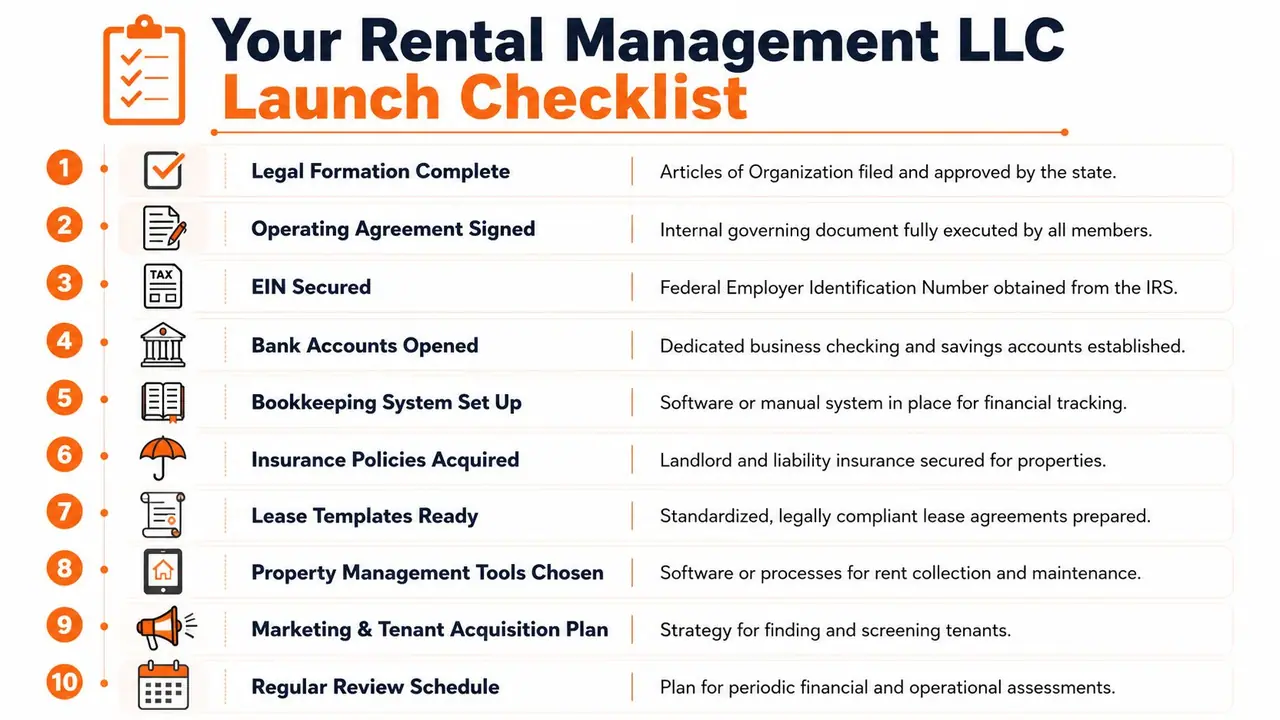
Launch actions to complete in order
- Choose and clear the LLC name: Confirm it works with your state registry, bank, and operating brand.
- Appoint the registered agent: Make sure legal and tax notices go to a reliable contact point.
- File the formation documents: Use accurate ownership, address, and management details.
- Get the EIN: Set up the business to open accounts and handle tax administration properly.
- Sign the operating agreement: Define authority, ownership, distributions, and recordkeeping rules.
- Open dedicated bank accounts: Keep company money separate from day one.
- Move contracts into the business: Update leases, vendor forms, and billing records to the LLC where appropriate.
- Align insurance with operations: Confirm the entity, property use, and coverage all match.
- Create a bookkeeping routine: Track income, expenses, reimbursements, and reserves consistently.
- Set compliance reminders: Keep annual filings, renewals, and internal documentation current.
The practical test
If a guest claim, tax review, lender question, or vendor dispute showed up tomorrow, could you hand over a clean paper trail showing that the business operated through the LLC?
If the answer is yes, your setup is probably doing its job. If the answer is "mostly," you're still in the danger zone where many hosts linger too long.
If you want the operational side of your rental business to match the legal structure you've built, ScanStay gives hosts a way to centralize guest information, house rules, check-in details, recommendations, and service upsells in one digital guide, which helps turn scattered hosting habits into a cleaner business process.