Is Rent Arbitrage Airbnb Still Profitable in 2026?
Learn how to find markets, secure leases, and scale your rent arbitrage airbnb business with real profit margins in 2026.
Most rent arbitrage airbnb advice still sells the entry point. Find a landlord. Furnish fast. List the unit. Start collecting bookings.
That's the shallow version of the business.
The problem starts after launch. A lease turns your costs into fixed obligations. Guest support turns your time into a recurring expense. One sloppy turnover, one broken check-in flow, or one underwritten deal can wipe out what looked profitable on a spreadsheet. That's why the old easy-money framing doesn't hold up well anymore.
Recent commentary focused on 2026 says margins have tightened as rent has caught up with short-term rental revenue, and in 2025 the national STR premium averaged 138% according to AirDNA's 2026 arbitrage analysis. That changes the job. Success now depends on market selection, conservative underwriting, and avoiding high-rent metros, weak occupancy, and strict STR rules.
If you want a side hustle fantasy, arbitrage will disappoint you. If you want a disciplined operating model, it can still work.
Table of Contents
- Is Rent Arbitrage Still a Golden Ticket in 2026
- Validate Your Market and Model Your Profit
- Secure the Lease with a Professional Pitch
- Furnish Smart and Launch a Standout Listing
- Master Guest Operations and Experience
- Scale Your Portfolio with Automation
- Conclusion Your Path to Arbitrage Profitability
Is Rent Arbitrage Still a Golden Ticket in 2026
Only if you stop treating it like a shortcut.
An Airbnb rent arbitrage deal is still the same fundamental business. You lease a property long term and try to earn more from short-term stays than you pay in rent and operating costs. That sounds simple, but simple businesses are often unforgiving. The math either clears or it doesn't.
The operators who survive usually aren't the ones who got the slickest first unit. They're the ones who learned to say no to marginal deals, document every process, and keep support load under control. Arbitrage used to get marketed as low-capital access to hospitality. In practice, it's fixed-rent exposure tied to a service business.
Practical rule: If a deal only works in your best-case scenario, it doesn't work.
That mindset matters more now because the market has become less forgiving. Tightening spreads mean you can't rely on enthusiasm, “good vibes,” or a nice-looking comp set. You need a margin cushion, clear permissions, and a unit that can be run consistently without constant hand-holding.
A lot of new hosts focus on getting approved by a landlord and forget the harder question. Can this unit operate cleanly for months without eating your time alive?
What has changed
Older arbitrage content made the model sound like a repeatable formula. Pick a tourist market. Add furniture. Turn rent into nightly income. Scale. The problem is that the spread has compressed, while the work hasn't.
That's why many first-time operators confuse activity with profitability. They answer messages all day, coordinate cleaners manually, patch over listing issues with discounts, and still think they're building a portfolio. They're often just subsidizing a weak unit with their own labor.
What still works
Good arbitrage deals still exist, but they usually share a few traits:
- Rent leaves room for mistakes. You don't need a perfect month to stay afloat.
- Local rules are workable. You're not operating one policy update away from shutdown.
- The property fits guest demand. Layout, parking, access, and neighborhood all matter.
- Operations are systemized. Check-in, FAQs, cleaning, and issue resolution don't depend on you replying in real time.
That's the lens to use for every decision that follows.
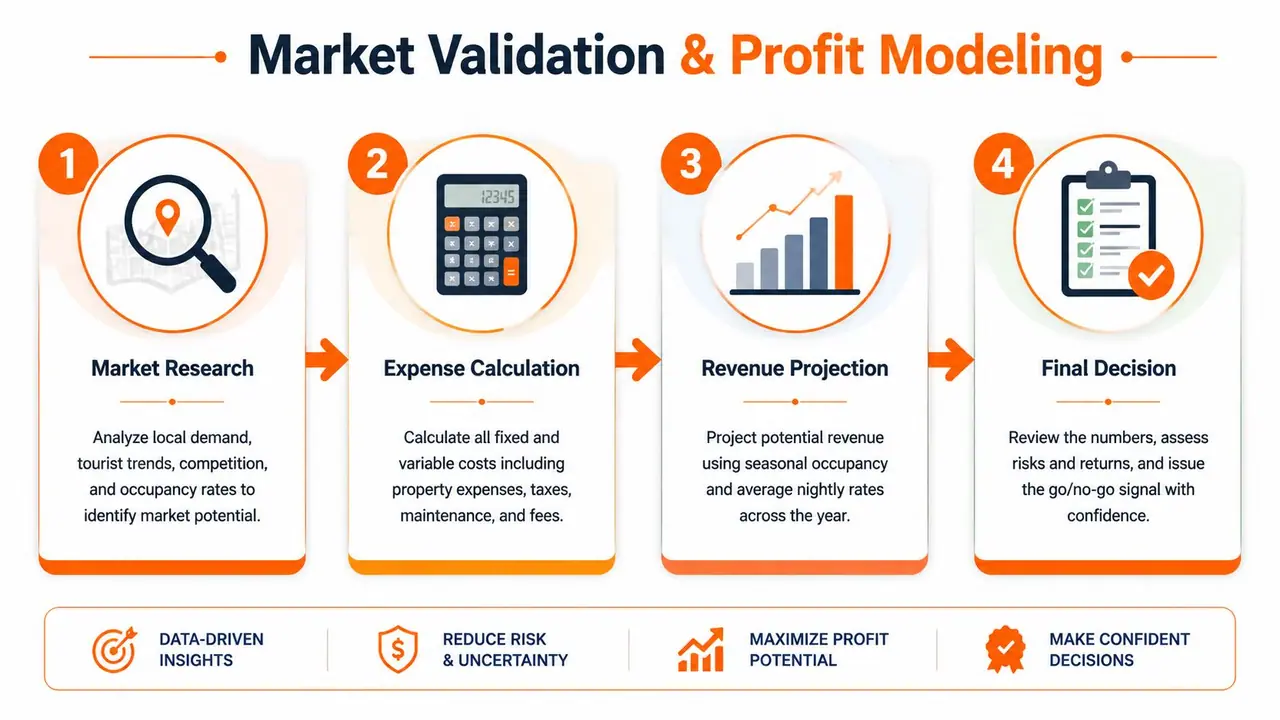
Validate Your Market and Model Your Profit
Bad arbitrage deals usually look fine at first glance. The spreadsheet only breaks once you price in the work, the dead nights, and the small costs that keep stacking up.
A nearby host charging a strong nightly rate does not prove your unit will work. Validation means matching local demand to your exact unit type, then testing whether the spread still holds under average conditions instead of best-case assumptions.
Start with demand you can explain
Before you model revenue, answer a simpler question. Why would someone book this unit instead of a hotel or another Airbnb nearby?
The answer should be specific. Walkable downtown locations can support weekend leisure demand. Units near hospitals may attract traveling nurses or patient families. Suburban properties near distribution hubs can draw project crews and relocation stays. If you cannot describe the guest profile in one clear sentence, the deal is still too fuzzy to price.
Then check the market by looking at comparable listings with the same basics. Same bedroom count. Similar location. Similar parking situation. Similar amenity level. A two-bedroom with free parking and self check-in is not competing with a luxury loft that has a hot tub and skyline views.
Strong ADR can still hide a weak deal.
Revenue has to cover rent first. Then it has to absorb cleaning, platform fees, utilities, supplies, insurance, internet, replacements, and the friction that shows up once guests start coming through the door. If you want a broader benchmark for evaluating unit economics, this guide on whether Airbnbs are profitable is worth reviewing before you commit to a lease.
Build the boring version of the P and L
New operators usually make the same underwriting mistake. They model a good month and call it the business.
Use a conservative month instead. Lower occupancy a bit. Assume a few gaps between bookings. Include routine replacements, a refund line, and some paid support time even if you plan to self-manage. That approach gives you a real operating view instead of a fantasy margin.
Your pre-lease model should include:
- Rent: Full monthly lease obligation and any required fees
- Revenue: Conservative ADR and occupancy based on true comps, not the best listing in the market
- Turnovers: Cleaning frequency based on expected stay length
- Platform costs: The Airbnb fee structure you'll use
- House operations: Utilities, insurance, internet, laundry, consumables, and restocking
- Friction costs: Refunds, damaged items, emergency calls, lockouts, and guest support time
| Item | What to model |
|---|---|
| Rent | Fixed monthly lease obligation |
| Revenue | Conservative monthly RevPAR or ADR and occupancy estimate |
| Turnovers | Cleaning frequency tied to your stay pattern |
| Platform costs | Airbnb fee structure you'll use |
| House ops | Utilities, insurance, consumables, laundry, internet |
| Friction costs | Refunds, replacement items, support time, emergency calls |
Two operators can book the same gross revenue and end up with very different results. One has a clean calendar, a reliable cleaner, and tight supply controls. The other is replacing linens every few weeks, refunding over minor issues, and spending hours each weekend patching service failures. Gross income hides that difference. A disciplined P and L exposes it.
Stress-test the unit before you sign
I use a simple filter before I spend time chasing a landlord.
- Does the unit work in an average month, not a peak month?
- Is there still margin after realistic overhead, not optimistic overhead?
- Can the unit handle slower periods without me discounting my way into bad guests?
- Would this still be worth operating if support volume doubled for a month?
- Is the demand stable enough to survive one rule change, one bad review cycle, or one slower season?
A good arbitrage deal usually looks boring on paper. That is a good sign. The units that depend on perfect weekends, premium pricing, and constant hands-on management are the ones that wear operators down.
Walking away is part of underwriting. If the numbers only work when everything goes right, the model is too thin.
Secure the Lease with a Professional Pitch
Landlords don't care that you watched a few videos about passive income. They care whether you'll pay on time, keep the property in shape, and avoid turning their building into a complaint machine.

Landlords approve operators, not dreamers
The pitch has to sound like business risk reduction.
Don't lead with “I want to Airbnb your place.” Lead with how you'll operate. Explain that you run professionally cleaned, professionally managed short-stay accommodations under written approval. Show the owner how guest screening, cleaning, noise expectations, and property care will be handled.
A strong landlord conversation usually includes:
- Reliable payment: Frame the lease as a stable arrangement with predictable rent collection.
- Property condition: Explain that regular cleanings and inspections mean the unit gets more eyes on it, not fewer.
- Professional standards: Share your check-in process, guest communication standards, and house rules.
- Clear accountability: Make it obvious that you, not the owner, are handling guest issues.
A weak pitch sounds like opportunity. A strong pitch sounds like control.
What your lease language needs to do
Verbal approval isn't enough. You need written permission that specifically allows the intended use.
A corporate lease addendum or STR addendum should make subletting authority explicit, define what kind of stays are permitted, and set expectations around guest count, cleaning, maintenance responsibilities, and complaint handling. It should also clarify insurance obligations and what happens if local policy changes affect operations.
The lease should answer problems before they happen. Noise complaint. Guest damage. Access requests. Early termination. Insurance. If it's vague, it's unfinished.
This is also where many operators get sloppy with compliance. Before you sign, confirm local zoning, permit requirements, building rules, and any restrictions that could block short-term stays. Some units are “approved by the landlord” but still unusable because the city, HOA, or building rules don't match the plan.
If a landlord resists putting permission in writing, move on. Ambiguity is not flexibility. It's exposure.
Furnish Smart and Launch a Standout Listing
The furnishing phase decides two things at once. How well the property photographs, and how well it survives guests.
Most new operators overinvest in decor and underinvest in durability. That's backwards. In rent arbitrage airbnb, furniture is a tool for revenue, not self-expression.
Buy for abuse, not for compliments
Think commercial, not precious. Guests drag luggage, eat on beds, stain towels, ignore coasters, and lean on everything.
Prioritize spending in places that affect sleep, cleanliness, and replacement frequency:
- Mattress and pillows: Guests forgive a lot, but they don't forgive bad sleep.
- Sofa and dining chairs: These take repeated impact. Cheap pieces look tired fast.
- Linens and towels: Buy matching sets you can replace without visual drift.
- Lighting: Bright, even lighting improves guest experience and listing photos.
Save money on trendy accents, fragile decor, and anything that creates cleaning complexity. A vase with dried stems may look nice once. A wipe-clean surface does more for margins.
Launch the listing like a revenue asset
Your listing has one job. Convert views into bookings from the right guests.
That starts with photos. You don't need gimmicks. You need clean framing, natural light, and a sequence that answers practical questions fast. Exterior, entry, living space, kitchen, bedroom, bathroom, workspace if relevant, and any standout amenity that matters to your target guest.
Then write copy that reduces uncertainty. Good descriptions don't just sound appealing. They help guests self-qualify. Mention access, parking, stairs, sleep setup, neighborhood feel, and any rule that would matter before booking.
For a useful hosting checklist, this guide on tips on Airbnb hosting covers the basics that support a smoother launch.
Early listing decisions that matter
A new listing usually needs momentum. That doesn't mean racing to attract every booking.
Use these filters:
- Choose your first guests carefully. Early reviews shape the listing's direction.
- Write house rules clearly. Rules hidden in dense text create disputes later.
- Set expectations in the title and opening lines. Quiet retreat, walkable base, work-friendly stay, family setup. Be specific.
- Avoid overpromising. “Luxury” creates a higher refund standard than many units can sustain.
A standout listing isn't the one with the most adjectives. It's the one that attracts the right guest, delivers what it promised, and creates fewer problems after check-in.
Master Guest Operations and Experience
Arbitrage margins usually slip after launch for a boring reason. Daily operations get messy.
The unit may pencil well on day one, then lose money through slow replies, missed turnovers, weak cleaner follow-up, refund requests, and reviews that drag down occupancy. New operators tend to focus on getting the first booking. The stronger operators protect margin after booking.

Guest experience is an operations system
Guests judge the stay by how easy it is to use the property. They care about getting in on time, finding the Wi-Fi fast, understanding parking, and getting quick answers when something is off. If those basics fail, nice decor does not save the review.
For arbitrage, that matters more than many hosts admit. You do not own the asset, so your room for error is smaller. Poor reviews hurt ranking. Extra support requests eat time. Small service failures turn into discounts, chargebacks, and landlord friction if guests create problems on site.
A clean operation usually includes four parts:
- Access control: Smart locks, a backup entry option, and arrival instructions that a tired guest can follow at night.
- Turnover management: Cleaner checklists, photo verification, and a clear rule for what gets escalated before check-in.
- Message timing: Scheduled messages for booking confirmation, pre-arrival, arrival day, first-night check-in, and departure.
- House information: Wi-Fi, parking, appliance instructions, rules, and neighborhood guidance stored in one place.
Operators who want a broader view of the systems behind this can review this guide to vacation property management operations.
Reduce support volume before guests ask
The cheapest support ticket is the one you never receive.
Guidance from platforms like PriceLabs has emphasized a common operational problem in arbitrage. Hosts lose time to repetitive questions about Wi-Fi, check-in steps, parking, house rules, and local recommendations. That workload looks minor one message at a time. Across multiple stays, it becomes a staffing problem.
The fix is simple. Put repeat answers into a system guests can access without waiting on you.
A digital welcome book helps by centralizing arrival instructions, Wi-Fi details, appliance how-tos, checkout steps, local recommendations, and upsells. ScanStay is one example. It gives hosts a QR-based guest guide for check-in details, house information, local recommendations, and optional upsells without requiring an app.
Use a tool if it saves real labor. Skip it if it adds one more dashboard nobody checks. The standard is straightforward. If guests ask the same question every week, the answer should live outside your inbox.
Protect reviews with turnover discipline
Bad reviews usually start before the guest arrives.
A missed crumb on the counter is not the core problem. The fundamental challenge is an unreliable turnover process that lets small misses stack into a first impression that feels careless. In arbitrage, that first impression affects far more than pride. It affects refunds, occupancy, and whether the unit keeps producing enough cash to justify the lease.
Use a turnover process that forces proof:
- Cleaner confirms completion with timestamped photos.
- The same critical items get checked every stay. Bed setup, bathroom reset, supplies, lock status, temperature, and Wi-Fi display.
- Maintenance gets triaged the same day. Cosmetic later. Guest-impacting now.
- Guests get proactive messages about anything unusual. If the elevator is out or the upstairs unit is being worked on, say it before they discover it.
Responsiveness matters. Predictability pays better.
Scale Your Portfolio with Automation
Scaling exposes bad operations fast.
One unit can survive on memory, late nights, and constant checking. A small portfolio cannot. In rent arbitrage, fixed rent keeps running whether your systems are ready or not, so growth has to follow process, not excitement from one strong month.

The role change from host to operator
At three to five units, the work changes. Your main job is no longer answering guests. It is keeping pricing, turnovers, maintenance, and team communication consistent across every property.
That means documented SOPs, clear ownership, and software that reduces repeat decisions. A PMS should centralize reservations, guest messages, and calendar sync. Pricing software should update rates without you touching every listing by hand. Task workflows should tell cleaners and runners what to do, when to do it, and how to confirm it was done.
For operators making that shift, this guide to vacation property management systems and workflows is a useful reference point.
Build a stack that removes repeat work
Keep the stack simple enough to use every day. Fancy tools do not help if your cleaner ignores them and your VA works from a different checklist.
A workable setup usually includes:
- A PMS for booking management, message templates, and unified calendars
- Dynamic pricing software for rate changes across multiple units
- A digital guide system for reusing house info and reducing repetitive guest questions
- Cleaner and maintenance workflows for task assignment, photo proof, and issue tracking
- Market research tools for comparing new zip codes, building rules, and seasonal demand before you sign another lease
The goal is labor reduction with control. If a tool saves ten minutes but creates new errors, skip it.
Here's a practical walkthrough that complements that operator mindset:
Expand only after the model survives stress
Add units only after the first one runs calmly under normal pressure. That means slower weeks, guest complaints, a cleaner calling out, a small repair mid-stay, and rate compression that cuts into margin.
Conservative underwriting matters more at scale because one bad lease is a problem, but three bad leases can wipe out your cash buffer. Hostfully's overview of Airbnb rental arbitrage recommends using conservative occupancy assumptions and validating market demand with data tools before expanding. That is the right approach. Underwrite deals so they still make sense in an average month, not just a peak one.
I tell new operators to earn the next unit twice. First on paper, then in operations. If the current portfolio still depends on your personal intervention every day, the answer is not more doors. The answer is tighter systems.
A durable portfolio runs on reusable information, stable vendor processes, disciplined pricing, and the same underwriting standard for every lease you add.
Conclusion Your Path to Arbitrage Profitability
Rent arbitrage airbnb still works for some operators. It just doesn't reward casual execution anymore.
The profitable version of the model is not “lease, furnish, list.” It's validate the market carefully, secure written permission, furnish for durability, launch with clear positioning, and build guest operations that don't depend on your constant attention. That's the difference between owning a job and running a business.
The biggest mistake newcomers make is thinking the deal is the business. The lease is only the starting point. Profit is protected later, in the daily mechanics. Clean turnovers. Clear guest information. Conservative assumptions. Tight communication systems. Controlled expansion.
If you approach arbitrage like a shortcut, the fixed rent will expose you. If you approach it like hospitality with financial discipline, you give yourself a real chance.
That's the standard to use going forward. Not “Can this unit make money in a great month?” Ask, “Can this operation stay calm, compliant, and efficient month after month?” That's where durable margin comes from.
If you want to cut repetitive guest questions without adding another app for guests to download, ScanStay gives you a simple digital welcome book that puts Wi-Fi, check-in details, house rules, local recommendations, and optional upsells behind one QR code. For arbitrage operators, that kind of centralized guest info helps protect time, consistency, and margins across one unit or a growing portfolio.