Cancellation Policy for Short-Term Rentals Explained
Master your cancellation policy for short-term rentals. Compare Airbnb and Booking.com rules, choose the right flexibility level, and present it clearly
A guest cancels 48 hours before check-in, just as a peak-season weekend is about to begin. The calendar is blocked, the cleaning team is booked, and the chance of replacing the reservation depends on demand, price, and how quickly the listing returns to sale. The guest sees a refund decision. You see an empty night, a possible platform dispute, and a policy you may have configured months ago without considering this exact situation.
That's why a cancellation policy is more than a refund rule. It determines the guest's freedom to cancel, the compensation or penalty that applies after a deadline, and the way platform rules can override or layer onto your settings. It also affects whether a traveler books in the first place. A highly restrictive policy may protect one reservation while discouraging another.
Table of Contents
- What a Cancellation Policy Actually Controls
- Comparing Standard Policy Types and Refund Windows
- How Airbnb and Booking.com Enforce Policies Differently
- Choosing the Right Policy for Your Property
- The Hidden Cost of Host-Initiated Cancellations
- Publishing and Presenting Your Policy Clearly
- Message Templates for Common Cancellation Scenarios
What a Cancellation Policy Actually Controls
In the 48-hour scenario, the outcome depends on three separate decisions. First, was the guest still inside the free-cancellation window? Second, what portion of the accommodation charge remains payable after that window? Third, does the platform apply an additional rule, such as a grace period or an exception, before your selected policy takes effect?
A flexible policy might return most or all of the accommodation charge if the guest cancels before its deadline. A firmer policy may retain part of the booking value, allowing you to recover some revenue while the guest receives less back. Taxes, service fees, cleaning charges, and payout timing can follow separate platform rules, so hosts shouldn't promise a precise refund until the cancellation screen shows the platform's calculation.
The practical effect is a negotiation between guest conversion and revenue protection. A guest who expects plans to change may choose a listing with a longer free-cancellation window. A host with scarce peak-season inventory may prefer a shorter window, particularly when a replacement booking is unlikely.
The three decisions behind every cancellation
A useful way to audit any policy is to separate it into these parts:
- Deadline: Identify the exact date and time when free cancellation ends, including the time zone used by the platform.
- Financial consequence: State what the guest pays or forfeits after that deadline, without relying on a vague label such as “strict.”
- Platform overlay: Check whether the marketplace applies a grace period, extenuating-circumstance rule, payment rule, or host-protection process that can change the result.
A written rental agreement can help preserve consistency between the listing, booking confirmation, and house information. Hosts who want a broader reference for documenting booking terms can review this guide to vacation rental contracts. For transport reservations, the same principle applies, although the terms differ by provider. Travelers arranging a transfer can review the Cancun airport transfer cancellation conditions before paying.
Practical rule: Never describe a cancellation policy by its label alone. Tell guests the deadline, the consequence, and which charges the platform controls.
A policy also influences reviews. Guests usually accept an unfavorable outcome more readily when the rule was visible, understandable, and applied consistently. They become frustrated when the host changes the explanation after cancellation or presents a deadline that wasn't clear at booking.
The strongest setup treats policy language as part of the sales experience. It should protect the calendar, but it should also answer the guest's risk question before they commit.
Comparing Standard Policy Types and Refund Windows
A guest books a peak weekend, then cancels after the calendar has been blocked for weeks. The outcome depends less on the label shown in your dashboard than on the deadline, retained amount, and platform rules attached to that reservation. In 2026, hosts should treat Flexible, Moderate, and Firm as starting points, then verify the guest-facing wording for each platform and booking.
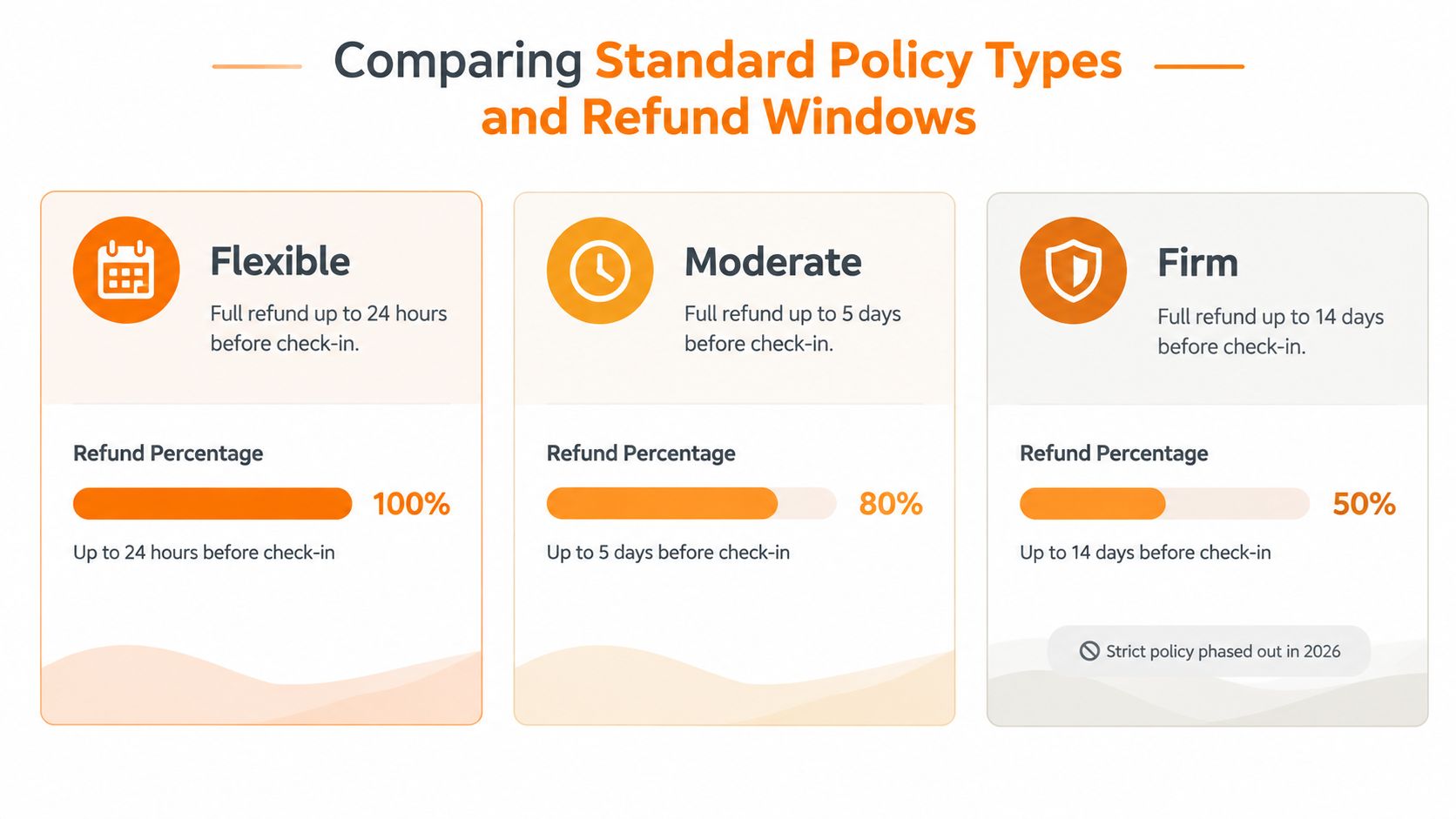
Flexible terms can reduce hesitation and attract guests whose plans may change. Firm terms protect revenue after the deadline, although they can make a property harder to book for risk-conscious travelers. Moderate terms balance those pressures and often fit properties that need occupancy without leaving peak inventory exposed.
| Policy Type | Free Cancellation Window | Penalty After Window | Best For |
|---|---|---|---|
| Flexible | Longer free-cancellation period, subject to the platform's displayed terms | Lower retained amount after the deadline | Urban listings, last-minute demand, and guests who value flexibility |
| Moderate | Intermediate deadline and refund structure | Partial retention after the deadline | Properties balancing occupancy with revenue protection |
| Firm | Shorter free-cancellation period | Greater retention after the deadline | Scarce peak dates, advance-planned stays, and inventory that's difficult to replace |
Use the table as a comparison tool, not as a promise of one universal refund percentage. Open a sample booking on every active channel and check the exact deadline, refund, service-fee treatment, and payment wording shown to the guest. A house rule that repeats only “Firm” leaves room for disputes.
Why stricter isn't automatically better
Research involving more than 500 U.S. hotels found that moderate cancellation policies produced the strongest financial performance in the study, because both the cancellation window and penalty severity affect demand and revenue. The hotel policy study supports testing calibrated protection instead of selecting the harshest setting by default. A policy that protects one reservation can still reduce future conversion if guests see too much risk before booking.
The deadline deserves its own review. Experimental research involving 291 participants found that the cancellation deadline had a statistically meaningful effect on booking decisions, while the fee amount itself did not. A lenient deadline performed similarly to having no cancellation policy in that experiment. The booking-behavior research suggests adjusting the window first, then checking whether the penalty still matches the property's replacement prospects.
Operationally, record the policy version used at booking. Platforms may apply a new 24-hour grace period, an exception, or another payment rule even when your selected tier remains unchanged. Keep the deadline and consequence visible in the listing, confirmation, and pre-arrival messages. Tools such as ScanStay can help keep those explanations consistent across guest-facing materials, reducing disagreements before cancellation occurs.
The same discipline applies outside accommodation. A refund may exclude certain charges or follow a different return process, so shoppers should check return conditions for covers before ordering.
How Airbnb and Booking.com Enforce Policies Differently
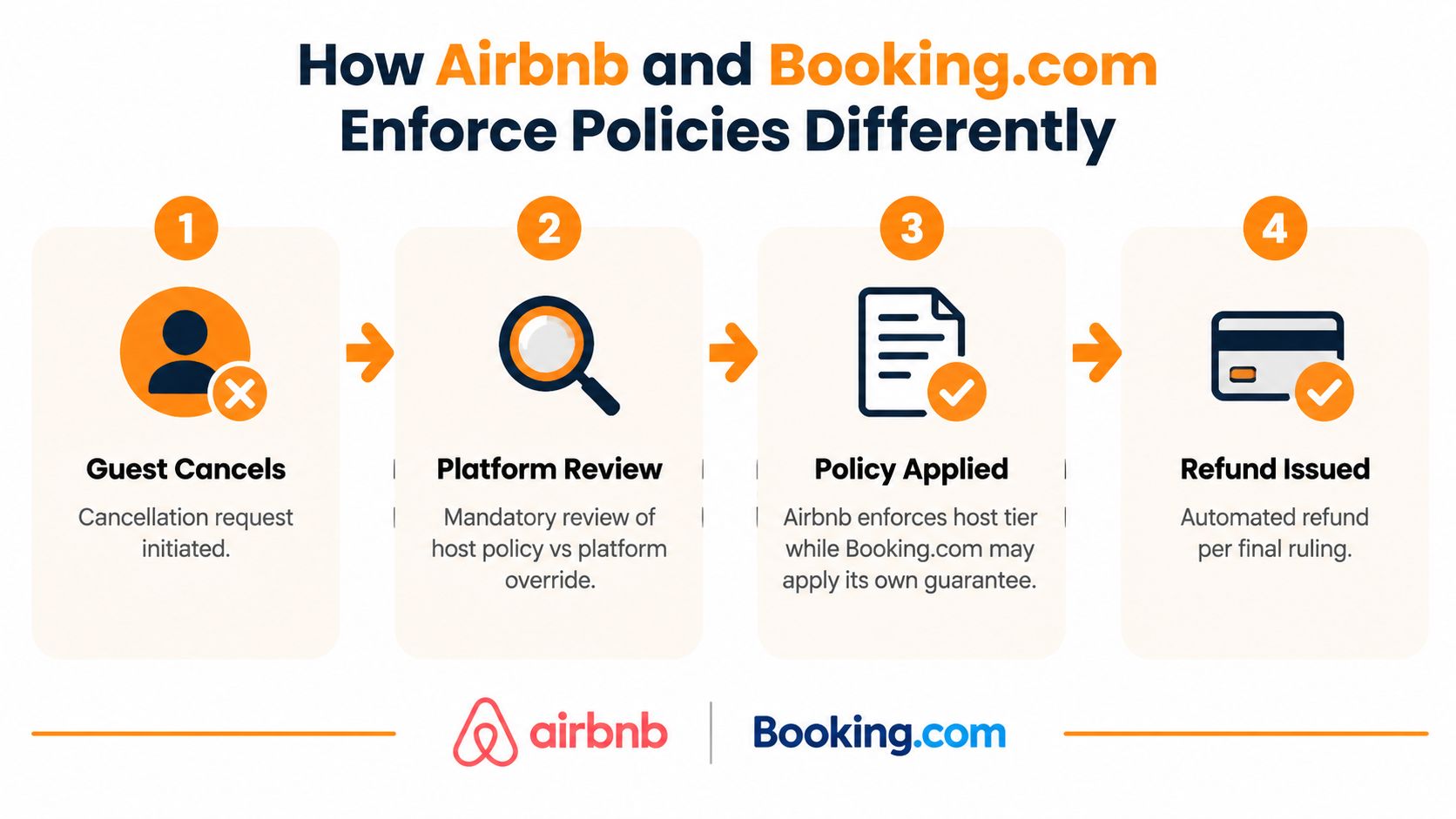
Hosts who distribute the same property across Airbnb and Booking.com often discover that identical wording doesn't produce identical outcomes. Each marketplace controls its own booking flow, cancellation display, payment handling, and exception process. Your internal policy may be consistent, but the guest's contract is formed through the platform where the reservation was made.
A major operational change affects many Airbnb-style short stays. Starting October 1, 2025, a mandatory 24-hour free-cancellation grace period applied to many bookings for stays under 28 nights when the reservation was made at least seven days before check-in, according to the platform-policy analysis from Beyond Pricing. That rule can apply even when a host selected a firmer standard policy.
Airbnb requires a grace-period check
For an Airbnb reservation, the booking lead time matters before the host's chosen tier does. A reservation made sufficiently far ahead may enter the 24-hour grace period. A reservation made inside the seven-day lead-time condition may be treated differently, so the same policy label can produce different outcomes across bookings.
Hosts should verify the cancellation preview for each reservation rather than calculate refunds manually. Check the accommodation amount, taxes, cleaning charge, service fee, payout status, and the exact cancellation timestamp. The platform may decide which components return to the guest, and a host shouldn't state that every charge will be refunded unless the platform shows that result.
Instant Book adds another source of confusion. Confirmation can happen before the host has reviewed the guest's plans, so the cancellation clock and payout assumptions begin immediately. A clear operating routine, including a reservation audit and channel-calendar synchronization, matters more than a strong policy label. Hosts who need a plain explanation of the platform's broader workflow can review how Airbnb works for hosts.
Booking.com rewards careful configuration
Booking.com commonly gives properties more control over rate plans and cancellation conditions, but that control creates configuration risk. A host can publish different terms for different offers, such as a flexible rate and a nonrefundable rate. If the channel manager maps those products incorrectly, the guest may book under conditions the host didn't intend.
For both platforms, keep a written record of the rule shown at booking. Save the reservation confirmation, the cancellation screen, and messages that explain the outcome. Don't move a dispute into an improvised private agreement before checking the marketplace's official process. Platform enforcement can override a host's preferred result, and the evidence trail helps support staff understand what the guest saw.
Choosing the Right Policy for Your Property
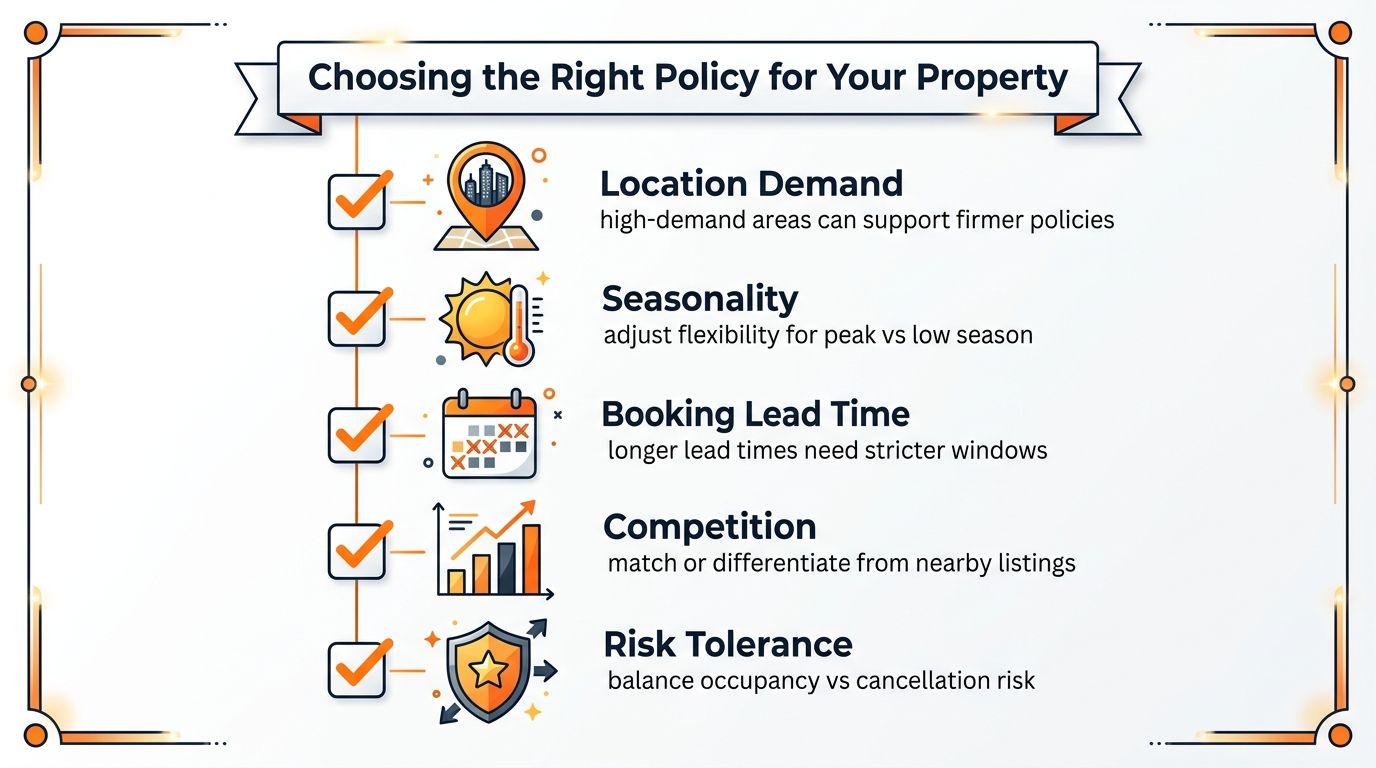
The right cancellation policy starts with the property's replacement risk, not with a preference for being lenient or strict. An urban apartment near business activity may refill a canceled night quickly. A remote cabin with limited transport access, seasonal demand, and longer preparation time may need stronger protection for advance reservations.
Use these questions before changing a setting:
How quickly can you replace a canceled date? Review your own booking history by season and lead time. If replacement demand is dependable, flexibility may support more bookings. If dates routinely remain empty after a late cancellation, a firmer window may be justified.
What does your calendar sell? A single city-night and a multi-night rural stay carry different risks. Long stays can create a larger inventory gap, while short stays may be easier to refill with a nearby arrival.
When do guests usually book? Long-lead reservations give you more time to resell a canceled date, but they also leave more time for plans to change. Short-lead inventory may need a clear cutoff because the resale window is narrow.
What happens during peak season? Apply policy choices to demand patterns, not assumptions. A calendar that sells out months ahead can support firmer terms for scarce dates, while low-season dates may benefit from a more welcoming window.
What does the competition display? Compare the actual guest-facing deadlines and rate differences in nearby listings. Matching the market can reduce friction. Differentiating with a clearer or more flexible offer can help when your property lacks a location advantage.
Use the deadline as the first adjustment
The hotel research cited earlier found that moderate terms often balance conversion and revenue protection better than extremes. The experimental booking research also found that travelers reacted more strongly to the cancellation deadline than to the fee amount. Together, those findings point to a practical sequence: choose a defensible policy tier, then adjust the deadline before increasing the penalty.
A shorter deadline isn't automatically stronger protection if it prevents the guest from booking.
Track cancellations qualitatively if your software doesn't provide detailed reporting. Note the booking source, arrival season, time between booking and cancellation, and whether the date was resold. After enough operating experience, those records reveal whether your policy is protecting revenue or merely creating refund arguments.
The Hidden Cost of Host-Initiated Cancellations
Guest cancellations attract attention because they involve refunds. Host cancellations can be more damaging because the operator may lose the reservation, the payout, marketplace standing, and the guest's trust at the same time.
A host-initiated cancellation can result from overbooking, a channel-sync failure, urgent maintenance, a safety concern, or a genuine force-majeure event. The platform may distinguish among those situations, but an emergency explanation doesn't automatically erase the consequences. Current short-term-rental guidance highlights possible fees, withheld payouts, listing suspension, and reputational impact, while the details depend on the platform and circumstances. This analysis of host-side cancellation risk addresses the operational gap that guest-focused guides often overlook.
Prevent the avoidable cancellations
The most expensive host cancellation is usually the one caused by a preventable process failure. A multi-channel operator needs one reliable availability source, fast calendar updates, and a defined response when two reservations appear for the same dates.
Build a simple control routine:
- Audit every channel: Confirm that Airbnb, Booking.com, direct bookings, and any channel manager show the same inventory.
- Protect maintenance blocks: Close dates before contractors or inspections are confirmed, not after work begins.
- Escalate safety issues immediately: Keep records such as repair notices, inspection findings, and relevant guest communications.
- Review exceptions through support: Ask the platform how it classifies the event before promising the guest a result.
If you must cancel, contact the guest quickly and take responsibility without blaming them or another marketplace. Explain what you know, state the refund process accurately, and offer practical assistance with alternative accommodation only if you can do so reliably. Don't suggest that the guest cancel on your behalf to avoid host penalties. That approach can create a misleading record and worsen the dispute.
Operational discipline protects more than one payout. Repeated host cancellations can affect discoverability, status benefits, and future booking confidence. Platform rules are not uniform, and a 2026 guide on policy standardization notes that hosts increasingly need to account for differences based on booking lead time, jurisdiction, and marketplace configuration. The 2026 policy overview is a useful reminder to review settings across the portfolio instead of assuming one global rule applies everywhere.
Publishing and Presenting Your Policy Clearly
A cancellation policy only protects the business when the guest can find and understand it before booking. Put the same core explanation in the listing, the reservation confirmation, the pre-arrival message, and the digital welcome material. The wording can be shorter in each location, but the deadline and consequence must remain consistent.
Use plain language instead of legal shorthand. A useful guest-facing format is:
- Free cancellation: State the exact date and local time.
- After the deadline: Explain the retained amount or refund treatment.
- Platform rules: Note that the marketplace may apply grace periods or exceptions.
- Questions: Give guests one channel for clarification before arrival.
Avoid burying the rule beneath a long house manual. Bold the deadline, use bullets, and distinguish accommodation charges from taxes, service fees, and optional extras when the platform treats them differently. Don't write “standard terms apply” if the guest must open several pages to discover what those terms mean.
Keep the guest version synchronized
Your booking confirmation should repeat the rule the guest accepted. The pre-arrival message can restate it without sounding threatening: “Your reservation follows the cancellation terms shown at booking. If your plans change, please review the platform's cancellation screen before submitting the request.”
A digital welcome book can hold cancellation terms beside check-in instructions, house rules, Wi-Fi details, local recommendations, and service information. ScanStay provides a QR-code-linked mobile page that hosts can use for this kind of guest information, with no app required, and it supports content reuse across properties and AI translation in 18 languages. Place the QR poster where arriving guests will see it, but don't rely on it as the only disclosure. Guests need the policy before booking, not only after they arrive.

Keep dated copies of the published wording whenever you change a policy. That record helps you answer “What did I agree to?” with evidence rather than memory. It also exposes mismatches between your direct-booking agreement and marketplace terms before a guest finds them.
Message Templates for Common Cancellation Scenarios
Cancellation messages work best when they do three things in order: acknowledge the guest's situation, state the applicable rule, and explain the next action. Keep emotion out of the wording, even when the request arrives during a high-demand period.
Declining a refund outside the window
Hello [Guest name], I'm sorry your plans have changed. Your reservation is now outside the free-cancellation deadline shown at booking, so the platform's stated cancellation terms apply. Please submit the cancellation through [platform], and I'll review any amount the platform releases or retains according to that calculation.
This wording avoids arguing about fairness and doesn't promise a refund you can't control. If the guest asks for an exception, send a separate response:
I understand the situation. The published policy applies to this reservation, but I can review whether a goodwill adjustment is practical after the dates are released and any replacement booking is confirmed. I can't guarantee an exception in advance.
Offering a discretionary partial refund
Use this only when you can afford it and can define the limit:
I'm sorry this booking no longer works for you. The reservation falls outside the free-cancellation period, but I'm willing to offer [specific goodwill amount or portion] if the platform permits that adjustment. This would be a discretionary gesture and would not change the cancellation terms attached to future reservations.
Don't describe a discretionary payment as something the policy requires. That distinction protects consistency across guests.
Host cancellation or serious disruption
Hello [Guest name], I'm contacting you because an issue at the property means I can't provide the accommodation as booked. I'm sorry for the disruption. I've contacted [platform] to process the available refund and confirm the next steps, and I'll share the support case details as soon as I receive them.
Document maintenance, safety, or emergency circumstances before contacting support. Avoid telling the guest to cancel for you, blaming another guest, or making claims that you can't prove.
For more reusable wording, adapt these Airbnb message templates, then tailor the platform name, dates, and actual refund status to the reservation.
ScanStay gives hosts one QR-linked digital welcome book for cancellation terms, house rules, check-in details, and other guest instructions, helping keep information consistent across properties. Visit ScanStay to see how you can publish clearer guidance and reduce avoidable cancellation disputes.