South Lake Tahoe Vacation Rental Ordinance Explained
Understand the South Lake Tahoe vacation rental ordinance, from the 900-permit cap and permit process to noise, occupancy, and tax rules every host must follow.

South Lake Tahoe's Vacation Home Rental Ordinance 2026-1203 took effect on April 23, 2026, and it replaced the old 150-foot spacing rule with a hard cap of 900 VHR permits in residential areas, plus a minimum renter age of 25. If you own or manage a short-term rental there, the question isn't whether the rules changed. It's whether your property can still get, keep, or lose a permit under the new cap.
You're probably staring at a listing, a renewal calendar, or a guest complaint and trying to sort out what matters first. The answer is blunt, the city now controls supply through permit scarcity and controls risk through daily guest behavior, which means your permit status and your operating habits both matter every day.
Table of Contents
- What South Lake Tahoe Hosts Are Up Against
- What the Ordinance Covers and Who It Exempts
- How the Permit Process and 900-Permit Cap Work
- Daily Operating Rules Every Host Must Follow
- Enforcement, Violations, and Permit Risk
- Why Compliance Now Lives in the Guest Experience
- A Step-by-Step Compliance Checklist for Hosts
- Strategic Takeaways for Hosts and Buyers
What South Lake Tahoe Hosts Are Up Against
A host feels the change fast. One week the property follows a familiar short-term rental routine, the next week a permit cap and stricter enforcement change every decision around it. From that point on, each booking raises a hard question, can this home still operate legally tomorrow morning?
That is what the south lake tahoe vacation rental ordinance means today. The city now controls supply through a hard cap of 900 VHR permits and controls risk through daily guest behavior, which changes how hosts think about renewals, acquisitions, pricing, and even whether it makes sense to invest in upgrades before the permit picture is clear. The city's own VHR page and FAQ still point hosts to permit contacts and code requirements, which tells you the administrative side still matters, not just the zoning side (city VHR page, city FAQ).
Beyond legality
If you're a legacy host, the first issue is whether the property still fits inside the permit system, and if it does not, whether there is any path back in. That is why the old “is short-term rental allowed here?” question is too simple. The better questions are whether a permit is available, whether renewal is realistic, and whether the property can survive the city's operating rules long enough to keep that permit.
The permit cap changes the economics of the market. Scarcity affects what hosts can do with a property, and compliance risk affects what they can keep. If you are comparing options or trying to understand how regulated properties get valued, it helps to look at resource-style guidance from a financing perspective, such as see First Internet Bank's SBA ranking, because supply limits and operating compliance both shape the numbers.
Practical rule: treat permit status like an asset, not a checkbox. If you do not know where the permit stands, you do not know what you own.
The city's messaging still leaves a gap, and that gap matters. Hosts need more than a rule summary. They need to know what happens when the cap is full, how re-entry works, and how to keep a permit alive once they have it. That is the lens that makes the rest of this ordinance usable.
What the Ordinance Covers and Who It Exempts
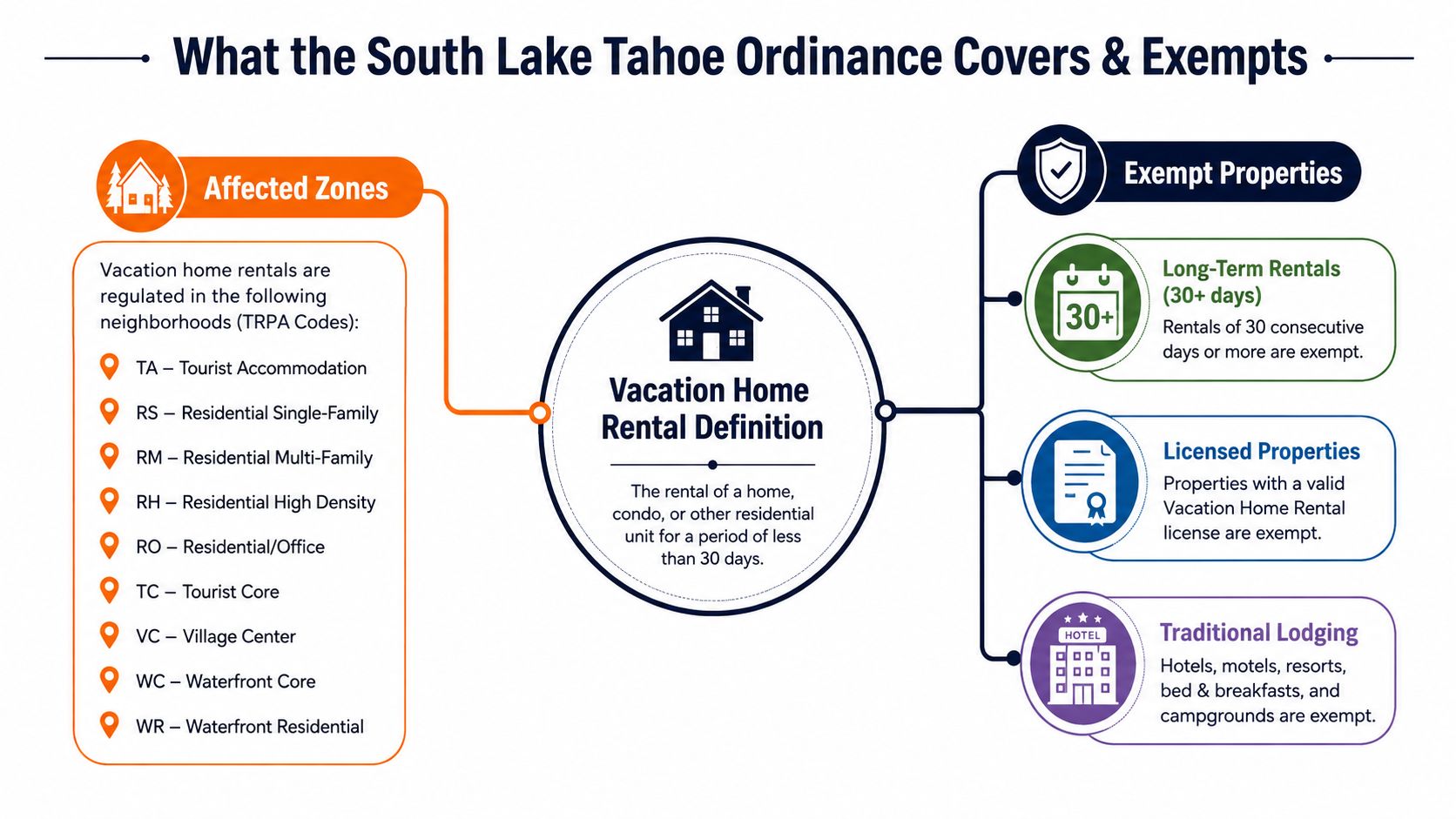
The city's framework is plain once you cut through the legal language. A vacation home rental, or VHR, is the short-term rental category the city regulates through its code and permit system, and the city's FAQ says a permit is required to operate one under City Code section 3.50.380(B) (city FAQ). If your property is rented for fewer than 30 days, the VHR rules should be treated as the default unless a clear exemption applies.
Start with three questions
Ask these in order.
- Is the property even a VHR? If it's a long-term rental of 30 days or more, it sits outside the short-term rental framework. Licensed hotels and traditional lodging are also in a different bucket, and the city's own materials separate those uses from VHRs. A practical definition of a short-term rental is laid out in ScanStay's short-term rental guide.
- Is it in the regulated zone? The city's current residential-area controls are the issue, not just whether a home exists in South Lake Tahoe. The ordinance is built around where permits may be issued and how many can exist.
- Does the booking meet the occupancy and age rules? Under the current ordinance, the primary renter must be at least 25, residential occupancy is 2 people per bedroom, and up to five children aged 13 and under can be excluded from that count (city ordinance page).
That occupancy formula is where many hosts get sloppy. A listing that “feels right” is not enough. The booking must fit the adult count and the child exclusion logic, or you are building a violation into the reservation before anyone checks in.
Exemptions are narrower than people think
The best mistake to avoid is assuming “not a hotel” means “regulated like a hotel.” It doesn't. The city carves out long-term rentals and licensed lodging, but the working test is still whether the property is being used as a short-term VHR and whether the permit requirement applies. If the host is unsure, verify before advertising. Waiting until the first guest is already on the road is how problems start.
The core challenge is more operational. Hosts need more than a rule summary. They need to know what happens when the cap is full, how re-entry works, and how to keep a permit alive once they have it. That is the lens that makes the rest of this ordinance usable.
How the Permit Process and 900-Permit Cap Work
The permit process now matters more than the old buffer rule ever did, because the city has turned access into a scarce administrative asset. South Lake Tahoe's current system is built around the 900-permit residential cap. That cap is the actual constraint, and it changes the value of every home that can still clear the city's approval process.
What the cap replaced
The old rule was a 150-foot spacing buffer outside the Tourist Core Area Plan. Under that regime, the city reportedly denied 270 applications because of the buffer rule, which tells you how blunt and litigation-prone the old system had become (KCRA coverage). The new system works differently. Instead of measuring distance between properties, the city now counts permits and manages access through a hard ceiling.
| Element | Prior Spacing Rule | 2026-1203 Ordinance |
|---|---|---|
| Control method | 150-foot buffer outside the Tourist Core Area Plan | Hard cap of 900 VHR permits in residential areas |
| Practical effect | Location-based denial risk | Permit-availability scarcity |
| Host concern | Proximity to existing VHRs | Whether a permit is available at all |
| Planning issue | Siting and spacing | Re-entry, renewal, and waitlist pressure |
What hosts should do now
The permit workflow still runs through the city's official contacts and application process, and the city FAQ points applicants to the required permit channel (city FAQ). The question is not whether the form exists. It is whether your property can get a permit and stay inside the cap.
A host who waits until renewal week to ask about availability is already late.
That warning matters most for legacy permit holders. A lot of coverage treats the ordinance like a debate over whether short-term rentals are legal in the abstract. The core issue is operational. Can a former permit holder get back in, or has the cap already become a gate that closes behind the active inventory?
For owners and buyers, that changes the value proposition. A property with a permit carries a different value proposition than a comparable home without one. One has a place inside a capped system. The other is a bet on administrative opening, timing, and whatever the city decides next.
Daily Operating Rules Every Host Must Follow
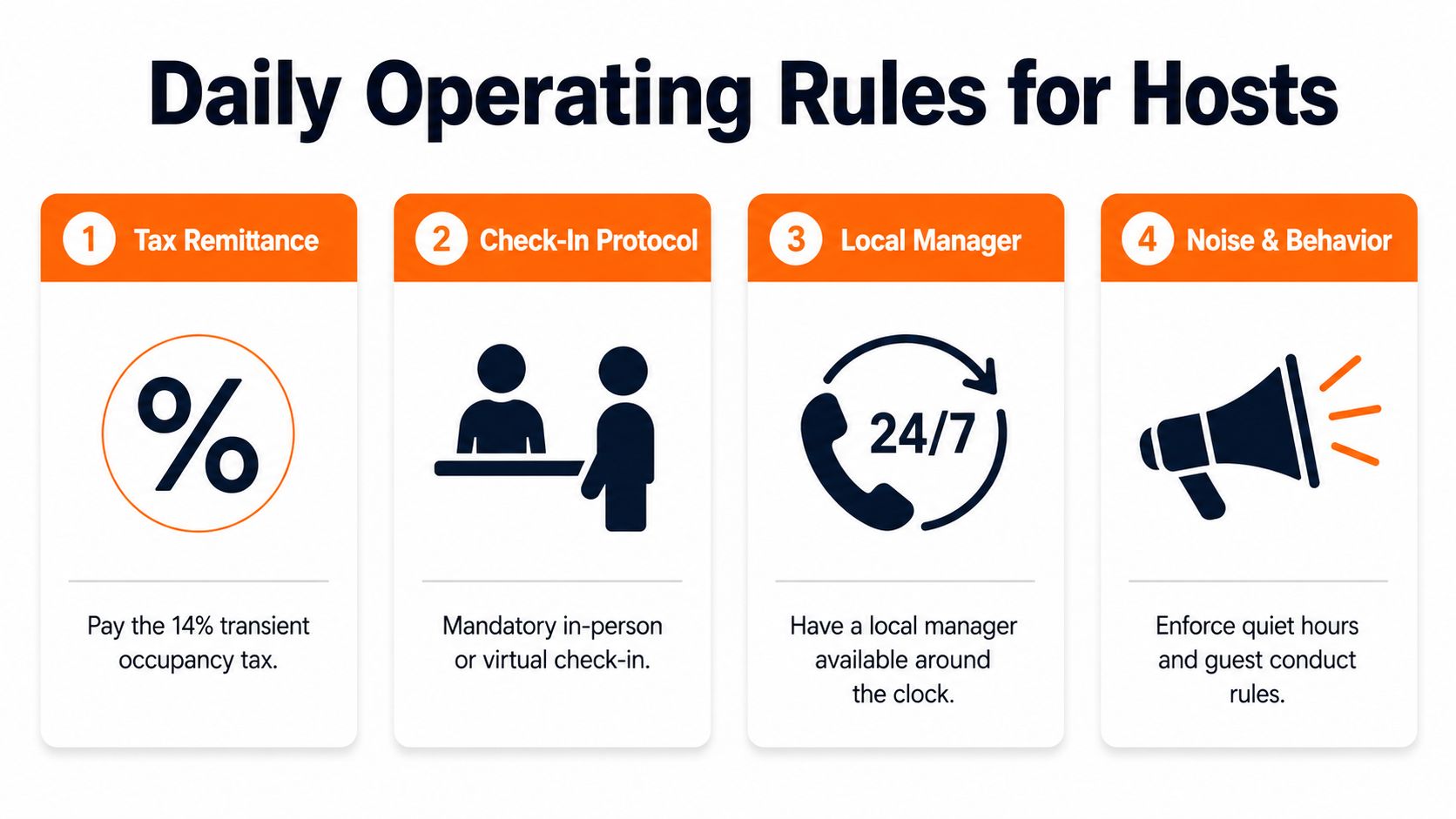
A permit is not the finish line in South Lake Tahoe. It is the start of daily discipline, and the city expects that discipline to show up in taxes, guest screening, local contact coverage, parking, and noise control every time the home is occupied. The part most owners miss is simple. A permit can be lost through bad operations long before anyone questions the legality of short-term rentals in the abstract.
The money piece is immediate. Hosts have to account for the 14% transient occupancy tax, and that tax sits directly on short-term rental revenue. That tells you what the city is really regulating here. It is not just access to the market, it is control over how the market behaves once a guest checks in.
Operating requirements that matter most
A host routine has to be built around the rules that create the most risk on an ordinary night.
- Tax remittance: file and pay the 14% TOT on schedule.
- Check-in control: use in-person or virtual check-in so the right adult takes responsibility for the reservation.
- Local manager access: keep a 24/7 local property manager available for issues.
- Occupancy and behavior: enforce the bedroom-based occupancy limit and stop the reservation from drifting into party behavior.
- Noise control: use indoor noise monitoring, exterior cameras where required, and respect the 10 p.m. cutoff for amplified outdoor music.
- Parking and trash: keep vehicles within the site's capacity and make sure trash carts follow the pickup rules.
The city also expects hosts to handle guest registration without sloppiness. If the reservation record is incomplete or the guest list is loose, you are creating the kind of paper gap that makes enforcement easier. A clear guest registration process helps keep the stay aligned with the permit record (guest registration guidance).
The point is not to memorize every clause. The point is to run the home so violations are hard to trigger in the first place.
What compliant and non-compliant look like
A compliant stay starts before arrival. The guest gets a pre-arrival message, sees the house rules, knows where to park, and understands who to contact if something goes wrong. That cuts down on avoidable friction, which matters because most complaints start with confusion, not malice.
A weak operation looks different fast. Extra cars, no clear adult contact, vague check-in instructions, and a guest who never hears about the music cutoff all set up the same outcome, a complaint that lands on the host instead of the guest. A current guest guide and a written response plan do more for compliance than last-minute reminders ever will. The city's own guidance on guest compliance points in that direction, and so does the permit process itself (guest compliance guide).
Operational truth: most violations don't start with bad intent. They start with bad instructions.
Enforcement, Violations, and Permit Risk
South Lake Tahoe enforcement is not abstract. It starts with complaints, and complaints usually come from the people living next door, then code enforcement or city response systems turn that call into a case. A late-night party, a trash cart left out, or a booking that doesn't match the permit record can all trigger the same basic outcome, attention you don't want.
Small mistakes become permit problems fast
The danger is not just the original violation. It's the pattern. One guest who parks badly is manageable. Repeat complaints about noise, parking, or occupancy start to look like an operational failure, and that's where permit risk rises.
The city's operating framework makes enforcement effective because each rule is easy to observe in the field. A car blocking the wrong spot, a speaker carrying past the cutoff, or an unregistered reservation are all visible failure modes. Once neighbors complain, the host is no longer dealing with a private inconvenience, they're dealing with a documented problem.
What usually goes wrong
- Late-night noise: one noisy stay can pull in a complaint that leads to more scrutiny on the property.
- Trash left at the curb: it seems minor, but it signals poor management and can keep the complaint cycle alive.
- Unregistered booking: if the permit status or guest record is off, the city doesn't need a dramatic incident to act.
- Repeated occupancy issues: too many people in the home makes every other rule harder to defend.
The city and third-party coverage both point to escalating enforcement tools, including permit-related consequences for repeat issues (KCRA coverage, guest policy summary). That's the part many owners ignore. The first mistake is rarely fatal. The second or third one is what gets a permit dragged into a hearing.
If you want the blunt version, this is a compliance business that happens to involve real estate. The city doesn't need perfection. It needs evidence that the host is serious about control.
Why Compliance Now Lives in the Guest Experience
The ordinance shifts the burden from code knowledge to guest management. That's the part most hosts still underinvest in. You can know every rule and still lose the permit if your guests keep tripping the same violations because no one built a system that tells them what to do.
The city's controls, check-in, occupancy, parking, noise, and local manager availability, only work when the guest sees and follows them. That means compliance is now a product design problem. The host has to shape behavior before arrival, not just react after the complaint.
Where the guest experience does the heavy lifting
Use the same discipline you'd use for onboarding a new employee. Pre-arrival instructions need to be short, visible, and unavoidable. House rules should be easy to scan on a phone, parking instructions should be tied to the actual driveway or garage layout, and noise expectations should be repeated before the stay begins.
A digital welcome book is a practical fix because it centralizes the details guests forget. A QR code on-site works better than a binder nobody opens. Pre-arrival messages work better than assuming the booking platform's default email is enough. That's why structured onboarding matters so much in regulated markets, as discussed in ScanStay's welcome book guide.
If your guest has to ask three times where to park, your system is already too vague.
The contrarian point is simple. Tighter rules can increase the value of better onboarding. Hosts who make the rules obvious reduce complaints, lower friction, and protect the permit they've already fought to get. Hosts who treat compliance as paperwork keep discovering too late that enforcement target is guest behavior.
A Step-by-Step Compliance Checklist for Hosts
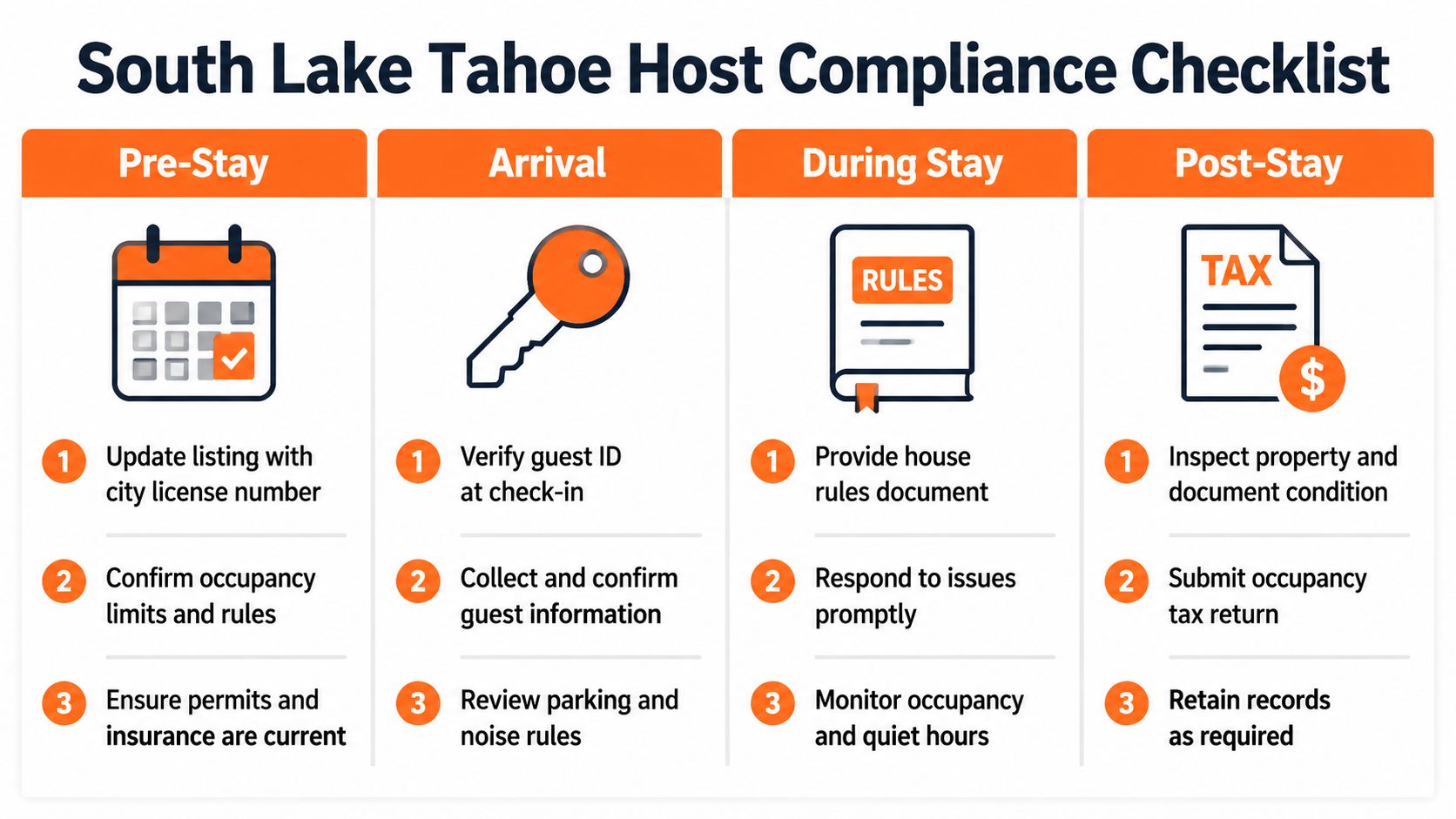
Use this before every stay. Use it again after every stay.
Pre-Stay
- Confirm the permit is active and the file is in good standing.
- Verify the primary renter is 25 or older.
- Send house rules, parking instructions, and check-in details before arrival.
Arrival
- Complete the in-person or virtual check-in.
- Confirm the number of guests matches what the property can legally hold.
- Make sure the guest knows the local manager contact.
During Stay
- Keep occupancy, parking, and noise rules visible in the guest guide.
- Watch for noise alerts and respond quickly.
- Remind guests about the 10 p.m. cutoff for amplified outdoor music.
Post-Stay
- Check trash carts and exterior cleanup.
- File and remit TOT on schedule.
- Log any complaints, alerts, or guest rule issues for the next stay.
- Run a post-stay noise check, then note whether the property needs a tighter reminder set before the next turnover.
If you need the city side of the process, pull the current permit forms, contact details, and filing instructions from the city's own materials, as noted earlier, so you are not working from a stale summary.
Strategic Takeaways for Hosts and Buyers
The 900-permit cap is not a temporary hiccup. It's a structural feature of the South Lake Tahoe market now, and it changes how you should think about buying, renewing, and exiting. A permitted property carries a different value proposition than a comparable home without permit access, because administrative scarcity is now part of the asset.
That means two things. First, don't underprice the value of a valid permit if you already have one. Second, don't overpay for a property that only works if the city eventually opens a path that may never come. The right cleaning, turnover, and guest-control systems matter too, because they protect the permit that makes the whole model work, and if you're deciding how to structure those operations, a practical reference on pricing and outsourcing cleaning can help frame the labor side of the business.
The hosts who win here are the ones who treat compliance as part of the guest experience, not an afterthought. Keep the permit safe, keep the guest informed, and keep the property boring from an enforcement perspective. That's how you protect reviews, operations, and property value at the same time.
If you want a cleaner way to manage guest instructions, house rules, and turn-by-turn onboarding for a South Lake Tahoe rental, visit ScanStay and see how a single QR-code guest guide can reduce confusion before it becomes a complaint. It's a practical way to turn compliance into a routine guests can follow, which is exactly what this market now rewards.