Multilingual Content Management: A 2026 Guide
Master multilingual content management for short-term rentals. Learn to plan, translate, and automate guest guides to boost reviews and cut support messages.
You know the moment. It's 2:07 a.m., a guest has arrived late, they can't find the Wi‑Fi password, the house manual is in English, and your phone is getting a stream of confused messages in broken translation. That's not a guest-service glitch, it's a content operations problem, and multilingual content management is what keeps it from repeating across every property and every market.
For short-term rentals, translation can't live in a dusty PDF or a one-off message template. It has to sit inside the way you publish house rules, check-in steps, upsells, emergency notes, and neighborhood recommendations, because guests need the right language at the exact moment they need the answer. The portfolios that scale cleanly are the ones that treat language as part of the operating system, not a last-minute add-on.
Table of Contents
- Why Multilingual Content Management Drives Rental Revenue
- Identifying Your Target Languages and Markets
- Choosing Between AI Translation and Human Localization
- Building Reusable Templates for Scalable Updates
- Integrating Guides with QR Platforms and QA Checks
- Maintaining Freshness Through Automated Workflows
Why Multilingual Content Management Drives Rental Revenue
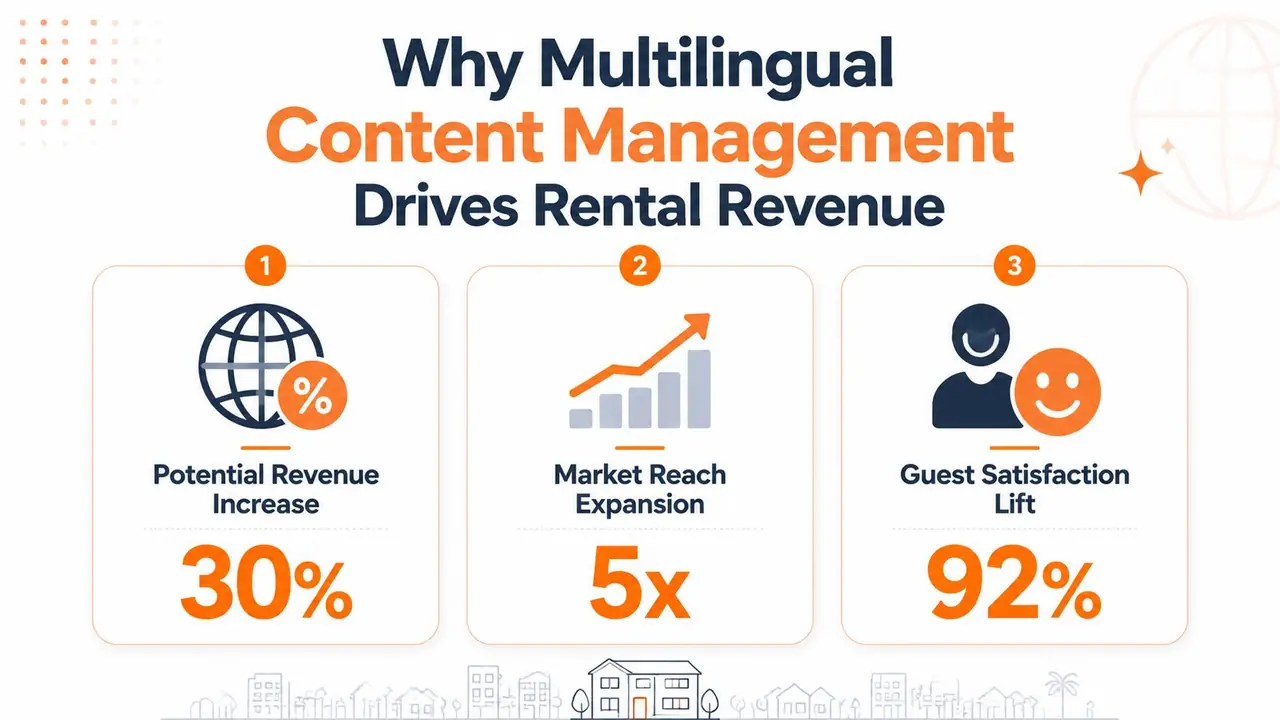
The fastest way to lose a booking isn't always a bad photo or a weak headline. Sometimes it's a guest who lands on your listing, likes the property, but hesitates because the arrival instructions, house rules, or payment terms are unclear in their language. That hesitation is exactly why multilingual content management belongs in revenue conversations, not just service conversations.
The business case is bigger than courtesy. A Liferay survey found that 40% of content managers create or manage content in more than one language, and among those, 56% handle three or more languages while 12% handle six or more Liferay. Once teams enter that kind of workflow, the job stops being “translate this page” and becomes a coordination challenge, because every update has to stay consistent across versions. That's where rental operators get burned, especially when check-in procedures, policy language, or local recommendations change faster than the translation process.
For distribution, the major CMS platforms already reflect this reality. WordPress powers about 43% to 44% of all websites, while Drupal supports 94 languages and Joomla supports 75 languages Liferay. Those numbers matter because they show multilingual publishing has moved into standard infrastructure, not niche tooling. In hospitality, that means the question isn't whether you can support multiple languages, it's whether your content system can keep pace with how often your guest-facing details change.
Practical rule: if a guest message can trigger a phone call, a refund request, or a bad review, it deserves localization before it reaches the room.
The revenue angle is also visible in broader market data. A 2024 outlook estimated the global multilingual content management software market at USD 2.8 billion in 2024, with a forecast to reach USD 8.5 billion by 2033, implying a 15.2% CAGR from 2026 to 2033 LinkedIn market outlook. That growth lines up with the University of Kent's forecast that language services and localization workflows will reach $65.5 billion in 2026 and $98.11 billion by 2028 LinkedIn market outlook. Smartling also cites research showing 86% of localized campaigns have higher conversions than English-only campaigns LinkedIn market outlook. For hosts and property managers, that doesn't mean every house rule needs a marketing rewrite. It does mean the content that shapes booking confidence and stay smoothness deserves the same operational discipline as pricing.
A better content system also reduces support load. If guests can read the basics in their own language, fewer of them will message you at night for details you already published. That's why rental revenue and guest satisfaction sit closer together than many teams admit.
For a related view on how this connects to pricing and stay economics, see vacation rental revenue management.
Identifying Your Target Languages and Markets
The wrong way to localize is to start with a list of “popular” languages and translate everything. That usually produces a pile of content nobody reads, while the primary demand signals sit inside your booking data, browser settings, and country-level traffic. The right way is much more boring and much more profitable.
Start with demand already visible in your data
Look at the markets that are already trying to book. Non-English browser settings, search behavior in the target language, and orders by country tell you more than a brainstorm ever will. Reform's guidance is simple and useful here, prioritize the roughly 20% of assets that drive about 80% of conversions, then expand based on what moves the numbers Reform.
For a rental business, that usually means the content closest to conversion and arrival. Pricing pages, booking steps, lead forms, check-in instructions, and cancellation rules matter more than a translated blog archive. If you're managing a portfolio across cities or countries, the high-intent markets often reveal themselves through repeated guest-origin patterns, not through guesses about global popularity.
Sequence by friction, not by ego
A common mistake is translating every paragraph because it feels thorough. It isn't thorough if the work delays the content guests need. Start with the markets that already generate demand, then localize the assets that remove booking friction first, especially the ones tied to payment, access, and pre-arrival clarity.
Don't start with the prettiest brochure copy. Start with the places where a confused guest is most likely to abandon the booking or call support.
A practical prioritization framework looks like this:
- Check market intent first: Use browser language settings, country-level booking patterns, and search queries to identify where guests are already showing interest.
- Rank the guest journey: Put booking-critical and arrival-critical content ahead of marketing fluff.
- Translate in layers: Move from core pages to supporting content only after the highest-friction moments are covered.
- Set a business outcome: Tie the rollout to conversion, retention, or support reduction, because translation without a metric turns into busywork.
That approach keeps the work bounded. It also helps teams avoid the burnout that comes from trying to launch too many languages at once, especially when each property has its own rules, quirks, and seasonal updates.
Choosing Between AI Translation and Human Localization
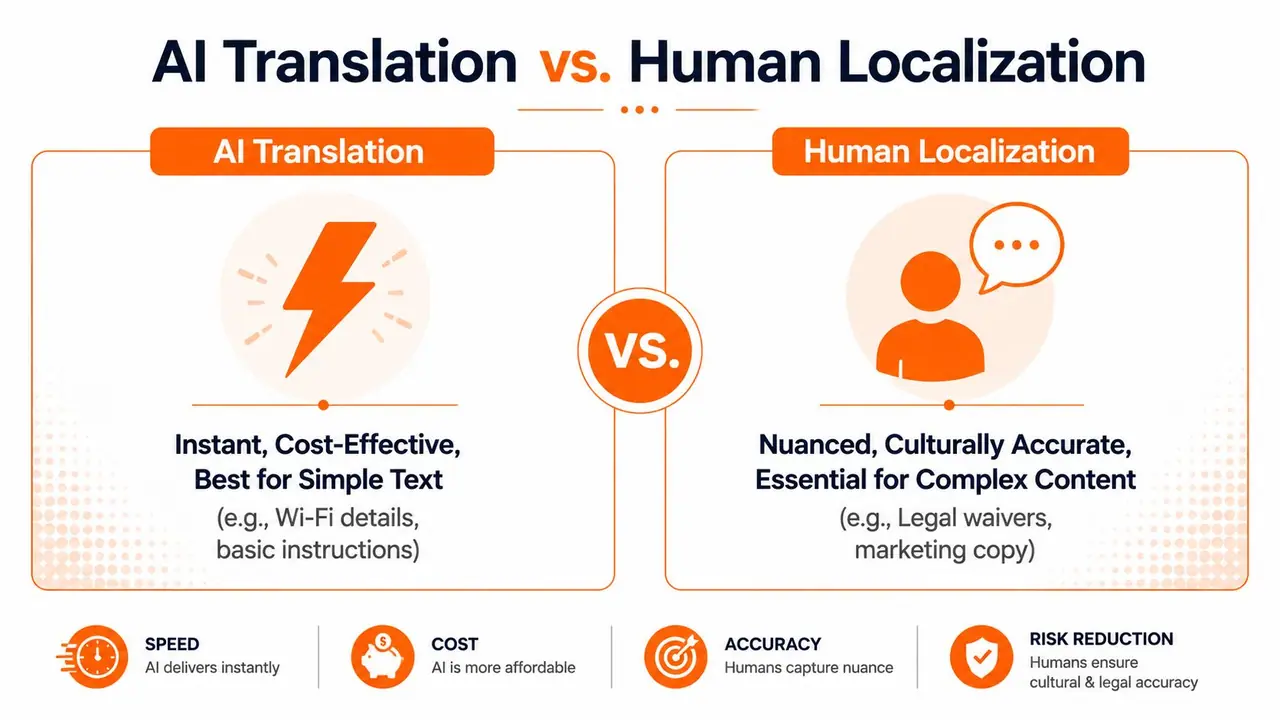
Not every line of rental content deserves the same treatment. A Wi‑Fi password can be translated quickly, but a liability waiver, emergency instruction, or refund policy needs a human who can catch nuance, legal risk, and tone. The useful question isn't “AI or human?” It's “which content needs speed, and which content needs judgment?”
Use automation where meaning is simple
AI translation can work well for short, factual content with low risk. Think network names, amenity labels, basic directions, or routine check-in reminders. In those cases, speed matters, and the phrasing tends to be straightforward enough that a machine draft can save time as long as someone checks the output before publish.
That said, simple text still needs context. If a translated line refers to “the back entrance,” “the second gate,” or “the blue key box,” the wording has to match the property layout exactly. Machine output can be fast, but it doesn't know whether your house rules use a shared entrance, a lockbox, or a host meet-and-greet unless you tell it.
Reserve humans for high-stakes language
Human localization matters when the stakes rise. Legal disclaimers, safety instructions, cancellation language, local etiquette, and marketing copy all benefit from someone who understands both the language and the guest expectation behind it. A machine can translate words. A localizer can adapt meaning so it still sounds natural and safe.
For property managers, that difference shows up in trust. Guests may forgive awkward phrasing in a nearby restaurant recommendation. They're much less forgiving when they can't understand a checkout penalty, pet policy, or emergency procedure.
A useful split is this:
| Content type | Better fit | Why |
|---|---|---|
| Wi‑Fi details, amenity labels, simple arrival steps | AI translation with review | Fast, factual, low ambiguity |
| House rules, liability language, emergency notes | Human localization | Nuance, legal sensitivity, clarity |
| Local recommendations, upsell copy, welcome messaging | Human localization or hybrid review | Tone matters, and so does cultural fit |
The practical balance is hybrid. Use automation to draft and speed up, then apply human review where the guest experience or legal exposure depends on precision. For the product side of this decision, what is language localization is a useful reference point.
For teams that want a visual comparison, the difference between the two approaches is easy to see in the guidebook itself.
Building Reusable Templates for Scalable Updates
Version drift is what happens when the English guide changes on Tuesday and the Spanish one still says last month's check-in process on Friday. In rentals, that's not a cosmetic issue, it's operational risk. Guests follow the wrong step, staff answer avoidable questions, and one outdated line can create five more support tasks.
Build one source of truth
A good multilingual system starts with a single canonical version of the content. That means property details, policies, and instructions live in one structured source, then get reused across languages instead of copied into separate files. WeBrand's guidance points to the same core idea, centralize assets, define workflows, and connect translation management so updates don't splinter across versions WeBrand.
The key move is modularity. Don't treat the welcome book like one giant page. Break it into pieces, such as check-in steps, appliance instructions, house rules, and local recommendations, so each piece can update independently. That's how you stop rewriting the entire guide every time the Wi‑Fi password changes or a new late-checkout option is added.
If a detail changes often, it should be its own block, not a line buried inside a long paragraph.
Use field-level updates instead of page duplication
Duplicating whole pages in every language is how teams create hidden chaos. One typo gets fixed in English, then the same fix has to be hunted down across each translated version. Field-level management avoids that trap because the update belongs to the content element, not the page copy.
That structure matters in short-term rentals because the same content gets reused across properties. A late-checkout upsell might be identical across a portfolio, while the parking note differs by building. Reusable templates let you separate the stable parts from the property-specific parts, which makes it easier to keep quality high without adding manual rework.
A simple template architecture usually includes:
- Canonical fields: Core facts that should stay the same unless the property itself changes.
- Reusable blocks: Shared sections like house rules, appliance help, and upsell prompts.
- Market-specific variants: Local recommendations, tone adjustments, and language-specific phrasing.
- Approval checkpoints: A final review before anything goes live in each language.
That's the point of the workflow. The template does the repetitive work, while people focus on exceptions, nuance, and compliance. For multi-property operators, that's usually the difference between a sustainable system and a spreadsheet with a translation problem.
Integrating Guides with QR Platforms and QA Checks
A guest can't use a great guide if they can't find it. In a rental setting, the best place for multilingual content is often the same place the guest already reaches for help, a QR code near the door, on the fridge, or inside the welcome packet. That turns a static document into a living reference that works in the moment of need.
Connect the guide to the guest journey
QR-based delivery solves a practical problem, access. Guests don't need an app, and they don't need to search through email chains for a PDF they forgot to save. ScanStay, for example, provides a digital guest book with multilingual content and AI translation, so hosts can surface Wi‑Fi, check-in steps, house rules, recommendations, and upsells through one mobile-friendly link ScanStay. In a short-term rental, that's useful because the content lives where the friction happens, not in a separate file that nobody opens.
A QR platform also makes updates easier to control. If the content changes, the live guide changes with it. That matters for things like lock instructions, emergency contacts, or seasonal rules, where stale information can become a nuisance fast.
The related setup details are covered in ScanStay's QR code generator guide, which is the natural companion to the multilingual content workflow.
Run a language and formatting QA pass
Translation quality is only part of the check. A guest-facing guide also has to survive formatting, cultural adaptation, and device rendering. Dates, currency markers, measurement units, and local etiquette all need a close look before publish, because a technically correct translation can still feel awkward or confusing if the presentation is off.
A solid QA checklist should include these points:
- Language selection: Confirm the guest sees the right language variant before the content loads.
- Formatting consistency: Check dates, times, and currency symbols for the target market.
- Layout behavior: Make sure longer translations don't break buttons, headings, or mobile spacing.
- Cultural fit: Review food, transit, local customs, and tone so the copy doesn't sound imported.
- Accuracy of property facts: Verify addresses, access steps, appliance names, and house rules against the current source.
A QR-delivered guide surpasses paper in this regard. You can correct a mistake once, then deploy the updated version across all units, eliminating the need to replace printed pages individually. For a portfolio manager, this approach saves time and reduces the risk of a single property falling out of sync with the rest.
Maintaining Freshness Through Automated Workflows
A static guide is already stale the day after a guest asks a question it should have answered. In rentals, freshness isn't a nice extra. It's the difference between a guide that gets used and one that gets ignored. The best multilingual systems keep themselves alive with review cycles, update alerts, and usage data.
Treat updates like operational maintenance
The content should change when the property changes. If the lock code process changes, the guide changes. If the local café closes, the recommendation gets edited. If a new service upsell becomes available, the relevant block gets updated in every language at the same time, not one week later after someone remembers the translation backlog.
That's where workflow governance matters more than translation talent. Gridly's guidance highlights the operational gap many teams miss, ownership, review cycles, and update tracking are often poorly defined even when the language quality is fine Gridly. In practice, that means someone has to own the change path from source text to published guest-facing content, or the system slowly drifts back into chaos.
The guide doesn't need more writing. It needs a cleaner update path.
Use scan behavior to refine what gets maintained
Once the guide is live, the usage pattern tells you what matters. If guests keep scanning the arrival instructions and rarely touch the local recommendations, that tells you where the operational pressure is. If one language version gets more traffic than the others, that's a sign to review whether the translation is accurate, visible, and easy to find and use.
This is also where automation helps with triage. Alerts can flag content that hasn't been reviewed in a while, or sections that receive repeated access after an update, which often means the copy isn't clear enough yet. The goal isn't to automate judgment. The goal is to automate the reminders that prevent stale content from lingering.
A workable maintenance rhythm looks like this:
- Monthly review of core guest-facing blocks to confirm rules, access notes, and upsells still match operations.
- Post-change review whenever a property detail, policy, or local recommendation changes.
- Language usage checks to see which versions guests open and where confusion may still exist.
- Support-message review to identify sections that still generate avoidable questions.
That cycle keeps the system honest. It also makes multilingual content management easier to defend internally, because you can show that the content isn't just translated, it's actively maintained.
If you want a cleaner way to run multilingual guest guides, ScanStay gives hosts a single QR-based place to publish house rules, Wi‑Fi, check-in details, and upsells in multiple languages. Visit ScanStay and see how a managed digital welcome book can replace paper binders, reduce repeat questions, and keep every property's guest information current.