Single Family Home Property Management: The Complete Guide
Master single family home property management with proven strategies for owners and hosts. Covers long-term rentals, short-term stays, KPIs, and modern tools.
You're probably dealing with the same thing every scattered-site owner ends up facing. A tenant texts that the AC is blowing warm, a vendor sends a quote you didn't ask for, rent is still missing, and the showing calendar keeps filling up because another house just went vacant. If that sounds familiar, the issue isn't that you need another generic checklist, it's that single family home property management is really a coordination business, and the coordination is happening across separate addresses, separate people, and separate problems.
Table of Contents
- Why Single-Family Management Is Its Own Discipline
- What Single-Family Home Property Management Actually Means
- Core Responsibilities Every Owner or Manager Owns
- Long-Term Rentals Compared to Short-Term Stays
- Legal, Compliance, and Maintenance Obligations
- The KPIs and Pricing Decisions That Actually Matter
- Tools and Workflows That Scale Single-Family Operations
- Best Practices, Common Misconceptions, and Your 30-Day Plan
Why Single-Family Management Is Its Own Discipline
A broken AC at one house, a late rent payment at another, and a vendor no-show at a third create a very different day than managing a 40-unit building. In a tower, you can centralize people, systems, and access. In a scattered portfolio, every problem has to be solved at the property level, which means every decision takes longer unless you've built a system that anticipates it.
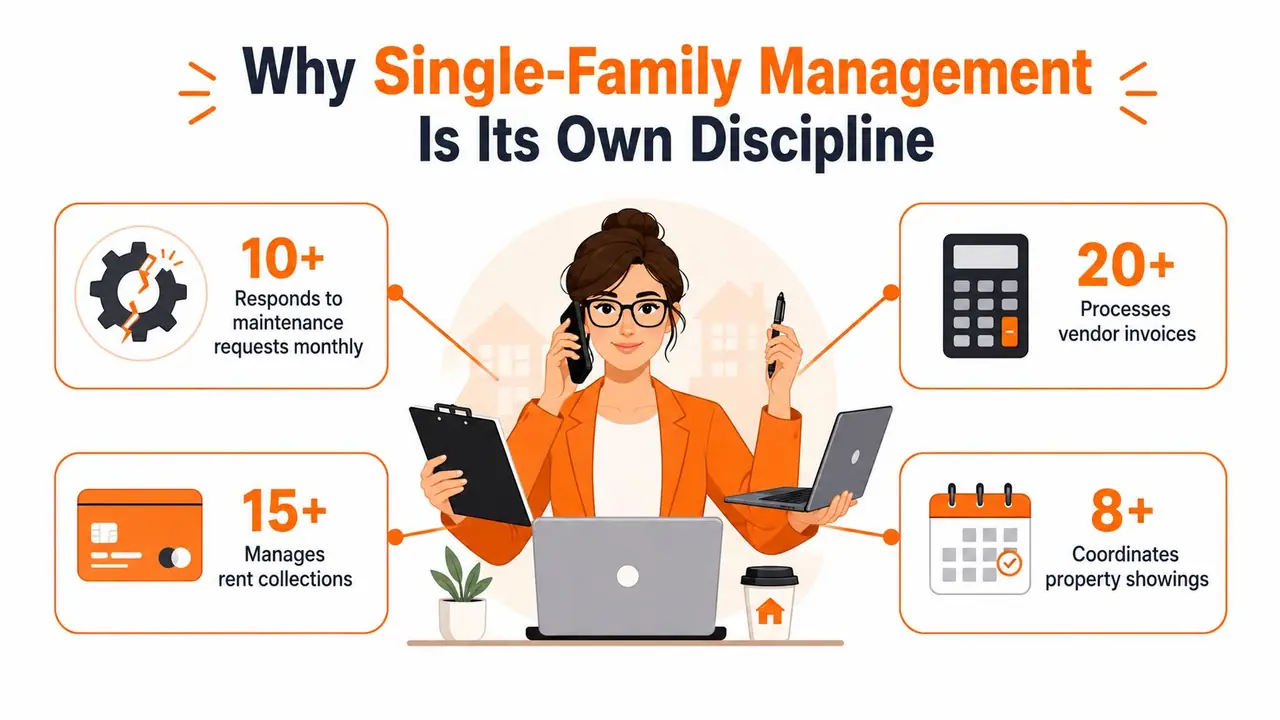
That's why I tell owners to stop thinking of this as “owning houses” and start treating it like a logistics operation. The U.S. rental ecosystem makes that clear, landlords owned 18.2 million rental units in 2024, and 88.5% of landlord-owned properties were single-family units, while landlords collected $428 billion in total rent that year, according to landlord statistics. Even a tiny reduction in friction matters when the workflow touches marketing, screening, collections, repairs, and tenant communication across dozens of separate addresses.
A good buy-and-hold decision still matters, and build wealth with buy and hold is worth reading if you want the ownership side of the equation. But once the house is leased, the work becomes operational discipline.
Practical rule: if a task has to be repeated at multiple addresses, you need a process before you need more effort.
That's the core difference. Single-family management is not just real estate. It's real estate plus coordination overhead, and that overhead is what burns out owners who treat scattered-site portfolios like a side hobby.
What Single-Family Home Property Management Actually Means
Single-family management is closer to being an air traffic controller for one plane at a time than running a concierge desk in one building. The flight path changes by address, by tenant, by vendor, and by lease term. If you miss one handoff, the delay shows up as vacancy, a maintenance complaint, or a cash flow hit.
The full scope of the job
The job usually includes marketing vacancies, screening tenants, lease administration, rent collection, maintenance coordination, inspections, tenant communication, and compliance tracking. In a single-address model, each home gets individualized attention because there isn't a building superintendent down the hall, and there isn't a front desk to absorb confusion. Owners often underestimate how much time disappears into follow-up, especially when every vendor, tenant, and showing is tied to a different property.
The hardest part is rarely the task itself. It's the handoff between tasks.
That's why the boundary between owner work and manager work matters so much. The owner decides whether the asset strategy is long-term, short-term, or hybrid, what level of finish the house should carry, and what price discipline is acceptable. The manager handles execution, meaning the recurring motions that keep the property occupied, paid, and maintained without creating avoidable churn.
Why the single-address model behaves differently
An apartment operator can standardize access, service, and resident communication inside one complex. A scattered-site owner has to manage inconsistent neighborhood conditions, different vendor routes, separate curb appeal issues, and different tenant expectations from house to house. That makes the workflow less about volume and more about sequencing.
The best operators use the same basic logic every time. They define the process, standardize the documents, and remove ambiguity before the next vacancy starts. If they don't, every address becomes a custom project, and custom projects don't scale.
Core Responsibilities Every Owner or Manager Owns
The work breaks into seven functional buckets, and you ignore any one of them at your own risk. In a fragmented industry where the U.S. property management services market is estimated at $122.02 billion in 2025 and projected to reach $184.25 billion by 2033 with 5.4% CAGR from 2026 to 2033, according to the market overview, the operators who win are the ones who systematize these buckets instead of improvising them every month.
Leasing, screening, and collection
Leasing starts with how you market the vacancy and how quickly you respond to leads. Screening needs a strong packet, not a vibe. I want income verification, rental history, identity checks, and a clear written standard that gets applied the same way every time.
Rent collection is where owners get sloppy. If your process depends on memory, you'll miss follow-ups and normalize lateness. Accounting should separate collected rent from held deposits, unpaid balances, and owner distributions so you can see the financial picture fast.
Maintenance, inspections, and vendor coordination
Maintenance is never just “fix the thing.” It's triage, price comparison, scheduling, access coordination, and making sure the repair doesn't create a second problem. Costs vary by neighborhood because age, build quality, tenant behavior, and vendor availability all affect the work. A house that looks identical on paper can behave very differently in practice.
Inspections should be scheduled, documented, and repeatable. Records matter too. If a tax auditor or insurer asks for proof, you'll need lease agreements, invoices, maintenance logs, inspection notes, insurance documents, and communication records.
Where delegation ends
Automation can handle reminders, payment links, and lead routing. Outsourcing can handle mowing, cleaning, and many repairs. But pricing judgment, tenant approval, and whether to approve a borderline expense still require an owner with actual skin in the game.
Keep this straight: automate repetition, outsource labor, reserve judgment for decisions that affect asset quality.
That split is what keeps the operation from becoming a mess. The work gets easier when each bucket has an owner, a rule, and a record.
Long-Term Rentals Compared to Short-Term Stays
A 12-month tenant and a nightly guest are not just two pricing models. They're two operating systems. One is built for lower touch and steadier cadence. The other is built for higher churn, more communication, and tighter service delivery.
| Dimension | Long-Term Rental | Short-Term Rental |
|---|---|---|
| Turnover frequency | Lower | Higher |
| Furnishing burden | Usually lighter | Usually heavier |
| Income pattern | More stable | More variable |
| Guest or tenant communication | Less frequent | More frequent |
| Access and check-in | Simpler | More operationally demanding |
| Regulatory exposure | Depends on local landlord rules | Often more licensing and local rule complexity |
| Owner involvement | Better for hands-off owners | Better for engaged hosts |
If you want a deeper operational comparison for vacation properties, the single-family vacation rental management guide is a useful companion read.
The decision rule is simple. If you want fewer handoffs and less day-to-day messaging, long-term rental management is the cleaner path. If you're willing to trade simplicity for more active revenue management and guest service, short-term makes sense.
Hybrid use cases
Some owners run hybrid models, especially when local demand swings by season. They use long-term occupancy for predictability and switch to short-term only when the revenue upside justifies the extra labor and compliance burden. That can work, but only if the home is already set up for fast changeovers and you've budgeted for the operational drag.
The trade-off is always the same. More turnover means more work. More work means more coordination. If your process is weak, short-term occupancy exposes the weakness fast.
Legal, Compliance, and Maintenance Obligations
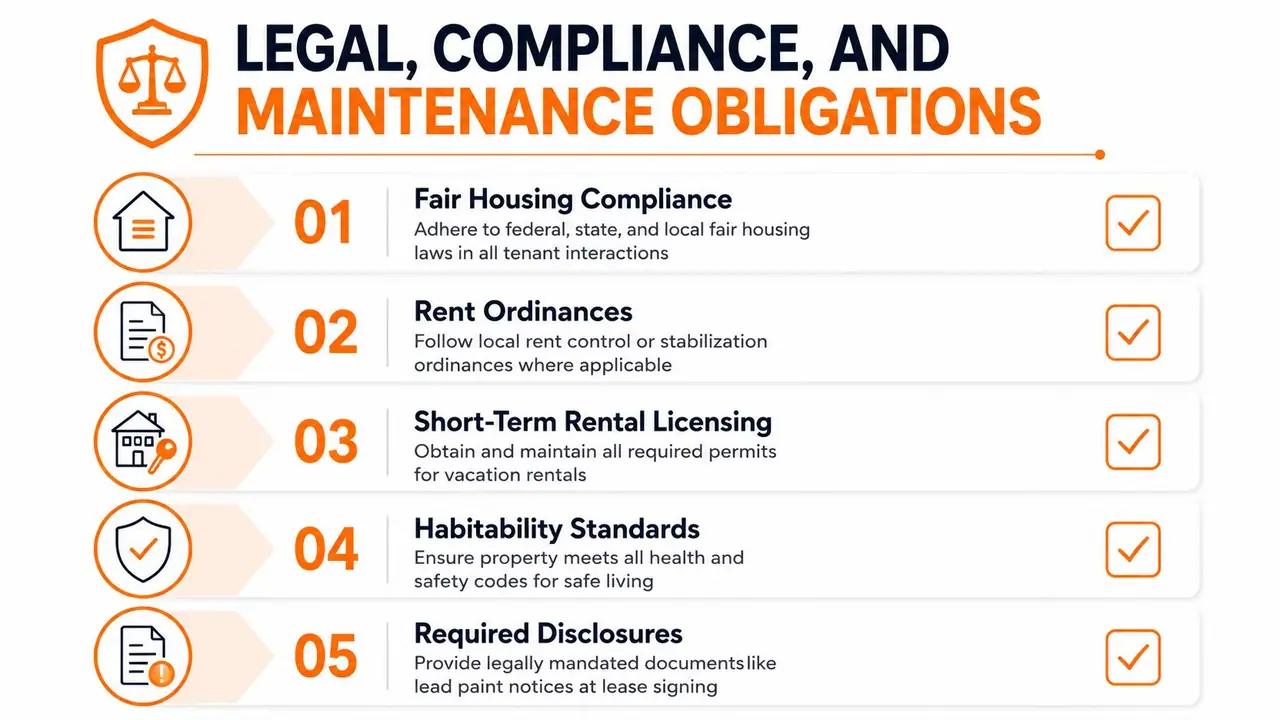
You can delegate tasks. You can't delegate responsibility. That's the part too many owners miss until a complaint, inspection, or claim forces the issue. Fair housing compliance, lease compliance, insurance obligations, habitability standards, and local permitting aren't optional because they sit at the legal edge of the business.
The compliance buckets that matter
Fair housing rules affect marketing, screening, and communication. Rent ordinances and short-term rental licensing are local issues, so you need to know the city and county rules before you set a plan. Habitability is essential, and so is the documentation that proves you maintained the home responsibly.
If you need a maintenance-specific reference point, the 2026 landlord gas safety check guide is a helpful reminder that safety work is not just box-ticking. It's part of keeping the asset insurable, habitable, and defensible.
A simple maintenance rhythm
A strong annual rhythm is boring on purpose. It includes seasonal HVAC servicing, gutter and roof checks, smoke and carbon monoxide device testing, exterior walk-throughs, plumbing review points, and a documented list of preventive repairs before they become emergencies. The exact calendar will vary by climate and property age, but the logic does not.
Use this rule of thumb for your own system.
If a repair becomes urgent only because you waited too long, it was a preventive failure first.
The biggest landmines are the ones owners rationalize away. A missing disclosure, a skipped permit, a sloppy inspection log, or a delayed safety repair can turn a manageable issue into a legal one. Good enough is not good enough here. The compliance standard is simple. If you cannot prove it, you do not really have it.
The KPIs and Pricing Decisions That Actually Matter
A lot of owners stare at occupancy and think they understand the portfolio. They don't. A house can be occupied and still underperform if rent is soft, collections are weak, repairs are dragging, or turnover is eating margin. That's why the right operating numbers matter more than the vanity number.
The metrics worth checking
For single-family portfolios, the useful KPIs are NOI, cash flow, rent collection rate, occupancy or vacancy rate, average days vacant, renewal rate, turnover rate, maintenance cost per home, response time, resolution time, and preventive maintenance completion rate, as listed by property management KPI guidance. I'd check collections, vacancy, and open maintenance items weekly. I'd review the rest monthly.
The market estimate tied to operational efficiency metrics matters because it shows where the advantage lies. In single-family, small improvements in rent discipline, vacancy control, and service speed compound across every address.
Pricing without guesswork
Pricing should start with comparable homes, then adjust for finish level, location, pet rules, yard burden, and lease term. If a house is sitting, the problem is usually one of three things. The rent is too high, the marketing is weak, or the property presentation is below market.
I do not trust gut feel on pricing. I trust evidence from the local comp set and the actual leasing response. If leads are slow, tours are thin, and applications are weak, the market is telling you something. Ignore that signal and you pay for it in vacancy.
Owner rule: the best rent is the one that keeps the property filled without training the market to wait you out.
That mindset keeps you from making emotional decisions. You're not trying to win a headline. You're trying to protect revenue and reduce avoidable downtime.
Tools and Workflows That Scale Single-Family Operations
The tech stack should be small and purposeful. You need a property management system as the system of record, a CRM for lead nurturing, and a showing and leasing platform that can handle scheduling, agent dispatch, and field feedback. That separation matters because scattered-site portfolios create more moving parts than a generic spreadsheet can handle.
Where the stack actually earns its keep
A PMS holds the authoritative lease, payment, and tenant record. A CRM keeps prospects from falling through the cracks. Showing tools remove friction when homes are spread across neighborhoods, because tour scheduling and access coordination are where wasted time piles up fastest.
For short-term workflows, a digital welcome book is the cleanest way to cut repetitive questions. ScanStay, for example, is a digital guest guidebook that puts Wi-Fi, check-in instructions, house rules, local recommendations, and video how-tos behind one QR code, which is useful when you're replacing paper binders and repetitive messages. It also supports one-tap upsells and content reuse across properties, which matters when guests keep asking the same thing.

Why workflow beats tool count
More software does not solve bad coordination. It only makes bad coordination faster. The win comes from reducing the number of handoffs, not from stacking tools that all require manual updates.
That's why I like systems that centralize the guest or tenant experience into one place and connect it to the property record. The property management automation guide is a useful reference if you're trying to decide which tasks should move into workflows first.
For short-term houses, cleaning is part of the system, not a side note. If you want that part handled properly, the framework in cleanings that protect your investment reflects the same principle I use in the field, clear standards beat vague instructions every time.
A practical operating standard
If a guest, tenant, cleaner, or vendor has to ask the same question twice, the workflow is weak. Put the answer where they'll see it. Then make sure the property record, access method, and communication channel all point to the same source of truth.
Simple standard: one property, one record, one workflow, one front door for information.
That's how scattered-site operations stop feeling scattered.
Best Practices, Common Misconceptions, and Your 30-Day Plan
The best operators do six things consistently. They standardize onboarding, build a vendor bench before emergencies hit, inspect on a schedule, price from comps, document every property, and review KPIs on a fixed cadence. They also stop believing three myths. Single-family management is not set it and forget it. More software does not fix weak coordination. And documented workflows are not just for large portfolios.
Your next 30 days should be blunt and practical. Build a tenant onboarding flow, create a vendor list with backup contacts, schedule preventive maintenance for the quarter, set pricing rules, and write down the approval path for repairs. If you run short-term units, deploy a digital welcome book and use it consistently.
That's enough to change the way the portfolio behaves. Not because it looks polished, but because it reduces chaos at the point where chaos usually starts.
ScanStay helps hosts and managers replace paper binders and repetitive guest messages with one QR code that holds the property's essential information. If you're managing scattered-site homes and want fewer support questions, cleaner check-ins, and a more consistent guest experience, take a look at ScanStay.