Agency Property Management: A Complete Guide for Hosts
Considering agency property management? This guide explains core services, fees, and how to vet agencies to scale your rental business effortlessly.
Your calendar starts filling up in a way that looked exciting at first. One listing became two. Then a friend asked if you'd co-host theirs. Then you added another property because the first ones were performing well. Now your phone runs your day. Guest messages start before breakfast, cleaners need schedule changes at midday, a leaking tap becomes your evening problem, and a late check-in request lands just as you're trying to switch off.
That tipping point is where many good hosts get stuck. You're no longer deciding whether short-term rentals work. You're deciding whether you can keep delivering a reliable guest experience without turning yourself into a full-time operator.
For some owners, self-management still makes sense. For others, agency property management is the move that protects both revenue and sanity. It's not just whether an agency can take tasks off your plate. It's whether they can run the property better than you can at scale, especially on guest communication, turnover consistency, and the small operational details that separate an average stay from a polished one.
If you're managing homes in a destination market, you can see the difference immediately. Guests browsing to find your perfect Algarve villa expect a professional standard before they ever book. The same pressure shows up in your own portfolio once you move beyond a single property. And before you hand over management, it's worth being honest about your numbers and workload, including the basics covered in this look at whether Airbnbs are profitable.
Table of Contents
- When Your Side Hustle Becomes a Second Job
- What Is Agency Property Management
- Agency Management vs Self Management
- Understanding Agency Fee Structures
- How to Choose and Vet the Right Agency
- The Technology Advantage of Modern Agencies
- Frequently Asked Questions About Agency Management
When Your Side Hustle Becomes a Second Job
A host with one well-run apartment can absorb a lot. You answer the same questions, manage cleaners directly, and fix small issues yourself. The system feels lean because you're close to everything.
That changes when you add more keys.
By the time you're juggling several properties, the work stops being about hospitality and starts becoming operations. One guest wants an early bag drop. Another can't find the Wi-Fi details. A cleaner arrives at the wrong unit because the turnover schedule changed after a same-day booking. A maintenance issue at one property steals attention from a check-in at another. None of these problems are catastrophic on their own. Together, they create drag.
The pressure builds in small tasks
Most hosts don't burn out because of one big crisis. They burn out because of repeated minor interruptions.
A typical day starts to look like this:
- Morning messaging: Guests ask for parking details, door codes, check-in instructions, and local recommendations.
- Turnover coordination: Cleaners need confirmation on timing, linen status, and damage notes.
- Mid-stay support: Someone can't work the heating, TV, or hot water.
- Owner-level admin: You still need to update listings, review pricing, reconcile payouts, and track maintenance.
The hardest part of scaling a rental business isn't getting bookings. It's keeping service quality stable when your attention is split across too many moving parts.
At that point, outsourcing isn't "giving up control." It's deciding whether you want to keep acting as the entire back office of a growing hospitality business.
What scaling actually changes
More properties don't just create more bookings. They create more variation. Different house rules, different appliances, different cleaner schedules, different neighborhoods, different guest expectations.
That's why many capable self-managing hosts hit a ceiling. They know how to host. What they need next is a repeatable operating model.
What Is Agency Property Management
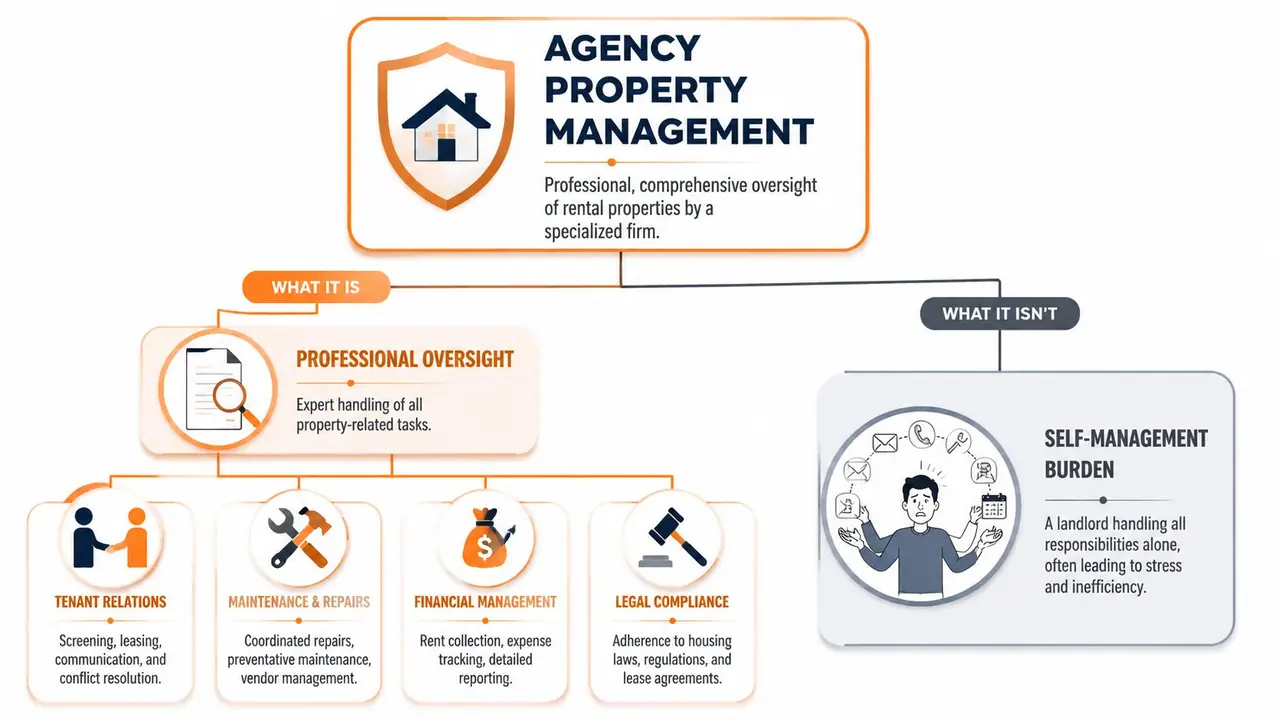
Agency property management is professional, ongoing operational management of a rental property by a specialist firm. In short-term rentals, that usually means the agency handles the day-to-day system that keeps the property bookable, guest-ready, compliant, and commercially healthy.
A good way to think about it is this. A self-managing host is a solo musician trying to play every instrument. An agency is the conductor. It coordinates pricing, guest service, cleaning, maintenance, listing quality, reporting, and owner communication so the performance stays consistent.
In the United States, this is also a market built around smaller operators, not just giant brands. One industry source describes the sector as highly fragmented, with the top 50 firms accounting for less than 20% of total industry revenue, which is why many owners end up working with small or mid-sized agencies rather than national chains (property management industry overview).
What an agency actually handles
The scope varies, but full-service agency property management usually includes:
- Listing and channel management: Writing and updating listings, syncing calendars, managing photos, and keeping rate plans aligned across platforms.
- Guest communication: Pre-booking replies, check-in instructions, mid-stay support, issue handling, and review follow-up.
- Turnover operations: Cleaner scheduling, quality control, linen coordination, consumables, and readiness checks.
- Maintenance coordination: Triage, contractor dispatch, preventive upkeep, and follow-up after repairs.
- Revenue oversight: Rate adjustments, minimum stay strategy, blackout dates, and owner statements.
- Compliance support: House rules, documentation, local operating requirements, and process discipline.
What it is not
Agency property management is not the same as a booking-only service. If someone only takes photos, publishes a listing, and forwards reservations, that isn't full operational management.
It also isn't passive ownership. Owners still make strategic decisions. They choose furnishing standards, approve major expenses, decide how much calendar availability to hold for personal use, and set performance expectations.
Practical rule: If an agency can't explain its process for guest messaging, cleaning quality control, and maintenance escalation in concrete terms, it probably isn't running a system. It's improvising.
Why the definition matters
Hosts often sign with an agency expecting relief, then discover they still have to solve the hard parts. The difference between a useful partner and a glorified middle layer is operational depth.
The best agencies don't just remove tasks. They create consistency. That's what owners are really paying for.
Agency Management vs Self Management
The decision usually comes down to three things: control, time, and execution quality. Money matters too, but most owners underestimate how much service inconsistency costs them before it ever appears on a statement.
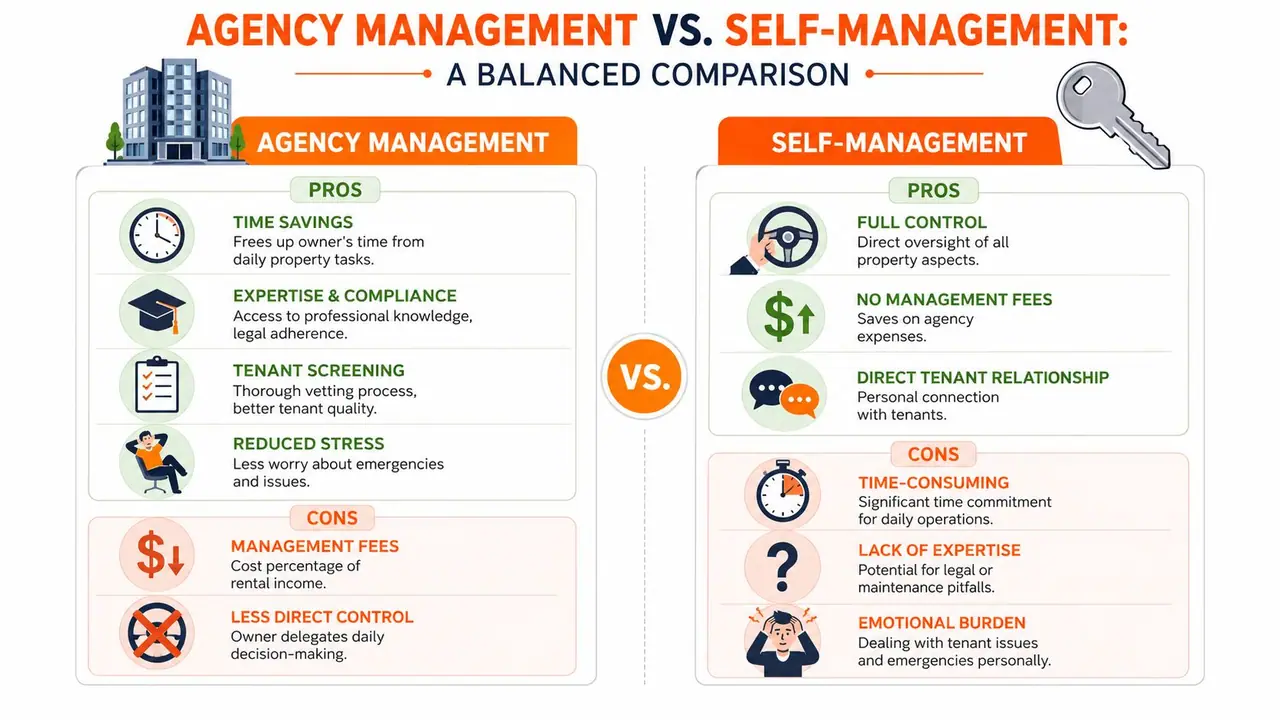
Self-management gives you direct control over every decision. That's attractive if you're detail-oriented, close to the property, and still small enough to manage without constant interruption. Agency management trades some of that control for systems, coverage, and execution capacity.
Where self-management still wins
If you enjoy the work and your portfolio is simple, self-management can be the better option.
| Factor | Self-management advantage | Hidden cost |
|---|---|---|
| Decision-making | You choose everything immediately | You become the bottleneck |
| Guest tone | Communication feels personal | Personal doesn't always scale |
| Vendor control | You pick cleaners and contractors yourself | You're still the scheduler and quality controller |
| Fees | No agency fee line item | Your time and attention aren't free |
Many owners also like the direct connection with guests. You can shape the stay exactly how you want, especially if hospitality is part of why you started in the first place.
Later in the section, it's useful to hear another perspective on the day-to-day workload:
Where agency management earns its keep
A strong agency becomes valuable when operational complexity rises faster than your bandwidth. That's common when you have multiple properties, remote units, mixed booking channels, or frequent same-day turns.
One of the biggest differences is how professionals think about revenue. In agency property management, occupancy rate and economic vacancy rate are not the same thing. Occupancy tells you how much space is physically rented. Economic vacancy measures income lost from vacancy, concessions, and specials relative to gross potential income. Two properties can show the same physical occupancy while producing different revenue outcomes if one relies heavily on discounts or incentives (economic vacancy explained).
That matters because many self-managing hosts chase occupancy as if it were the whole game. Good agencies pay attention to whether booked nights are producing healthy yield.
The real trade-offs
Agency management isn't automatically better. Plenty of agencies are weak at communication, slow on maintenance, or too generic in their guest service.
Use this lens:
- Choose self-management if you want hands-on control, have time to respond daily, know your vendors well, and don't mind being on call.
- Choose agency management if you want to scale, need backup coverage, operate remotely, or know your service standards slip when things get busy.
- Avoid either option if the process is unclear. A sloppy agency and a disorganized owner create the same result. Confused guests and preventable problems.
For owners who keep properties long term, the operational basics matter outside the booking platforms too. Even a simple guide for rental property owners can be a useful reminder that plumbing, preventive maintenance, and response speed affect guest experience just as much as listing quality. If you're comparing options across vacation rentals specifically, this overview of vacation property management is also worth reviewing.
A management fee is easy to spot. The cost of missed messages, inconsistent cleaning, weak pricing discipline, and owner fatigue is harder to see, but it shows up everywhere.
Understanding Agency Fee Structures
Agency proposals often look straightforward until you read the exclusions. That's where owners get surprised.
Most agencies charge in one of three ways. The right model depends less on which one is "best" and more on whether the pricing aligns with the service level you're getting.
The main fee models
Commission on rental revenue is common in short-term rentals. The agency takes a share of booking income, which means its compensation rises and falls with property performance. This can align incentives, but only if the contract clearly states what counts as revenue and which deductions happen before or after the fee.
Fixed monthly management works better when the service scope is stable and the owner wants predictable costs. It can be attractive for high-performing properties because the fee doesn't automatically rise with every strong month. The risk is the opposite problem. If the agency gets paid the same regardless of effort, service can drift unless accountability is tight.
Hybrid pricing combines a base monthly fee with additional charges tied to bookings, guest services, or specific operational tasks. These models aren't bad in themselves. They just require more careful reading.
What may not be included
Owners need to pay close attention at this point. A management fee might exclude:
- Setup work: Onboarding, listing creation, photography coordination, or system migration.
- Operational extras: Deep cleans, restocking trips, linen rental, damage inspections, or emergency callouts.
- Maintenance handling: The repair itself, plus any project management or contractor coordination fee.
- Guest-related charges: Meet-and-greet service, after-hours arrivals, or special request handling.
A better way to compare proposals
Don't compare agencies on the headline fee alone. Compare them on net owner outcome and division of responsibility.
Ask for a plain-English breakdown covering:
- Included services for normal operations.
- Separate pass-through costs billed to the owner.
- Markup policy on contractor invoices or supplies.
- Approval thresholds for repairs and emergency decisions.
- Owner duties that remain outside the contract.
If a proposal looks cheap but leaves you managing suppliers, replacements, complaints, and exceptions, it isn't cheap. It's incomplete.
The best fee structure is the one you can understand without interpretation. If you need a salesperson to repeatedly explain the contract, expect future disputes.
How to Choose and Vet the Right Agency
Most owners spend too much time comparing promises and not enough time examining process. Agencies are easy to like in a sales meeting. The critical test is whether they can run a repeatable operation when a guest arrives early, the cleaner is delayed, and the lock battery dies on the same day.
What to review before the first call
Start with evidence, not chemistry.
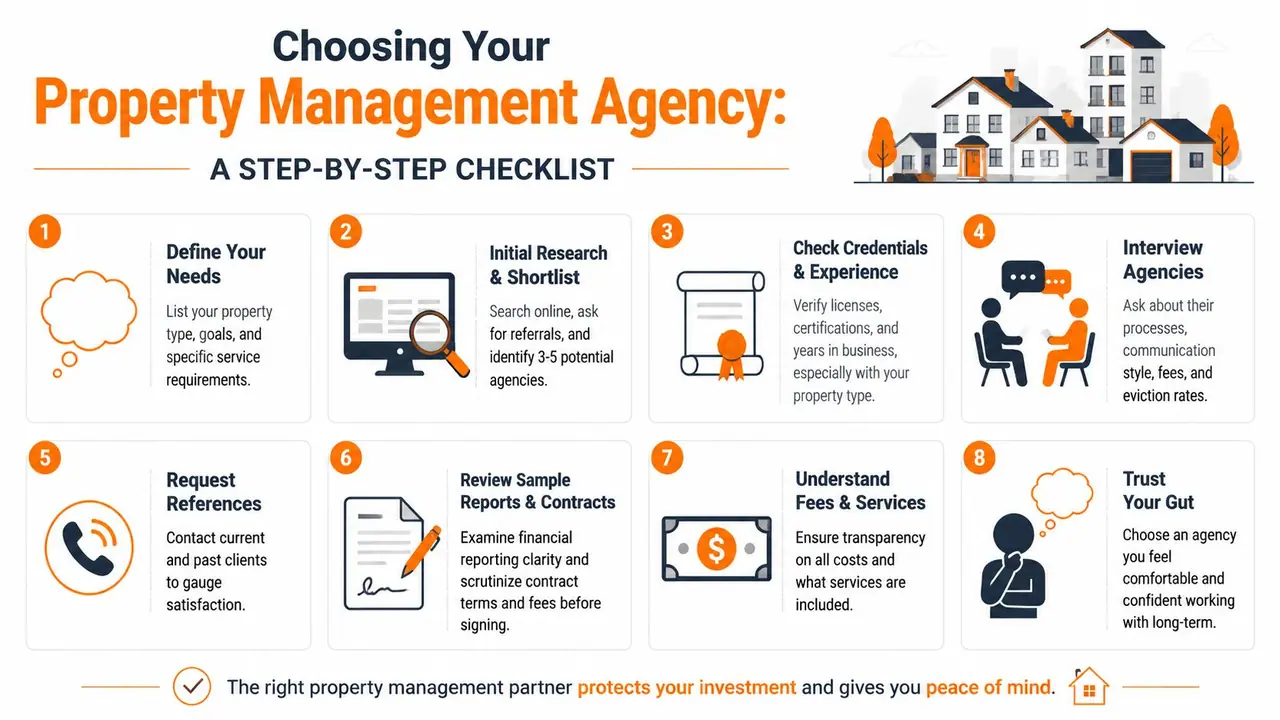
- Current portfolio fit: Look at the kinds of properties they already manage. A firm that handles urban apartments may struggle with remote villas or guest-heavy holiday homes.
- Guest experience standard: Review listings, photos, check-in clarity, house manuals, and review themes across their current inventory.
- Owner communication style: Ask how often they report, what they share proactively, and who answers when something goes wrong.
- Insurance and local compliance readiness: They should be able to explain their operating safeguards without speaking in generalities.
A useful signal is whether the agency can describe its systems in sequence. Good operators know exactly what happens after a booking is confirmed, when a cleaner reports damage, or when a guest asks for a late checkout.
Questions that expose operational maturity
Use direct questions. Vague answers usually mean vague execution.
Sample interview questions
- How do you handle guest communication outside business hours?
- What happens if a property isn't ready at check-in time?
- How do you verify cleaning quality between stays?
- Who approves maintenance work, and at what point do you contact the owner?
- How do you keep property information consistent across multiple listings and team members?
- What reports will I receive each month, and what decisions should those reports help me make?
Don't just listen for confidence. Listen for workflow.
The best agencies answer with steps, ownership, and contingencies. Weak agencies answer with adjectives.
Contract points that deserve scrutiny
Before signing, read the agreement as if the relationship has already gone wrong. That's how hidden problems surface.
Key contract points
| Contract area | What to look for | Why it matters |
|---|---|---|
| Term and termination | Notice periods, lock-in clauses, exit process | You need a clean way out if service slips |
| Fee detail | Included work and chargeable extras | Prevents statement shock |
| Repair authority | Spending limits and emergency rules | Avoids disputes over unapproved work |
| Calendar control | Owner stays, blackout dates, booking approval rules | Protects your flexibility |
| Data and asset ownership | Listings, photos, guest data, guide content | Important if you switch agencies |
Also ask for a sample owner statement and a sample incident report. You can learn more from those than from a polished pitch deck.
What usually goes wrong
Owners often choose agencies based on friendliness, local presence, or a low fee. Those factors matter, but they don't tell you whether the team can execute under pressure.
Warning signs include:
- No clear escalation path for maintenance or guest complaints
- Inconsistent communication during the sales process
- Unclear boundaries around owner responsibilities
- No sample documentation for reports, checklists, or service standards
Trust matters, but trust should follow verification.
The Technology Advantage of Modern Agencies
The strongest agencies don't use technology just to save their own staff time. They use it to create a guest experience that feels faster, clearer, and more consistent across every property they manage.
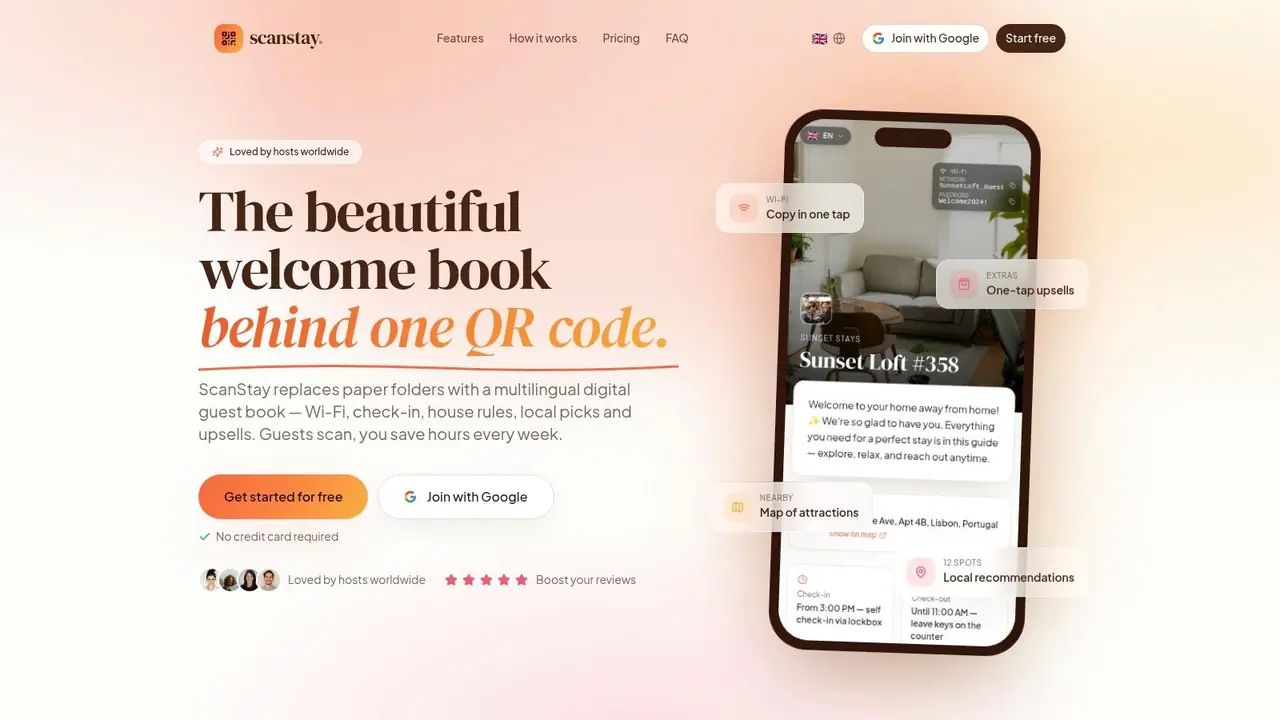
That distinction matters because hospitality breaks down in the same places over and over. Guests ask where to park, how to get in, what the Wi-Fi password is, how the heating works, whether they can check out late, and what to do nearby. If every answer lives in someone's inbox or memory, service quality becomes uneven immediately.
What a modern tech stack should do
At minimum, an agency should have a practical stack built around three jobs:
- Central control: A property management system keeps reservations, calendars, task assignments, and property notes in one place.
- Revenue coordination: Pricing tools and reporting help managers react to booking pace, stay patterns, and demand shifts without guessing.
- Guest information delivery: Digital guidebooks, automated messaging, and standardized arrival instructions reduce confusion before it becomes support traffic.
This isn't optional admin polish. It's operational design.
Industry commentary around agency-managed hospitality highlights a major blind spot here. The global short-term rental market was estimated at about $124.5 billion in 2024, yet many agencies still underestimate the burden of repeated guest communication. Common questions about check-in, Wi-Fi, and local tips are one of the clearest opportunities to reduce labor load while improving consistency across a portfolio (short-term rental communication gap).
Why hosts struggle to replicate this alone
A self-managing host can absolutely buy software. That's not the hard part.
The hard part is maintaining one clean information system across multiple homes, cleaners, contractors, guest profiles, languages, and service scenarios. Agencies that do this well treat operations as a measurement system. Portfolio-level analytics can combine current and historical information about rents, demand, renewals, maintenance histories, and tenant feedback so managers can spot weak points early instead of reacting after a service failure (portfolio analytics in property management).
That same mindset applies on the guest side. A strong agency standardizes welcome information, local recommendations, house rules, troubleshooting steps, and upsell options so every guest gets the same baseline clarity. If you want to understand what that software category looks like from a buyer's perspective, this roundup of affordable property management software gives useful context.
Better technology doesn't replace hospitality. It removes the repetitive friction that makes hospitality feel disorganized.
For owners, that can be the hardest advantage to copy alone. Not because the tools are secret, but because consistency across a growing portfolio is difficult without dedicated systems and people.
Frequently Asked Questions About Agency Management
Can I still block dates for personal use
Usually, yes. The contract should spell out how much notice the agency needs, how blackout dates are entered, and what happens if you've already accepted bookings. Good operators make owner stays part of the workflow rather than a special exception.
Who handles furnishing and initial setup
It depends on the agency. Some only manage operationally once the home is guest-ready. Others will help with setup decisions, inventory lists, photography coordination, and launch preparation. Get the scope in writing so you know whether you're buying management, setup support, or both.
How much communication should I expect as an owner
Expect regular reporting, prompt contact on major issues, and clear escalation when approvals are needed. You shouldn't need daily updates to feel informed, but you also shouldn't have to chase for basic answers. The right level is structured, predictable communication.
Will an agency protect my standards or dilute them
That depends on how well your standards can be documented and enforced. A good agency turns your expectations into checklists, service rules, messaging templates, and approval thresholds. A weak one relies on staff memory and broad intentions.
What should make me walk away before signing
Walk away if the fee structure is unclear, the contract is hard to exit, responsibilities are blurred, or the team can't explain day-to-day operations in plain language. Charm doesn't fix weak systems.
Is agency property management worth it for a small portfolio
It can be, especially if your properties are remote, operationally demanding, or consuming time you can't keep giving. The right question isn't how many units you have. It's whether the business still fits your life and whether service quality holds when you're stretched thin.
If you're trying to scale without drowning in repetitive guest questions, ScanStay gives hosts and agencies a cleaner way to deliver check-in details, Wi-Fi info, house rules, local recommendations, and upsells through a single digital welcome book. It's a practical way to standardize guest communication, reduce support friction, and keep the experience polished across one property or a growing portfolio.