Property Management vs Landlord: Pick Your Path
Compare property management vs landlord to decide which approach boosts rental ROI. See costs, control, and growth options in 2026.
You're staring at a booking dashboard, a cleaner just texted about a delayed turnover, and a guest wants early check-in while another says the Wi-Fi password doesn't work. That's the point where property management vs landlord stops being a theory question and turns into a daily operations decision. If you own a rental, the choice is rarely “Should I be involved?” It's whether you want to keep carrying the ownership role, the operations role, or both.
| Comparison Point | Self-Managing Landlord | Property Manager |
|---|---|---|
| Core role | Owner and operator | Contracted operator |
| Main advantage | Direct control | Delegated execution |
| Main risk | Time drain and inconsistency | Less direct control |
| Best fit | Smaller, hands-on portfolios | Larger or more complex portfolios |
| Decision focus | Tasks and responsiveness | Systems, reporting, and accountability |
Table of Contents
- The Midnight Message That Changes Everything
- Defining the Roles and Legal Accountability
- Breaking Down the True Cost of Each Approach
- Day-to-Day Operations Compared Side by Side
- Which Path Fits Your Host Profile
- How to Transition Between Self-Management and a Property Manager
- Tools and Processes That Reduce the Self-Management Burden
The Midnight Message That Changes Everything
At 11:07 PM, the message arrives. A guest can't find the keybox, the Wi-Fi is down, and the cleaner forgot to restock towels after the last turnover. If you self-manage, your night is over. If you use a property manager, you're still involved, but the phone doesn't necessarily belong to you.
That's why the property management vs landlord decision feels so personal. On paper, it looks like a simple task split. In real life, it changes who absorbs stress, who gets called when something breaks, and who is expected to keep the guest experience from slipping.
Ownership and operations are not the same job
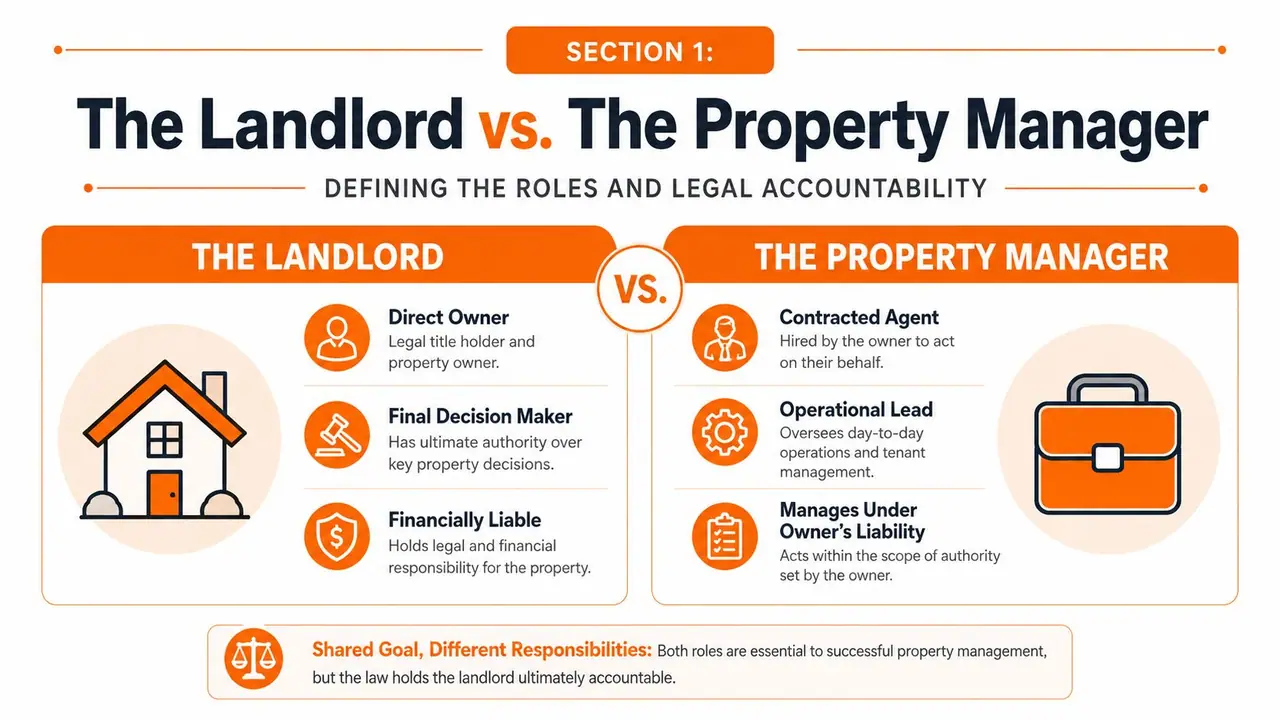
A landlord owns the asset and carries the financial and legal responsibility. A property manager is an agent paid to run day-to-day operations under contract, which is why the question is really ownership vs operations, not just “who answers messages.” That distinction matters when pricing changes, repairs escalate, or a guest issue starts looking like a liability problem, not a nuisance.
For many small hosts, the first version of the business is a handful of routines done ad hoc. That works until the workflow starts multiplying, especially if you're balancing remote ownership, turnover logistics, and guest support across multiple bookings. In larger portfolios, the job becomes less about personal hustle and more about process discipline.
Practical rule: if your calendar is being managed by guest problems instead of revenue decisions, you're already doing operations work whether you call it self-management or not.
The useful question is not which title sounds better. It's which model gives you better net income, better control, and fewer failures under pressure. That's the thread running through the rest of this discussion.
Defining the Roles and Legal Accountability
The cleanest way to separate the two roles is simple. The landlord owns the property, makes the final financial decisions, and ultimately carries the risk. The property manager handles the operational layer, usually under a management agreement that spells out authority, fees, and service expectations.
That difference sounds obvious until something goes wrong. If a repair becomes expensive, if a guest challenges a charge, or if a compliance issue surfaces, the key question is who had the authority to act and who carries the legal exposure. That's why a comparison that only lists “guest communication” and “maintenance” misses the part that matters most.
What changes when operations are contracted out
Under a management contract, the manager becomes the operational lead, but not the owner. That means the manager may control the day-to-day flow, while the landlord still sits behind the asset, the financing, and the final exposure. In practice, this creates a chain of decision rights, not a handoff of responsibility.
That's also why legal and safety obligations still matter even when someone else handles the calendar. A landlord can't outsource the consequences of a poorly handled safety issue just by outsourcing the inbox. For a practical overview of landlord obligations for tenant safety, the legal baseline is worth reviewing before deciding how far to delegate.
What most comparison guides leave out
Many buyer guides stop at who changes lightbulbs or answers calls. They don't answer who approves major repairs, who sets pricing guardrails, or who handles escalation when a guest complaint becomes a claim. That's the decision-rights layer, and it's where owners get surprised.
The contract should define more than a fee. It should define who can spend, who can approve, and who has to be notified when an issue crosses a threshold.
For owners, that clarity is not administrative fluff. It's the difference between a clean operating model and a vague arrangement where everyone assumes someone else is responsible. If you want tighter control, the contract has to say exactly where authority starts and stops.
Breaking Down the True Cost of Each Approach
The visible cost of professional management is easy to compare, but it's not the whole bill. Typical management fees are commonly 8%–12% of monthly rent, according to TenantCloud's property management statistics. In short-term rentals, the fee can run higher, so the key question becomes whether the service reduces enough friction, vacancy, and mistake risk to improve net income, not just convenience.
Self-management looks cheaper until you price the hidden labor. Your time, your software stack, your late-night troubleshooting, your vendor coordination, and your compliance overhead all sit in the margin. If the property is small and simple, those costs may still be worth absorbing. If the property is complex, remote, or turnover-heavy, they start to behave like an operating expense even when they never hit a line item.
| Cost Category | Self-Managing Landlord | Property Manager (10% fee) |
|---|---|---|
| Direct management fee | None | Ongoing percentage of rent |
| Owner time | High, and often unpredictable | Lower, because tasks are delegated |
| Software and systems | Owner-selected and self-run | Often bundled or coordinated by manager |
| Maintenance coordination | Owner handles vendors and follow-up | Manager coordinates day-to-day repairs |
| Compliance overhead | Owner keeps track of requirements | Manager may absorb part of the workflow |
| Vacancy friction | Depends on owner response speed | Depends on manager execution |
| Accounting burden | Owner prepares records and exports | Manager may provide cleaner reporting |
Where break-even usually shows up
For a single property, the break-even point often depends on whether your own time is free. If you're spending evenings on guest support and turnover fixes, outsourcing can improve net income even before the fee looks attractive. If the property is calm, close by, and easy to maintain, self-management usually keeps more of the gross revenue in your pocket.
For a three-property operator, the decision gets sharper. The coordination burden grows faster than the income, because each new unit adds messages, vendors, payment tracking, and housekeeping management. At that point, professional management can win if it reduces costly errors, delays, and owner burnout.
For a ten-property portfolio, the conversation shifts again. You're no longer deciding whether to save a few hours. You're deciding whether your process can scale without breaking reporting, tax prep, and owner oversight. That's where management quality, reporting discipline, and support response start to matter as much as the fee itself.
If you're pressure-testing the economics of your short-term rental, the profitability framework in this guide on Airbnb profitability gives a useful lens for separating gross revenue from actual operator take-home.
Bottom line: outsourcing improves net income only when it replaces enough owner labor, error risk, and vacancy drag to justify the fee.
Day-to-Day Operations Compared Side by Side
A self-managing host feels every operational failure directly. A property manager absorbs more of that noise, but the property still needs systems, escalation paths, and quality control. The difference shows up in the workflow, not just the job title.
What happens when things go wrong
A broken appliance at 2 AM is a different problem depending on who owns the process. The self-managing landlord has to diagnose the issue, find a vendor, decide whether to refund, and calm the guest. The manager routes it through a standardized escalation path, but that only works if the owner has already approved response rules and spending limits.
Cleaning is similar. If a cleaner cancels on turnover day, the self-manager is usually the dispatcher, backup coordinator, and customer service lead all at once. A manager may have a bench of vendors, but portfolio quality depends on how disciplined that vendor network really is.
For bedding and presentation standards, operators often overlook how much consistency matters. A simple resource like durable bedding in rentals is more useful than generic décor advice because linen durability affects both replacement cycles and guest perception.
The hidden work behind “simple” tasks
Pricing updates sound easy until seasons change, demand shifts, and competitors adjust. A self-manager can move quickly if they understand the market, but they also own the research, the timing, and the downside if they price too low. A manager may automate part of that work, but automation is only as good as the strategy behind it.
Review management also looks different in practice. The self-manager usually reads every review and feels every comment personally. The manager can monitor reputation across properties, but the owner still needs a standard for what gets escalated and what gets ignored.
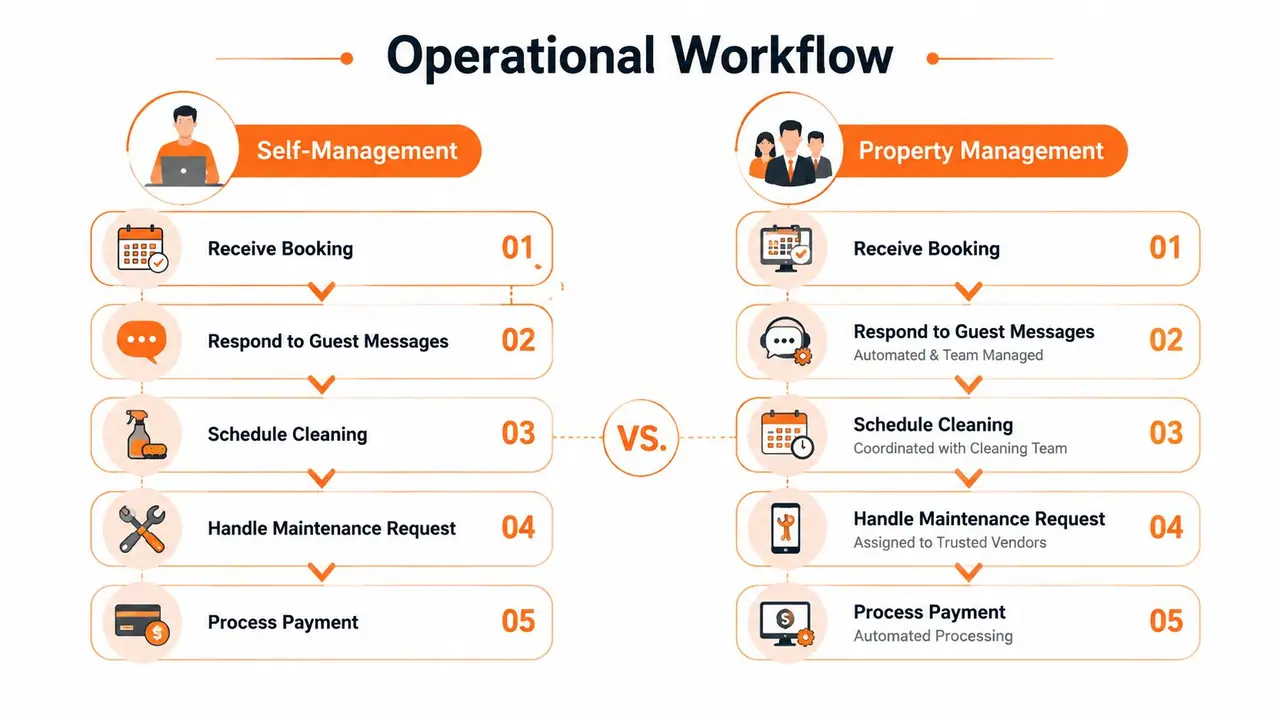
The technology stack matters, too. Self-management usually leans on messaging tools, channel management, and manual checklists. Property management depends on the same tools, but the difference is that the manager's workflow is built around delegation and standardization rather than personal oversight.
Which Path Fits Your Host Profile
The best model depends on portfolio shape, not ego. A host with one nearby property and lots of availability has a very different operating problem from a remote owner with multiple units and limited time. That's why the same answer doesn't fit everyone.
A practical decision matrix
- One property, close by, hands-on by nature. Self-management usually makes sense if you're comfortable handling messages, turnovers, and the occasional disruption yourself.
- A few properties, remote from the assets. A manager becomes more attractive when travel time and coordination overhead start eating into margins.
- A growing portfolio with repeatable processes. Professional management tends to fit better once consistency, reporting, and handoff discipline matter more than personal control.
- Passive-income goals with low tolerance for interruptions. Outsourcing usually aligns better because the owner wants fewer operational decisions and less daily involvement.
For short-term rentals, the decision often tilts sooner than owners expect because guest communication and turnover work don't behave like traditional long-term leases. A hybrid setup can work, but only when the split is clean. If one person handles pricing while another handles guest issues, but nobody owns escalation rules, coordination gets messy fast.
When hybrid makes sense, and when it doesn't
Hybrid management works when the owner keeps high-value decisions and outsources execution. It can fail when the division of labor creates delays, duplicate messaging, or vendor confusion. The model only holds if everyone knows who owns which step.
For larger operators, internal KPIs become useful. The right metrics are NOI, occupancy rate, operating expense ratio, cash-on-cash return, tenant retention, and average days to lease, compared against both internal history and market benchmarks, as outlined by the National Property Management Authority. Residential portfolios usually care most about occupancy, rent collection, and tenant retention, while commercial portfolios lean harder on NOI, lease renewal rate, and CAM reconciliation accuracy.
If your current setup needs three people to do one person's job, the problem isn't your team size. It's your operating model.
How to Transition Between Self-Management and a Property Manager
Switching models works best when the handoff is treated like an operational project, not a casual conversation. The transition starts with the contract, because the contract defines whether you're dealing with termination notice, exclusivity, access rights, and reporting expectations. Before you sign anything, ask how the manager handles pricing authority, repair approvals, and guest escalation.
If you're hiring out, evaluate the manager on fit, communication, and reporting discipline. A useful external checklist is the agent and manager detail guide, because it highlights the kind of operational information that's easy to overlook when you're focused only on fees. That matters more than polished sales language.
The handoff needs a timeline
Day one should be about access. Listings, guest communication tools, vendor contacts, owner statements, and payment paths all need to move cleanly. Week one should be about monitoring whether the manager's actual response pattern matches the promises made in the contract.
If you're moving back in-house, the sequence flips. Notify the current manager, retrieve account access, rebuild your message templates, and reset the financial workflows before taking new bookings. It's also smart to document which vendors are yours, which belong to the manager, and which need to be replaced.
For deeper context on manager selection and operating handoffs, the internal guide on Airbnb property manager options is a useful companion reference.
What to watch during the first month
- Response consistency: Are guest messages answered on time and in the right tone?
- Financial clarity: Are payouts, fees, and repairs showing up in a format you can audit?
- Vendor follow-through: Are cleaners and maintenance providers being managed without owner intervention?
- Escalation discipline: Does the manager flag expensive or sensitive issues quickly, or after the fact?
The goal is not just to change who does the work. It's to make sure the work keeps getting done without ambiguity.
Tools and Processes That Reduce the Self-Management Burden
If you're not ready to hire, the smartest move is to strip away repetitive work before it burns you out. A digital welcome book can replace paper binders and a lot of one-off messages, especially for check-in details, Wi-Fi credentials, house rules, and local recommendations. ScanStay is one option in that category, and it centralizes guest instructions in a QR-based mobile experience with reusable property content.
Automation should sit around the repetitive edges of the workflow. Messaging templates handle arrival instructions, cleaning coordination apps keep turnovers visible, and maintenance trackers help you avoid losing requests in text threads. Dynamic pricing tools can also reduce the guesswork around rate changes, but they still need owner oversight.
For hosts trying to reduce the support load before outsourcing, the most useful setup is usually a simple stack, not a sprawling one. The internal guide on property management automation is a good companion if you're building that layer yourself.
Focus on fewer messages, not just faster replies
The goal is to prevent common questions before they get asked. If guests can find the Wi-Fi code, checkout steps, and amenity notes without messaging you, you've already cut a chunk of operational drag. That gives you back time whether you self-manage long term or eventually hire help.
Strong systems also make delegation easier later. A manager can only perform well if your property already has clean instructions, clear vendor contacts, and a predictable guest experience. Technology doesn't replace management judgment, but it can make either model run cleaner.
If you want fewer midnight interruptions without losing control of your property, ScanStay gives you a digital welcome book that puts guest info, house rules, and useful upsells behind one QR code. It's a practical fit for hosts deciding between self-management and outsourcing, because it reduces repetitive messages while keeping the guest experience consistent. Visit ScanStay to see how it can simplify your operations and make the path you choose easier to run.