Residential Property Management: A Complete 2026 Guide
Our complete guide to residential property management covers core tasks, pricing, KPIs, and tech. Learn to manage long-term or short-term rentals effectively.
You buy a rental because the spreadsheet looks clean. Then the actual work starts. A clogged drain on Sunday, a tenant who says the portal won't accept rent, a lease renewal that got buried in your inbox, and three different vendors all telling you they'll “stop by tomorrow.”
That's the point where most new investors realize a property isn't managed by owning it. It's managed by running systems around it.
That matters even more now because the same owner might hold a conventional year-long rental and a short-term unit listed on Airbnb or Booking.com. One needs steady leasing, compliance discipline, and predictable maintenance. The other needs fast turnovers, tighter communication, and a guest experience that feels almost like hospitality. The principles overlap. The operating tempo does not.
Table of Contents
- What Is Residential Property Management
- The Four Pillars of Property Management
- Long-Term vs Short-Term Rental Management
- Choosing Your Path Self-Management vs Professional Help
- Key Metrics and Common Pricing Models
- Technology and Automation in Modern Management
- Best Practices for Scaling and Compliance
What Is Residential Property Management
Residential property management is the day-to-day operation of housing assets so they stay occupied, maintained, compliant, and financially useful to the owner. That sounds simple until you're the one answering the calls, coordinating repairs, collecting rent, documenting move-in conditions, and deciding whether a late payment is a one-time issue or the start of a pattern.
In practice, residential property management is less a service category and more an operating system. It gives the property rules, workflows, deadlines, and accountability. Without that structure, investors drift into reaction mode. They spend time putting out fires instead of protecting income and the underlying asset.
Commercial management has its own logic, but residential is a different animal. The tenant volume is often higher, emotions run hotter, and small mistakes compound fast because housing is personal. A missed repair in an office suite is a problem. A missed repair in someone's home becomes a trust issue.
Practical rule: If a task repeats, document it. If it creates risk, standardize it. If it affects income, measure it.
That applies whether you're running long-term leases or a short-term rental with frequent guest turnover. The tools change, but the job stays the same: preserve condition, reduce friction, and keep revenue dependable.
Even basic systems deserve attention. Plumbing is a good example. Many first-time owners treat leaks, shutoff access, and fixture wear as occasional issues, then get surprised by preventable damage. A practical checklist like these find rental property plumbing tips helps translate “maintenance” into actual owner actions.
The Four Pillars of Property Management
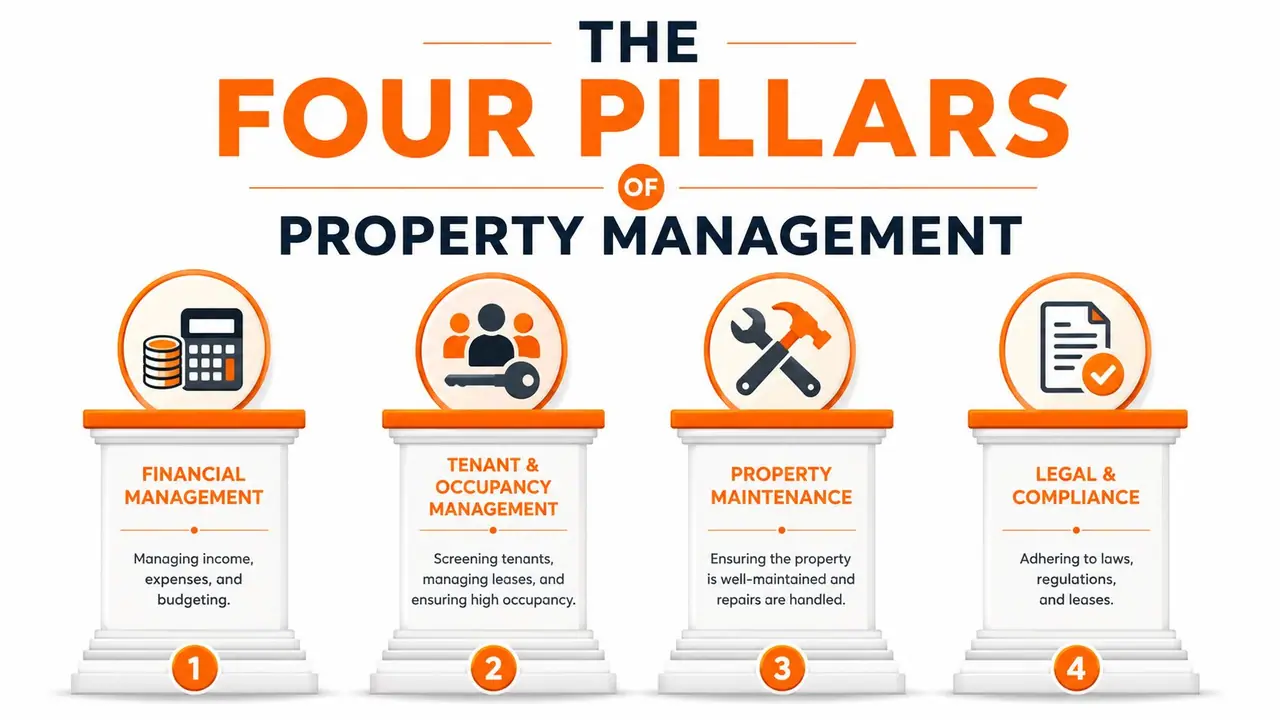
Most management problems make more sense when you sort them into four buckets. If you don't, everything feels urgent and unrelated. In reality, nearly every issue comes back to finance, occupancy, maintenance, or compliance.
Order beats effort
Financial management
This pillar starts with rent collection, but it doesn't end there. Good operators track what came in, what didn't, what was spent, and whether those expenses protected value or just patched a symptom.
A healthy process usually includes:
- Rent collection discipline: Clear due dates, late fee enforcement, and a documented follow-up sequence.
- Budget control: Seasonal planning for repairs, turnovers, and routine vendor spend.
- Owner reporting: Monthly statements that make it easy to see income, expenses, and outstanding issues.
If your books are messy, every other decision gets worse. You can't price renewals well, judge vendor performance, or know whether a unit is profitable.
Tenant and occupancy management
This is the full lifecycle of the resident relationship. Marketing, screening, lease signing, move-in coordination, renewals, notices, and move-out all sit here.
The mistake new owners make is focusing only on placement. Placement matters, but so does the quality of communication after move-in. A qualified tenant who gets slow responses can still become a non-renewal. In short-term rentals, this same pillar shows up as listing quality, booking communication, check-in clarity, and review management.
Property maintenance and operations
Maintenance is where a lot of investor optimism goes to die. Owners often assume the challenge is finding someone with tools. It isn't. The challenge is triage, authorization, scheduling, follow-up, documentation, and knowing whether the same issue will reappear next month.
There are two types of work here:
- Preventive work: Servicing systems before failure, inspecting turns carefully, replacing worn components on a schedule.
- Reactive work: Responding to leaks, lockouts, appliance failures, and safety issues when they happen.
Preventive work feels slower and less dramatic, but it's usually what keeps margins intact.
Administration and compliance
This pillar is the quiet one, which is why owners neglect it. Leases, notices, inspection logs, insurance requirements, local rules, fair housing practices, renewals, vendor paperwork, and documentation all live here.
When admin slips, the business starts relying on memory. Memory is not a management system.
Why residential dominates
Residential isn't a niche inside property operations. It is the center of gravity. Residential property management accounts for more than 84% of total global property management industry revenue, and the industry totaled $100.8 billion in 2024 according to property management industry statistics.
That scale makes sense on the ground. Housing has constant operational demands, and those demands don't pause just because an owner has a full-time job or lives in another city.
The simplest way to think about the four pillars is this: finance tells you if the property works, occupancy keeps income moving, maintenance protects the asset, and compliance keeps one mistake from turning into a legal problem.
Long-Term vs Short-Term Rental Management
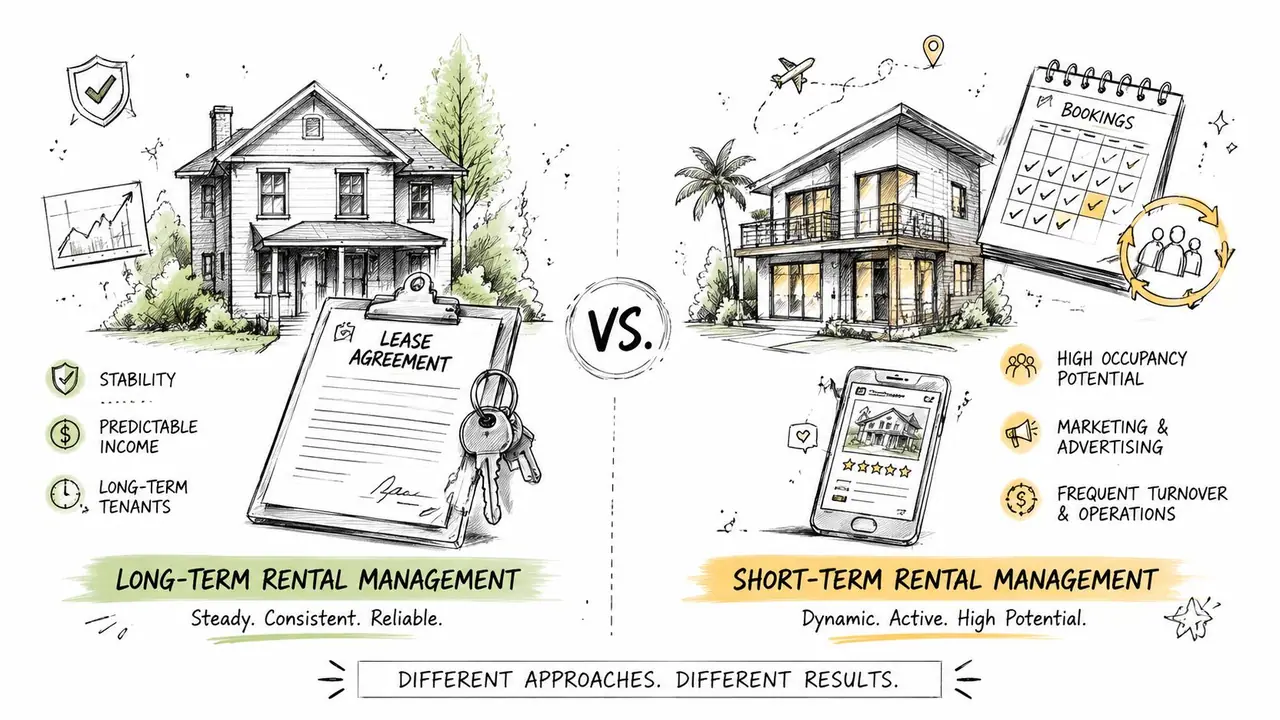
A long-term rental and a short-term rental can sit on the same street and still require completely different operating habits. New investors often underestimate that difference because both are “residential.” That's true legally and physically. Operationally, they behave like cousins, not twins.
A day in each model
A long-term rental usually rewards consistency. You market a vacancy, screen carefully, sign a lease, collect rent, handle maintenance, and work toward renewal. The cadence is steadier. Problems still happen, but they tend to cluster around leasing, repairs, and payment issues.
A short-term rental runs more like a compact hospitality business. The calendar keeps moving, guest questions repeat, turnovers are constant, and small presentation mistakes show up in public reviews.
Here's the practical contrast:
| Area | Long-term rental | Short-term rental |
|---|---|---|
| Turnover rhythm | Less frequent, but heavier when it happens | Frequent and operationally repetitive |
| Communication | Lower volume, issue-based | High volume, pre-stay to post-stay |
| Marketing | Leasing photos, pricing, screening | Listing optimization, guest appeal, review sensitivity |
| Maintenance timing | Can often be scheduled around tenancy | Must fit between bookings or be solved fast |
| Experience standard | Safe, functional, reliable home | Clear, frictionless stay with hospitality touches |
One model is not automatically better. Instead, they punish different weaknesses.
Where short-term operators win or lose
Short-term rentals expose process gaps faster. If a long-term lease has a weak onboarding packet, the tenant may ask a few questions and settle in. If a short-term rental has unclear Wi-Fi instructions, parking confusion, or a thermostat no one can figure out, support messages pile up immediately.
That's why communication design matters so much more in STR operations. There's also a missed revenue angle. A documented gap in the market is that many hosts still don't have a reliable system for turning routine guest questions into paid add-ons like late checkout or transfers while keeping support friction low, as discussed in this short-term rental communication analysis.
Short-term rentals don't just need answers. They need answers delivered before the guest has to ask.
That's also where marketing and operations merge. Your listing promises a stay. Your systems have to fulfill it. Owners trying to sharpen their booking funnel can borrow useful ideas from these real estate investor Airbnb strategies, especially when they're trying to match pricing, photos, and guest expectations more tightly.
For many investors, the choice isn't “Which model makes more?” It's “Which model fits my operating tolerance?” If you want fewer moving parts, long-term is simpler. If you want the flexibility and higher-touch model of STRs, you'll need stronger systems and better tech from day one.
Choosing Your Path Self-Management vs Professional Help
The decision to self-manage or hire a professional shouldn't be framed as pride versus convenience. It's a business choice about time, control, and execution quality. Plenty of owners can self-manage one unit. Fewer can do it well once life gets busy, the portfolio grows, or the property type becomes more demanding.
Three questions to answer honestly
The first question is time. Not spare time. Real interruptible time. Can you respond during the workday, coordinate repairs, review leases, chase delinquencies, handle turnover, and still keep records clean? If the answer depends on “most weeks,” you're already seeing the weakness.
The second question is skill. Some tasks are teachable quickly. Others aren't. Fair housing practices, documentation standards, notices, vendor control, and conflict management all punish inexperience. In short-term rentals, guest communication and turnover quality control create their own learning curve.
The third question is temperament. Some owners stay calm under pressure and document everything. Others avoid confrontation, delay decisions, or over-accommodate. That doesn't make them bad investors. It just means operations may not be their best role.
A professional manager usually brings:
- Process maturity: Leasing steps, maintenance workflows, and repeatable follow-up.
- Vendor coordination: A working bench of contractors and clearer authorization rules.
- Distance from emotion: Better handling of renewals, collections, and policy enforcement.
Self-management offers its own advantages:
- Direct control: You make every decision and shape the resident or guest experience personally.
- Closer market feel: You hear complaints, see patterns, and notice pricing shifts faster.
- No management layer: Fewer handoffs can mean faster decisions if you're organized.
Quick comparison
| Factor | Self-Management | Professional Management |
|---|---|---|
| Cost | No management fee, but your time carries real value | Ongoing fee, plus possible leasing or service add-ons |
| Time demand | High and unpredictable | Lower owner involvement in daily operations |
| Control | Maximum direct control | More oversight than control of each task |
| Speed of learning | Steeper, especially during problems | Faster operational consistency if the manager is competent |
| Scalability | Harder as units or guest turnover increase | Easier to standardize across multiple properties |
| Risk of inconsistency | Higher if systems live in your head | Lower if workflows are documented and followed |
There's a middle ground too. Some owners keep strategy, pricing, and major approvals while outsourcing leasing, maintenance coordination, or guest messaging. Agency-style support models can make sense when the portfolio is too big for solo management but not large enough for a full in-house team. This breakdown of agency property management models is useful if you're comparing hands-on ownership with outsourced execution.
If your management system depends on you remembering everything, you don't own a passive investment. You own another job.
My usual advice to new investors is simple. Self-manage only if you can commit to building procedures, not just handling tasks. If you won't document the process, eventually the process will run you.
Key Metrics and Common Pricing Models
Most owners look at rent and stop there. That's too shallow. A property can bring in money every month and still be underperforming because collections slip, vacancies linger, or operating expenses keep eating the margin.
The numbers that actually matter
Think of KPIs like the dashboard in a car. Speed alone doesn't tell you whether the engine is healthy. In property management, rent amount alone doesn't tell you whether the asset is being run well.
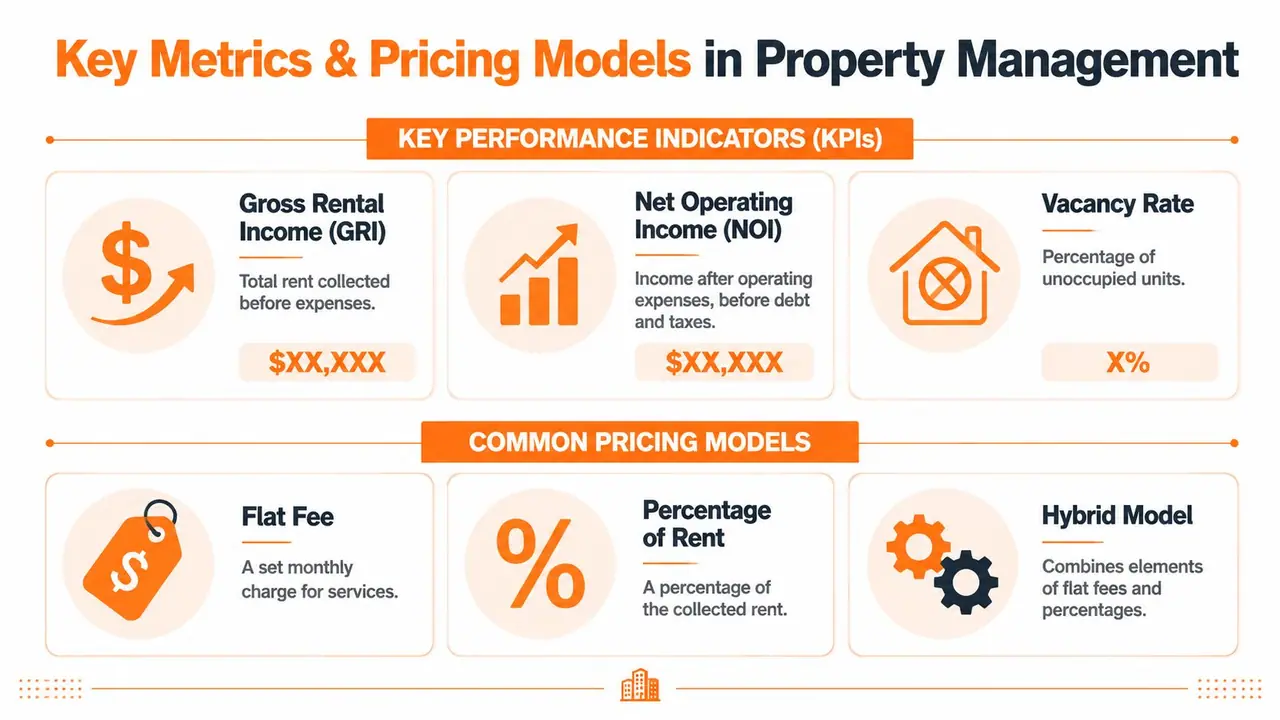
Start with these core measures:
- Gross rental income: The total rent collected before operating expenses.
- Occupancy: Whether units are filled at a level that supports stable income.
- Net operating income: Income after normal operating expenses, before debt and taxes.
- Cash flow: What remains after all obligations are paid.
Two benchmarks deserve special attention. A rent collection rate above 95% is the benchmark for uninterrupted revenue stability, and an occupancy rate in the 90% to 95% range is considered desirable for maximizing profitability, according to property management KPI guidance.
That's why collections matter so much. A fully leased building with poor collections is like a full restaurant where half the tables don't pay. Occupancy looks fine on paper, but the bank account tells the truth.
Another useful habit is tying each metric to one operating question:
| KPI | What it tells you | Question to ask |
|---|---|---|
| Gross rental income | Top-line performance | Are pricing and collections aligned with expectations? |
| Occupancy | Demand and leasing execution | Are vacancies caused by price, condition, or slow leasing? |
| NOI | Operational efficiency | Are expenses protecting value or masking recurring failures? |
| Cash flow | Investor reality | After everything is paid, is the property still worth holding? |
For a deeper operational lens, this overview of operational efficiency metrics in rentals helps connect reporting habits with actual management decisions.
How managers usually charge
Professional managers generally use one of three fee structures.
Percentage of collected rent
This is common because it aligns the manager with actual collections. If rent doesn't come in, the fee shrinks too. The downside is that owners sometimes assume the percentage covers everything when it may not.
Flat fee
This works best when the scope is well defined and the property is stable. Owners like the predictability. Managers like it when the workload is consistent. It can become awkward when a supposedly simple property starts generating complex issues.
Hybrid model
Some operators combine a base fee with separate charges for leasing, renewals, turnovers, or short-term rental support functions. This is often the clearest model when service intensity varies by month.
Pricing only makes sense when you compare it to execution. A cheaper manager who allows collections to slip or vacancies to drag is often more expensive in practice.
When you evaluate a proposal, don't ask only, “What do they charge?” Ask, “Which outcomes are they responsible for, and how will I know they're delivering?”
Technology and Automation in Modern Management
Modern residential property management runs on software the same way a hotel runs on checklists and front-desk systems. Without tools, teams default to texts, memory, scattered spreadsheets, and inbox archaeology. That approach can limp along for one unit. It breaks when volume rises.
Your tech stack should remove repeat work
The right stack doesn't just digitize old habits. It removes low-value repetition.
For long-term rentals, the core categories usually include:
- Property management software: Rent collection, lease storage, maintenance tickets, owner reporting.
- Communication systems: Templates, documented threads, and response tracking.
- Inspection and turnover tools: Photo records, unit condition logs, and task assignment.
Short-term rentals need those basics plus a guest-facing layer. That includes digital check-in instructions, house rules, appliance guides, local recommendations, and a way to answer the same guest questions without rewriting them every week.
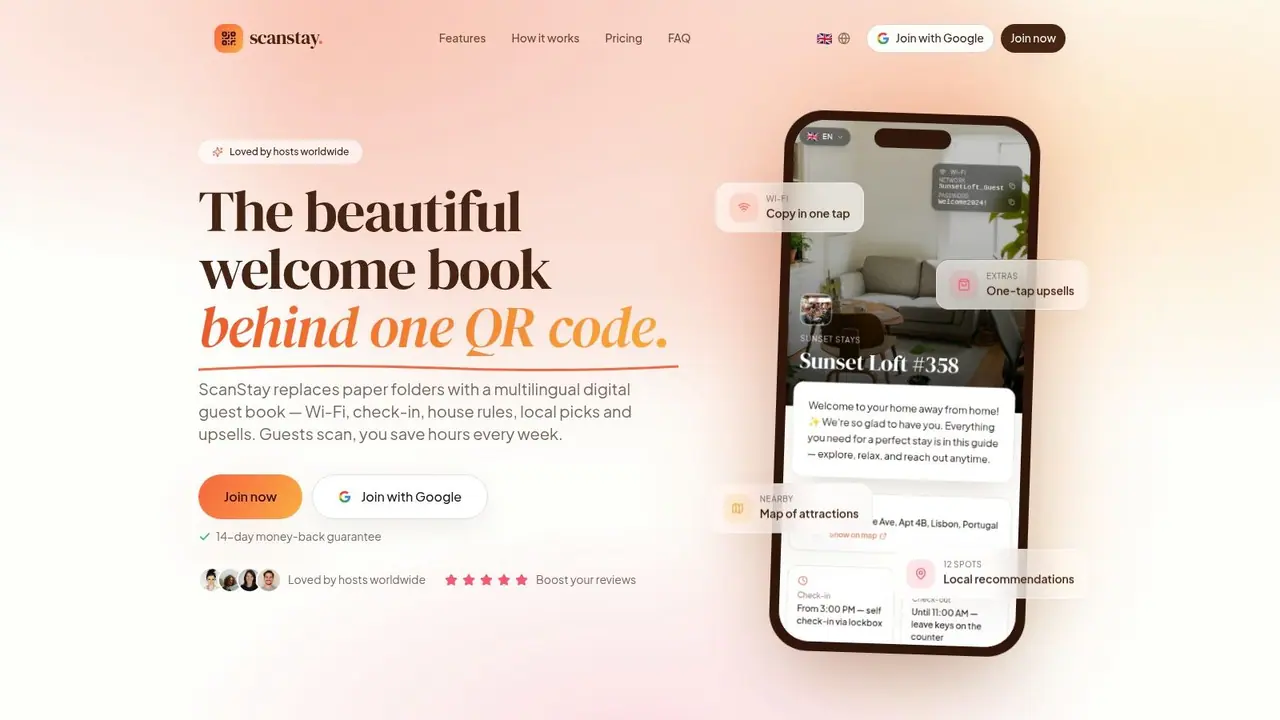
One option in that category is rental management software for hosts and operators, including tools like ScanStay that provide digital guidebooks, QR-based guest access to property information, and support for service upsells such as late checkout or transfers. The value isn't abstract. It's operational. Less repeated messaging, fewer avoidable questions, and a cleaner handoff from booking to stay.
Maintenance speed is an operating advantage
Maintenance software matters because repair handling is not just a convenience issue. It affects renewals, reviews, and owner confidence.
The performance gap between operators is stark. Top-quartile residential property management operators achieve a maintenance SLA breach rate under 5%, while median operators breach SLAs more than 15% of the time, with a 2.7-day benchmark for world-class repair speed according to this property management automation benchmark.
That tells you something important. Faster maintenance is not just about having a handyman on speed dial. It comes from workflow design:
- Intake clarity: The resident or guest submits a complete issue, with photos if possible.
- Triage rules: Emergency, urgent, and routine requests follow different paths.
- Vendor dispatch: The right person gets the job with authorization details attached.
- Closure documentation: Work completed, tenant informed, owner record updated.
A weak workflow makes every repair feel custom. A strong workflow makes most repairs boring. Boring is profitable.
Communication tools matter more in short-term rentals
In STR operations, communication automation has a second job beyond reducing workload. It shapes the guest experience. If check-in details are buried in messages, guests feel uncertain before they arrive. If local recommendations are vague, they ask more questions. If upsells are handled manually, they're easy to forget and awkward to offer.
This product walkthrough shows the type of guest-facing experience many operators now build into their communication stack:
The key is integration. Your software should behave like a relay team. The booking creates the guest record. The guide delivers the stay information. The maintenance tool captures issues. The reporting tool closes the loop. If you have to manually carry information from one tool to another every day, you don't have a stack. You have extra admin.
Best Practices for Scaling and Compliance
Scaling a rental portfolio doesn't come from handling more chaos. It comes from reducing variation. That applies whether you're adding long-term units, growing a co-hosting operation, or turning one short-term rental into several.
The direction of the market supports that push toward professionalization. The global residential property management market was valued at about $7.21 billion in 2024 and is projected to reach $12.12 billion by 2030, at a 9.04% CAGR, according to residential property management market analysis. Growth creates opportunity, but it also raises the cost of sloppy operations.
Standardize before you expand
Every repeat task should have a standard. Not a vague preference. A standard.
That includes:
- Leasing standards: Screening criteria, application handling, approval rules, and move-in documentation.
- Maintenance standards: Preferred vendors, spending limits, emergency definitions, and inspection triggers.
- Guest or tenant communication standards: Message templates, response windows, and escalation paths.
A useful analogy comes from outside real estate. Fleet operators don't scale by waiting for each driver to describe vehicle issues differently every day. They use repeatable checklists, service intervals, and reporting discipline. The same logic shows up in these fleet management best practices, and it translates surprisingly well to property operations.
Growth without standardization creates a larger version of the same mess.
Compliance is part of operations
Many owners treat compliance as paperwork that happens after the “real work.” That's backwards. Compliance is embedded in leasing, advertising, fee disclosure, notices, fair housing practices, habitability responses, and recordkeeping.
For long-term rentals, that means the lease has to match your operating reality. If your team can't consistently enforce a clause, don't rely on it as your safety net. For short-term rentals, local operating rules, building restrictions, and guest documentation requirements need the same seriousness.
A practical compliance posture has three habits:
- Document decisions: Especially around applications, accommodations, notices, and disputes.
- Use current forms and templates: Outdated paperwork creates preventable risk.
- Audit your process periodically: Ads, leases, recurring fees, and house rules should match what residents or guests experience.
Owners who scale well usually become more boring, not more improvisational. Their listings, lease files, maintenance handling, vendor approvals, and communication patterns all become easier to inspect. That's a feature, not a loss of flexibility.
If you manage short-term rentals and want fewer repetitive guest messages, clearer check-in instructions, and a cleaner way to present upsells and house information, ScanStay fits neatly into that operational layer. It gives hosts a digital welcome book guests can open by QR code, which helps replace paper binders and scattered message threads with one organized guest-facing resource.