Vacation Rental Revenue Management: A Complete Guide
Master vacation rental revenue management with this guide. Learn about dynamic pricing, KPIs like RevPAR, and how to boost ancillary revenue.
If you're managing a vacation rental today, there's a good chance your pricing still gets changed in bursts. You notice a gap in the calendar, check a few competing listings, lower a weekend, raise a holiday, and hope the market agrees with you. Then a guest asks for late checkout, another wants an airport transfer, and someone else asks where to rent bikes. Most hosts treat those requests as admin.
That's where revenue leaks.
Good vacation rental revenue management isn't just about setting the right nightly rate. It's about controlling the whole earning system around each stay. Price matters. Stay rules matter. Channel mix matters. But the operators who build stronger margins also pay attention to the small paid extras that happen around the booking. Ignore those, and you're optimizing only part of the business.
If you manage homes in destination markets, practical local planning matters too. A regional resource like this Spain holiday accommodation guide is useful because guest expectations, seasonality, and trip patterns often shape both pricing and add-on opportunities.
Table of Contents
- What Is Vacation Rental Revenue Management Anyway
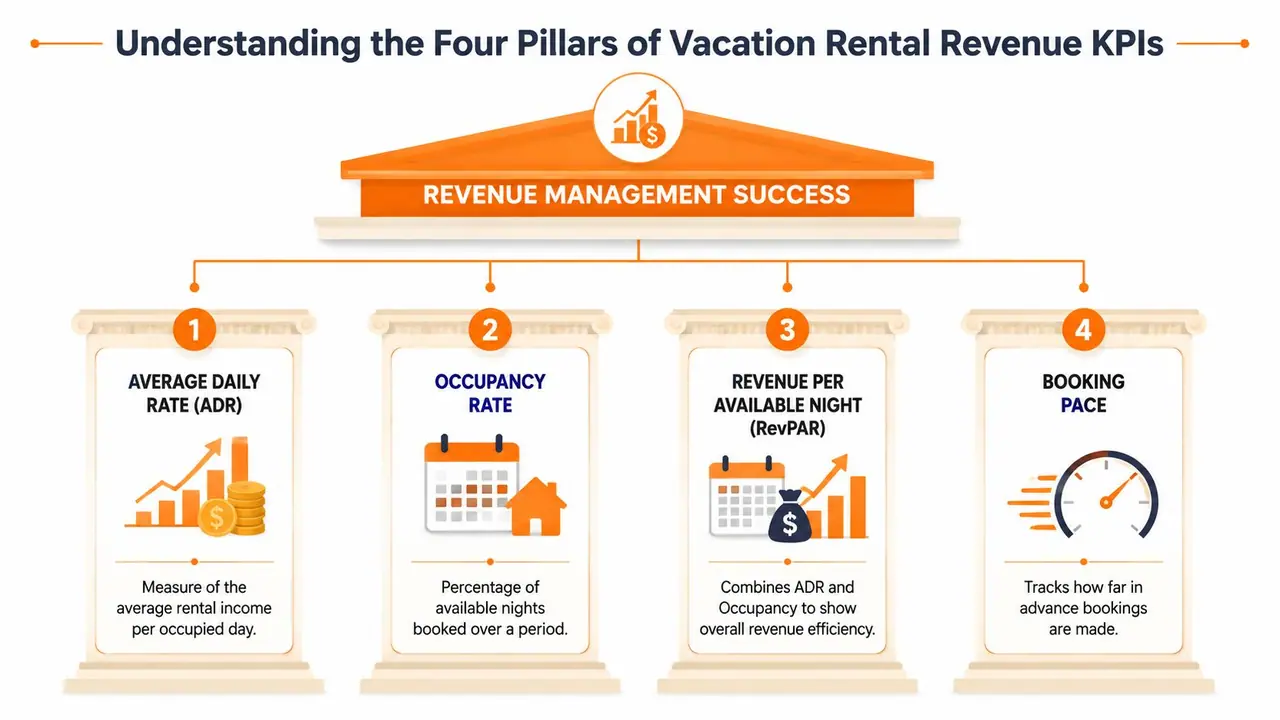
- Understanding the Four Pillars KPIs That Matter
- Using Dynamic Pricing and Stay Rules to Your Advantage
- Optimizing Your Channel Mix for Maximum Profit
- Boosting Revenue with Upsells and Ancillary Services
- The Essential Tech Stack for Automation and Reporting
- A Practical Implementation Checklist for Hosts
What Is Vacation Rental Revenue Management Anyway
A lot of hosts start with pricing, not revenue management.
They open Airbnb or Booking.com on a Sunday night, compare three nearby listings, and move rates up or down based on instinct. If a weekend isn't booked, they discount it. If a holiday starts to fill, they raise it. That feels active, but it's still guesswork if you don't know who you're trying to attract, when they usually book, and which dates deserve protection.
Vacation rental revenue management is the discipline of answering those questions with data and then acting on them consistently. It decides the right price, yes, but also the right minimum stay, the right booking window, the right channel, and the right opportunities to earn more from the same guest.
Revenue management is broader than pricing
Pricing is one lever. Revenue management is the full control panel.
A practical way to think about it is this:
- Pricing controls value capture: What is each night worth right now?
- Stay rules control calendar quality: Which bookings improve the rest of the month and which ones create awkward gaps?
- Distribution controls margin: Where did the booking come from, and what did it cost to get it?
- Ancillary offers control total guest revenue: What else can the guest buy that adds convenience and margin?
Revenue management is the difference between filling nights and building a profitable calendar.
The right question isn't occupancy alone
I've seen plenty of calendars that look healthy and still underperform financially. High occupancy can hide weak pricing. Premium pricing can also fail if the calendar is too empty. Professional operators don't ask, "How do I get fully booked?" They ask, "How do I earn the most from the inventory I have?"
That shift matters. Once you start treating each property like a limited set of perishable nights, the business becomes clearer. Every empty night expires. Every underpriced peak date is gone forever. Every unoffered add-on is a missed chance to increase total revenue from a guest who was already in your funnel.
Understanding the Four Pillars KPIs That Matter
If you don't track the right KPIs, revenue management turns into opinion. You need a few numbers that tell you whether your pricing, demand capture, and booking patterns are working together or fighting each other.
A strong overview of reporting structure also helps when you're building dashboards across properties. This guide to vacation rental analytics is useful if you want a clearer view of what to monitor regularly.
ADR tells you what guests paid
ADR, or Average Daily Rate, tells you the average revenue earned per booked night. It's the cleanest way to see how much value you're capturing when a reservation lands.
High ADR looks good on paper, but it can be misleading. If you're holding rates too high and losing too many bookings, ADR alone won't tell you that. It's a pricing metric, not a full performance metric.
Occupancy shows demand captured
Occupancy rate tells you how much of your available inventory sold.
This metric matters because unused nights can't be stored for later. But occupancy becomes dangerous when hosts chase it without context. Discounting your way to a full calendar often feels productive because the property looks busy. The profit line usually tells a different story.
RevPAR keeps you honest
RevPAR, or Revenue Per Available Rental, combines rate and occupancy into one measure. It's the balancing scale of vacation rental revenue management.
According to a 2024 analysis of 10,000 properties across 15 major global markets, a strategic 5% increase in ADR that caused only a 1.5% drop in occupancy still produced an approximate 3.5% RevPAR gain. The same analysis found that blindly lowering rates to gain occupancy often damaged RevPAR instead. That relationship is summarized in the verified industry fact set referenced as Fact 2.
Practical rule: A full calendar at the wrong price is not a win.
Here's the simplest way to read the four pillars together:
| KPI | What it tells you | Common mistake |
|---|---|---|
| ADR | Average revenue per booked night | Celebrating a high ADR while the calendar stays thin |
| Occupancy | Share of nights booked | Discounting too aggressively just to fill gaps |
| RevPAR | Revenue efficiency across all available nights | Ignoring it and optimizing only one input |
| LOS | Average length of stay | Taking short bookings that block stronger reservations |
Length of stay affects calendar quality
Length of Stay (LOS) doesn't get enough attention, but it changes the economics of your calendar. A two-night booking over a peak period might look attractive until it blocks a longer, higher-value reservation or creates a dead gap before the next arrival.
Longer stays can reduce turnover pressure, cleaning coordination, and fragmentation. Shorter stays can help in softer periods when flexibility matters more. LOS isn't just an operations metric. It's a revenue lever.
A practical review each month should include:
- Check ADR by season: Strong ADR in summer may hide weak shoulder-season pricing.
- Look at occupancy with context: Ask whether the nights booked were the nights you most needed to sell.
- Use RevPAR as the scorecard: It forces pricing and occupancy into the same conversation.
- Watch LOS by property type: Family homes, urban apartments, and remote cabins often need different stay patterns.
Using Dynamic Pricing and Stay Rules to Your Advantage
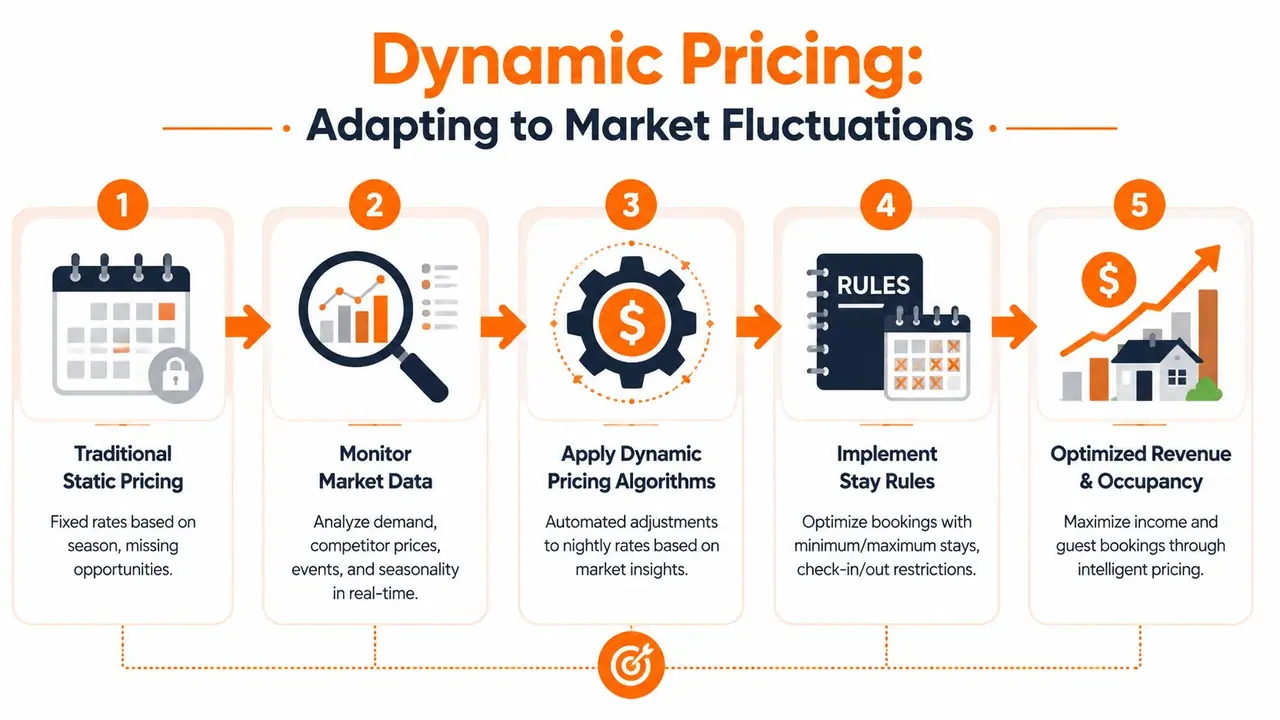
Static rates are comfortable because they feel predictable. They also miss demand shifts constantly.
Professional operators moved away from fixed seasonal pricing because market conditions change faster than manual updates can keep up. In the verified industry data, over 70% of professional short-term rental operators in major markets like the United States and Europe were using automated dynamic pricing tools by 2025, and those properties achieved an average RevPAR increase of 15% to 20% compared with fixed-rate properties, according to the 2025 Beyond Pricing Report summarized in Fact 1.
Static pricing breaks in fast markets
A fixed summer rate assumes every July week is equal. It isn't.
Demand shifts because of local events, school calendars, flight patterns, weather, and booking pace. Good pricing engines react to those signals quickly. They don't just compare your home with generic market averages. They process large sets of live inputs and keep adjusting as the date approaches.
In practice, dynamic pricing works best when you stop treating it like autopilot and start treating it like a co-pilot. You still need to set the base strategy. The tool handles speed and pattern detection. You handle market judgment.
Useful signals to watch include:
- Local event pressure: Concerts, festivals, sports weekends, and conferences can justify higher rates before your competitors move.
- Day-of-week demand: Many leisure markets carry stronger weekend compression than midweek demand.
- Lead time: Some destinations book far ahead. Others fill late. Your pricing should reflect how guests shop.
- Pacing against prior periods: If bookings are coming in ahead of normal, discounting early is usually a mistake.
This short video gives a practical overview of how dynamic pricing fits into modern rental operations:
Stay rules shape better bookings
Nightly rate gets most of the attention. Stay rules often do the heavier lifting.
Minimum stay restrictions help protect high-demand periods from low-value reservations. If you accept a short booking too early on a prime weekend, you can block a longer reservation that would have produced more total revenue and cleaner calendar flow.
The industry data in the verified fact set shows that the hybrid model became dominant in the 2022 to 2023 period. Operators using 3 to 5 night minimum stays during peak weeks saw occupancy stabilize at 85% while ADR increased by 18%, generating a 22% total revenue uplift compared to the previous year, as summarized in Fact 2. The lesson is simple. Restrictions are not there to make life harder for guests. They're there to protect your best inventory.
The strongest calendars aren't the busiest. They're the least fragmented.
Common stay-rule decisions that work:
- Peak holiday protection: Require longer stays early, then relax closer to arrival if needed.
- Weekend control: Avoid one-night or awkward two-night stays that split a high-demand block.
- Gap management: Shorten minimums only when it helps fill orphan nights between reservations.
- Midweek flexibility: In many markets, looser midweek rules create demand without weakening premium weekends.
What to watch every week
Revenue management gets easier when you make fewer emotional decisions.
A simple weekly routine works better than constant fiddling:
- Review the next booking windows. Look at near-term dates and future high-value periods separately.
- Check pickup pace. Ask whether each period is ahead, on track, or behind expectations.
- Audit restrictions. Make sure minimum stays still match demand.
- Inspect outliers. If a date is much cheaper or much more expensive than surrounding nights, confirm there's a reason.
- Watch competitor behavior carefully. Don't copy it blindly. Many operators underprice because they're nervous.
What doesn't work is reacting to every empty night with a discount. Empty nights matter, but not every gap is a problem. Some are just unsold inventory that hasn't reached the right booking window yet.
Optimizing Your Channel Mix for Maximum Profit
Revenue doesn't only depend on what guests pay. It also depends on where they book.
A reservation from Airbnb, Booking.com, Vrbo, or your direct site may produce very different net results even when the nightly rate looks similar. That's why channel mix belongs inside vacation rental revenue management, not in a separate marketing bucket.
Not all bookings are equal
Most hosts start by pushing the same price everywhere. That sounds tidy, but it usually ignores channel economics and guest behavior.
Some channels bring reach. Some bring convenience. Some bring repeat guests and stronger margins. A portfolio with healthy distribution doesn't depend too heavily on one source, and it doesn't assume every booking is equally valuable.
A practical comparison looks like this:
| Channel type | Main advantage | Main trade-off |
|---|---|---|
| Major OTA | Broad visibility and steady demand | Lower margin and less guest ownership |
| Direct booking | Better margin and stronger repeat potential | Requires trust, systems, and follow-up |
| Niche or regional channels | Better fit for certain guest types or destinations | Lower volume and more management complexity |
How to think about channel strategy
The right approach is usually not to abandon OTAs. It's to use them intentionally.
OTAs are excellent for visibility, market entry, and shoulder-demand capture. Direct bookings become more valuable when you already have repeat traffic, a recognizable brand, or a strong post-stay remarketing process. The mistake is treating direct and OTA reservations as interchangeable.
A few practical rules help:
- Price for net outcome: A slightly lower direct rate can still produce better profit if the booking costs less to acquire.
- Use channel-specific offers carefully: Flexible cancellation, longer-stay perks, or direct-booking bonuses can shift behavior without training guests to bargain.
- Protect premium dates: Don't rely on blanket promotions across all channels during strong demand windows.
- Review guest quality by channel: Some channels produce more support load, shorter stays, or lower ancillary spend.
If a booking fills the calendar but weakens margin, blocks a better stay, and produces more manual work, it isn't your best booking.
The best operators don't ask which channel is best in general. They ask which channel is best for this property, for this date range, at this stage of the booking window.
Boosting Revenue with Upsells and Ancillary Services
This is the part most revenue strategies miss.
Hosts spend hours tuning nightly rates and almost no time building structured offers around the stay itself. That leaves money on the table because guests don't just buy accommodation. They buy convenience, time savings, flexibility, and local access.
In the verified 2025 data, 78% of hosts use automated pricing, but only 12% systematically integrate ancillary service upsells into the guest journey. The same data notes that contactless, one-tap upselling can convert 20% to 30% of routine support inquiries into profitable transactions, as summarized in Fact 5.

A useful starting point is understanding how digital guest materials can organize those offers clearly. This overview of a vacation rental welcome book shows the kind of guest-facing structure that makes add-ons easier to present.
Nightly rate is only one layer of revenue
If a guest asks for early check-in, late checkout, mid-stay cleaning, airport transfer, baby gear, bike hire, firewood, fridge stocking, or local equipment rental, that isn't a support interruption. It's a buying signal.
Operators often lose this revenue in three ways:
- They answer manually: The guest gets the service, but the process is slow, inconsistent, and hard to scale.
- They never formalize the offer: Staff may approve exceptions ad hoc without charging properly.
- They hide options in chat threads: Guests don't see what's available unless they ask.
That approach creates a micro-revenue gap. The guest has demand. The host has inventory or partner services. The system connecting the two is missing.
What actually sells as an add-on
The best ancillary offers are not random. They solve friction that appears at predictable points in the stay.
Good examples include:
- Arrival friction: Airport transfers, grocery pre-stocking, parking add-ons
- Timing friction: Early check-in, late checkout, luggage hold
- Comfort friction: Mid-stay cleaning, extra linens, baby equipment
- Destination friction: Ski passes, bike rentals, beach gear, local experiences
What doesn't work is stuffing guests with irrelevant offers. A city apartment near the airport needs a different menu than a mountain cabin or a beach house. Add-ons should match location, guest type, and trip purpose.
Guests rarely object to paying for convenience when the offer is timely and easy to buy.
Why digital guest tools change the game
Most hosts already send arrival messages, local tips, and house rules. That's exactly why guest-facing tools are powerful. They turn information that already exists into a structured revenue surface.
Instead of answering the same request five times a week, you publish the offer once. Instead of burying options inside long message threads, you place them where guests naturally look during the stay. Instead of relying on staff memory, you standardize the flow.
That matters because ancillary revenue isn't just extra income. It improves the guest journey when done well. A paid late checkout offered clearly before departure feels more professional than a last-minute chat negotiation. A transfer link inside the digital guide feels easier than a back-and-forth message exchange.
For multi-property operators, revenue management becomes more complete. You're no longer optimizing only what happens before check-in. You're optimizing total revenue per guest from booking through departure.
The Essential Tech Stack for Automation and Reporting
Strategy falls apart fast when the tools don't connect.
A modern revenue setup usually needs three categories working together: a dynamic pricing engine, a PMS with channel management capability, and a guest experience layer. When these systems are disconnected, teams waste time fixing avoidable mistakes instead of improving performance.
Verified industry data shows that properties using integrated, automated systems where pricing tools, PMS, and channel managers work together achieve 20% higher revenue efficiency than properties relying on manual pricing adjustments, according to the source summarized in Beyond Pricing's revenue management software overview.
If you're comparing systems, this guide to affordable property management software is a practical place to start.
The core systems that need to connect
You don't need the fanciest stack. You need one that syncs reliably.
The core setup usually looks like this:
- Dynamic pricing engine: Tools such as PriceLabs or Beyond adjust nightly rates and sometimes stay rules based on demand signals.
- PMS and channel manager: This is the operational hub. It pushes rates, syncs calendars, prevents double bookings, and centralizes reservations.
- Guest experience platform: This handles pre-arrival information, house instructions, local recommendations, and structured guest communication.
What good automation actually does
Good automation removes repetitive decisions, not strategic control.
You should still decide pricing boundaries, peak-period rules, and property positioning. The system should handle the repetitive mechanics:
| Function | Manual workflow | Integrated workflow |
|---|---|---|
| Rate updates | Repriced one channel at a time | Synced across channels automatically |
| Restrictions | Easy to forget on one listing | Applied consistently through connected tools |
| Calendar changes | Higher error risk | Managed centrally |
| Guest information | Sent repeatedly in messages | Standardized and reusable |
What doesn't work is layering tools without a process. If your pricing engine recommends one thing, your PMS pushes another, and your guest-facing offers live in separate spreadsheets or message templates, you'll feel busy without improving revenue.
A Practical Implementation Checklist for Hosts
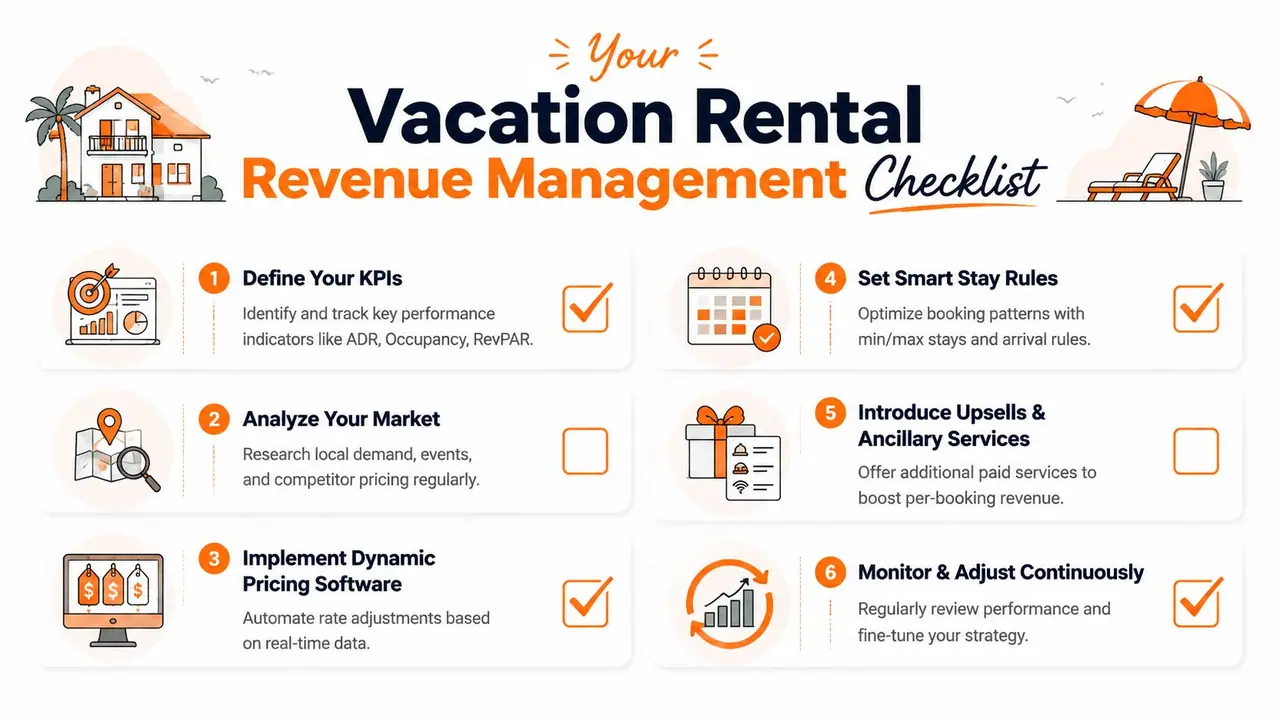
Most revenue problems don't come from missing theory. They come from inconsistent execution.
Hosts know they should review pricing, watch occupancy, and offer extras. The issue is that each task sits in a different place, happens at a different time, and gets handled only when there's a problem. A checklist fixes that by turning revenue management into an operating rhythm.
Start with measurement not assumptions
Before changing prices or adding services, get your baseline straight.
- Track the core KPIs. Watch ADR, occupancy, RevPAR, and length of stay for each property, not just across the whole portfolio.
- Segment by property type. Family villas, compact city units, and seasonal cabins shouldn't be judged by one blended average.
- Review booking pace manually if needed. Even a simple month-over-month or period-over-period comparison is better than pricing blind.
A common mistake is chasing occupancy because it's visible. Profitability is less visible, so it gets ignored. That's why weak strategies often survive longer than they should.
Build the pricing engine
Your pricing setup should reflect how your market books.
Use this sequence:
- Set a realistic base price: Start from true market position, not from what you'd like the property to earn.
- Define ceilings and floors: Give the pricing tool room to react without letting it drift into obviously wrong territory.
- Apply stay rules by demand period: Peak dates, event periods, weekends, and low-demand windows usually need different logic.
- Review outliers weekly: Automation catches patterns, but you still need to catch mistakes.
Field note: The best automated setup is the one you trust enough not to override emotionally every other day.
Add ancillary revenue on purpose
Many portfolios still operate casually.
Build a real ancillary menu for each property or location cluster. Don't wait for guests to ask. Decide in advance which services you want to offer, how they'll be fulfilled, and when they should be presented.
A practical framework looks like this:
| Stage of stay | Best type of offer | Why it works |
|---|---|---|
| Before arrival | Transfers, early check-in, grocery setup | Guests are planning logistics |
| During stay | Cleaning, equipment rental, local add-ons | Needs become immediate and contextual |
| Before departure | Late checkout, luggage options | Guests want flexibility and convenience |
This part needs localization. Verified reporting from 2024 to 2025 shows that 65% of multi-property managers fail to differentiate ancillary offers by location, leading to a 15% lower conversion rate than single-property hosts who tailor offers to the setting, as summarized in Fact 6.
That means a portfolio-level template should never become a portfolio-level blind spot. A ski property should not carry the same upsell logic as an urban flat near a business district. A beach home should not push the same extras as a trail-side cabin.
Review monthly and fix what is leaking
A monthly review should answer four direct questions:
- Which dates were underpriced? Look for periods that sold too quickly at rates that now look light.
- Which dates sat too long? Identify whether pricing, restrictions, or weak positioning caused the drag.
- Which channels produced the healthiest bookings? Compare not just volume, but margin and booking quality.
- Which ancillary offers moved? Keep the useful ones. Remove the clutter.
What doesn't work is treating all weak performance as a pricing issue. Sometimes the problem is minimum stay logic. Sometimes it's channel fit. Sometimes it's that guests are asking for paid extras and you still handle those requests manually.
A solid implementation rhythm is simple:
- Weekly: Check pacing, rates, restrictions, and holes in the calendar.
- Monthly: Review property-level KPI trends and booking-source quality.
- Quarterly: Rebuild your ancillary menu by location and guest type.
- Before every major season: Stress-test base pricing and stay rules.
Hosts who do this consistently usually stop making reactive moves. They don't need to guess as often because the system shows them where revenue is being won and where it's leaking out.
ScanStay helps hosts turn guest information into a cleaner revenue system. With one QR-based digital welcome book, you can centralize check-in details, house rules, local recommendations, and one-tap upsells like late checkout, transfers, or equipment rentals. If you want a simpler way to reduce repetitive messages while creating more opportunities to monetize each stay, take a look at ScanStay.