Vacation Rental Property Management Your Complete Guide
Master vacation rental property management. Our guide covers self-management vs pros, operations, tech, pricing, legal, and KPIs for hosts and managers.
You bought or inherited a short-term rental because the math looked good. Then the work started. A guest wants early check-in. The cleaner is waiting on linens. Someone can't find the Wi-Fi password. A neighbor texts about trash cans. At 10:47 p.m., another guest asks how to work the hot tub.
That's the shape of vacation rental property management. It isn't one job. It's reservations, hospitality, operations, maintenance coordination, pricing, compliance, and reputation management stacked into one daily system.
The upside is that this isn't a tiny side niche anymore. The global short-term vacation rental market reached USD 149.2 billion in 2025 and is projected to reach USD 362.4 billion by 2033, with an 11.8% CAGR from 2026 to 2033, according to Grand View Research's short-term vacation rental market report. That growth is why so many owners are willing to professionalize fast instead of hosting by instinct.
Guests are also comparing your rental to a much wider set of travel options. In family-heavy destinations, expectations around local planning start before they even arrive. If you host in Southern California, a practical planning piece like this Los Angeles family trip hotel guide shows the level of trip support travelers already use when choosing where to stay.
Table of Contents
- The Reality of Managing a Vacation Rental
- The Two Paths DIY vs Professional Management
- Core Operational Workflows from Booking to Checkout
- Building Your Tech Stack for Efficiency and Automation
- Pricing Strategies and Fee Structures Explained
- Navigating Legal Requirements and Compliance
- Measuring Success KPIs and Reporting for Your Rental
The Reality of Managing a Vacation Rental
Most new hosts underestimate the middle of the business. They think about the listing, the photos, and the nightly rate. They don't think about who confirms the door code was sent, who notices the missing wine glasses before check-in, or who answers when a guest says the upstairs neighbor is loud even though the problem is the HVAC.
That's why good operators stop thinking like hosts and start thinking like system builders.
The job is repetitive until it isn't
A lot of the work looks simple because it repeats. Confirm booking. Send directions. Coordinate cleaning. Check supplies. Request review. The problem is that every repeatable task breaks in a slightly different way. A simple calendar issue becomes a cleaner conflict. A small maintenance issue becomes a refund discussion. An unclear house rule becomes a neighbor complaint.
Practical rule: If a task happens more than twice a week, it needs a written workflow, not memory.
Profit comes from consistency
The operators who last aren't always the ones with the prettiest properties. They're the ones with fewer avoidable mistakes. They reduce guest confusion, shorten response loops, and make the property feel predictable in a good way.
Vacation rental property management gets easier when you treat every stay as part of one operating model. The rest of the article follows that mindset.
The Two Paths DIY vs Professional Management
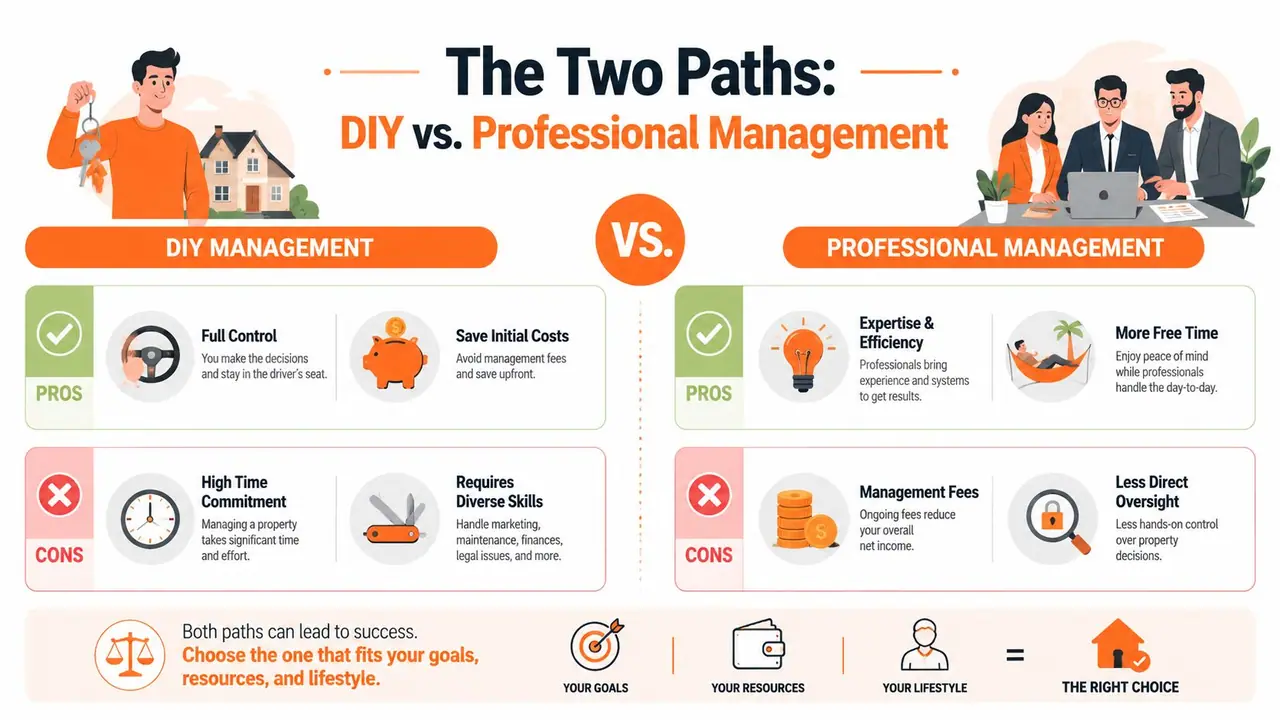
The first real decision is simple on paper and messy in practice. Do you manage the property yourself, or do you hire a professional manager?
A lot of owners treat this like a personality question. It's really an operating model question. Your answer affects margin, time, control, risk, guest experience, and how fast you can add properties.
The professional route is no longer niche. In the U.S., there are 1,985,280 professionally managed vacation rental properties supported by approximately 25,000 vacation rental management companies, according to iPropertyManagement's vacation rental industry statistics. That tells you two things. First, many owners have already decided the workload is big enough to outsource. Second, the market is mature enough that you can compare managers by process, not just promises.
What DIY actually requires
DIY works best when the owner wants direct control and can respond fast. It also works when the property is close by, the maintenance network is reliable, and the owner is willing to build systems.
The hidden cost is not just time. It's context switching.
One hour of vacation rental property management rarely stays one hour. A quick guest reply turns into a platform update, then into cleaner coordination, then into ordering replacement supplies. Owners who manage one property often do fine with DIY. Owners who manage several units usually hit the same wall. The work doesn't just increase. It fragments.
DIY tends to work when you can handle these responsibilities well:
- Guest communication: Fast, clear, and available at awkward hours.
- Turnover control: Cleaner scheduling, inspection follow-up, linen and supply management.
- Maintenance triage: Knowing what is urgent, what can wait, and who to call.
- Listing management: Photos, copy updates, calendar accuracy, and channel consistency.
- Basic revenue management: Adjusting rates, restrictions, and minimum stays based on demand.
What professional management really buys
A manager isn't magic. A good one brings process, coverage, vendor coordination, and local market judgment. A weak one adds cost and puts a layer between you and the guest.
Owners usually benefit from professional management when they have one of these conditions:
- Distance: The property is too far away for practical oversight.
- Scale: Multiple units create too many moving parts for one person.
- Lifestyle constraints: You don't want to be on call.
- Operational weakness: You're strong on acquisition or design, but not on daily operations.
A manager earns their fee when they reduce mistakes you can't see, not when they merely answer messages you could have answered yourself.
The trade-off is loss of direct visibility. If the manager doesn't provide clean reporting, owner statements, and clear issue logs, you can end up with less control and no better performance.
A practical decision table
| Decision factor | DIY management | Professional management |
|---|---|---|
| Control | Highest. You make every call. | Lower. You approve more than you execute. |
| Time demand | Heavy and often unpredictable | Lighter for the owner, heavier for the operator |
| Margins | Potentially higher if operations stay tight | Lower due to management fees |
| Speed of changes | Fast if you're hands-on | Depends on manager responsiveness |
| Best fit | Nearby owners, small portfolios, process-minded hosts | Remote owners, busy owners, growing portfolios |
| Main risk | Burnout and inconsistent execution | Paying for mediocre oversight |
A simple way to decide is to ask three questions:
Can you respond reliably without resentment?
If guest messages already feel intrusive, DIY won't get better with volume.Do you have local vendors you trust?
Most operational failures start with cleaning, maintenance, access, or restocking.Will you review the business weekly? Owners who choose DIY but don't monitor operations usually get the worst of both worlds.
Core Operational Workflows from Booking to Checkout
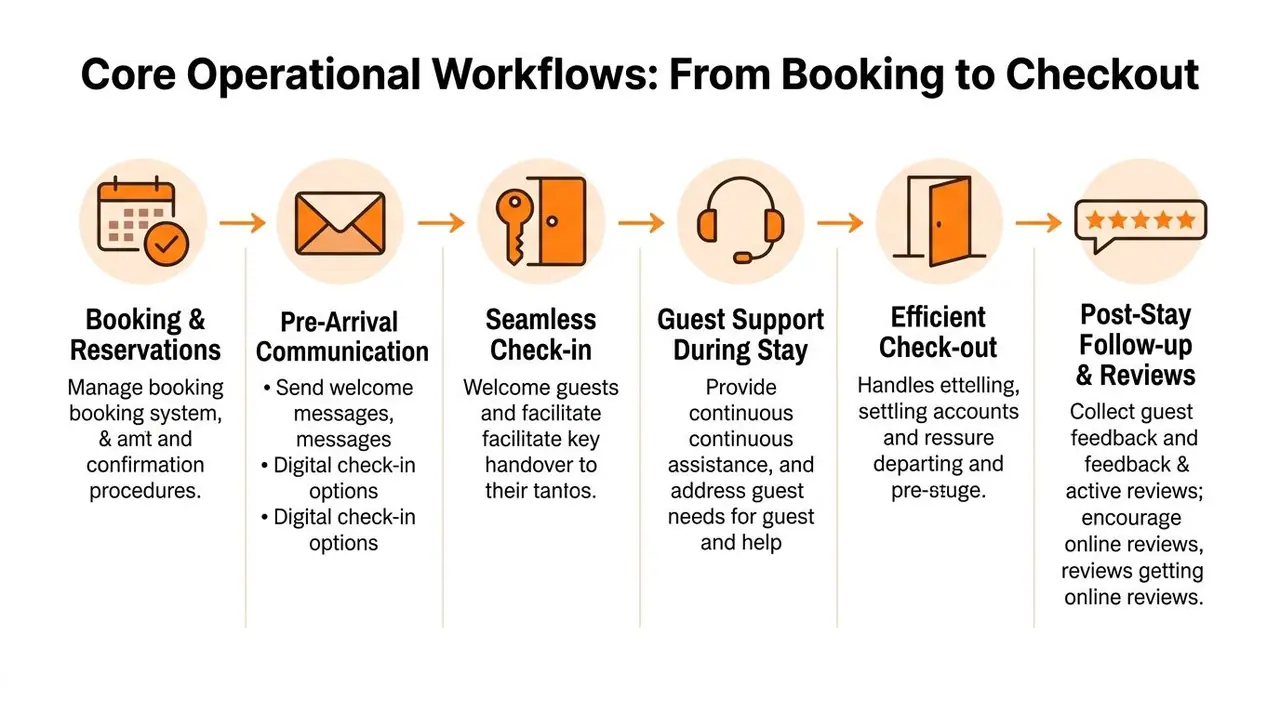
Most hosting problems don't start as big problems. They start as missing information, vague instructions, late handoffs, or unchecked details. The fix is a clean operational workflow that runs the same way every stay.
Pre-arrival systems
Pre-arrival work determines whether the stay starts calm or chaotic. Once a booking is confirmed, the goal is to remove uncertainty before the guest travels.
Your standard pre-arrival sequence should cover:
- Booking confirmation: Reconfirm dates, guest count, and core property details.
- Expectation setting: Make cancellation terms, parking rules, and occupancy limits obvious.
- Arrival details: Send check-in time, access method, address, and what to do if they arrive early.
- Property prep trigger: Cleaning, inspections, maintenance checks, and restocking should all tie to booking dates.
A lot of hosts wait too long to send the information guests need. They send a pleasant welcome message and leave the important details for later. That creates inbound questions you could have prevented.
Check-in without friction
A smooth check-in isn't about sounding friendly. It's about reducing failure points.
Guests need five things clearly presented in one place: how to get in, where to park, what the Wi-Fi is, what the key rules are, and who to contact if something breaks. If any of those items are scattered across platform messages, PDFs, and paper binders, confusion goes up fast.
That's also where neighbor complaints often begin. Guests don't break rules only because they're careless. Many break them because nobody showed them the rules in a way they would read.
In-stay support and complaint prevention
The strongest operators prevent repetitive questions before they arrive. One of the clearest examples is the shift from paper binders to digital guest guides. According to Rent Responsibly's neighbor guidance resource, hosts using QR-based digital guides report 30% fewer 3-star reviews due to "noise" or "confusion," and these guides proactively address 60-70% of guest issues before they escalate into complaints.
That matters because the operational pain isn't only in bad reviews. It's in message volume. Every avoidable question steals attention from real service issues.
If guests have to ask where to put trash, how to park, or when quiet hours start, your system is under-documenting the stay.
A practical digital guide should include:
- House rules written plainly: No legal essay. Just clear instructions.
- Parking guidance: Photos help. So do landmarks.
- Trash instructions: Which bins, which day, where they go.
- Noise expectations: Quiet hours and what's expected outdoors.
- Appliance how-tos: Thermostat, TV, hot tub, grill, coffee machine.
- Local recommendations: This reduces wandering questions and upgrades the guest experience.
Cleanliness belongs in the same workflow. A strong turnover checklist should cover reset quality, photo verification, supply replenishment, and final staging. If you need a practical turnover reference, this Pine Country Window Cleaning resource is useful because it reflects how hosts think through checklist discipline, not just surface cleaning.
Checkout turnover and review follow-up
Checkout is where many operators rush and lose money. They focus on getting the next guest in and skip the inspection loop that catches damage, missing items, and maintenance drift.
A disciplined checkout workflow usually includes:
- Departure confirmation so you know when turnover can start.
- Cleaner task list with standards, not vague reminders.
- Inspection step for damage, missing stock, and maintenance flags.
- Restock reset for consumables and welcome items.
- Review request while the stay is still fresh.
Review requests work better when the stay felt organized from start to finish. Guests don't reward effort they never saw. They reward clarity, comfort, and a lack of friction.
Building Your Tech Stack for Efficiency and Automation
Hosts often buy tools in the wrong order. They start with pricing software because revenue feels urgent, then add messaging software, then discover they still don't have one place to run the property. The better approach is to build the stack by function.
A useful stack has three layers. One system runs operations. One system supports pricing. One system handles the guest-facing experience.

Start with the operating core
Your first priority is a property management system. This is the operational spine. It should keep calendars synced, centralize reservations, support task coordination, and reduce manual cross-checking between Airbnb, Booking.com, and direct channels.
Without a PMS, every added property multiplies risk. Double bookings, stale check-in notes, and missed cleaning assignments usually trace back to fragmented systems.
After that, add dynamic pricing software if you need help adjusting rates and stay rules across dates. Pricing tools are useful, but they don't replace an operator. They optimize one part of the business. They don't solve guest confusion, turnover quality, or owner reporting.
For hosts comparing software categories, this affordable property management software overview is a helpful starting point because it frames tools by operational need rather than by feature overload.
Use one guest-facing hub
The guest experience layer matters more than many owners expect. If guests receive six different messages and a paper binder on the kitchen counter, the information is technically there, but the experience still feels disorganized.
That's why digital welcome books have become a practical tool, not a novelty. A platform like ScanStay gives guests a mobile browser page accessed by QR code where they can find Wi-Fi details, check-in instructions, house rules, local recommendations, and service add-ons in one place. The operating value is simple. It reduces repetitive messaging and gives the host one editable source of truth.
The best guest communication tool isn't the one with the most features. It's the one guests will actually use while standing at the front door.
Where the video example fits
A short walkthrough helps when you're deciding whether a digital guide fits your operation or would just add another layer to manage.
The key test is operational, not visual. Ask whether the tool will replace scattered answers with one stable guest flow. If yes, it's worth considering. If not, it's software clutter.
Pricing Strategies and Fee Structures Explained
Pricing isn't just picking a nightly rate that feels competitive. It's a set of controls you use to shape demand, protect margin, and reduce calendar waste.
Many hosts underprice weekdays, overprice low-demand weekends, and forget that restrictions matter almost as much as rate. A property with the right minimum stay rules, cleaning fee logic, and date-based adjustments usually performs more cleanly than one with a single flat approach.
How to think about pricing daily
Start with a simple operating lens. Your price should reflect demand, stay length, booking window, and operational cost.
Useful levers include:
- Seasonal adjustments: Raise or lower rates based on local demand cycles.
- Length-of-stay rules: Use discounts carefully. Don't invite longer stays that create more wear without enough return.
- Gap-night management: Avoid stranded nights that are hard to fill.
- Fee clarity: Guests tolerate fees better when the total offer still feels coherent.
Flat pricing models in other service industries are a good reminder that predictable pricing can improve customer trust when the scope is clear. This guide to flat rate limousine services is outside hospitality, but the logic is relevant. Guests dislike pricing surprises more than they dislike firm pricing.
Fee models owners usually see
When hiring management, you'll usually encounter three broad structures:
| Fee model | How it works | Best for | Main concern |
|---|---|---|---|
| Commission-based | Manager takes a share of booking revenue | Owners who want aligned incentives | Can get expensive in strong markets |
| Flat-fee | Fixed monthly or property-based charge | Stable operations and predictable service scope | May not align with revenue performance |
| Hybrid | Base fee plus commissions or add-ons | Mid-size portfolios and custom service levels | Harder to compare apples to apples |
Always ask what is included. Messaging, cleaning coordination, inspections, maintenance markup, guest screening, and listing updates are not always bundled the same way.
The manager versus software ROI question
Many owners make the wrong comparison. They compare a manager's fee to doing nothing themselves. The better comparison is a manager versus a capable owner using software.
In top U.S. short-term rental markets, professional managers with dedicated revenue teams typically increase revenue by 5-8% more than software-only hosts, but that gain comes at a 25-35% fee, according to Mosaic Getaways' analysis of short-term rental management pros and cons. That's the trade-off.
For many single-property and small-portfolio hosts, the conclusion isn't “never hire a manager.” It's “hire one for the right reason.” If your main problem is pricing, software may solve enough. If your real problems are guest communication, local oversight, turnover reliability, and issue response, a competent manager may still be worth it even if the revenue lift alone doesn't justify the fee.
Navigating Legal Requirements and Compliance
Poor compliance can shut down a good property faster than weak marketing. Most hosts don't get into trouble because they intended to ignore the rules. They get into trouble because they assumed the rules were simple.
They usually aren't.
Licenses permits and local rules
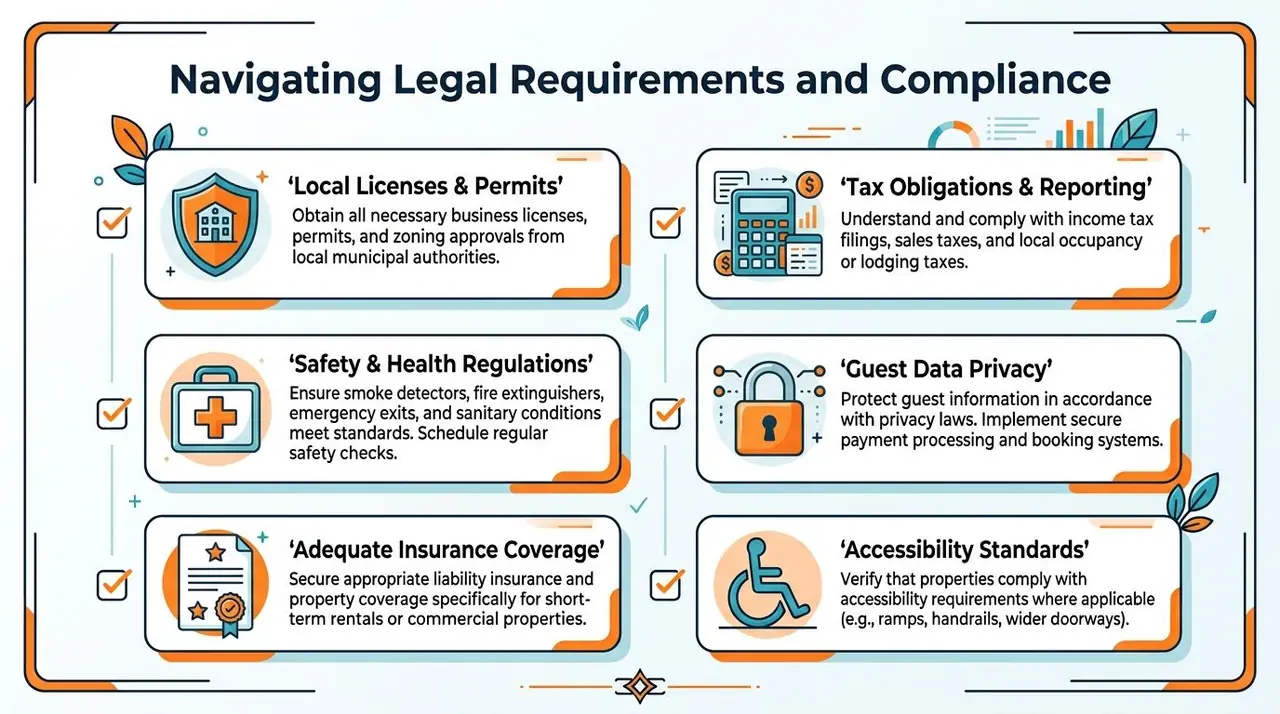
Start local. City and county rules often decide whether you can operate at all, how often you can rent, whether you must live on site, and what you must display on listings.
A practical compliance checklist starts with:
- Business licensing: Confirm whether your city or county requires a permit or registration.
- Zoning rules: Verify that short-term rental use is allowed in your area.
- Occupancy limits: Match your listing and house rules to the legal limit.
- Parking requirements: Some jurisdictions care about this more than hosts expect.
- Display requirements: Permit numbers or registration details may need to appear on listings.
The safest habit is to save every permit, renewal date, and authority contact in one owner file.
Taxes records and guest registration
Tax obligations usually operate at more than one level. You may have platform-collected taxes, local lodging taxes, business income reporting, and recordkeeping duties that still remain your responsibility.
Guest records matter too. If you manage multiple stays or operate in a jurisdiction with stricter reporting expectations, keeping clear registration records reduces confusion later. This guest registration guide is relevant because it focuses on documenting guest information in an organized way.
Compliance gets easier when every booking produces the same paper trail.
Safety insurance and house rules
The minimum standard is not enough. You want a property that is both compliant and defensible if something goes wrong.
Review these items regularly:
- Life safety equipment: Smoke detectors, carbon monoxide detectors where required, and fire extinguishers.
- Emergency information: Exit instructions, emergency contacts, and utility shutoff guidance if appropriate.
- Insurance coverage: Confirm your policy covers short-term rental activity.
- House rules tied to risk: Pool rules, occupancy rules, pet rules, and quiet hours should be explicit.
- Accessibility considerations: Know what standards apply to your property type and booking channels.
A lot of “guest issues” are really documentation issues. If the safety rule exists only in your head, it doesn't count.
Measuring Success KPIs and Reporting for Your Rental
Owners who treat the rental like a business outperform owners who rely on gut feel. Revenue in the bank matters, but it doesn't tell you why performance improved or slipped. For that, you need a simple KPI set and a reporting routine you'll keep.
The numbers that matter every month
Three core metrics show the commercial health of the property:
Occupancy rate
This tells you how full the calendar is. High occupancy at weak rates can still be a pricing problem. Lower occupancy at stronger rates can still be healthy.Average daily rate
This shows the average booked nightly price. Watch it alongside occupancy, not alone.Revenue per available night
This combines pricing and occupancy into one clearer view of performance.
You don't need complicated dashboards to use these well. You need consistency. Track them on the same schedule every month and compare them against your own prior periods.
Operational KPIs most hosts ignore
A property can look profitable while operations degrade unnoticed. That's why I also track process metrics.
Examples worth watching include:
| KPI | Why it matters | What it often reveals |
|---|---|---|
| Response time | Direct impact on guest confidence | Understaffing or poor alert setup |
| Review themes | Shows repeated friction points | Check-in confusion, cleanliness drift, unclear rules |
| Maintenance recurrence | Flags repeat repairs | Cheap fixes replacing real fixes |
| Turnover completion quality | Protects reviews and refunds | Weak cleaner training or vague checklists |
Qualitative reporting matters too. Don't only read star ratings. Read the wording. If guests keep mentioning parking confusion, temperature issues, or trouble finding instructions, your system is pointing at the problem.
Use reporting to make decisions not just track history
A useful owner report should answer three questions. What happened? Why did it happen? What changes next?
That can be as simple as monthly notes on pricing changes, review patterns, maintenance items, and guest communication issues. If you want a framework for what to analyze, this vacation rental analytics guide is a practical reference point.
Good vacation rental property management looks calm from the outside because the operator measures the right things on the inside. That's the shift from reactive host to strategic operator.
If you want to reduce repetitive guest messages and put check-in details, Wi-Fi, house rules, and local recommendations in one mobile-friendly place, ScanStay is built for that workflow. It gives hosts a QR-based digital welcome book that replaces paper binders and helps standardize guest communication across one property or a larger portfolio.