Vacation Rental Welcome Book: A Host's Guide for 2026
Create a vacation rental welcome book that wows guests and saves you time. Our guide covers essential content, digital vs print, monetization, and UX tips.
Your guest checks in late, drops their bags, and within minutes your phone lights up. What's the Wi-Fi password? How do they open the back door? Which remote controls the TV? Can they get a later checkout?
None of these questions are hard. They're just expensive in a different way. They break your evening, slow down your team, and make the guest feel like the stay wasn't fully prepared.
That's why a vacation rental welcome book matters more than most hosts think. Done badly, it's a dusty binder nobody opens. Done well, it becomes part guest guide, part operations manual, and part revenue tool. It answers the routine questions before they become messages, sets expectations before they become complaints, and gives guests a smoother stay without needing you to be on-call for every small detail.
For single-property hosts, that means fewer interruptions. For managers with multiple listings, it means consistency across the portfolio. Either way, the welcome book stops being a chore and starts acting like infrastructure.
Table of Contents
Why a Welcome Book Is Your Most Valuable Employee
At 10 PM, the question about Wi-Fi isn't really about Wi-Fi. It's a sign that the guest doesn't know where the important information lives.
That creates a chain reaction. One message turns into four. Then the guest asks about parking, checkout, the heating, and whether the house rules were in the app somewhere. You answer each one, but the stay already feels less polished than it should.
A good vacation rental welcome book fixes that by becoming the first place guests look. Instead of sending scattered details through booking messages, email, and memory, you put the stay in one organized system. That changes the tone of the entire visit. Guests feel looked after, and you stop playing customer support for issues that should've been handled before arrival.
According to BuildUp Bookings vacation rental statistics, 77.9% of homeowners still rely solely on email to welcome guests. That's the gap. If your competitors are still sending long message threads, a structured guide immediately makes your operation feel more professional.
It handles repetitive work every day
Think of the welcome book like a staff member who never forgets the lock code, never skips the trash day instructions, and never gets irritated answering the same appliance question again.
The highest-value tasks it takes off your plate are usually the most repetitive:
Arrival basics: entry steps, parking, Wi-Fi, and what to do if a guest arrives after dark.
Property use: thermostat, TV setup, hot tub steps, coffee machine, and any quirks unique to the home.
Expectation setting: quiet hours, visitors, smoking policy, pet rules, and checkout tasks.
Practical rule: If you've answered the same guest question more than twice, it belongs in your welcome book.
It improves the stay before anything goes wrong
Most hosts think of a welcome book as prevention. That's true, but it also works as presentation. A clear guide tells guests they're staying with someone organized. That matters.
When the stay feels organized, guests tend to be more relaxed. They know how to use the property, where to find help, and what you expect. That lowers friction on both sides. It also gives you back something hosts rarely talk about enough: time.
The Essential Content Blueprint for Your Welcome Book
The strongest welcome books follow the guest journey. They don't dump every fact into one long document. They answer the right question at the right moment.
Use this as your base structure.
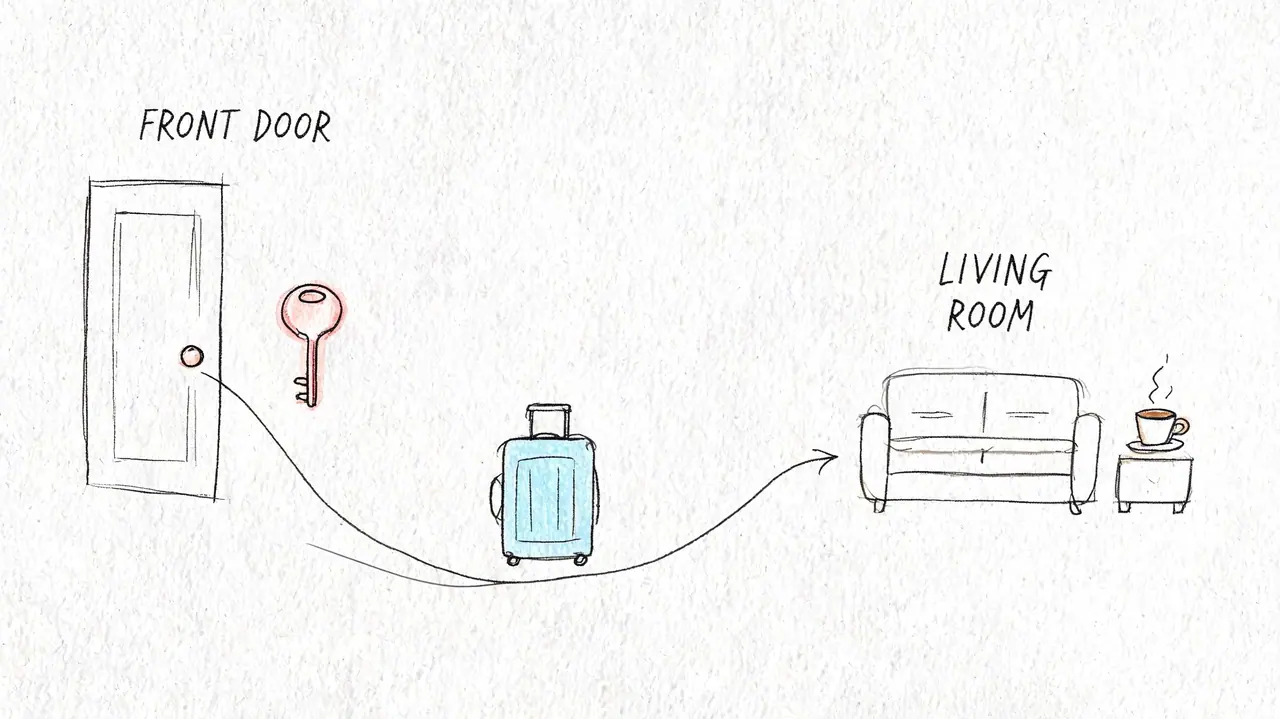
Arrival information that prevents first-hour friction
The first half hour shapes the whole stay. If the guest struggles with access, parking, or internet, they start frustrated. If they settle in smoothly, the property feels easy.
Your arrival section should answer the questions guests ask while standing at the door with bags in hand:
How do I get in: gate code, lockbox steps, keypad instructions, or building entry notes.
Where do I park: exact space, overflow options, street restrictions, and what not to block.
How do I get online: Wi-Fi name, password, and what network to use if there are multiple.
Who do I contact: one primary contact method and when to use it.
Don't write this like legal text. Write it like a calm host helping someone after a travel day.
A simple example:
Welcome. If you arrive after dark, the keypad is to the right of the front door. Enter the code slowly, then press the lock symbol. Wi-Fi details are below so you can get connected before unpacking.
That small tone shift matters. It feels human without being chatty.
During-the-stay content that guests actually use
Most welcome books frequently falter. Hosts include everything they can think of, and guests stop reading. The fix is to focus on moments of confusion.
Start with operational items that can interrupt a stay:
Appliances and systems: thermostat, TV, sound system, hot tub, washer and dryer, dishwasher, fireplace.
House quirks: a sticky door, slow-draining shower, outdoor lights on a timer, septic reminders, or a tricky induction hob.
Supplies and storage: where extra towels, trash bags, toilet paper, and cleaning items are kept.
Safety and essentials: emergency contacts, first-aid location, fuse box, water shutoff, and any property-specific safety note.
Then add the local guide. This isn't filler. It's one of the few parts guests remember after checkout.
Keep it curated:
Nearby basics: grocery store, pharmacy, gas station, coffee.
Best easy wins: breakfast spot, family dinner option, rainy-day activity, walkable attraction.
Property-fit recommendations: if you host beach travelers, send them to the easiest beach access with parking. If you host couples, point them to the quieter dinner spot, not the obvious tourist list.
Guests rarely want more recommendations. They want fewer, better ones.
Short video links can also help when written instructions aren't enough. If your hot tub controls or media setup regularly confuse guests, a short clip often solves the problem faster than a paragraph.
Departure instructions that reduce checkout confusion
Checkout should feel simple. The guest is packing, checking travel times, and trying not to forget a charger. This is not the moment for a long task list.
A clean departure section usually includes:
Checkout time and whether it's strict.
What to do with used towels.
Trash and recycling instructions.
Dishwasher or kitchen expectations.
How to lock up and return keys.
What to do if something was damaged during the stay.
Use plain phrasing. For example:
Before you leave: please place used towels in the bathroom hamper.
Kitchen: load used dishes into the dishwasher and start it if it's full.
Lockup: close all windows, lock the back door, and press the lock button on the front keypad.
That's enough for most homes.
One more operational habit matters. Update the guide regularly. According to Touchstay's welcome book guidance, hosts who update their welcome book content quarterly see an average of 25% more 5-star reviews. That makes sense in practice. Stale restaurant picks, old entry instructions, and missing amenity details create avoidable frustration. Fresh information protects the guest experience.
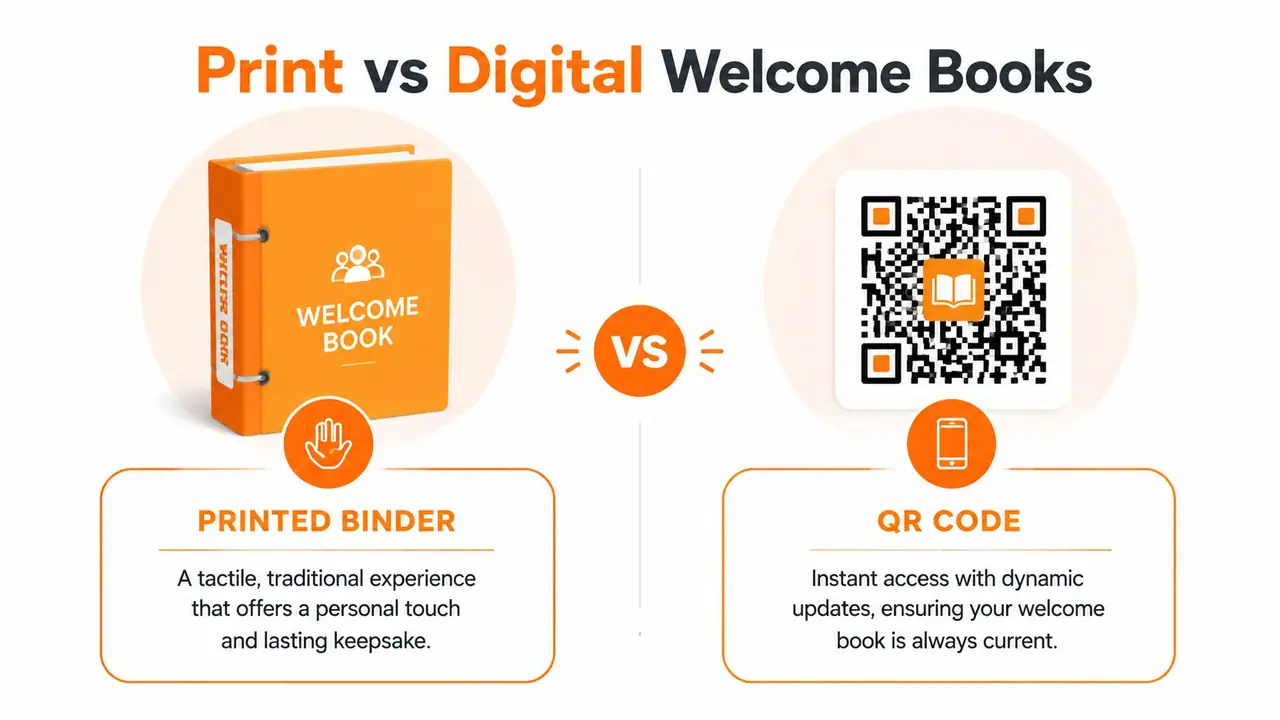
Choosing Your Format Print vs Digital QR Code
A guest arrives late, drops their bags, and needs three answers fast: how to get in, how the heat works, and where to park the second car. Your format decides whether those answers are easy to find, easy to update, and useful to your operation after the stay ends.
That is why this choice is bigger than binder versus QR code. It affects guest friction, staff time, consistency across properties, and whether your welcome book can produce measurable business value.
Where print still works
Print still earns its place in some homes. I like it for properties with older guests, weak cell service, or a very simple setup where the same answers rarely change.
A printed guide also helps with in-home visibility. Guests see it on the counter. They do not need to scan, tap, or search their inbox. For a studio, cabin, or one-bedroom with stable house rules, that can be enough.
Keep print narrow in scope:
Property basics
Wi-Fi details
Emergency contacts
A short checkout list
The trade-off is maintenance cost, not just printing cost. Every lock code update, appliance replacement, parking change, or local recommendation edit creates one more task for your team. If that task gets missed, the book stops helping and starts creating support messages.
Physical books also wear out fast. Pages go missing. Covers stain. Cleaners refile pages incorrectly. If you host international guests, translating and replacing printed pages turns into a recurring chore.
Where digital pulls ahead
Digital wins on control. Update the guide once, and every guest sees the current version.
That matters even more across multiple listings. Standard check-in steps, appliance instructions, local recommendations, and upsell offers can be reused, then adjusted by property instead of rebuilt from scratch each time. That saves hours over a season.
Digital also does jobs print cannot handle well:
Pre-arrival access so guests can review directions before they drive over
Clickable maps for parking, trailheads, restaurants, or beach access
Short videos for locks, hot tubs, TVs, and thermostats
Language options for mixed guest profiles
Upsell placement for late checkout, gear rentals, or local add-ons
Usage tracking so you can see what guests open
Cost usually should be judged as an operating decision, not a line-item comparison. A printed binder may look cheaper at first. A digital guide often saves more over time if it cuts repetitive questions, reduces update work, and creates opportunities for add-on revenue.
A practical side-by-side comparison
Here is the decision in operational terms.
| Criteria | Printed binder | Digital QR code guide |
|---|---|---|
| Guest access | Easy once guests are inside the home | Easy before arrival and during the stay |
| Updates | Manual page swaps or reprints | Immediate |
| Media | Text and photos | Text, maps, links, video |
| Language support | Hard to maintain | Easier to manage |
| Consistency across listings | Time-consuming | Easier to standardize |
| Upsells and tracking | Limited | Practical and measurable |
For single-property hosts with a stable setup, print can still do the job.
For managers who care about scale, response time, and revenue, digital usually pulls ahead.
The best answer for many operators is a hybrid. Keep a one-page printed quick-start sheet in the home with Wi-Fi, emergency info, and checkout basics. Put the full guide in a digital format guests can open before arrival and during the stay.
If you are comparing tools, Hostfully, Touchstay, and ScanStay are all in this category with different strengths. ScanStay uses a QR-code-based guide that opens in the guest's mobile browser and includes multilingual support, analytics, and upsell features. The right choice depends on what creates the most return for your business: cleaner operations, stronger branding, simpler setup, or better reporting.
Designing for a Flawless Five-Star Guest Experience
Good content won't help if guests don't use it. Design matters because attention is limited, especially after travel. The guide has to feel easy, clear, and welcoming within seconds.
That's true for both print and digital, but digital makes the design choices more visible. A messy layout gets ignored faster than a bad binder.
Write like a host, not a compliance officer
A lot of welcome books sound defensive. They open with warnings, penalties, and pages of house rules. Guests feel that tone immediately.
Lead with hospitality, then deliver the rules clearly.
Compare these two approaches:
Bad: Do not move furniture. Do not use white towels for makeup. Any rule violations may result in fees.
Better: Please help us keep the home in great shape for the next guests. Use the dark makeup cloths provided in the bathroom, and leave furniture where it is.
Same point. Better delivery.
Use short sections, plain labels, and front-load the answers guests want most. If they have to hunt through a long paragraph for the Wi-Fi password, you've already lost them.
Use visuals where words usually fail
Some instructions are faster as pictures. Others are faster as video.
Use visuals for anything with buttons, locations, or multiple steps:
Lock and entry systems
Thermostat controls
Hot tub startup
Trash and recycling locations
Parking spot identification
Remote control combinations for TV and streaming
A single photo showing “your parking space is the one beside the hedge” can prevent a lot of back-and-forth. The same goes for cupboard contents, fuse box access, or where to find pool towels.
A guest under time pressure won't read a dense paragraph if a labeled photo answers the question in three seconds.
Place the guide where guests need it
Delivery matters as much as design. The guide should show up before the guest needs support, not after.
Use a few touchpoints:
Pre-arrival message: send the link before check-in so guests can review access instructions.
On-site display: place a visible QR code near the entry, kitchen, or main living area.
Backup placement: if you use print, keep it in an obvious spot and tell guests where it is.
For larger portfolios, a digital format can create real operational savings. According to Guesty's advice on creating a short-term rental welcome book, digital welcome books accessed via QR scan can cut guest support queries by 50-70% in multi-property portfolios, with top-performing hosts achieving a 92% guest access rate during their stay. That's the operational case for putting effort into layout, delivery, and usability instead of treating the guide as an afterthought.
Monetize and Optimize with Analytics
Most hosts think of a welcome book as support content. The smarter approach is to treat it like a business tool with two jobs: reduce friction and create opportunity.
A digital guide can do both if you structure it intentionally.
Turn the guide into a revenue surface
You don't need to force sales language into the guest experience. In fact, that usually backfires. The better approach is to place useful add-ons where they feel natural.
Examples that fit well:
Late checkout near the checkout section
Mid-stay cleaning inside the housekeeping section
Airport transfers in the arrival and local transport area
Equipment rental near activity recommendations
Romance or celebration add-ons in a welcome or special occasions section
The rule is simple. Offer extras that remove hassle or improve the trip. If the service feels like help, guests are far more likely to consider it.
Track what guests open and where they stop
Digital provides distinct advantages over print. If guests scan the guide, you can see whether they used it and what sections drew attention.
That helps you answer practical questions:
Are guests opening the guide before arrival or only after they're confused?
Does nobody click the hot tub instructions, suggesting the controls are already clear?
Are guests spending time on local recommendations?
Are your upsell offers visible enough to be found?
According to AvantStay's vacation rental welcome book article, a 2025 AirDNA report found that properties with QR-linked digital welcome books saw 28% fewer guest inquiries and a 15% higher rate of 5-star reviews, yet only 12% of hosts currently track scan rates or engagement. The takeaway isn't just that digital guides help. It's that many hosts still don't measure whether theirs is working.
If you can't see what guests use, you can't improve it with confidence.
What to improve after the first month
Once your guide has been live for a few weeks, review it like an operator, not a writer.
Look for patterns:
Repeated guest messages: if questions keep coming, the answer is either missing or buried.
Low-engagement sections: trim or rewrite anything guests consistently skip.
High-interest local content: move your strongest recommendations higher.
Ignored upsells: test better placement, clearer naming, or better timing.
The welcome book becomes more than a handbook through this process. It turns into a small feedback system for your property. Guests tell you what's confusing by what they click, what they ignore, and what they still message about.
That's useful whether you manage one listing or a full portfolio. It gives you a way to improve the stay without waiting for a bad review to explain what went wrong.
Your Action Plan for Crafting Your Welcome Book This Weekend
Creating a vacation rental welcome book doesn't require perfection to be beneficial. What matters is that it effectively addresses the common inquiries guests have.
Begin with the essentials and expand gradually.
Saturday Morning
Compile the essential operational details:
Access Information: Include keypad codes, detailed lockbox instructions, gate access procedures, and specific parking guidelines.
Connectivity Details: Provide the Wi-Fi network name and password for easy internet access.
Primary House Rules: Clearly outline policies on noise levels, smoking, pet allowances, visitor permissions, and waste disposal.
Property Operations Manual: Explain how to use the thermostat, television, hot tub, various appliances, and any unique quirks of the property.
Departure Checklist: Specify the checkout time and list tasks such as cleaning dishes, handling towels, disposing of trash, and securing the property upon departure.
Saturday Afternoon
Decide on the format of your welcome book. If you manage a single, straightforward property and prefer a tangible option, a concise printed version may suffice. For those seeking easy updates, multilingual options, interactive maps, or additional sales opportunities, a digital format is ideal.
Draft the content in the sequence your guests will experience their stay: begin with arrival information, then cover aspects relevant during the stay, and finish with departure instructions.
Sunday
Refine the language used. Eliminate any phrasing that may come across as harsh, redundant, or unnecessarily lengthy. Where beneficial, replace detailed explanations with labels, bullet points, images, or concise video clips.
Conduct a practical test. Access the document on your phone. Simulate arriving late with luggage and limited patience. If information on Wi-Fi, entry procedures, and parking isn't immediately clear, make the necessary adjustments.
Focus on addressing the questions that disrupt your routine most frequently. These are the areas where you can achieve the quickest improvements.
An effective welcome book saves time right away. An exceptional one also boosts reviews, ensures consistency, and enhances guest confidence. Once it's active, keep it updated and integrate it into your operations as an essential component, not just a one-time creation to be overlooked.
If you want a digital way to replace paper binders with a QR-based guest guide, ScanStay lets hosts publish Wi-Fi details, check-in instructions, house rules, local recommendations, and upsells in one mobile-friendly welcome book. It's a practical option for hosts who want fewer repetitive messages and better visibility into how guests use the guide.