House Rules Samples: Protect Your Rental
Discover 7 copy-paste house rules samples for your rental. Protect your property & enhance guest experience with templates for pets, check-in, and safety.
A 2 AM noise complaint. A guest parked in the wrong spot because the instructions were buried in a check-in message. A late checkout that triggers a cleaner delay and knocks the rest of the day off schedule. These problems usually come from unclear delivery, not guest intent.
Good house rules samples do more than list restrictions. They reduce repeat questions, give guests one clear standard to follow, and give hosts language they can enforce when something goes wrong. The job is not to write more rules. The job is to put the right rules in front of the guest at the right moment, in the right tone.
That is why this guide treats house rules as a toolkit.
Each sample below is built for real use: a friendly version for setting expectations without sounding cold, a firmer version for higher-risk situations, and practical enforcement notes based on how disputes tend to play out in short-term rentals. The same logic applies in long-term leasing too. If you manage both, this breakdown of what to include in a lease agreement shows how written expectations protect both sides when terms are specific.
The old printed binder still has a place, but it fails in the moments that matter most. Guests do not read it before arrival. They do not carry it to the driveway when they need parking details. They do not open it during self-check-in when they are trying to find the right door code.
Digital delivery solves that operational gap. A digital welcome book in ScanStay lets hosts place quiet hours, Wi-Fi details, parking rules, pet limits, checkout steps, and emergency instructions in one place guests can open on their phone. That cuts down on repetitive messages, makes enforcement easier, and lowers the stress that comes from answering the same preventable question five times a week.
The sections that follow are written to be copied, adapted, and used.
Table of Contents
- 1. Basic Guest Conduct and Respect Policy
- 2. Check-in/Check-out Procedures and Access Rules
- 3. Pet and Animal Policy
- 4. Wi-Fi, Technology, and Connectivity Usage Rules
- 5. Safety, Security, and Emergency Procedures
- 6. Housekeeping, Maintenance, and Cleaning Expectations
- 7. Local Community Respect and Neighborhood Etiquette Policy
- 7-Point House Rules Comparison
- From Rules to Revenue Your Actionable Takeaway
1. Basic Guest Conduct and Respect Policy
A guest gets back late, opens the balcony door, starts a speaker, and invites two friends over for “just one drink.” Ten minutes later, the neighbor messages. That is the moment your conduct policy either protects the booking or creates an argument.
This section sets the operating standard for the stay. It should cover noise, visitor limits, smoking, use of shared spaces, and basic care for the property in language a guest can understand on one quick read.
Set the tone early
Write rules that define behavior, not intentions. “Be respectful” sounds fine, but it gives you very little to point to if a guest brings unregistered visitors, smokes near an entry, or uses an off-limits storage area.
State the boundary. State when it applies. State what happens if the guest ignores it.
Practical rule: If two reasonable people could read a rule and reach different conclusions, rewrite it.
I keep conduct rules separate from access instructions for a reason. Guests skim, especially on mobile. The conduct section should answer these questions fast: Who may be on the property? What counts as a gathering? When do quiet hours start? Where is smoking prohibited? Which areas are private or staff-only?
Good delivery matters as much as good wording. Hostify recommends showing rules in multiple guest touchpoints, including the listing, pre-arrival communication, and the home itself, because hidden rules are harder to enforce and more likely to create friction (multi-touchpoint rule delivery). In practice, I'd put this policy in your booking message, your digital guide, and a short printed or framed summary near the entry. If you use a digital welcome book, a QR code check-in system for guest instructions also gives guests one place to find conduct rules without digging through old messages.
Copy-paste sample
Friendly tone
Please treat the home, building, and neighbors with care. Only registered guests may be on the property unless you've asked us first. No parties or events. Please keep noise low during quiet hours and avoid using speakers outdoors or in shared areas. If you are unsure about a visitor, balcony use, or any restricted space, message us before proceeding.
Firm tone
Only registered guests are permitted on the property unless approved in writing. No parties, events, unauthorized visitors, DJ equipment, or amplified outdoor music. Quiet hours apply nightly, and smoking is prohibited except in any area specifically designated by the host. Private, locked, or marked staff areas are off-limits. Violations may lead to fees, early termination of the stay, or action under the booking terms.
Add enforcement notes behind the scenes, even if guests never see that version. For example, tie “unauthorized visitors” to exterior camera review where legally permitted, tie smoking violations to odor or ash evidence, and tie noise rules to neighbor complaints or device alerts if you use a noise monitor. Rules work better when your proof standard is clear before a dispute starts.
Video also helps here. A 30-second walkthrough can show the balcony boundary, the shared hallway, the parking edge, and any locked owner closets. Don't assume guests will infer those limits on arrival.
If you need a longer-form legal companion document for recurring stays or lease-style setups, it also helps to review what to include in a lease agreement.
2. Check-in/Check-out Procedures and Access Rules
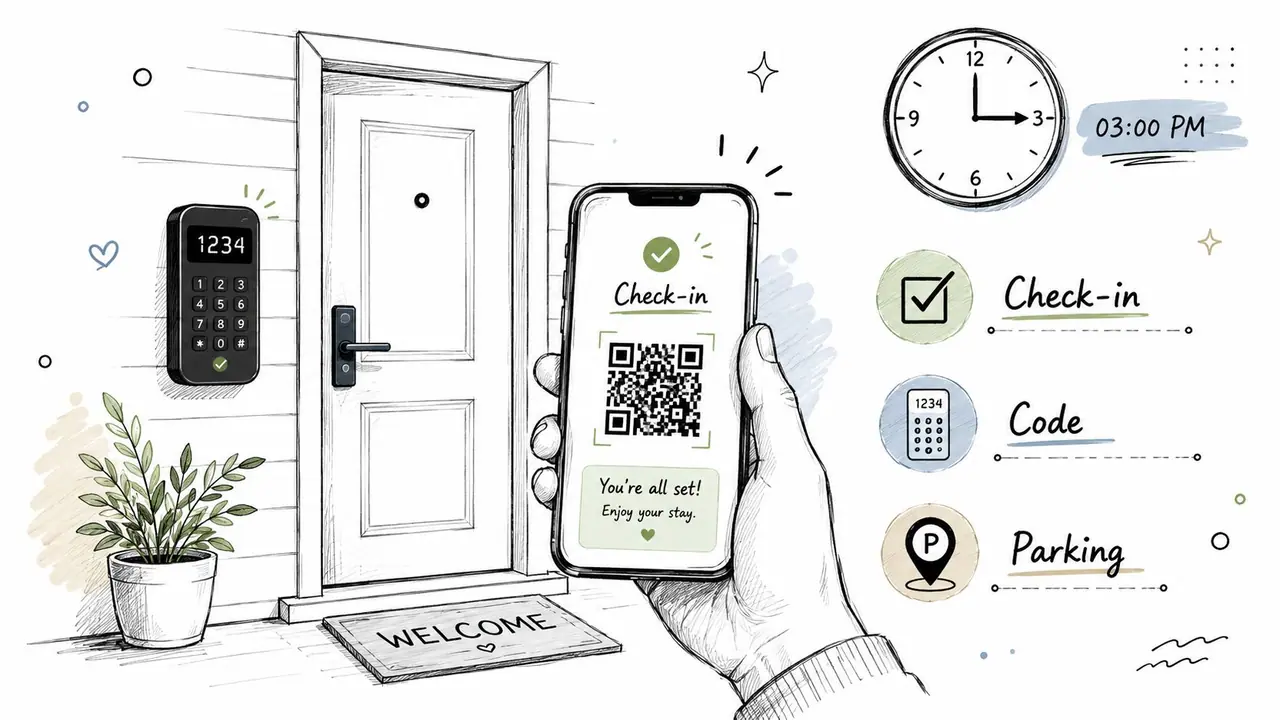
A guest pulls up after dark, the building has two entrances, the parking sign is easy to miss, and the keypad times out before they finish reading your message. That is how a simple arrival turns into three support texts and a bad first impression. Check-in rules need to prevent that chain reaction.
Arrival rules should remove guesswork
Strong access rules cover five points: arrival time, entry steps, parking, backup instructions if access fails, and checkout tasks. Keep them separate from general behavior rules. Guests standing outside the property do not want to scan past visitor limits or quiet hours to find the door code process.
Guests ignore friction, not instructions. The fix is a short sequence they can follow under pressure, on a small screen, with one hand free.
I use a simple rule here. If a first-time guest cannot get from curb to couch in under two minutes using your written directions, the process still needs work.
Copy-paste sample
Friendly tone
Check-in begins at 3 PM, and your door code will activate at that time. Please use only the assigned parking space and follow the arrival steps in the guest guide. Before checkout, lock all doors, turn off lights, place used towels in the bathroom, and complete the departure checklist provided in the guide.
Firm tone
Access codes are issued only for the confirmed reservation and may not be shared. Early entry and late checkout must be approved in advance. At departure, guests must secure the property, return any physical access items, and complete all posted checkout steps.
The wording matters, but the delivery matters just as much. Break access instructions into tap-friendly sections such as "Before you arrive," "How to enter," "Where to park," and "Checkout steps." A digital guide helps because guests can pull up the exact step they need instead of scrolling through a long message. If you use self-check-in, a QR code check-in system for rentals gives you a cleaner way to organize that flow.
Enforcement and implementation tips
Write rules that match how you will enforce them. If early check-in is not available on turnover days, say that directly. If lost key cards trigger a replacement fee, list it. If codes expire at checkout time, automate that through your smart lock instead of arguing about late departure after the fact.
Backup instructions also need a place in the rule set. Tell guests what to do if the code fails, the battery dies, the gate is closed, or the lobby door requires a separate step. Properties with layered access cause the most confusion. Building entrance first, elevator or hallway second, unit door third. Spell out that order.
A short lock video, one annotated parking photo, and a checkout checklist usually prevent more issues than a longer paragraph ever will. That is where a digital welcome book earns its keep. It reduces repeated questions, standardizes the guest experience across units, and lowers host stress because the answer is already documented where guests can find it.
3. Pet and Animal Policy
A guest shows up with two dogs after booking for one “small pet,” then leaves for dinner and the barking starts. That problem usually began long before arrival. The rule was too vague.
Pet rules need precision
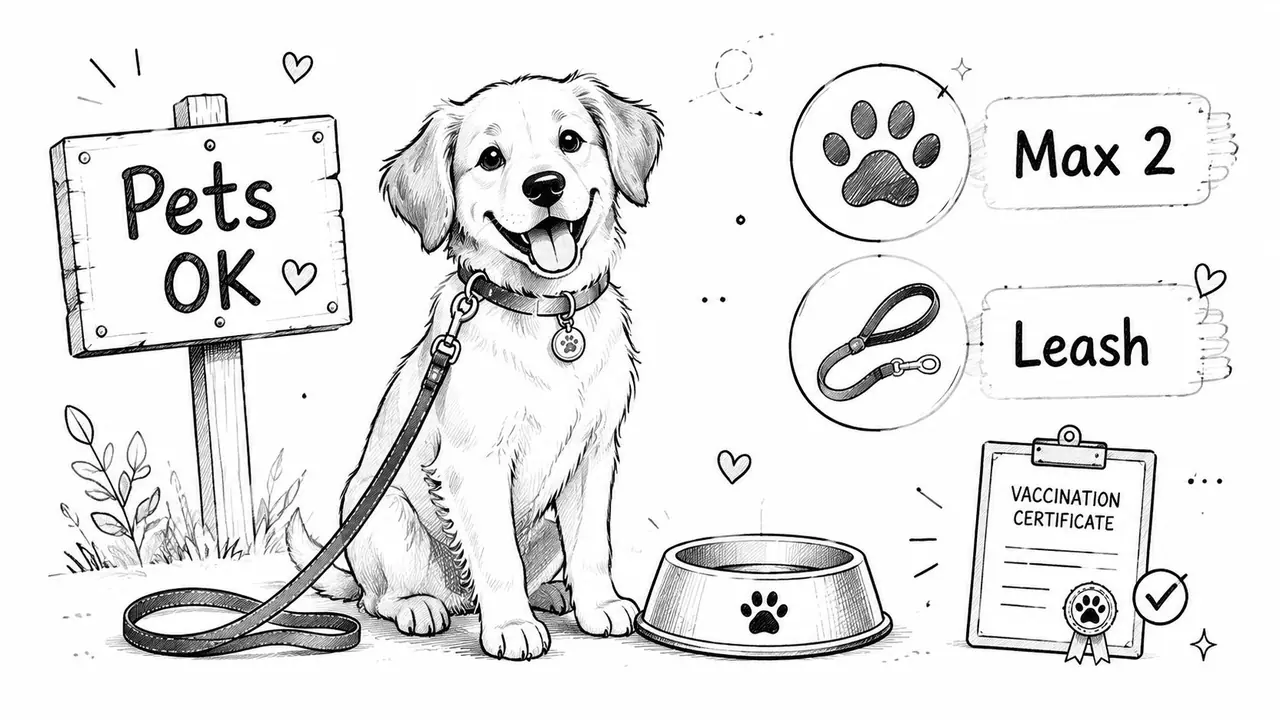
Pet policies work best when they answer the practical questions guests have before they travel with an animal. Are pets allowed at all. Which types and how many. Are there breed, size, or age limits. Can pets be left alone in the unit. Where are they not allowed. Who handles waste, accidents, scratching, hair, or odor issues.
That level of detail protects both sides. Guests know whether the home fits their trip, and hosts avoid case-by-case arguments after check-in.
I also recommend separating your policy into approval rules and stay rules. Approval rules cover what must be disclosed before booking. Stay rules cover how the animal must be handled once the guest arrives. That split makes enforcement easier because you can point to the exact step the guest missed.
Copy-paste sample
Friendly tone
Pets are welcome with prior approval. Please tell us the type, breed, and number of pets before arrival. Keep pets off beds and upholstered furniture, clean up waste right away, and do not leave pets unattended unless they are calm, quiet, and crate-trained. If there is an accident or any damage, message us promptly so we can address it early.
Firm tone
Approved pets only. Guests must disclose all animals before arrival. Pets may not enter restricted areas, climb on beds or furniture, or create noise that disturbs neighbors. Guests are responsible for waste removal, accidents, and any extra cleaning or damage charges permitted under the booking terms.
Enforcement and implementation tips
Pet rules fail when the written policy is broader than your actual operation. If your cleaner charges extra for heavy shedding, state that. If your insurance, HOA, or local rules limit certain animals, state that too. If unattended pets have triggered neighbor complaints before, ban unattended pets unless crated and specifically approved.
Use photos to remove ambiguity. Show the allowed outdoor relief area, the gate that must stay closed, and any rooms that are off-limits. A digital guide built from a vacation rental welcome book template helps here because guests can see the pet rules, cleanup instructions, and nearby vet info in one place instead of asking by message.
One more trade-off matters. A stricter pet policy may reduce some bookings, but a loose policy often increases cleaning costs, furniture wear, and refund disputes. Clear rules tend to attract the right pet owners and filter out the guests who were going to test boundaries anyway.
4. Wi-Fi, Technology, and Connectivity Usage Rules
Technology rules matter more now because guests treat internet access as basic infrastructure. If the TV app logs out, the Wi-Fi password is hard to find, or the router gets unplugged, support messages stack up fast.
Tech rules should solve support tickets before they start
This isn't about lecturing guests on bandwidth. It's about making normal tech use simple and abnormal use easy to identify. A welcome book works well here because guests can pull Wi-Fi credentials, smart TV instructions, and router reset steps from one place instead of messaging you line by line.
Most hosts also underwrite this section. They write “Wi-Fi available” and stop there. Better house rules samples cover responsible use, device handling, login boundaries on streaming apps, and what to do if equipment stops working.
Put the answer where the problem happens. TV help should sit next to TV instructions, not on page four of a PDF.
Copy-paste sample
Friendly tone
Wi-Fi details are provided in the guest guide for your convenience. Please use the internet and smart devices responsibly, log out of personal streaming accounts before checkout, and message us if something isn't working so we can help quickly.
Firm tone
Internet access and in-home devices are provided for standard guest use only. Guests may not tamper with routers, cameras in disclosed exterior locations, network equipment, or locked settings on TVs and smart-home systems. Please log out of personal accounts before departure.
This section is also the right place to explain any disclosed technology related to the stay. Independent hosting guidance increasingly references party bans, quiet hours, exterior cameras, and decibel-based noise monitors, while stressing that noise devices detect sound levels rather than conversations and that exterior cameras must be disclosed and follow local law (modern rules around noise and disclosed tech).
For delivery, a digital guide beats a printed binder. Guests can scan once, get the password instantly, and open troubleshooting instructions on the same screen. If you want to build that flow, this vacation rental welcome book template shows the structure well.
5. Safety, Security, and Emergency Procedures
Safety rules only work if a guest can use them under stress. That means short wording, visible placement, and zero clutter.
A surprising number of hosts hide critical details inside a long manual. That's backwards. Fire, lockout, gas smell, medical issue, severe weather, and evacuation instructions should be easier to find than the coffee machine guide.
Safety rules have to be usable under stress
One of the biggest gaps in public house rules samples is enforceability. Many templates explain what to include, but not how to align rules with leases, bylaws, occupancy limits, or formal enforcement steps. A non-rental housing template from a fraternity organization makes this point clearly by advising operators to put house rules into bylaws, provide them to new members, post them in the house, and attach them to the room lease as an addendum, which underscores that enforcement mechanics matter as much as the text itself (sample enforcement structure for house rules).
That same lesson applies in short-term rentals. If a guest disputes a fee, a camera disclosure, an occupancy limit, or a smoking penalty, you need rule placement, timestamped communication, and a documented process.
Before you write your safety section, show guests where things are. A short walkthrough helps:
Copy-paste sample
Friendly tone
Your safety matters to us. Please review the emergency information on arrival, including exits, extinguisher location, and emergency contacts. Lock doors and windows when leaving, and let us know immediately if you notice anything unsafe or not working properly.
Firm tone
Guests must follow all posted safety instructions and local occupancy requirements. Tampering with safety devices, disabling detectors, or ignoring emergency procedures is prohibited. Report hazards, damage, or security concerns immediately.
A strong safety page in a digital guide includes:
- Emergency contacts: local emergency services, property manager, backup contact.
- Equipment locations: extinguisher, breaker panel, first-aid kit, shutoff points if relevant.
- Evacuation instructions: where to exit and where to gather.
- Property security steps: lock procedures for doors, windows, gates, and shared entrances.
If the property has exterior cameras or noise-monitoring devices, disclose them clearly and keep the language neutral. Hidden or vague disclosure creates trust problems fast.
6. Housekeeping, Maintenance, and Cleaning Expectations
A guest checks out at 10:00. Your cleaner arrives at 10:15 and finds greasy pans, loose trash, wet towels on the wood floor, and patio chairs dragged into the living room. That is not a cleaning problem. It is a house-rules problem.
Cleaning expectations need to protect turnover without making guests feel like they paid a cleaning fee and then got assigned chores. The line is simple. Ask for basic reset tasks that prevent odors, stains, pests, and delays. Do not ask guests to do your cleaner's job.
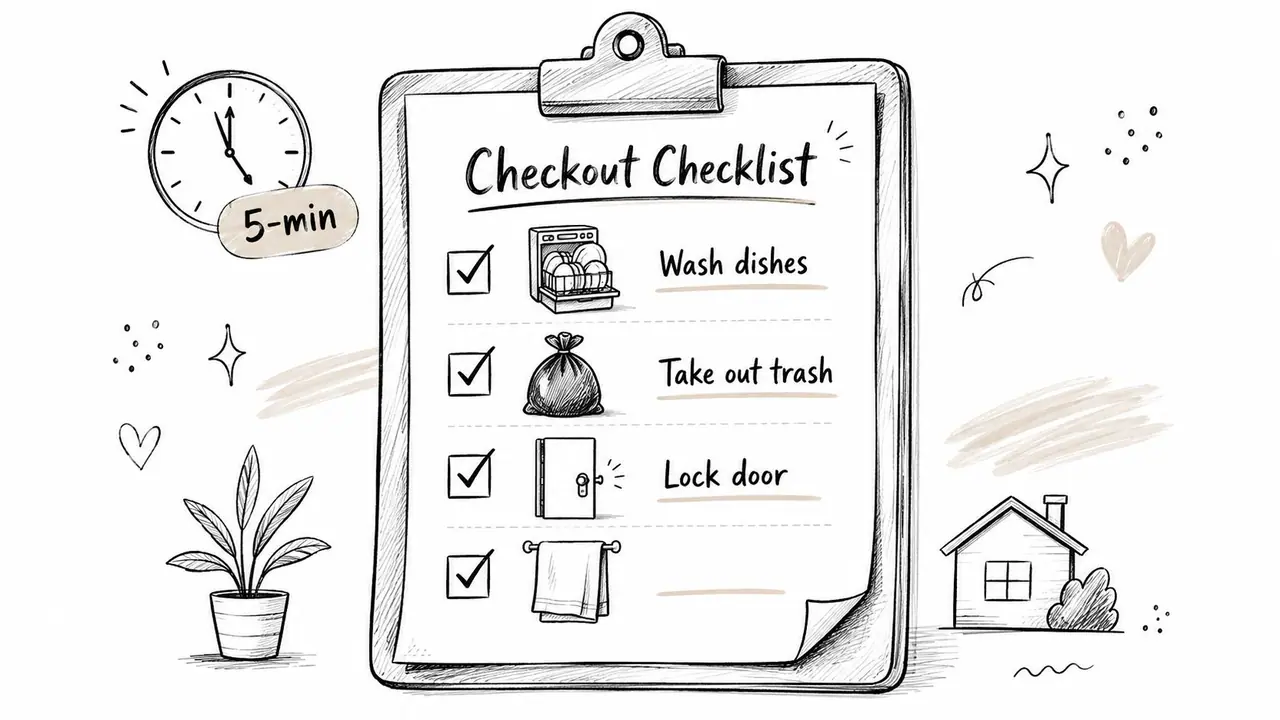
The clearest setup separates during-stay expectations from checkout instructions. During the stay, focus on spills, trash, dishes, furniture returned to its place, and prompt damage reporting. At checkout, keep the list short and specific. Guests follow short lists. They ignore long ones.
Copy-paste sample
Friendly tone
Please help us keep the home in good condition by washing used dishes, bagging trash, wiping major spills, and reporting breakage promptly. At checkout, place used towels in the bathroom and follow the departure steps in the guide. No need to deep clean. Just leave the home reasonably tidy.
Firm tone
Guests are expected to maintain basic cleanliness during the stay and complete posted checkout tasks before departure. Excessive mess, unreported damage, or misuse of linens, towels, or appliances may lead to additional cleaning or replacement charges where permitted by the booking terms.
What works best in practice is a visual checklist inside your digital welcome book. Show the actual trash location, where used towels go, where dishwasher tablets are stored, and any property-specific issue, such as not leaving food in an outdoor bin because it attracts animals. Photos cut down on “we didn't know” messages and give cleaners a clear standard to document.
For hosts tightening turnover workflows, this guide to an Airbnb cleaning jobs app is useful if you want your cleaning operations and guest-facing instructions to match.
One rule I recommend adding: report maintenance issues as soon as they happen, not at checkout. A loose faucet, leak under the sink, or broken remote is much easier to fix mid-stay than during a same-day turnover. In ScanStay or any digital guide, make that reporting path obvious with a button, short form, or prewritten message prompt.
Guests follow visible standards better than abstract standards.
If you want fewer disputes, avoid vague language like “leave the place spotless.” Spell out the standard instead. Wash used dishes. Bag trash. Put used towels in the bathroom. Report damage promptly. That wording is easier to follow, easier to enforce, and easier to support if a post-stay charge becomes necessary.
7. Local Community Respect and Neighborhood Etiquette Policy
A guest can follow every in-house rule and still create a problem the minute they step into the hallway. That is usually how neighbor complaints start. Loud arrivals, extra cars, smoking near shared entrances, or late-night balcony conversations are what get hosts fined, reported, or blocked by HOAs and building managers.
Community etiquette needs to be written like an operating rule, not a polite afterthought. Guests need to know what applies outside the unit, where the sensitive friction points are, and what happens if they ignore them.
Neighbor-facing rules need to be specific
Broad language such as “please respect the neighbors” is too weak to guide behavior and too vague to enforce. Stronger rules name the setting and the expected conduct. Shared hallways. Stairwells. Parking areas. Balconies. Front gates. Trash rooms. Outdoor spaces after quiet hours.
The practical trade-off is tone. Soft wording feels more welcoming, but it gives you less to point to when a neighbor calls. Firm wording protects the property better, but it can feel cold if every sentence reads like a warning. The fix is simple. Keep the policy clear, then match the tone to your brand and building type.
Copy-paste sample
Friendly tone
You're staying in a residential neighborhood where people live and work year-round. Please keep voices low in hallways, stairwells, and outdoor areas, especially late at night or early in the morning. Park only in the assigned space, follow building signage, and avoid blocking driveways, walkways, or shared access points. We appreciate guests who help us keep a good relationship with our neighbors.
Firm tone
Guests must follow all neighborhood and building etiquette rules during the stay. This includes keeping noise low in shared areas, using only approved parking spaces, avoiding unauthorized gatherings, and respecting shared entrances, outdoor spaces, and access routes. Neighbor complaints about noise, blocked access, smoking in prohibited areas, or misuse of common property may result in immediate contact from the host and action under the booking terms.
The best version of this rule is tied to the actual property. A downtown condo needs different wording than a cottage on a residential lane. If the gate slams, say so. If the bins are in a shared alley, explain the route. If the upstairs neighbor has young children or the HOA watches parking closely, put that context in plain language.
A digital welcome book such as ScanStay helps turn this from a wall of text into a usable system:
- Show guests exactly where to go: mark parking, entrances, bin areas, and any off-limits spaces.
- Set behavior by time and place: list quiet hours and identify echo-prone or high-sensitivity areas.
- Reduce preventable messages: answer the neighborhood questions before guests ask them, especially around parking, smoking, and outdoor use.
One tactic I have seen work well is adding a short human note before the formal rule. “This is a residential building, and neighbors know when guests ignore the basics.” That line lands better than generic hospitality language because it explains the actual consequence. Guests are more likely to cooperate when the rule feels connected to actual people, not just host preference.
7-Point House Rules Comparison
| Policy | 🔄 Implementation Complexity | ⚡ Resource Requirements | ⭐ Expected Outcomes | 📊 Ideal Use Cases | 💡 Key Advantages / Tips |
|---|---|---|---|---|---|
| Basic Guest Conduct and Respect Policy | 🔄 Low, template-driven, needs clear wording | ⚡ Low, documentation and host communication | ⭐ High, reduces noise/neighbor complaints and property damage | 📊 All short-term rentals, city-center and multi-property hosts | 💡 Display via QR; split weekday/weekend hours; list specific prohibited activities |
| Check-in/Check-out Procedures and Access Rules | 🔄 Medium, integrates tech (smart locks) and procedures | ⚡ Medium, smart locks/lockboxes, reliable comms, occasional 24/7 support | ⭐ High, improves operational efficiency and guest satisfaction | 📊 Contactless/self-service operations, remote hosts, multi-unit properties | 💡 Use QR video tutorials, embed maps for parking, offer paid late-checkout upsells |
| Pet and Animal Policy | 🔄 Medium, requires legal clarity (service animals) and fee structures | ⚡ Medium, extra cleaning, pet supplies, possible higher insurance | ⭐ Medium–High, attracts pet market and increases revenue but raises liability | 📊 Pet-friendly markets, properties with outdoor/yard space | 💡 Require vaccination proof, list pet amenities, present policy prominently in QR |
| Wi‑Fi, Technology, and Connectivity Usage Rules | 🔄 Low–Medium, policy + network config and monitoring | ⚡ Medium, quality router, bandwidth controls, tech support | ⭐ Medium, prevents congestion and liability; enhances perceived value when reliable | 📊 Properties with metered connections, corporate housing, high-bandwidth demand | 💡 Deliver Wi‑Fi via QR, show device limits infographic, offer premium high-speed as upsell |
| Safety, Security, and Emergency Procedures | 🔄 High, legal/regulatory requirements and regular testing | ⚡ High, safety equipment, signage, testing, documentation, training | ⭐ High, reduces liability exposure and protects guests | 📊 All rentals (often legally required), higher-risk properties | 💡 Provide 2‑minute safety videos, translated content, pin emergency contacts on maps |
| Housekeeping, Maintenance, and Cleaning Expectations | 🔄 Medium, detailed standards and verification processes | ⚡ Medium, cleaning supplies, professional cleaners, photo documentation tools | ⭐ High, maintains condition and reduces post-stay disputes | 📊 High-turnover, luxury, or shared-space properties | 💡 Use photo-based checkout checklists, embed a 5‑minute checkout infographic, offer turnover cleaning upsell |
| Local Community Respect and Neighborhood Etiquette Policy | 🔄 Medium, requires local customization and ongoing updates | ⚡ Low–Medium, local research, maps, printed/QR materials | ⭐ Medium, improves neighbor relations and regulatory compliance | 📊 Urban city centers, regulated jurisdictions, buildings with HOAs | 💡 Pin neighborhood maps/hours, create a “Good Neighbor” QR poster, include local complaint procedures |
From Rules to Revenue Your Actionable Takeaway
Effective house rules aren't about restriction. They're about clarity, repeatability, and fewer avoidable problems. When hosts use strong house rules samples, they stop reinventing the same explanations for every booking and start running a steadier operation.
The pattern across the strongest rule sets is consistent. Keep them short. Make them specific. Focus on the categories that produce disputes, support messages, and neighbor complaints. Then repeat them at the moments guests need them most: before arrival, during the stay, and at checkout. That multi-touchpoint approach is what makes rules easier to follow and easier to enforce.
The other half of the job is enforcement design. A rule hidden in a listing description is weak. A rule shown before booking, repeated in pre-arrival messaging, posted in the property, and connected to a documented process is much more durable. That matters whether the issue is smoking, extra visitors, parking, noise, pet cleanup, or a disputed checkout fee.
In practice, the biggest upgrade isn't writing more rules. It's delivering them better. A paper binder gets ignored. A long message gets skimmed. A digital welcome book makes the rules searchable, visible, and easier to revisit when guests are standing at the door, trying to use the TV, or figuring out what to do before departure.
That's why hosts increasingly move this material into one mobile-friendly place. With a platform like ScanStay, you can place house rules alongside Wi-Fi details, check-in instructions, local recommendations, and how-to videos behind a single QR code, with multilingual delivery available across 18 languages based on the publisher's product information. For properties with repeat workflows, that centralization cuts down on repetitive messaging and makes your standards more consistent across units.
Clear rules also support the guest experience. Good guests want to know the boundaries. They'd rather see a simple, well-written policy than worry they missed something important. If your current setup still relies on a binder and scattered chat messages, it's worth modernizing it.
For broader operational housekeeping ideas beyond rules alone, Shiny Go Clean Madison's rental tips offer a practical companion read.
If you want to turn your house rules into something guests read, ScanStay gives you a simple way to host them in a digital welcome book with one QR code, alongside check-in details, Wi-Fi info, local recommendations, and video how-tos. For hosts managing one property or many, that setup can reduce repetitive messages and make rule delivery much easier.