Channel Manager Definition: 2026 Guide for Hosts
Understand the channel manager definition and how it empowers hosts to streamline operations. Discover its benefits in our 2026 guide.
A channel manager is software that automates and syncs your property's availability, rates, restrictions, and bookings across online sales channels from one dashboard. It has become important enough that one market projection estimates the global channel manager market will reach USD 3.26 billion in 2026 and grow to USD 7.57 billion by 2035.
If you're managing a listing on Airbnb, Booking.com, and maybe your own website, you already know the feeling. One guest books on one platform, you rush to block the same dates everywhere else, and for a few minutes you wonder whether another booking will slip through before you finish. That's the “too many calendars” problem.
Most new hosts think the answer is to work faster. It isn't. The professional answer is to stop updating each channel separately and use one system that keeps everything in sync for you. That's the practical meaning behind the channel manager definition in hospitality.
The confusion starts because people use the term in two different ways. In short-term rentals and hotels, a channel manager usually means software. In broader business settings, channel management can also mean managing reseller or partner relationships. For hosts, the software meaning is the one that matters day to day, but it helps to know both so you're not reading the wrong advice.
Table of Contents
- Introduction to Channel Management for Hosts
- How a Channel Manager Works
- Key Features and Benefits for Your Rental Business
- Integrating a Channel Manager with Your Tech Stack
- How to Choose the Right Channel Manager
- Beyond Bookings The Complete Guest Experience
- Frequently Asked Questions
Introduction to Channel Management for Hosts
When hosts first hear the phrase channel manager definition, they usually want a simple answer. Here it is in plain English: it's the tool that keeps all your booking channels aligned so you don't have to babysit every calendar yourself.
That matters because manual updates break down fast. One property on one platform is manageable. Add Airbnb, Booking.com, Vrbo, a direct booking page, and a few repeat guests messaging you directly, and your workflow starts depending on memory and speed. That's when mistakes happen.
A hospitality-focused definition from Cloudbeds' guide to channel manager software describes a channel manager as a software system that coordinates a property's distribution across multiple online sales channels from one interface, automatically syncing room inventory, rates, restrictions, and availability in real time to reduce manual updates and prevent double bookings.
The real problem is fragmented distribution
Hosts often think they have a calendar problem. In reality, they have a distribution problem.
Every booking channel has its own extranet, rules, update flow, and timing. If you're logging into each one separately, you're acting as the connector between systems. A channel manager takes over that job.
Practical rule: If you're selling the same dates in more than one place, you need one source of truth for availability.
Who this is for
A channel manager makes sense when you:
- List on multiple platforms: Airbnb and Booking.com alone can create enough update work to cause errors.
- Take direct bookings: Your own website adds another calendar that has to stay accurate.
- Manage more than one unit: Even a small portfolio gets hard to control manually.
- Want cleaner operations: Less admin means more time for pricing, guest service, and turnovers.
If you're still building your hosting setup, this short-term rental guide for new and growing hosts is a helpful companion to think through the wider operation, not just bookings.
How a Channel Manager Works
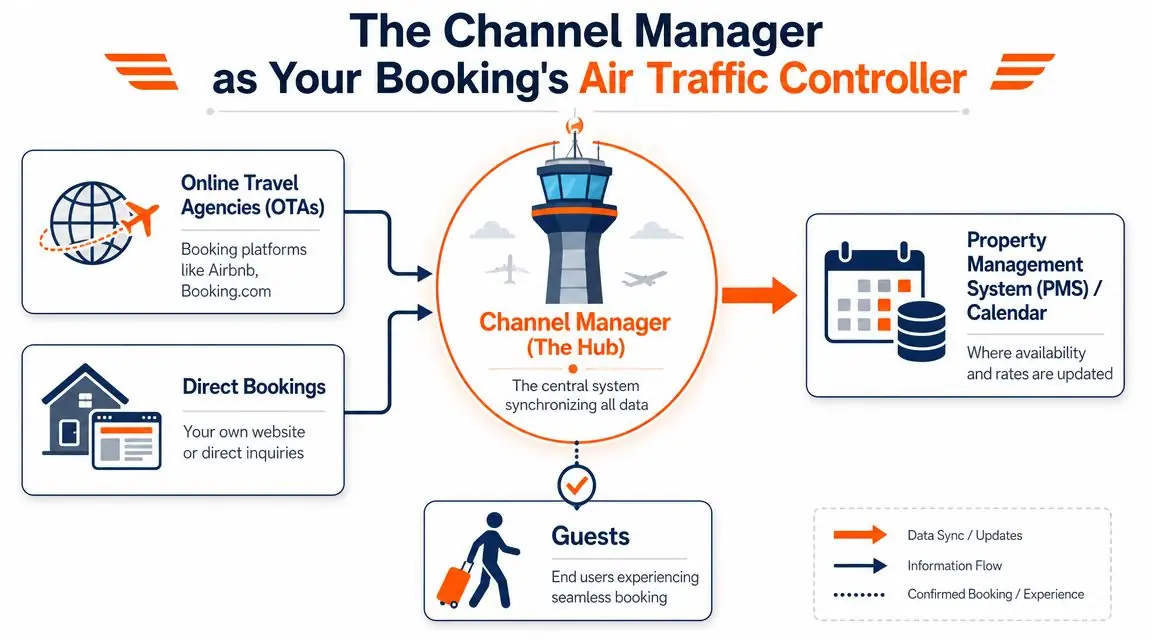
The easiest way to understand a channel manager is to think of it as an air traffic controller for your bookings.
Planes still fly. Airports still operate. Passengers still travel. But one central control point keeps movements coordinated so two planes don't try to use the same runway at the same time. Your booking channels work the same way. Airbnb, Booking.com, your direct site, and your calendar are all moving parts. The channel manager is the control tower.
The basic flow
Here's the practical version of what happens:
- You set availability and rates in your central system.
- The channel manager sends that data to connected channels.
- A guest books on one channel.
- The channel manager receives the reservation and updates the remaining availability elsewhere.
- All connected channels show the new status without you logging in one by one.
That two-way syncing model is the big shift in hospitality distribution. Instead of updating each extranet separately, the system connects your internal setup with external channels so changes move in both directions.
What gets synced
A good channel manager doesn't just block dates. It typically handles:
- Availability: Whether the unit can be booked.
- Rates: The nightly price you want shown.
- Restrictions: Minimum stays, closed dates, or booking rules.
- Inventory status: Which units or room types are open for sale.
That's why the software matters more than a simple calendar export. A basic calendar connection may show dates. A channel manager supports the commercial side of selling your property online.
If one reservation changes your availability everywhere, you stop relying on speed and start relying on system design.
A simple host example
Say you manage a two-bedroom apartment listed on Airbnb, Booking.com, and your direct website.
A guest books three nights on Booking.com. Without a channel manager, you'd need to block those dates on Airbnb and your website yourself. If you miss one update, another guest could book the same stay. With a channel manager, the reservation updates the other channels automatically.
That's why spreadsheets became impractical as online travel agencies multiplied. The software exists because the old manual method doesn't scale.
Key Features and Benefits for Your Rental Business
Once hosts understand the definition, the next question is practical: what do you gain from using one?
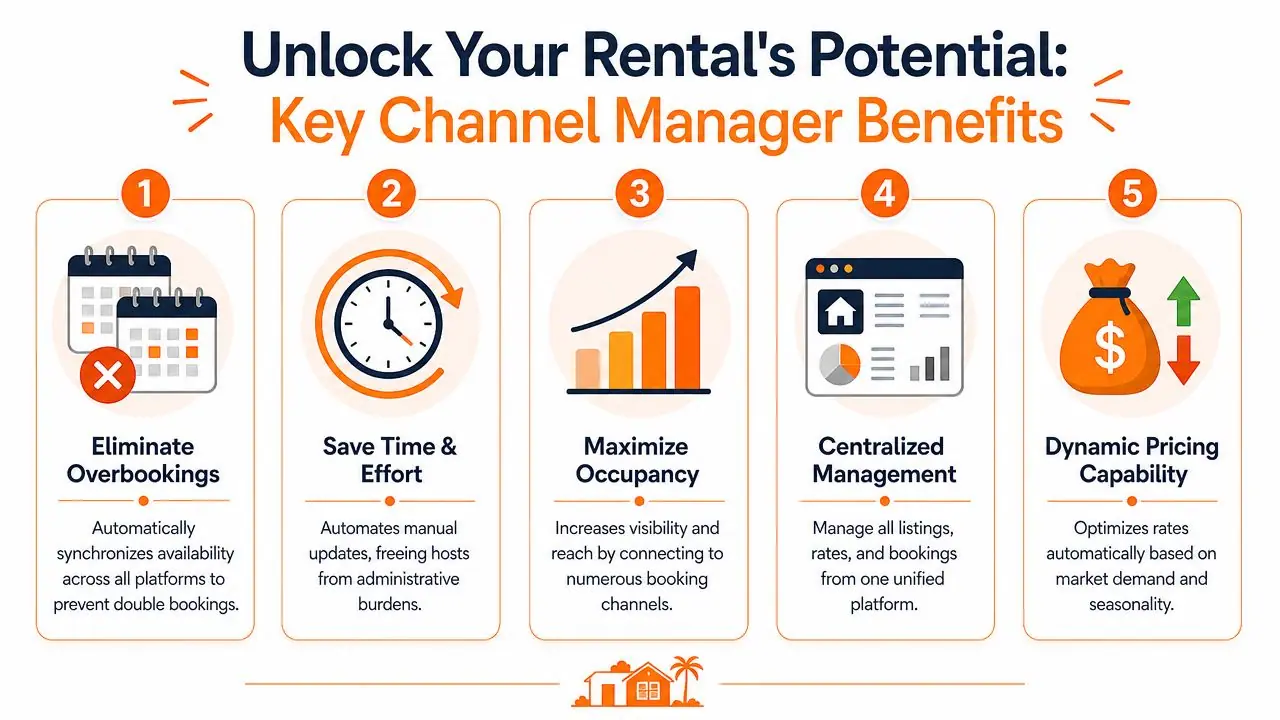
The obvious answer is fewer booking conflicts. The better answer is control. A channel manager gives you one place to manage distribution instead of chasing changes across disconnected dashboards.
A market projection from Business Research Insights on the channel manager market estimates the market will reach USD 3.26 billion in 2026 and grow to USD 7.57 billion by 2035 at a 9.8% CAGR, with Europe at 35% and North America at 30% of hospitality system demand. That doesn't prove one tool is right for every host, but it does show channel management is now part of mainstream hospitality infrastructure, not a niche add-on.
The benefits hosts feel first
Some benefits show up immediately:
- Fewer manual updates: You stop logging into every channel to make the same change.
- Safer multi-channel selling: You can list broadly without feeling like every booking creates risk.
- Cleaner rate control: You manage pricing centrally instead of patching rates channel by channel.
- Less mental load: You're no longer trying to remember what was updated where.
For small operators, that last one matters more than people admit. The stress of “Did I block that date everywhere?” disappears when the system handles it.
Features worth looking for
Not all channel managers feel the same in daily use. The strongest options usually make these jobs easy:
| Feature | Why it matters |
|---|---|
| Real-time sync | Delays create booking risk and force manual checking |
| Broad channel integrations | Your tool needs the platforms you actually use |
| Restriction management | Minimum stays and booking rules need to stay consistent |
| Central dashboard | Faster changes, less tab switching |
| Reporting visibility | Helps you see where bookings are coming from |
| PMS or CRS connection | Keeps your wider operation aligned |
What hosts often underestimate
The software is not only about avoiding a bad outcome. It also supports a better commercial workflow.
You can safely expand distribution, compare channel performance, and manage availability with more confidence. In practice, that changes how you run the business. You spend less time pushing data around and more time deciding where you want to sell.
Main takeaway: A channel manager isn't just a safety tool. It's part of how modern hosts run distribution professionally.
Integrating a Channel Manager with Your Tech Stack
A channel manager works best when you stop thinking of it as a standalone app and start seeing it as one layer in your operating system.
Hosts often ask whether they need a channel manager or a PMS. In many setups, that's the wrong question. Instead, the key question is how those tools work together.
The simple role split
A useful mental model is this:
| Tool | Main job |
|---|---|
| Channel manager | Sends rates, availability, and restrictions to booking channels and receives reservation updates |
| PMS | Organizes internal property operations such as reservations, housekeeping flow, and day-to-day management |
| CRS | Centralizes reservations in setups that need broader reservation control |
| Booking engine | Lets guests book directly on your own website |
The channel manager is your distribution layer. The PMS is your operations layer.
If you only use a channel manager, you may still need another system to run the property cleanly. If you only use a PMS without strong channel connectivity, you may still end up doing too much manual distribution work.
Where the confusion comes from
A lot of platforms bundle these tools together. Some PMS products include a built-in channel manager. Some channel managers add light reservation features. That's convenient, but it also blurs the boundaries.
The key is to ask one practical question: Where does the source of truth live?
For many professional hosts, the PMS or central reservation setup holds the master data, and the channel manager distributes it outward. When a booking arrives from an OTA or a direct site, the data flows back into the system so operations stay aligned.
A complete stack for modern hosting
A solid hosting stack often includes:
- Distribution tools: Channel manager, direct booking engine
- Operational tools: PMS, cleaning coordination, payment handling
- Guest-facing tools: Digital guidebooks, check-in information, house manuals, upsell tools
- Performance tools: Reporting, channel analysis, rate management
That last group gets overlooked. A booking is only the start of the job. Once a guest confirms, your software needs to support the stay, not just the sale.
How to Choose the Right Channel Manager
Choosing a channel manager is less about feature lists and more about fit. The right tool for one boutique hotel or short-term rental portfolio can be the wrong one for another.
Start by looking at your actual operating reality. Which channels do you use today? Which ones do you plan to add? Do you already have a PMS? Do you take direct bookings? Those answers narrow the field quickly.
The shortlist questions that matter
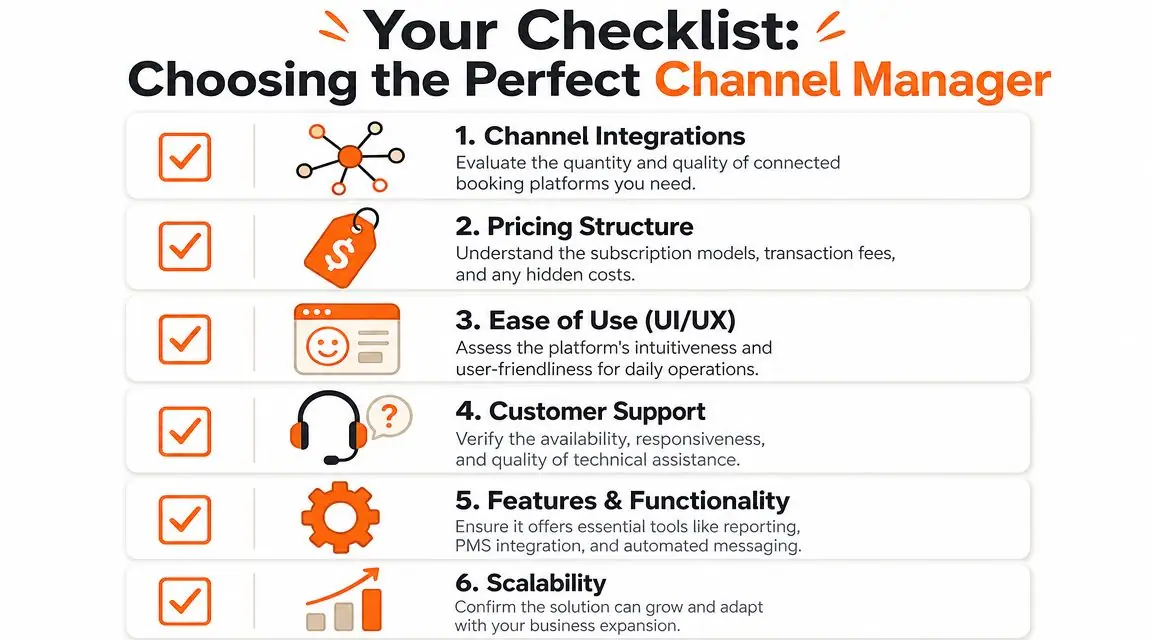
Use this checklist when comparing options:
- Channel coverage: Does it connect to the platforms you rely on, not just the biggest names?
- Integration quality: Will it work cleanly with your PMS, booking engine, or current workflow?
- Sync reliability: Are updates dependable enough that you won't keep checking manually?
- Ease of use: Can you change rates, restrictions, and availability without hunting through menus?
- Support quality: If a connection breaks on a weekend, can you reach someone useful?
- Pricing structure: Is the fee model simple, or does it get expensive as you grow?
For hosts exploring software combinations, this guide to affordable property management software helps compare the wider system around the channel manager too.
What a channel manager doesn't solve
Many “channel manager definition” articles fall short; they explain syncing, then stop there.
A more realistic view from eviivo's explanation of what a channel manager is notes that a channel manager doesn't solve everything. It can have connectivity limits, may not handle channel-specific rules well, and raises a bigger question than time savings alone: when do you still need a PMS or CRS?
That matters because hosts often buy a channel manager expecting it to fix every distribution and operational issue. It won't.
Buy a channel manager for synchronized distribution. Don't expect it to replace your entire operating stack.
A few examples of what may still need separate tools or manual attention:
- Guest messaging workflows: Not every channel manager handles these thoroughly.
- Housekeeping coordination: Usually better handled inside a PMS or operations tool.
- Owner statements and accounting: Often outside the core channel manager role.
- Guest arrival experience: Check-in instructions, local guides, and on-stay support sit elsewhere.
- Channel-specific merchandising: Some platforms still need manual tuning.
The video below is a useful vendor-style overview of how buyers often evaluate the category.
Red flags during evaluation
Watch for these warning signs:
- Hidden complexity: The demo looks clean, but simple tasks take too many clicks.
- Weak niche integrations: Your most important channel works, but only partially.
- Overpromised automation: The vendor implies the tool handles guest ops, accounting, and reporting equally well.
- Vague onboarding: If setup feels fuzzy, daily use often will too.
Beyond Bookings The Complete Guest Experience
A booking system gets the reservation in. It doesn't carry the guest through the stay.
That distinction matters more than many hosts realize. You can have a clean distribution setup and still drown in repetitive guest questions about Wi-Fi, parking, check-out, house rules, or how to use the heating. In other words, fixing the booking workflow doesn't automatically fix the guest experience workflow.
The handoff after the reservation
Once the stay is confirmed, your job shifts from distribution to delivery.
Guests don't care that your rates synced correctly across channels. They care whether arrival feels easy, instructions are clear, and answers are available without sending three messages. This is why modern hosting stacks usually include a guest-facing layer in addition to a channel manager and PMS.
What guest-facing tools solve
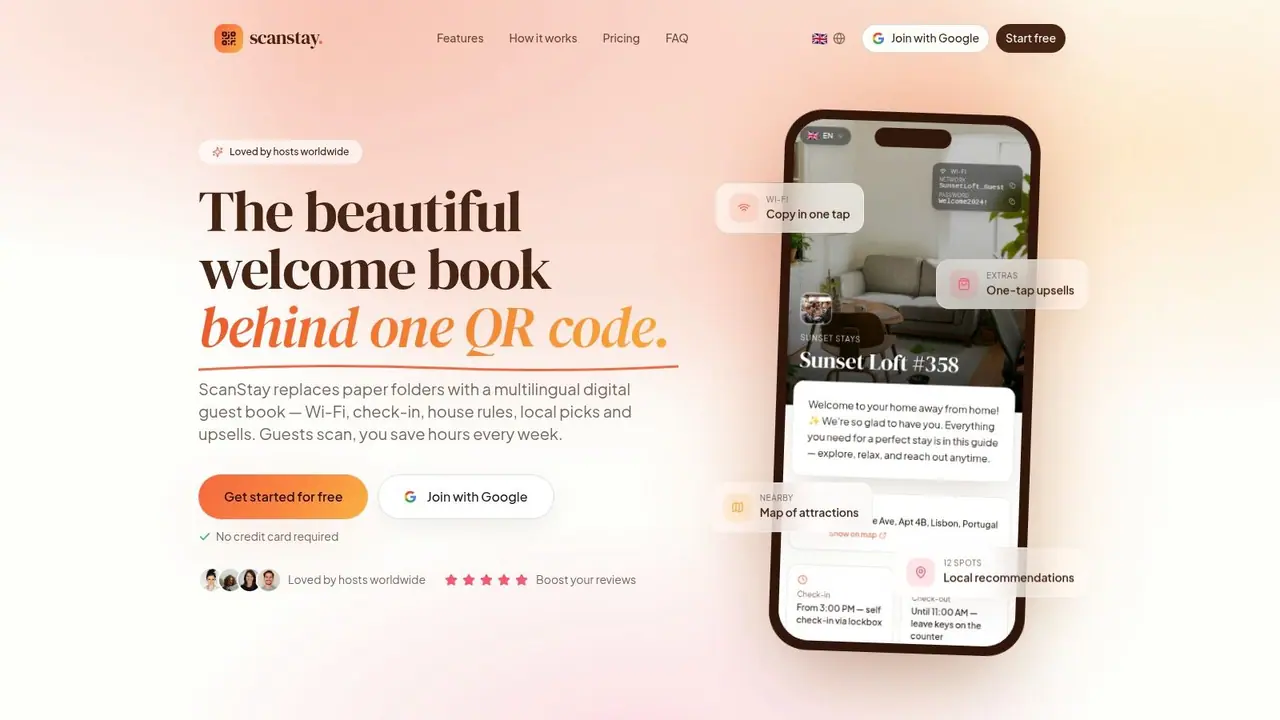
A digital welcome book or QR-based guide can handle things a channel manager never aims to do well:
- Arrival instructions: Check-in steps, parking details, building access
- In-stay basics: Wi-Fi, appliance guides, house rules
- Local recommendations: Restaurants, transport tips, neighborhood suggestions
- Reduced repetitive messages: Guests self-serve common answers
- A more polished feel: Information is organized instead of scattered across chat threads
That's why the strongest setup isn't one magical platform. It's a stack where each tool has a clear role.
Good hosting software should match the guest journey. One tool helps guests book. Another helps them stay comfortably.
A practical way to think about the full stack
For a new host, the sequence often looks like this:
- A guest finds your property on Airbnb, Booking.com, or your website.
- The channel manager keeps availability accurate across those booking paths.
- Your core operations system tracks the reservation and internal tasks.
- Your guest guide delivers the stay information in one easy place.
If you're thinking about the arrival side of the experience, this guide to a QR code check-in system for rentals shows how hosts are simplifying on-property communication after the booking is already secured.
Frequently Asked Questions
Do I need a channel manager if I'm only on Airbnb
Usually, not yet.
If you only list one property on one platform, a channel manager may be more software than you need. The value appears when you start selling the same inventory across multiple channels, take direct bookings, or manage enough units that manual updates become risky.
What's the difference between a channel manager and a PMS
A channel manager handles external distribution. It syncs availability, rates, restrictions, and reservation updates across connected channels.
A PMS handles broader property operations. Depending on the setup, that can include reservation organization, internal workflows, and other day-to-day management tasks. Many professional operators use both, or choose a PMS that includes a built-in channel manager.
Does channel management mean something different outside hospitality
Yes. The phrase can confuse people at this point.
In hospitality, the channel manager definition usually refers to software for syncing inventory and rates across booking channels. In broader B2B sales, Salesforce's explanation of channel management describes it as coordinating third-party sellers and partner relationships, including partner enablement, incentives, accountability, and channel conflict management.
So if you search the phrase online and land on a sales article instead of a hospitality article, you're seeing the other meaning of the term.
Can a channel manager improve profitability on its own
Not automatically.
It can reduce manual work, support cleaner distribution, and make it easier to manage your channels well. But profitability still depends on pricing, channel mix, direct booking strategy, operational costs, and guest experience. The software helps the system run better. It doesn't replace business judgment.
If you've already cleaned up your booking flow, the next win is reducing repetitive guest messages after the reservation comes in. ScanStay helps hosts replace paper binders and scattered chat replies with a digital welcome book guests open from a single QR code, so Wi-Fi details, check-in instructions, house rules, local tips, and upsells all live in one place.