What Is Ancillary Revenue and How Hosts Can Use It
Learn what is ancillary revenue and how short-term rental hosts and small hoteliers can use late checkout, transfers, and gear rentals to grow income.

Ancillary revenue is any income you earn beyond the base booking rate, from late checkout and airport transfers to equipment rentals and local experiences. In short-term rentals, that extra layer matters because the booking itself is only part of what guests are willing to pay for.
A guest asks if they can stay two hours longer. Another wants a ride from the airport. Someone else needs a crib, bikes, or a stocked breakfast basket. Those are all ancillary revenue moments, and when they're handled well, they turn a flat booking into a more flexible, more profitable stay.
Table of Contents
- Ancillary Revenue in Plain Language for Hosts
- How Ancillary Revenue Became a Structural Revenue Line
- The Highest-Converting Upsells for Short-Term Rentals
- Pricing and Packaging Upsells Without Undercutting the Room Rate
- Operational Workflows That Make Upsells Work
- Measuring Ancillary Revenue and Running a Simple ROI Check
- Legal, Tax, and Guest Experience Guardrails Hosts Often Miss
- A Practical Rollout Plan and Common Pitfalls to Avoid
Ancillary Revenue in Plain Language for Hosts
A guest sends a message at 9 p.m. asking for early check-in, or they land late and want an airport pickup. If you charge for that convenience, the money you collect is ancillary revenue, because it sits on top of the core booking rate rather than replacing it.
That definition lines up with how the term works in airlines. Industry guidance defines ancillary revenue as income beyond the base fare, and the categories usually include direct passenger purchases, third-party commissions, loyalty monetization, and bundled offer value IdeaWorksCompany's ancillary revenue framework. For hosts, the same logic applies, just with different products. The base stay is the core product, and everything extra, late checkout, transfers, gear, and experiences, becomes an add-on line.
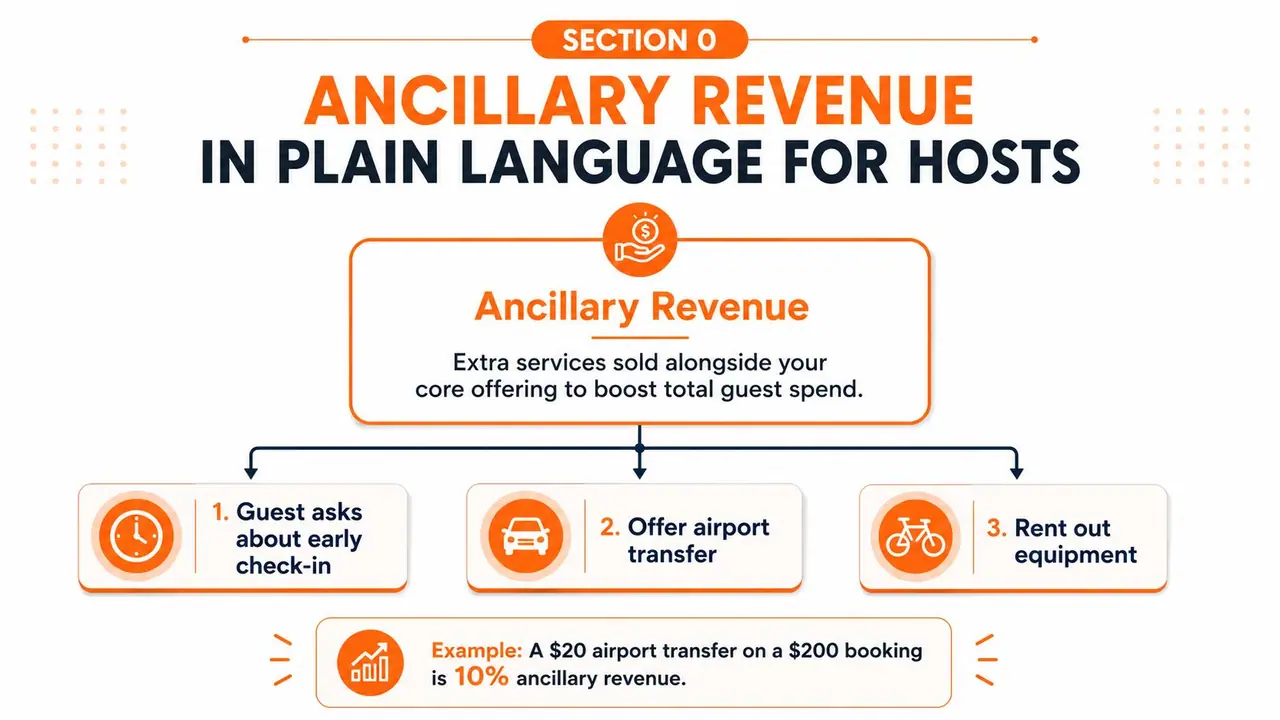
What counts and what doesn't
If the guest would still book your place without it, it's an ancillary offer. If the guest needs it to get the core stay they thought they were buying, you're drifting into a fee problem, not a revenue opportunity.
Practical rule: charge for convenience, customization, or optionality, not for essentials guests assumed were included.
A welcome basket, a paid luggage drop, or a bicycle rental can work because they're clearly optional. Charging for Wi-Fi, air conditioning, or basic clean linens usually creates frustration because those are part of the expected stay experience.
Why hosts should care
Airlines didn't build ancillary revenue because it sounded clever, they built it because it changed the economics of the business. OAG's global airline data shows ancillary revenue rising from $42.6 billion in 2013 to over $102 billion in 2022, and reaching 15% of total airline revenue in 2022 OAG. That's a big shift in what operators treat as normal revenue.
For short-term rentals, the lesson is simple. The booking rate gets guests in the door. Ancillary revenue gives you another way to monetize the stay without forcing the nightly rate higher for everyone.
How Ancillary Revenue Became a Structural Revenue Line
Ancillary revenue used to sound like a side hustle inside travel. It does not anymore. Industry forecasts project global airline ancillary revenue at $148.4 billion in 2024 and $157 billion in 2025, up from $67.4 billion in 2016 DWU Consulting summary of industry reporting. That shift is why operators now treat it as part of the core model, not a fringe tactic.
The airline pattern matters for hosts because it shows what happens when a business stops bundling everything into one headline price. Seat selection and baggage became the dominant add-ons in aviation, and together they accounted for over half of ancillary revenue in the 2022 OAG data, with baggage alone making up more than one-third OAG. Once the product is unbundled cleanly, guests choose what matters to them, and the business gets paid for flexibility.
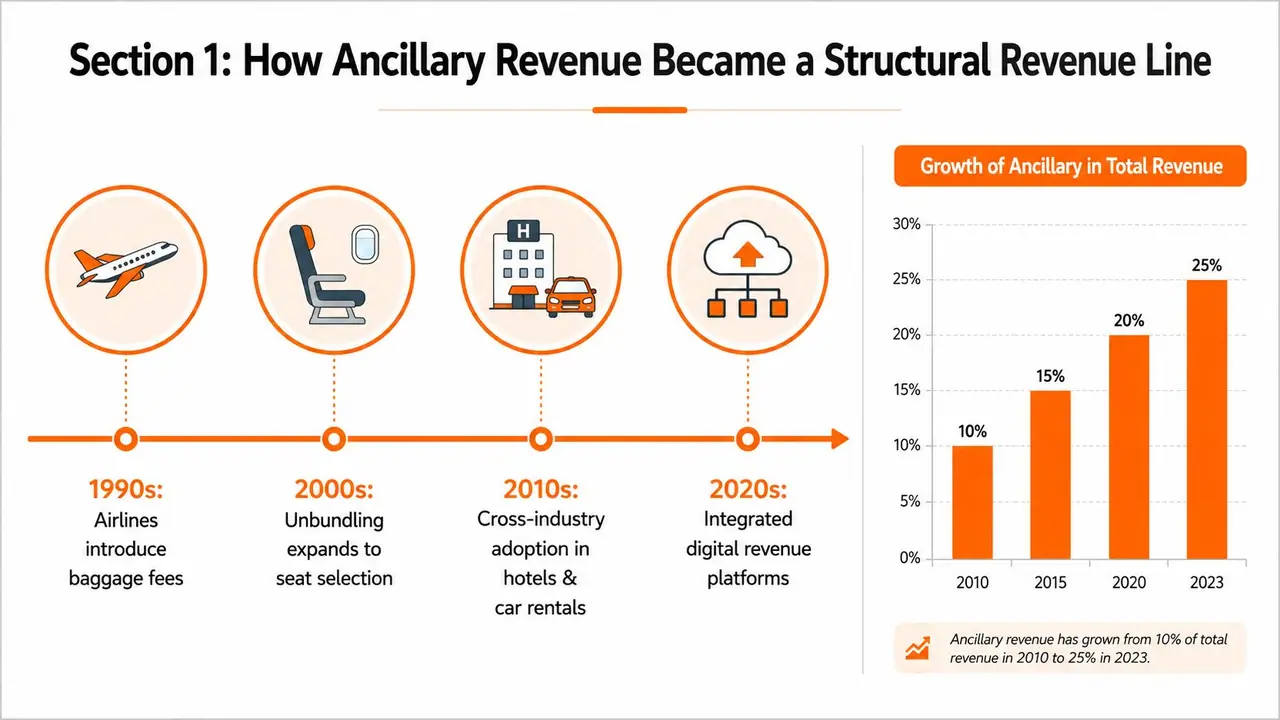
Airline history also points to a second truth. Ancillary revenue is not only about selling more, it is about protecting the base product. In hospitality, add-ons often help offset OTA commission pressure and keep the room rate competitive, which means the economics depend on channel mix and fulfillment costs rather than any promise of easy profit SiteMinder.
What that means for short-term rentals
Hosts who understand this do not frame extras as nickel-and-diming. They frame them as choice architecture. A guest who does not want the add-on declines, and a guest who values it pays for it.
That creates a cleaner pricing system. The room rate stays understandable, while optional services absorb the guests who need more convenience, more flexibility, or more local experience.
A QR welcome book helps make that repeatable. A guest scans once, sees the same paid extras every time, and can add what they need without waiting for a back-and-forth message thread. If you want a practical setup for that flow, the ScanStay welcome book guide is a useful reference.
The strategic shift
Ancillary revenue becomes structural when it changes how you price and package the stay. You stop relying on one number to do all the work.
Bottom line: a healthy add-on menu makes the base rate easier to defend, because not every guest wants the same level of service.
The Highest-Converting Upsells for Short-Term Rentals
The best upsells are the ones that solve a real friction point fast. A business traveler who's arriving early cares about check-in timing. A family with kids cares about gear. A couple on a weekend trip may care about a local experience that feels curated, not generic.
The offers that usually convert
Late check-in and early check-out are often the easiest to explain because the value is obvious. Guests already understand time as a commodity. If the stay can flex around their schedule, many will pay for it without much back-and-forth.
Airport transfers and local transfers work well where transport is annoying, expensive, or inconsistent. They're especially useful for new arrivals, large groups, and properties that are hard to find on the first visit.
Equipment rentals can be a strong fit for beach houses, bike-friendly neighborhoods, and family-friendly listings. Think bikes, beach chairs, baby cots, strollers, or coolers. The key is usefulness. If the item removes a trip to a store, it's more likely to sell.
Local experiences can perform well when they're simple and credible, not overproduced. A chef dinner, a guided wine tasting, or a private tour can work if the host has a trusted operator and the guest sees the upside clearly.
For hosts who want a way to present those offers inside a structured guest flow, BonusQR coupon management is relevant because it shows how digital offer presentation can be organized instead of buried in chat threads.
What usually underperforms
Some ideas sound good in a planning meeting and then sit untouched. Overly niche add-ons, complicated pickup instructions, or anything that requires too much coordination for the guest rarely convert well.
- Overdesigned welcome gifts: They feel nice, but they're hard to scale and hard to defend on price.
- Highly specific local services: Great in theory, weak in practice if the guest can't understand them in ten seconds.
- Anything that needs repeated explanation: If you have to sell it twice, the offer is probably too complex.
For layout and presentation, a digital guest guide can help. A practical example is this vacation rental welcome book guide, which fits neatly with how guests browse information on arrival.
The shortlist worth testing first is usually small, two convenience offers and one experience offer. That keeps the menu tight enough that guests can understand it without feeling marketed to.
Pricing and Packaging Upsells Without Undercutting the Room Rate
Pricing add-ons works best when you resist the urge to make everything cheap. Cheap pricing can look guest-friendly, but it can also make your extra work feel invisible, which is a fast way to create bad habits in the operation.
Three ways to price an offer
Cost-plus pricing is the simplest place to start. Add up the direct cost, the labor, the coordination time, and a margin you can defend. That works well for things like transfers or gear where the fulfillment cost is real and visible.
Competitor benchmarking helps when the service already exists in the local market. If nearby taxis, luggage storage operators, or tour providers charge a certain level for convenience, your offer should sit in a believable range rather than being pulled from thin air.
Value-based pricing fits offers like late checkout, where the guest is paying for flexibility more than for inputs. The price should reflect the inconvenience you're absorbing, the cleaning schedule shift, and the fact that the guest is buying relief from a constraint.
Bundles usually sell better than clutter
A bundle can make the choice easier. Late checkout paired with a breakfast basket, or airport transfer paired with a local experience, feels more complete than three isolated charges.
- Convenience bundle: late checkout plus luggage storage
- Arrival bundle: airport transfer plus early check-in
- Family bundle: baby gear plus stocked snacks
Keep the base rate separate. Don't hide add-ons inside a higher nightly price unless you've tested that market carefully. Guests often accept a fair optional fee more easily than a room rate that feels padded.
Practical rule: price the room to compete, price the extras to recover real value, and don't try to make every dollar on the same line.
Clear disclosure matters too. Guests respond better when the offer is visible before they ask, because then it reads as an option, not a surprise.
Operational Workflows That Make Upsells Work
The weak point in upsells is usually the workflow, not the offer. If every purchase depends on a manual message chain, a host gets a few wins and leaves too many opportunities on the table.
A QR-based digital welcome book solves that bottleneck because the guest sees the offer while looking for useful information. Late checkout, airport transfers, and gear rentals feel relevant in that moment instead of sounding like a hard sell. It also keeps the same details in one place, which matters when different guests in the same booking ask the same question at different times.
ScanStay is one example of that model. It places guest information, house rules, and one-tap service upsells inside a QR-led mobile guide, which works well if the offer should live inside the stay instead of scattered chat threads.
A simple workflow that doesn't eat your evenings
Start with booking confirmation, where the guest gets the guide link and sees what is available. Then show arrival-related offers before check-in, not after the guest is already irritated by logistics.
Use templated messages for offers that still need a human step, such as a transfer confirmation or a late checkout approval. That keeps staff from rewriting the same answer over and over.
Multi-property managers benefit from a central setup because the same offer can be reused across listings with small edits. That reduces inconsistency, which is one of the main reasons add-on programs drift into chaos.
Operational insight: if a guest has to ask for the offer before they can buy it, the impulse has already faded.
The cleaner setups also create a clear handoff point. The guest browses the guide, taps the offer, gets a confirmation, and staff steps in only when fulfillment is required. That is the difference between a revenue line and a message burden.
For operators who want to connect this workflow to broader vacation rental revenue management, the same principle applies, keep the offer visible, keep the process short, and keep the manual work tied to only the cases that need it.
Measuring Ancillary Revenue and Running a Simple ROI Check
You don't need a complicated dashboard to know whether upsells are working. You need a few numbers that tell the truth.
The metrics that matter
Attach rate tells you how many bookings result in at least one add-on purchase. Average upsell value tells you how much a guest spends once they buy. Ancillary revenue per booking tells you how much extra income the portfolio earns on average. Ancillary margin tells you what's left after fulfillment costs, coordination, and any third-party fees.
Those four metrics matter because a popular offer can still be a bad one. If guests buy it often but the labor wipes out the gain, the menu is busy but not profitable.
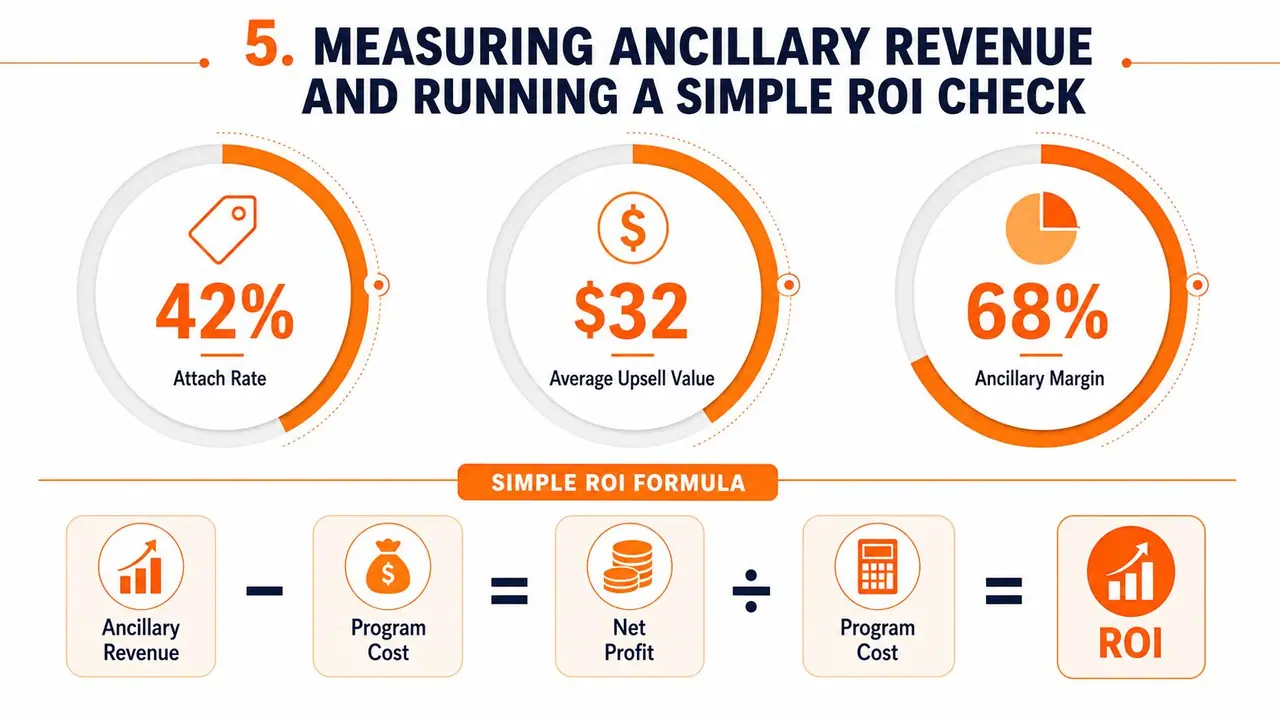
A simple ROI check is enough for most hosts. Start with ancillary revenue, subtract program cost, and compare the net profit against what it took to run the offer. If the program requires too much coordination for the return it creates, cut it or repackage it.
A practical reading routine
Review weekly at the listing level, then monthly across the portfolio. Weekly checks show whether the offer is getting seen and bought. Monthly checks show whether the economics still hold after cleaning schedules, vendor invoices, and staff time.
The vacation rental revenue management guide is useful context if you already manage base-rate strategy and want the add-on menu to complement it instead of competing with it.
Simple test: if you removed the upsell tomorrow, would anyone miss it enough to ask for it again?
If the answer is no, the offer might still be earning, but it isn't yet part of the guest expectation. If the answer is yes, you may have a strong candidate for a permanent menu item.
Legal, Tax, and Guest Experience Guardrails Hosts Often Miss
The quickest way to damage a strong ancillary offer is to launch it before checking the boring parts. Some extras need permits, insurance, or local licensing, especially when you are selling transport, tours, or equipment through third parties.
Tax treatment can differ as well. Ancillary income may be handled differently from the base booking on platforms and in local reporting, so check how VAT, occupancy tax, and income reporting apply in your market before you turn on the menu.
Guest experience matters just as much as compliance. Optional offers should feel like a service, not a trap. That means clear disclosure before booking, an easy way to decline, and no pressure tactics in the message flow.
For a broader customer-experience lens, customer loyalty with SupportGPT is a useful reminder that trust is built in small interactions, not just in big moments.
The line you should not cross
Do not turn core amenities into paid extras. Guests notice that immediately, and the reputational damage can outweigh any short-term gain.
Late checkout for a fee is understandable. Charging for something a guest assumed was part of the stay, especially if it affects comfort or access, creates friction that lingers after checkout.
The amenity fee guide is a useful companion if you are deciding where a fair service charge ends and an awkward fee starts.
Guardrail: if the guest experience feels smaller after the fee is introduced, the offer is probably wrong.
Ancillary revenue works best when it feels optional, useful, and clearly priced. The more transparent the offer, the less likely it is to damage trust.
A Practical Rollout Plan and Common Pitfalls to Avoid
Start with one or two offers you can fulfill cleanly, then surface them in a QR welcome book so guests can see them. Add tracking next, then expand only after you know which offers earn their keep.
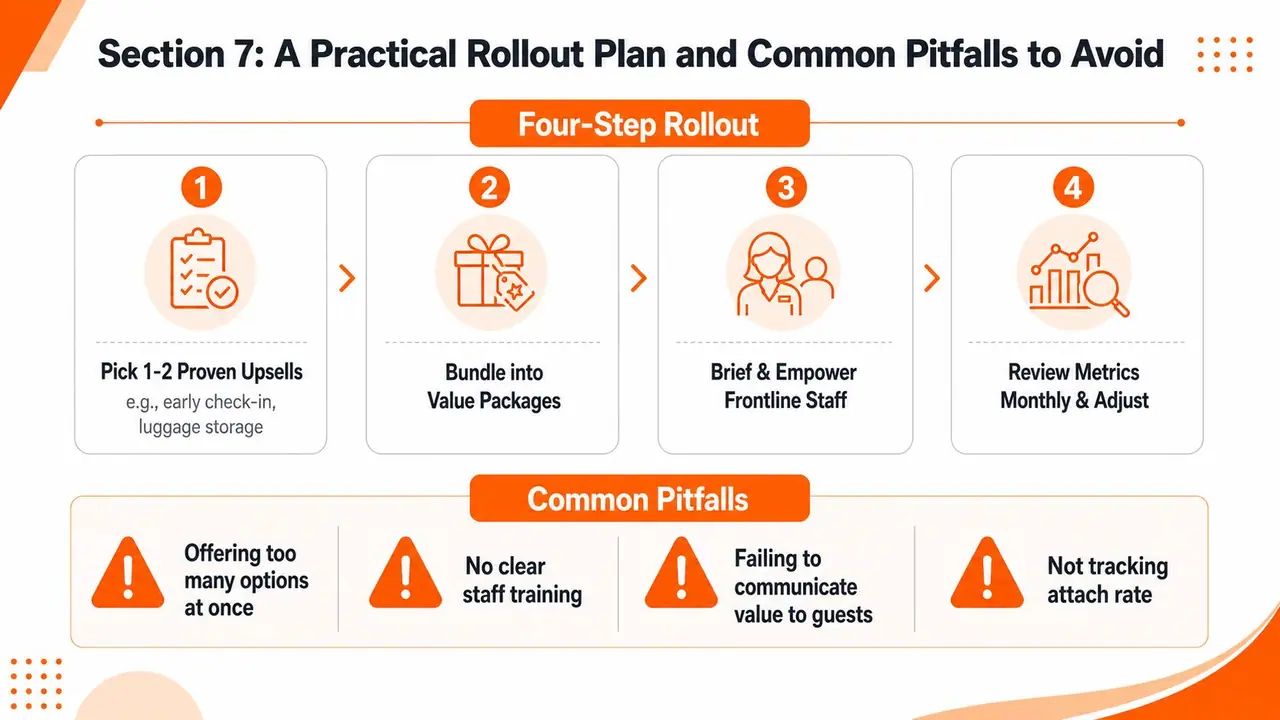
The common mistakes are familiar. Hosts offer too many options at once, skip staff training, fail to explain value clearly, or never track attach rate, so the menu looks active but doesn't prove anything. Another mistake is treating ancillary revenue as a replacement for base-rate strategy. It isn't.
The strongest setup is modest and repeatable. A few good offers, a clean digital presentation, and monthly review beats a bloated menu every time.
ScanStay turns this into a practical guest journey by putting your guide, house rules, and paid extras in one QR-based mobile experience. If you want to test late checkout, transfers, or equipment rentals without adding more message chaos, visit ScanStay and see how the workflow fits your listings.