Vacation Rental Contracts: A Host's Guide to Bookings
Draft, customize, and enforce your vacation rental contracts. Our guide covers key clauses, e-signatures, and integrating contracts into your guest workflow.
A booking comes in at 10:42 p.m. The guest message looks normal. Your calendar is full, the cleaner is lined up, and you send the check-in note.
Three days later, you're dealing with extra people in the unit, a complaint from a neighbor, or a chargeback tied to fees the guest says they never agreed to. That's the moment many hosts realize platform terms were never designed to run the day-to-day risk of a short-term rental business.
A booking confirmation is not a complete operating system. It confirms that a reservation exists. It usually doesn't spell out your exact access rules, visitor limits, late checkout consequences, trash procedures, pet conditions, or how you'll handle damage and policy breaches in a way that fits your property. That's where vacation rental contracts earn their keep.
This matters more now because the business has scaled far beyond casual hosting. The worldwide vacation rentals market was valued at US$174.84 billion in 2025 and is projected to reach US$481.8 billion by 2034, while online bookings already account for a 96.0% share in the U.S. market in 2025, according to Fortune Business Insights on the vacation rentals market. If guests are booking digitally at that level, contracts need to be delivered, accepted, and stored digitally too.
Hosts who treat the contract as a static PDF usually get half the benefit. Hosts who treat it as part of the guest journey get much better operational control. The contract should live alongside your check-in instructions, rules, and support information, not in a forgotten email thread. A well-built vacation rental welcome book helps put those terms where guests look for them.
Table of Contents
- Why Platform Terms Are Not Enough
- Anatomy of an Ironclad Rental Agreement
- Drafting Your Contract and Staying Compliant
- Automating Contract Delivery and Signatures
- Enforcing Your Contract and Avoiding Disputes
Why Platform Terms Are Not Enough
If you host on Airbnb, Booking.com, or another OTA, you're operating inside their framework first. That framework helps process reservations, collect payments, and manage messaging. It does not replace a property-specific agreement that reflects how your home operates.
The gap gets wider as competition increases. In the U.S., 1.77 million rental listings were projected for 2026, with demand projected to grow 4.1% year over year, while softer occupancy has pushed hosts to tighten terms around fees, cancellations, and minimum stays, according to StayFi's vacation rental statistics roundup. In a tighter market, sloppy terms cost money fast.
What OTAs handle well and what they don't
Platforms are good at distribution. They are not good at tailoring your risk controls.
They usually won't define the operational details that create friction at the property level:
- Unauthorized occupancy: A platform reservation may show one primary guest, but your real concern is who arrives, how many people enter, and whether visitors are allowed.
- House-rule enforcement: A listing summary is not the same as a signed acknowledgment of quiet hours, smoking restrictions, parking rules, or event bans.
- Fee disputes: If your guest challenges a cleaning fee, pet charge, or late checkout charge, your position is stronger when the fee appears in your own signed agreement.
- Access control: Platform messaging doesn't create a clean rule that says no signed agreement, no code.
- Property-specific disclosures: Stairs, shared amenities, septic limitations, dock rules, pool use, and accessibility details need their own clear language.
Platform terms protect the platform's transaction. Your agreement protects your operation.
A direct agreement gives you control
A separate rental agreement gives you something practical. It creates a single document that ties the reservation to your exact policies, your exact property, and your enforcement process.
That matters because guests don't experience your business in legal categories. They experience it through moments: booking, pre-arrival, arrival, stay, checkout, and any follow-up after departure. Your contract should support each of those moments.
A stronger setup usually includes:
- A listing notice that tells guests a signed rental agreement is required.
- A post-booking workflow that sends the agreement immediately.
- A signature gate before access instructions go out.
- A guest-facing rules hub where the signed terms are easy to reference.
- A documented enforcement path if a rule gets broken.
If you want a practical benchmark for what hosts often include in their booking terms, review short-term rental terms examples. Not to copy blindly, but to pressure-test whether your own rules are specific enough to enforce.
The most common blind spot
Many hosts think, “My house rules are already in the listing.” Guests rarely treat listing text with the same weight as a signed agreement. They skim it. They forget it. Sometimes they never see the parts you thought were obvious.
That's why vacation rental contracts shouldn't just exist. They should repeat the rules that matter most in a format that can be acknowledged, stored, and referenced later.
Anatomy of an Ironclad Rental Agreement
The strongest vacation rental contracts are boring in the best possible way. They remove ambiguity. They mirror the booking details exactly. They make it easy to prove what the guest agreed to.
A robust contract workflow should match the reservation record precisely. The agreement needs structured fields such as the property address, rental period, occupancy, and total fees, and hosts are advised to withhold property access codes until the guest has signed, as noted in Hostaway's guidance on rental agreements and e-signatures.
The clauses that actually do the work
Start with identity and scope. The contract should name the host or operating entity, the primary guest, and the property being rented. Use the exact street address and the exact stay dates. Nicknames for properties are fine for marketing, but not as the primary legal identifier.
Then define access and occupancy clearly. Many disputes start when the reservation says four guests but six people show up, or when a guest assumes friends can stop by without issue. Your contract should say how many people may stay overnight, whether day visitors are allowed, and what happens if that limit is exceeded.
Financial terms need to be precise, not broad. Show the total rent, cleaning fee, taxes, deposit or damage terms, and any optional charges that apply. If your PMS says one total and your contract says another, you've created your own dispute.
Practical rule: If a cleaner, co-host, or guest can ask “What exactly did they agree to?” the answer should be visible in one paragraph, not buried in five emails.
Essential Clauses for Your Vacation Rental Contract
| Clause | Purpose | Pro Tip for Customization |
|---|---|---|
| Parties and property | Identifies who is responsible and which property is covered | Use full legal names and the exact property address from your booking system |
| Rental term | Defines arrival and departure dates and times | Include check-in and checkout times, not just dates |
| Occupancy and visitors | Controls extra guests and unauthorized gatherings | Separate overnight occupancy from visitor rules |
| Payment terms and fees | Confirms what the guest owes and when | Mirror rent, cleaning fees, and taxes exactly from the reservation |
| Security deposit or damage terms | Sets expectations for damage handling | Explain what documentation you'll use if charges are necessary |
| Cancellation policy | Prevents refund confusion | Match your policy to the channel where the guest booked |
| House rules | Makes operational rules enforceable | Focus on noise, smoking, pets, parking, trash, and events |
| Access rules | Controls code release and entry rights | State that access details are released only after required steps are complete |
| Maintenance and emergencies | Reserves your ability to respond to urgent issues | Add language for emergency entry and urgent repair situations |
| Liability and indemnification | Allocates responsibility for certain risks | Keep it plain English and have local counsel review it |
| Compliance disclosures | Covers location-specific legal requirements | Add any tax, licensing, or local occupancy disclosures required where you operate |
| Signature and acknowledgment | Confirms acceptance | Use a digital signature process that timestamps the execution |
Sample wording that stays practical
Good contract language is specific enough to enforce and simple enough for a guest to understand on a phone screen.
For occupancy:
The maximum overnight occupancy for the property is [X] registered guests. Unapproved additional overnight guests or gatherings may result in immediate action under this agreement.
For access control:
Access instructions and door codes will be released after all required booking steps are complete, including execution of this rental agreement.
For smoking or vaping:
Smoking and vaping are prohibited [inside the property / anywhere on the premises]. Additional cleaning or remediation costs caused by smoke, odor, or residue may be charged to the guest.
For parties and events:
Parties, events, and commercial activities are not permitted without prior written approval from the host.
For checkout timing:
Checkout is at [time]. Late departure without approval may result in additional charges if it affects cleaning, maintenance, or the next reservation.
A few drafting choices make a real difference in practice:
- Write for enforcement, not decoration: “Respect the home” sounds nice but doesn't help much. “No glitter, confetti, or open-flame candles” does.
- Separate guest limits from visitor rules: Hosts often combine them, which creates loopholes.
- Tie fees to conduct carefully: If you charge for late checkout, unauthorized pets, or smoking, the rule should be explicit and easy to find.
- Avoid contradictions: Your listing, confirmation email, house rules, and contract should all point in the same direction.
- Use plain language: Complex wording doesn't make a weak clause stronger.
One more operational note. If you manage more than one property, don't create a totally custom contract from scratch every time. Build a master template with fixed legal language and variable fields for dates, guest names, fees, occupancy, and property-specific rules. That's how you stay consistent without becoming rigid.
Drafting Your Contract and Staying Compliant
Hosts often frame this as a simple choice. Grab a free template or hire a lawyer. In practice, the answer is usually both.
A template is useful for structure. Legal review is useful for enforceability. The mistake is assuming the template is compliant because it looks professional.
Template versus lawyer is the wrong debate
If you run one straightforward property in a location with clear rules, a solid template can get you moving faster. But it still needs editing. Generic templates often miss local disclosures, tax language, occupancy restrictions, or channel-specific quirks that matter once a real dispute starts.
If you manage multiple listings, accept direct bookings, host longer stays, or operate in a city with active short-term rental regulation, legal review becomes much harder to skip. The more operational complexity you have, the more dangerous a one-size-fits-all document becomes.
A practical workflow looks like this:
- Start with a base template: Use it to define your structure and standard clauses.
- Map your actual operation: Add your real rules on pets, noise, parking, trash, pool use, and access.
- Check local requirements: Review city, county, and state rules that affect disclosures and enforcement.
- Get targeted legal review: Have counsel review the clauses that touch local compliance, liability, cancellation, and occupancy.
- Turn the final version into a reusable workflow: Don't leave the approved contract sitting as a desktop file.
Where hosts usually miss compliance
The most overlooked issue is the intersection between OTA bookings and local law. A guest may book on a platform, but the stay can still raise questions about which statutes apply, whether the stay is recreational or business-related, and whether landlord-tenant rules come into play in a dispute.
That ambiguity isn't theoretical. The University of North Carolina's analysis notes that North Carolina's Vacation Rental Act may apply to recreational stays booked through internet platforms, while business-purpose stays may require case-by-case legal analysis, as explained in UNC's review of the North Carolina Vacation Rental Act and short-term rentals.
If your contract doesn't say which rules govern the stay, your guest will fill in the blanks with whatever they think is fair.
That's why compliance work isn't just about the contract file. It's also about where the guest sees the terms during the stay. A digital workflow helps because you can keep the signed agreement, check-in instructions, and legal notices in one place instead of scattering them across inboxes and platform threads.
One example is ScanStay, which lets hosts place house rules, check-in details, and guest information in a QR-based digital welcome book. Used carefully, that gives guests one mobile-friendly place to reference the practical terms they already accepted.
Automating Contract Delivery and Signatures
A contract that arrives late gets ignored. A contract that requires printing gets delayed. A contract hidden in a long email chain gets forgotten until there's a problem.
The delivery method matters as much as the wording.
Build the workflow around the booking event
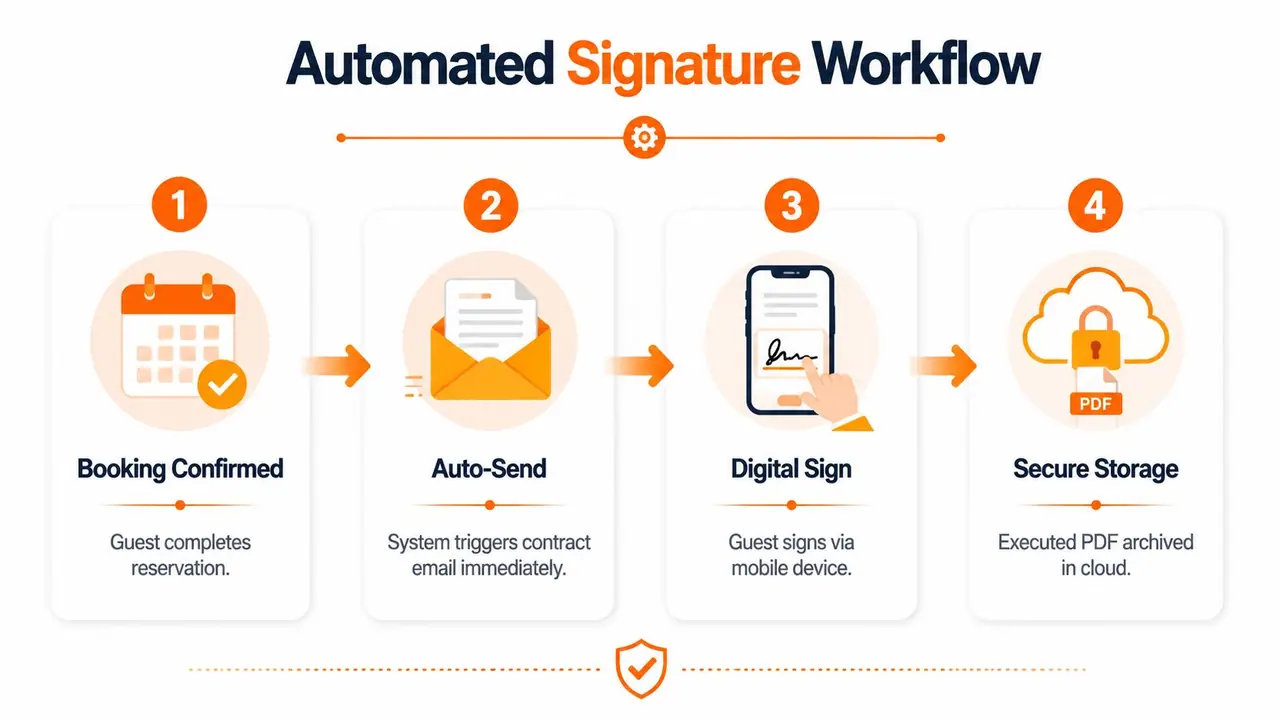
The cleanest setup is event-driven. Booking confirmed. Contract sent automatically. Signature captured. Access released only after completion.
That sequence removes chasing, guesswork, and exceptions. It also gives the guest a more professional experience because they know what needs to happen next.
A workable automation flow usually looks like this:
Reservation confirmed The guest receives a short confirmation message that explains a signed rental agreement is required before arrival.
Agreement sent immediately Don't wait until the day before check-in. Send it while the booking is still top of mind and there's time to resolve questions.
Reminder logic kicks in If the guest hasn't signed, send a reminder. Keep the message brief and mobile-friendly.
Access stays locked Door codes, lockbox details, and arrival instructions should remain withheld until the agreement is completed.
Executed copy is archived Store the signed PDF where your team can find it quickly if there's a dispute, maintenance issue, or guest question.
Here's a useful walkthrough of the broader operational side of this process in vacation property management workflows.
A quick visual helps if you're building the process for a team:
Keep the signed agreement accessible during the stay
Most hosts think of the contract as a pre-arrival item. That's too narrow. The guest often needs those terms during the stay.
If quiet hours start at a certain time, if parking is restricted, if trash goes out on a certain day, or if checkout has specific requirements, the contract should be easy to reference alongside your practical guest instructions.
That's why the best workflow doesn't end at signature. It carries the accepted terms into the stay experience.
Use these operating principles:
- One source of truth: Don't make guests search across OTA messages, text threads, PDFs, and a binder on the kitchen counter.
- Phone-first formatting: Guests sign and read on mobile. Dense legal blocks get skipped.
- Short companion summaries: Keep the full agreement on file, then surface the most important rules in plain language.
- Shared team access: Your co-host, cleaner, and support staff should know where to find the signed agreement when something goes sideways.
A signed contract has the most value when your team can pull it up in seconds, not when someone has to search old inboxes.
Enforcing Your Contract and Avoiding Disputes
When a guest breaks a rule, the contract shouldn't be your first weapon. It should be your reference point.
The best enforcement is calm, documented, and specific. You're not trying to sound intimidating. You're trying to show that the expectation was clear and the response is consistent.
Use the contract as a communication tool first
Start with evidence. Keep dated pre-arrival and post-departure photos. Save message history. Document noise complaints, extra occupancy, smoking evidence, or damaged items in a way that another person could follow later.
Then communicate in plain language. Refer to the exact rule, not your frustration.
A useful pattern is:
- State what happened: Describe the issue factually.
- Reference the accepted term: Point to the relevant clause or rule.
- State the next step: Explain what the guest needs to do now or what charge review will occur.
- Keep the tone steady: Don't over-argue. Don't guess motive.
For example:
We observed evidence of an unauthorized pet after checkout. The signed rental agreement prohibits pets unless approved in advance. We're reviewing the additional cleaning required and will follow up with documentation.
That approach works better than broad accusations. It also gives you a cleaner record if the issue escalates.
Prevent the dispute before the stay starts
Many enforcement issues stem from communication breakdowns. Guests may misunderstand parking regulations or assume a sleeper sofa allows for higher occupancy. Frequently, they are unaware of building quiet hours or expect accessibility features that were not available.
This is one area hosts still under-handle. Federal rules prohibit disability discrimination in public accommodations, and operators are increasingly advised to specify accessibility features and responsibilities in both contracts and guest-facing information, as reflected in 28 CFR Part 36. In practice, that means your accessibility information shouldn't be vague, hidden, or outdated.
Use your contract and your guest communications to clarify:
- Accessibility features: Describe what is and isn't available.
- Property limitations: Stairs, narrow entries, bathroom constraints, and parking access should be stated plainly.
- Service contacts: Make it easy for the guest to ask for help before arrival.
- Operational rules: Put the same expectations in the signed agreement and the guest guide.
Vacation rental contracts work best when they do two jobs at once. They protect the property, and they reduce avoidable confusion. Hosts who understand that usually have fewer arguments, faster resolutions, and a more professional business.
If you want a simpler way to keep house rules, check-in details, and signed-stay expectations accessible to guests, ScanStay gives hosts a QR-based digital welcome book that works in the guest's mobile browser without an app. It's a practical way to keep key information in one place so your contract isn't isolated from the rest of the guest journey.