How the Airbnb Search Algorithm Works in 2026
Learn how the Airbnb search algorithm ranks listings in 2026, the signals that matter most, and evidence-based tactics hosts can use to improve visibility.

You refresh your Airbnb dashboard after replacing the mattress, rewriting the description, and uploading brighter photos. Yet a nearby competitor with older images and weaker reviews still appears ahead of you. The frustrating part is that your effort may have improved the guest experience without immediately improving your position in search.
That's because the Airbnb search algorithm doesn't rank listings as a simple contest of effort or beauty. It estimates which listing is most likely to produce a booking for a particular guest, on particular dates, at a particular moment. Once you adopt that mental model, sudden visibility changes become easier to diagnose and your daily operating decisions start to look like ranking decisions too.
Table of Contents
- Why Your Listing Disappears in Search
- The Mental Model Behind Airbnb Ranking
- How Behavioral Signals Become a Ranking Score
- Operational Inputs Most Hosts Overlook
- Optimization Tactics That Move the Needle
- Testing and Measuring Ranking Changes
- Timelines, Misconceptions, and the Bigger Picture
Why Your Listing Disappears in Search
Airbnb search behaves less like a permanent leaderboard and more like a live auction. Your listing competes for attention against the properties available for the guest's dates, destination, budget, filters, and travel purpose. A listing that looks strong for a family searching for a beach house may be a poor match for a couple seeking a city apartment.
The platform's public guidance identifies quality, popularity, price, and location as the main ranking pillars. Quality includes the accuracy and usefulness of your content, guest ratings and reviews, communication, customer service, cancellation information, and amenities. Popularity includes engagement such as wishlists, bookings, and messages, while price is assessed against comparable listings for the same dates. Airbnb also says location has a large impact, especially when a stay is near popular landmarks. These principles are outlined in Airbnb's Help Center guidance on search ranking.
A stronger listing can therefore lose visibility for reasons that have nothing to do with one recent photo upgrade. Your competitor may be cheaper for the searched dates, have more recent engagement, offer availability that matches the guest's filters, or sit closer to the area the guest selected. The result can feel unfair if you judge ranking by the amount of work you've done rather than by the probability Airbnb predicts.
Why position changes from search to search
Search results change as inventory changes. Guests also search with different dates, group sizes, price ranges, and filters, so Airbnb has a different matching problem each time. The same property may appear prominently for one traveler and much lower for another because the platform is personalizing relevance.
The ranking system has also evolved toward machine learning and booking prediction. Airbnb's search and Maps research described listings as being ordered by booking probabilities, while its Experiences ranking work included signals such as duration, price, category, reviews, and recent bookings. The historical development of this approach is summarized in Airbnb's ranking technology overview.
Practical rule: Don't ask, “Why am I not always on page one?” Ask, “Which guest, dates, and competing listings does Airbnb believe I'm less likely to convert than?”
That question leads to useful actions. You can inspect price competitiveness, improve the first impression, reduce booking friction, maintain accurate availability, and deliver stays that generate current positive feedback. You can't control every input, but you can operate the listing so the system has more evidence that a booking will go smoothly.
The Mental Model Behind Airbnb Ranking
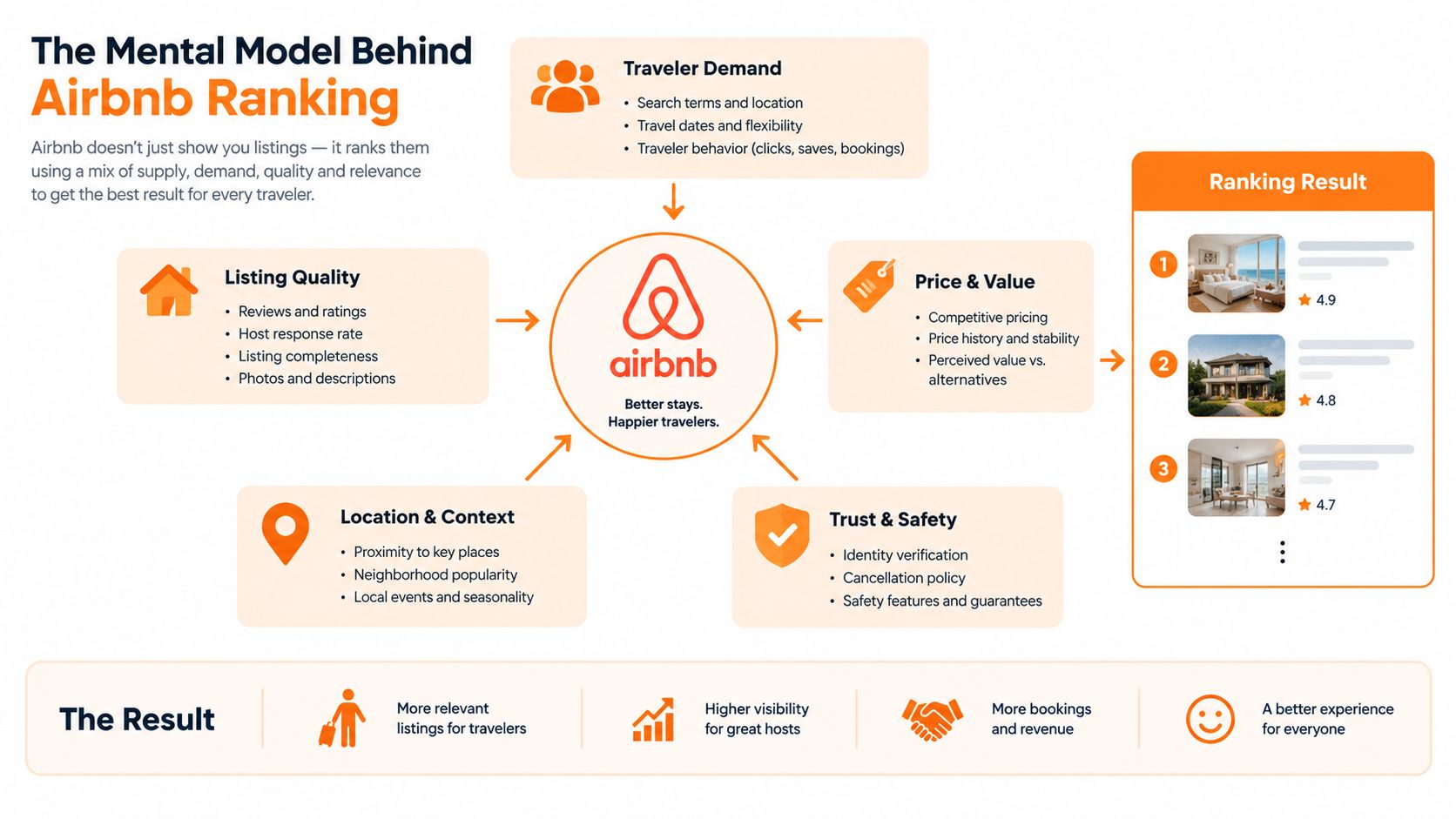
Think of Airbnb as a restaurant manager seating the next guest. The manager isn't choosing the restaurant's “best table” in the abstract. They're choosing the table that best fits this guest's party size, preferences, budget, timing, and reason for visiting.
Your listing is that table. Quality tells Airbnb whether the meal and service are likely to match what the guest expects. Popularity indicates whether comparable guests have shown interest by clicking, saving, messaging, and booking. Price answers whether the value makes sense beside similar options for the same dates. Location determines whether the property fits the traveler's geography and search intent.
These pillars aren't four independent grades that Airbnb adds together. They are inputs to a broader prediction about booking likelihood. A property with excellent photos may still rank poorly if its price discourages bookings. A modestly photographed apartment may rank well if it matches the guest's location, dates, budget, and demonstrated preferences.
Quality is broader than visual polish
A listing's quality signal includes more than professional-looking images. Airbnb's published guidance refers to photos and videos, guest ratings and reviews, host-guest communication, customer service, cancellation information, and amenities. That means an attractive listing with an inaccurate description can create a weaker outcome than a simpler listing that sets clear expectations and delivers reliably.
Quality also interacts with relevance. If a guest needs a workspace, parking, or a particular amenity, clearly documented information helps Airbnb understand whether your property belongs in that search. Missing or ambiguous information creates uncertainty before the guest ever contacts you.
Popularity reflects guest behavior
Popularity is not a popularity contest based only on total review count. Airbnb identifies engagement signals such as wishlists, bookings, and messages. Those actions tell the platform that travelers find a listing relevant or desirable, even when they don't book immediately.
Price and location then shape the context. Airbnb compares your total price with other listings in the area for the same dates, and it says listings priced below comparable options with similar characteristics tend to rank higher. Location can matter substantially because a stay near a popular landmark may better satisfy a traveler's purpose than a technically similar property farther away.
The most useful mental model is simple:
Airbnb doesn't ask whether your listing is good in isolation. It asks whether this guest is likely to book it compared with the alternatives available now.
How Behavioral Signals Become a Ranking Score
A guest's path from search to reservation leaves a trail of useful signals. They may save a property to a wishlist, open its page, examine the photos, send a message, compare dates, or book. Airbnb can combine those actions with listing attributes and outcomes to estimate whether similar guests are likely to complete a reservation.
Some signals happen before the listing page opens. A compelling cover photo and sensible displayed price can encourage a click. Once the guest arrives, the image sequence, amenities, reviews, cancellation terms, and description influence whether curiosity becomes confidence. A message may reveal unresolved uncertainty, while a booking provides the clearest evidence that the listing matched the guest's needs.
Relative performance matters
Consider two cabins with the same star rating. Cabin A attracts serious viewers who frequently proceed to book. Cabin B receives similar attention but loses more guests after they inspect the page. Airbnb doesn't need to label one host as “better” to separate them. The observed booking behavior gives the system different evidence about future booking probability.
The comparison must be fair. A cabin in a mountain destination during a holiday period shouldn't be judged against a city studio during a quiet weekday. The relevant question is how your listing performs against comparable properties for similar demand, dates, guest requirements, and price expectations.
| Signal | What Airbnb measures | Typical ranking effect |
|---|---|---|
| Wishlist saves | Whether guests preserve the listing for later consideration | More evidence of desirability and relevance |
| Bookings | Whether search interest becomes completed reservations | Stronger evidence of booking probability |
| Messages | Whether guests engage with the listing or need clarification | Indicates interest, while unresolved friction can weaken conversion |
| Reviews | Whether guests describe the delivered experience positively | Supports quality and future booking confidence |
| Price response | Whether guests accept the total cost compared with alternatives | Helps Airbnb assess value and conversion potential |
The platform's documented pillars and engagement signals make one point clear: behavior is the bridge between presentation and visibility. Improving the listing page matters because it changes what guests do next.
For the operational side of turning positive stays into stronger guest sentiment, hosts can also review this guide to improving guest satisfaction. The practical value is not a secret keyword formula. It's creating a stay that produces accurate expectations, fewer questions, smoother communication, and more favorable feedback.
Operational Inputs Most Hosts Overlook
A host can optimize every visible part of a listing and still create booking friction in the backend. Airbnb's own guidance confirms that availability, response times, and acceptance behavior affect ranking. Those factors matter because the platform wants to show guests options that can be booked and are likely to proceed smoothly.
Calendar hygiene comes first. If your availability is stale, your minimum-stay rules don't fit your market, or blocked dates create confusing gaps, a guest may discover that the listing can't accommodate the trip they searched for. Airbnb then has less reason to present that listing for similar searches. Keep availability accurate, review seasonal stay rules, and check that the settings match how travelers book your property.
Response speed is another operational signal. A guest who asks whether parking is available or whether an arrival time works may book a different property while waiting. Fast, consistent replies reduce that uncertainty and protect the conversion opportunity created by your listing.
Operational friction leaves a record
Cancellations are especially damaging because they represent a failed transaction and undermine confidence in future availability. Avoiding host-initiated cancellations requires more than good intentions. Keep calendars synchronized, confirm that your property is ready to sell, and don't accept reservations you can't reliably honor.
Review recency and review velocity are separate ideas. A strong historical average demonstrates past performance, but a steady flow of recent reviews gives Airbnb fresher evidence about the current guest experience. A listing can't rely indefinitely on old praise if recent booking outcomes provide little new information.
Superhost status and Instant Book belong in this same operational layer. They can support trust and reduce friction, but neither replaces reliable pricing, accurate availability, responsive communication, and strong stays. Instant Book may remove an approval step, while Superhost status signals a history of dependable hosting. The underlying behaviors still matter.
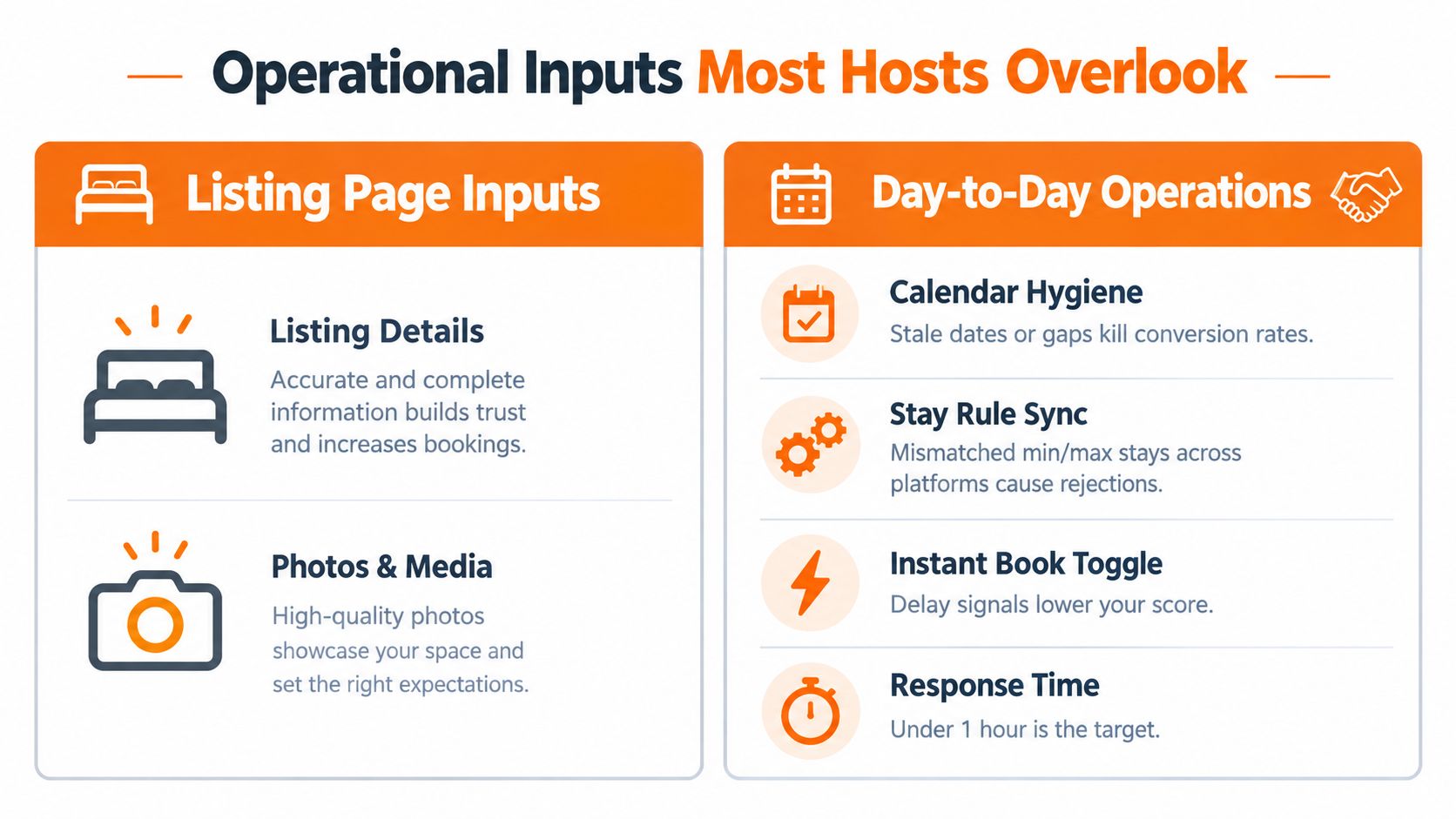
A useful operating routine includes:
- Calendar review: Check open dates, blocked dates, minimum stays, and maximum stays before each booking period.
- Message coverage: Set notifications, saved replies, or team ownership so inquiries don't sit unanswered.
- Reservation confidence: Accept only stays you can deliver, and maintain a backup plan for maintenance or access problems.
- Review follow-up: Ask guests for honest feedback after checkout without pressuring them to provide a particular rating.
Hosts who want a broader way to organize these routines can use operational efficiency metrics for short-term rentals as a management reference.
The operational connection is direct. A clean calendar makes a booking possible, a fast response keeps the guest engaged, and a dependable stay produces better evidence for the next ranking decision.
For a visual walkthrough of the operational layer, use the video below.
Optimization Tactics That Move the Needle
The most durable Airbnb optimization work improves the guest's decision, not just the listing's appearance. Focus on four connected levers: quality, pricing, reviews, and on-page clarity. Each one affects what a traveler sees, understands, and does.
Listing quality starts with the first impression
Put your strongest image first, but choose it for the guest's actual reason to book. A cabin may lead with its view, while a business-friendly apartment may lead with a bright workspace or convenient living area. The opening sequence should answer the guest's first questions quickly: What does the space feel like, who is it for, and what makes it worth considering?
Use the rest of the gallery to create an accurate tour. Show sleeping arrangements, bathrooms, entrances, outdoor areas, work surfaces, and any feature that could affect the decision. Don't hide limitations. Clear expectations support the quality signal because guests can compare the promise with the delivered stay.
If the property needs a visual refresh, practical guidance such as these Airbnb decor tips from SouthShore Fine Linens can help you think about comfort, cohesion, and guest perception without treating decoration as a substitute for operations.
Your title should be readable and specific. Include the feature or setting that distinguishes the property, then let the description explain the experience. Keyword stuffing makes the title harder to scan and doesn't solve a weak offer.
Price for booking probability
Airbnb compares the total price with comparable stays for the same dates. That means pricing is a visibility lever, not only a revenue decision. A higher rate can be rational when the property offers clear value, but an unexplained gap between your price and comparable options can reduce clicks and bookings.
Use the price that gives a traveler a credible reason to choose you. Check comparable properties with similar location, capacity, amenities, and review strength. Then account for the dates, because the right price for a quiet period may not suit a high-demand weekend.
Generate reviews through the stay
A perfect historical score isn't enough if guests aren't seeing recent proof of a good experience. Build review momentum through delivery: clear arrival instructions, a clean property, accurate amenities, and a quick answer when something goes wrong.
A short, personalized check-in note can prevent confusion before it becomes a complaint. After checkout, send a courteous reminder that invites honest feedback. Don't script praise. Remove the friction that stops satisfied guests from sharing it.
Write for search intent and human confidence
Match your copy to the phrases guests naturally use, such as “walkable to the old town,” “private parking,” or “quiet workspace,” but only when those statements are accurate. Place important information near the beginning of the description, organize details by guest concern, and use captions to explain what each photo shows.
The result is cumulative. Strong images earn attention, sensible pricing keeps the offer credible, recent reviews reinforce trust, and clear copy answers questions before they become objections.
| Lever | Relative impact | Time to see effect | Difficulty |
|---|---|---|---|
| Listing quality | High when the current presentation misrepresents or undersells the stay | Often visible after guest behavior changes | Moderate |
| Pricing | High when your total price is misaligned with comparable options | Can influence searches as dates and prices update | Moderate |
| Reviews | Builds evidence through delivered stays and guest feedback | Gradual, because it depends on completed reservations | High |
| On-page clarity | Supports relevance and reduces uncertainty | Usually follows new views and guest decisions | Low to moderate |
Treat the table as a prioritization tool, not a promise of a fixed ranking outcome. Airbnb weighs inputs in context, so improving one lever can expose a problem in another. Beautiful photos won't rescue an unavailable calendar, and a competitive price won't compensate for an inaccurate listing.
Testing and Measuring Ranking Changes
A host in a coastal market notices fewer inquiries and decides not to rewrite everything at once. Instead, they create a 60-day testing window and record the starting condition, the change made, and the resulting trend. The first test adjusts pricing for comparable dates while the photos, description, stay rules, and response routine remain stable.
They track impressions, listing-page visits, and bookings in the host dashboard. Page views are useful context, but they're noisy. A rising view count without reservations may mean the thumbnail attracts attention while the price, amenities, or description fails to convert it. Conversion is the cleaner question: after a relevant guest reaches the page, do they book?
Use a simple experiment log
Write down each change with its date and reason:
- Change: What did you alter?
- Hypothesis: What guest problem should it solve?
- Comparison: Which dates or comparable listings provide context?
- Result: What happened to impressions, visits, inquiries, and bookings?
- Decision: Keep, reverse, or test again?
Read week-over-week movement rather than reacting to a single day. Search demand, competitor availability, and guest intent fluctuate constantly, so daily changes can create false conclusions. Once the pricing test has a clear pattern, return the setting or keep it, then test one photo sequence or response-time improvement.
Hosts can use Airbnb analytics guidance for hosts to structure this review process. The tool matters less than the discipline. If you change the cover photo, price, minimum stay, and title together, you won't know which action influenced guest behavior.
Measurement habit: Keep a change log beside your dashboard. Memory records the result you hoped for, while a dated log records what actually happened.
Testing won't reveal Airbnb's private formula. It will show which changes improve your listing's ability to attract and convert the guests you want.
Timelines, Misconceptions, and the Bigger Picture
Ranking improvements rarely appear as a clean, immediate reward. A sustained change in pricing, response behavior, or review activity needs time to generate new guest behavior. Structural improvements, such as a major photo overhaul or meaningful amenity addition, may take longer because they must influence searches, bookings, stays, and feedback before the platform has much new evidence.
Avoid treating Instant Book as a visibility guarantee. It can reduce approval friction, but it doesn't make an overpriced, inaccurate, or poorly reviewed listing the best match for every traveler. Promotional discounts also aren't a universal shortcut. A lower price may improve competitiveness, but the booking still has to produce a stay that meets expectations.
One five-star review won't erase a pattern of weak availability, slow communication, cancellations, or mismatched pricing. The algorithm evaluates continuing signals, not a single dramatic reset. Similarly, changing your title repeatedly won't compensate for a cover image that fails to communicate the property or a calendar that rejects the guest's dates.
Build a durable operating loop
Use the four pillars as a recurring management cycle:
- Quality: Keep the listing accurate and deliver what the guest booked.
- Popularity: Give travelers reasons to click, save, message, and reserve.
- Price: Compare the total cost with relevant alternatives for the same dates.
- Location and relevance: Explain the setting and match the listing to the guests it can best serve.
Airbnb has described the same core ranking logic across its search surfaces since at least the early 2020s, so these signals are foundational rather than temporary tricks. The platform may change details and weighting, but hosts who produce reliable bookings and smooth stays have a stronger foundation than hosts who chase isolated hacks.
The bigger lesson is that search visibility is a byproduct of operations. Calendar accuracy creates real availability, responsive communication protects conversion, thoughtful pricing sets expectations, and a well-run stay gives recent reviews a reason to exist. Manage those inputs together, then use your dashboard to identify which part of the loop needs attention next.
If you want to turn ranking theory into a practical listing and guest-experience workflow, visit ScanStay to review tools for listing audits and mobile guest guides. Use it to organize arrival information, house rules, local recommendations, and post-stay support so guests can get clear answers without adding repetitive messages to your day.