How to Start a Bed and Breakfast: A 2026 Guide
Thinking of opening a B&B? Our guide on how to start a bed and breakfast covers everything from business plans and permits to marketing and guest experience.
You're probably looking at one of two things right now. A charming old house you can already imagine guests loving, or a spreadsheet that's starting to make that dream feel heavier than expected.
That tension is normal. Starting a bed and breakfast attracts people who care about hospitality, design, food, and place. But the owners who last don't build around the dream first. They build around viability. The romance only works when the numbers, permits, layout, and marketing engine support it.
I've seen smart people make the same mistake in different ways. They buy a beautiful property before checking zoning. They design rooms for compliments instead of cleaning speed. They assume bookings will come because the house is special. They underestimate how much of the business is really distribution, compliance, repetition, and margin control.
If you want to learn how to start a bed and breakfast in a way that can support both the business and your life, treat every decision as a profitability decision. Your location affects occupancy resilience. Your room design affects labor. Your booking mix affects margins. Your breakfast format affects staffing, food cost, and guest reviews. Nothing sits in its own silo.
Table of Contents
- Laying the Groundwork with Market Research and Niche Definition
- Crafting Your Business Plan and Securing Funding
- Navigating Legal Structures, Permits, and Insurance
- Designing the Property and Perfecting Guest Rooms
- Your Marketing Playbook for Driving Direct Bookings
- Streamlining Operations with a Modern Guest Experience
Laying the Groundwork with Market Research and Niche Definition
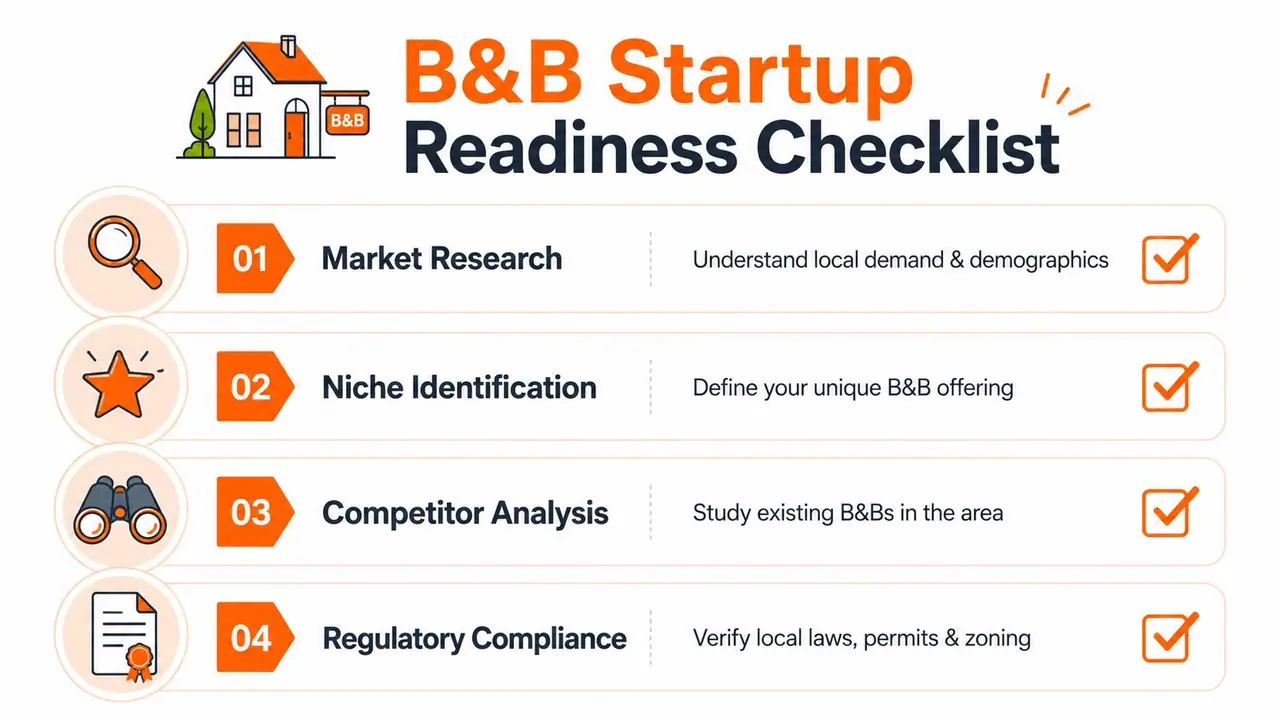
A lot of future innkeepers start with the house. The profitable ones start with demand.
That sounds less romantic, but it is how you avoid buying a beautiful property that stays busy for twelve summer weekends and struggles the rest of the year. A B&B is a small lodging business with high fixed costs, hands-on labor, and limited room inventory. If the market cannot support your rates, occupancy, and operating style, charm does not save the numbers.
Start with demand, not the building
A quick market check should answer one blunt question. Why will people book this property outside peak season?
Wedding venues, hospitals, colleges, business travel, outdoor recreation, family visits, and regional events all create demand. Some of those guests book for romance and leisure. Others book because they need to be in town. The second group often gives a small property more stable cash flow.
Review each market in three layers:
Demand drivers
Identify what brings guests in during weekdays, shoulder season, and slower months. A market that depends only on leaf season, ski weekends, or summer holidays puts more pressure on pricing and owner cash reserves.Competing lodging supply
Look beyond other bed and breakfasts. Compare boutique hotels, motels, inns, and short-term rentals. Read reviews with an operator's eye. Guests will tell you where the local market is weak on parking, breakfast, noise, check-in, mattress quality, or service consistency.Rate tolerance
Confirm what guests in that area will pay for a stay like yours. A property can be lovely and still be overpriced for the trip purpose. Convenience travelers shop differently from anniversary guests.
For a broader location screen, use this breakdown of the best places to own an Airbnb to compare market constraints, seasonality, and owner economics across destinations.
A simple rule helps here. If the deal only works with full weekends, premium rates, and no slow month surprises, the deal is thin.
Choose a guest you want to build for
Weak concepts usually fail because the owner wants every kind of guest. That decision spreads the product too wide and raises costs in the wrong places.
A couples-focused B&B makes one set of decisions. Privacy matters. Sound control matters. Bedding, bathrooms, lighting, and walkable dining matter. A hiking or cycling property needs different things: early breakfast timing, gear storage, mud management, laundry access, and local route knowledge. A family-oriented inn needs room layouts, outdoor space, and breakfast service that can handle a louder, less predictable morning.
Pick a core guest by answering three practical questions:
Why are they coming to town
Occasion travel, event travel, and overnight stopovers create different booking windows and different expectations.What makes them hesitate before booking
Bad parking, weak Wi-Fi, shared bathrooms, traffic noise, awkward self check-in, and dated rooms all reduce conversion.What will they mention in a review if you get it right
The answer usually points to the features worth paying for.
Here, lifestyle and profitability intersect. If you target guests who expect a high-touch social host experience, your day will look very different from an inn that is built for quiet, efficient, mostly self-directed stays. Both models can work. They do not create the same workload.
Build a niche that sharpens decisions
A niche should make operations easier to design and easier to market. If it only sounds good on a website, it is not doing enough.
I test a B&B niche by seeing whether it narrows real decisions:
| Decision area | Weak concept | Strong niche signal |
|---|---|---|
| Property choice | “Any charming house” | Layout fits the target guest, stay length, and privacy needs |
| Room design | “Something tasteful” | Amenities support the reason the guest booked |
| Breakfast style | Generic buffet ideas | Service matches guest expectations and labor limits |
| Marketing | Broad lodging language | Clear promise tied to a specific trip type |
That filter protects margin. It keeps owners from overspending on features guests do not value, underinvesting in the details that drive reviews, or creating a service model that turns the property into a full-time job with weak returns.
A good B&B position is usually built from four parts: location, guest type, room experience, and service style. It does not need to be quirky. It needs to be clear, profitable, and realistic for the way you want to live.
The category may have room for demand over time, but local fit decides whether a specific property works. In this business, the winning concept is rarely the prettiest one. It is the one that matches the market, supports the rate, and can be run without burning out the owner.
Crafting Your Business Plan and Securing Funding
A lot of aspiring innkeepers hit the same moment. They find a beautiful property, sketch out room ideas, picture full weekend occupancy, then sit down with renovation bids, insurance quotes, payroll assumptions, and debt payments. That is where the project stops being a lifestyle fantasy and becomes a business model.
A good B&B plan answers one hard question. Can this property produce enough cash to justify the capital, the owner workload, and the risk?
Build the plan lenders care about
Lenders are not funding charm. They are funding repayment capacity.
The strongest plans are plain, specific, and easy to pressure-test. They show how the property will operate in a real market, what it will cost to open, how bookings will be generated, and what happens if the first year is slower or more expensive than expected. Owners who skip that discipline often build a business that looks attractive at 75 percent occupancy on paper and feels punishing at 45 percent occupancy in real life.
Your plan should answer five questions clearly:
What are you opening
Define the property type, room count, target guest, seasonality, and service style.Why this market
Show the local demand drivers, competitor set, and the rate position you believe the property can hold.How will bookings happen
Explain your channel mix, launch marketing, and direct booking strategy.What will it cost to open
Include renovation, furnishing, licensing, insurance, equipment, and working capital.How will it perform
Present financial projections a cautious lender can follow line by line.
A credible projection usually covers multiple years, uses seasonal pricing, and includes the costs owners tend to understate early on, such as utilities, staffing, insurance, marketing, software, linens, breakfast supplies, merchant fees, and routine maintenance. The point is not to produce a polished spreadsheet. The point is to see whether the business still works after the easy optimism is removed.
Estimate costs by room, then by system
Startup budgets go wrong when owners price the visible items first and treat the operational backbone as a footnote.
According to SBDCNet's bed and breakfast business report, startup costs can run about $35,000 to $50,000 per guest room for larger properties and $20,000 to $40,000 per guest room for very small or low-cost operations. For many first-time buyers, that is the first number that brings the project back to earth.
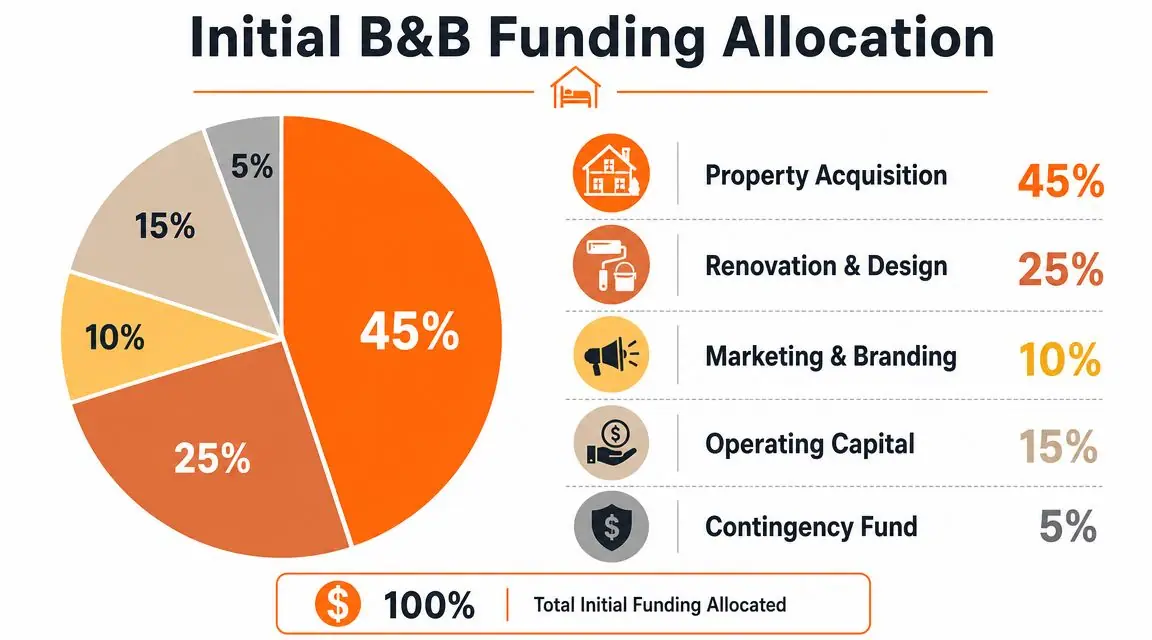
Room-level budgeting matters, but whole-property systems usually decide whether the opening is financially survivable:
Life-safety and code work
Fire separation, egress, alarms, accessibility-related changes, and inspection-driven fixes.Back-of-house functionality
Laundry flow, storage, breakfast prep space, owner workspace, and maintenance access.Opening runway
Cash for early payroll, supplies, utilities, marketing, and slow-season volatility.
I tell clients to run three ugly scenarios before they commit capital. Opening is delayed. Renovation scope expands. Bookings ramp up slower than projected. If any one of those breaks the business, the deal is too tight.
That same margin pressure shows up across short-term lodging models. This analysis of whether Airbnbs are profitable is useful for the same reason. Gross revenue can look healthy while retained profit stays thin.
The property does not need to be perfect at opening. It needs to be compliant, functional, and able to survive its first year.
Funding works better when the story is disciplined
B&B funding usually comes from some mix of personal capital, bank debt, SBA-backed lending where available, and private money. The source matters less than the quality of the case you present.
Lenders respond to restraint. They want to see that you understand the difference between a strong month and a durable business. They also want to know that your operating model fits the property. A six-room inn with daily hot breakfast, owner-led check-in, extensive common areas, and heavy wedding traffic may produce more revenue than a simpler stay model. It also brings more labor, more service complexity, and more burnout risk. Higher top-line potential does not automatically mean a better business.
Use this filter when shaping the funding case:
| What weakens a funding case | What strengthens it |
|---|---|
| Aggressive assumptions with thin backup | Conservative assumptions tied to local research |
| Vague renovation budget | Itemized scope with contingencies |
| Generic marketing plan | Clear launch channels and direct booking strategy |
| No working capital buffer | Realistic cash runway for the first operating period |
One revenue assumption deserves extra scrutiny. SBDCNet reports that direct booking on the property's website accounts for approximately 48% of industry revenue in the U.S. That matters because distribution cost changes the economics of the entire plan. Heavy OTA dependence can fill rooms, but it also cuts margin and weakens your control over repeat demand.
A strong business plan connects those dots. Your legal setup affects cost and risk. Your design decisions affect rate and cleaning time. Your marketing mix affects commission expense. Your breakfast format affects labor and owner lifestyle. That is the level of thinking that gets financing approved and keeps the business workable after opening.
Navigating Legal Structures, Permits, and Insurance
A buyer falls in love with a charming old house, budgets for paint and furniture, then learns the property cannot legally operate as guest lodging without a hearing, parking changes, and a fire-safety upgrade. I have seen that sequence cost months of delay and enough cash to break the project before the first booking.
Legal setup is not a side task. It shapes risk, renovation scope, opening timeline, and whether the business can produce a steady income without constant stress.
Choose the business structure early
Set up the business entity before signing vendor contracts, taking deposits, or starting major construction. The question is not which filing is fastest. The question is how well the structure protects the owner once paying guests are on site.
A bed and breakfast creates real exposure. Guests use stairs, showers, decks, fireplaces, parking areas, and shared spaces. Food service adds another layer. If the property is also your home, the line between personal and business risk has to be clear.
The exact entity choice belongs with an attorney and accountant. In practice, strong operators separate the business cleanly with dedicated bank accounts, written ownership records, lodging-specific contracts, and insurance that reflects commercial activity. That discipline also matters if you plan to refinance, bring in a partner, or sell later.
Treat compliance like part of development, not office paperwork
Local approval work can determine whether the deal works at all. Owners get into trouble when they treat zoning, permits, and inspections as something to clean up after closing.
Check use approval first. Then confirm what the jurisdiction requires for occupancy, food service, signage, parking, accessibility, and life-safety compliance. In older homes, one permit issue often triggers another. A small kitchen change can lead to ventilation requirements. A bedroom count change can affect septic, parking, or fire review. Those costs hit profitability fast.
A practical compliance list usually includes:
Zoning and use approval
Verify that short-term lodging or inn use is allowed before purchase or before the end of due diligence.Business licensing
Many jurisdictions require a general business license along with lodging-specific registration.Food service permissions
If breakfast is part of the offer, confirm whether the kitchen, storage, and service method meet local health rules.Health, fire, and building inspections
Ask early which upgrades may be required, especially for alarms, egress, accessibility, and occupancy limits.Tax registration
Set up lodging, sales, or occupancy tax accounts before opening so pricing and reporting are correct from day one.
Guest records matter too. A sloppy check-in process creates compliance problems and wasted labor. For owners setting up a cleaner arrival workflow, this guide to registration of guests gives a practical starting point.
Secure zoning before you get attached to the property. Emotion leads buyers to rationalize bad deals.
Insurance has to match the business you are actually running
I still see new owners assume a homeowner policy will carry them through the first season because they live on site. That is a dangerous shortcut. Once guests are paying to stay there, the insurer is looking at a lodging business, not a private residence.
Work with a broker who understands small hospitality properties. Ask direct questions about what is and is not covered. If the policy language is vague on paid lodging, food service, liquor, events, pools, or employee injury, fix that before opening.
At minimum, review these categories:
- Property coverage for the building, furnishings, linens, equipment, and any owner-supplied amenities
- General liability for guest injuries and accidents on the premises
- Business interruption coverage for closures after a fire, storm, water damage, or other insured event
- Workers' compensation and employer-related coverage if you hire staff
- Food and liquor exposure if you serve breakfast, packaged food, wine, or event catering
Insurance is part of the financial model, not just a box to tick. Cheap coverage that excludes common lodging claims can erase a year of profit in one incident. Strong coverage costs more, but it protects the business, your assets, and your ability to keep operating after something goes wrong.
Designing the Property and Perfecting Guest Rooms
The best B&B properties feel warm to guests and efficient to run. That combination is harder to create than most new owners expect.
I've walked through beautiful inns where every design choice increased labor. Delicate fabrics that stain easily. Open shelving that collects dust. Tiny bedside tables with nowhere to place a phone, glasses, and a water glass. Gorgeous bathrooms with no practical hooks. Guests notice comfort. Staff and owners feel friction.
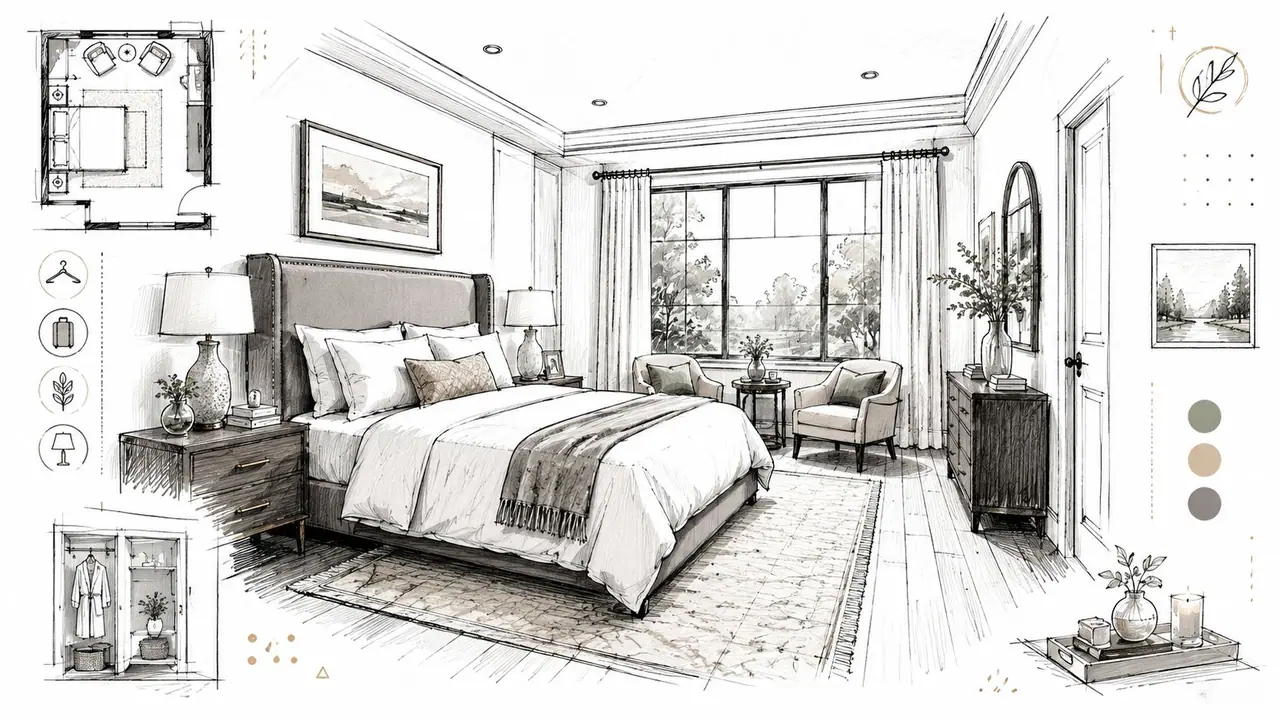
Design for privacy, flow, and housekeeping speed
One owner I advised had a lovely old house with excellent curb appeal. The first draft of the layout gave guests access through the same path used for breakfast prep, linen movement, and owner storage. It looked manageable on paper. In operation, it would have felt chaotic.
Good layout work solves three things at once:
Guest privacy
People want to feel looked after, not watched. Separate owner living areas, staff work zones, and guest circulation wherever you can.Operational flow
Housekeeping should move without dragging carts through social spaces. Breakfast service shouldn't block check-out traffic.Noise control
Plumbing walls, door placement, stair proximity, and flooring choices shape sleep quality more than decor does.
A strong property plan often includes one or two compromises. Maybe a room is slightly smaller so the bathroom works better. Maybe a lounge does double duty instead of becoming a low-use decorative space. Those are usually good compromises if they reduce friction every day.
What strong guest rooms have in common
Guests rarely say, “This room had excellent operating logic.” But they feel it when a room works. The room supports rest, convenience, and small rituals without confusion.
My practical guest room checklist looks like this:
Bed quality first
Mattress comfort, pillow mix, bedding feel, and proper blackout capability matter more than most decorative upgrades.Lighting that supports real use
Separate bedside lighting, useful bathroom lighting, and enough ambient light for reading and packing.Power where guests need it
Easy-access outlets and charging points near the bed and desk or table area.Storage that fits actual stays
Hooks, luggage space, hanging options, and a simple landing place for personal items.Reliable Wi-Fi and clear instructions
Guests shouldn't have to hunt for network details or appliance guidance.
A room earns repeat bookings when it removes tiny annoyances before the guest has to ask.
Bathrooms deserve the same discipline. Strong water pressure, shelf space, towel placement, ventilation, and easy-clean materials beat trend-driven finishes that age badly.
Make the style memorable, not fragile
A good B&B room should have personality. It just shouldn't be so precious that every turnover feels like restoration work.
I prefer a layered approach:
| Design choice | What works | What usually backfires |
|---|---|---|
| Upholstery | Durable, cleanable fabrics | Delicate textiles that spot easily |
| Decor | Fewer meaningful elements | Too many small objects to dust and replace |
| Flooring | Commercially resilient surfaces with warmth | Finishes that show wear immediately |
| Color and mood | Distinct palette tied to the brand | Trend-heavy choices that date fast |
If your concept leans historic, rustic, coastal, or romantic, let that show through a handful of consistent cues. Don't force every surface to perform the theme. Guests want authenticity, not a movie set.
The most profitable room designs usually feel easier than they look. That's the standard to aim for.
Your Marketing Playbook for Driving Direct Bookings
Rooms don't sell themselves. Not even in a strong market. Not even in a beautiful property.
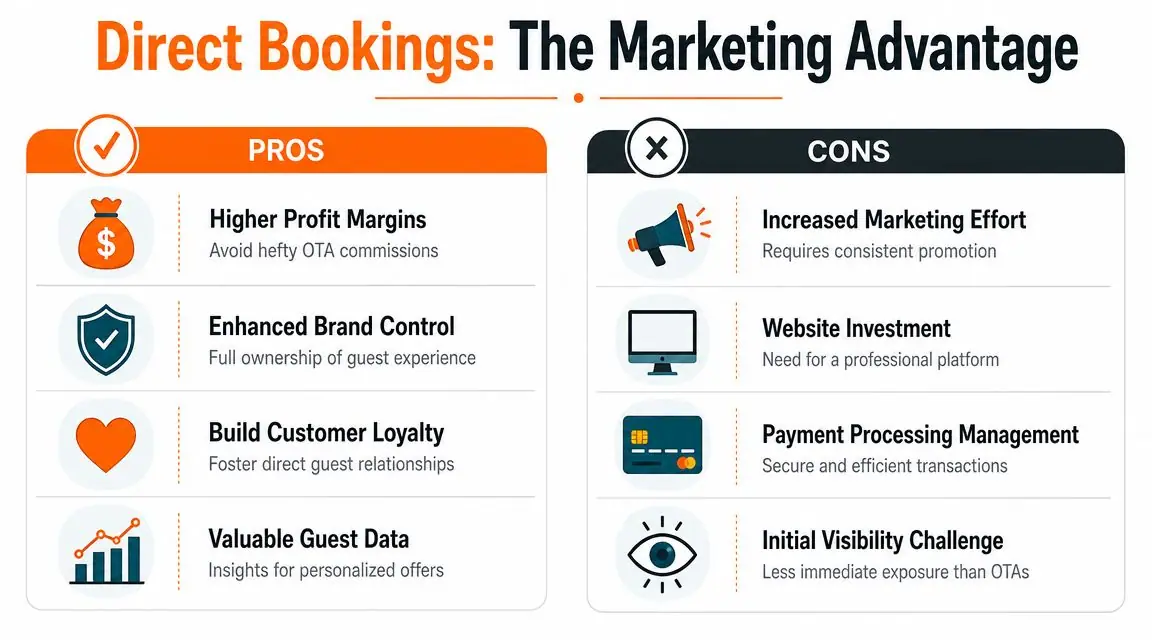
Marketing a B&B is really two jobs at once. First, you need visibility. Second, you need margin. Those goals overlap, but they aren't the same. Channels that help you get discovered can also weaken profitability if you stay dependent on them too long.
Direct bookings and OTAs serve different jobs
One of the better ways to think about launch distribution is this: OTAs are often a visibility engine, while your own website is a profit engine. You need both, but not in equal strategic roles forever.
That distinction matters because, as Hostex notes in its 2026 guide to starting a bed and breakfast, guides often cite startup costs of $20k to $200k+ but fail to model the unit economics, especially how OTA and direct-booking mix affects the ability to cover fixed costs. Smaller properties feel this fast. A few rooms leave less room for distribution inefficiency.
Use OTAs when they help you do one of these things well:
- Launch visibility in a market where nobody knows you yet
- Fill shoulder periods when demand is softer
- Capture search behavior from travelers who won't start on your website
Use direct channels to do the jobs OTAs can't do as well:
- Own the guest relationship
- Present your experience in full
- Retain more of the booking value
- Build repeat business and referral traffic
Here's a concise way to frame the trade-off:
| Channel | Strength | Limitation |
|---|---|---|
| OTA listings | Fast exposure and booking convenience | Less control and tighter margins |
| Direct website | Better brand control and stronger economics | Requires active marketing and better conversion discipline |
To see this balance explained visually, this short video gives a practical overview of hospitality booking strategy.
Build a website that sells the stay
Most B&B websites fail in one of two ways. They're pretty but vague, or informative but lifeless. The site has to convert. That means the guest should understand the stay quickly, trust the property, and know how to book without friction.
A high-converting B&B site usually includes:
Strong photography
Show rooms, bathrooms, breakfast, exterior arrival, and common spaces authentically and well.Clear room differentiation
If every room sounds the same, guests delay booking.Easy booking flow
Fewer clicks. Fewer surprises. Obvious policies.Useful local positioning
Explain what the guest can do nearby and why your location is convenient.
Guests book direct when the website answers the questions they'd otherwise take to an OTA.
Branding matters here too. Your name, visual identity, and tone should fit the guest you want. A romantic countryside inn should not sound like a generic apartment listing. A design-forward town B&B should not look dated online.
Price for season, not for ego
Pricing mistakes usually come from owner psychology. Some price from pride and overestimate what the market will bear. Others price from fear and train guests to expect permanent discounts.
A steadier approach is to set pricing around demand periods, room desirability, booking window behavior, and local events. The property's best room doesn't just need a higher rate. It needs a stronger reason for the guest to choose it.
Use pricing with intent:
- Seasonal variation to reflect demand swings
- Minimum stay rules where they protect revenue or labor
- Packages when they clarify value rather than hide weak room rates
- Direct-booking perks that encourage channel shift without sounding desperate
Email also matters more than many owners expect. Once someone has stayed with you, a thoughtful follow-up and occasional targeted offer can outperform broad social posting. Repeat guests are usually cheaper to win back than new guests are to acquire.
Ancillary revenue streams for a B&B
Small B&Bs often improve margins by adding practical extras that fit the guest journey. The key is relevance. Don't pile on random add-ons. Offer things the guest already wants.
| Revenue Stream | Description | Implementation Method |
|---|---|---|
| Late checkout | Extra departure flexibility for leisure travelers | Offer during pre-arrival and on-property communication |
| Early check-in | Useful for wedding guests or event arrivals | Make availability-based and operationally controlled |
| Transportation support | Airport, station, or local transfer coordination | Partner with reliable local providers |
| Celebration packages | Flowers, beverages, or simple room setup for special stays | Add at booking or pre-arrival |
| Local experience add-ons | Tours, tastings, or activity referrals | Curate trusted partnerships and simple booking steps |
| Premium breakfast upgrade | Enhanced options for select guests or occasions | Limit to formats your kitchen can handle smoothly |
Good ancillary revenue doesn't clutter the stay. It improves convenience and average booking value at the same time.
Streamlining Operations with a Modern Guest Experience
Most B&B owners don't burn out because they dislike guests. They burn out because the same questions, handoffs, and tiny service tasks hit them all day.
Operational strain usually starts with avoidable friction. Guests can't find Wi-Fi details. Check-in instructions are buried in old messages. House rules are explained differently every time. Someone asks how the heating works. Another asks where to park. None of these issues is dramatic. Together, they drain attention.
Remove repeat friction from the stay
A modern guest experience should feel simple from booking to check-out. That means your information is consistent, accessible, and easy to act on. The old paper binder on a dresser rarely does this well. It goes out of date, gets ignored, or creates another thing staff have to maintain manually.
The cleaner setup is digital and mobile-friendly. Guests should be able to access check-in details, Wi-Fi credentials, house guidance, breakfast times, local recommendations, and simple how-to instructions without downloading an app or texting you for basics.
That shift isn't just about convenience. It protects owner time.
A guest experience system is valuable when it prevents interruptions, not when it adds more software for the owner to manage.
Breakfast and housekeeping need operating discipline
Breakfast is one of the defining parts of a B&B. It's also one of the easiest places to create hidden labor stress. If the menu is too broad, timing gets messy. If dietary communication is inconsistent, mornings become reactive. If service style doesn't fit the kitchen and staffing reality, the guest experience suffers.
The same goes for housekeeping. Strong operators rely on repeatable checklists, room reset standards, and maintenance routines that catch issues early. Owners who “just keep an eye on things” usually end up with variable room quality and more last-minute fixes.
A practical operating rhythm includes:
- Pre-arrival clarity so guests know access, timing, and what to expect
- Breakfast systems with prep discipline and manageable service promises
- Turnover standards for room resets, inspections, and supply restocking
- Maintenance tracking for minor issues before they become room outages
Modern guest communication reduces owner fatigue
A digital welcome book is one of the simplest ways to improve consistency. One QR code can give guests instant access to property information, local recommendations, and service options in their browser. That reduces repetitive messaging and creates a smoother arrival experience.
It also opens a better path for upsells. Late checkout, transfers, rental add-ons, and other guest conveniences are easier to present when they're built into the guest information flow instead of added through scattered messages.
If you want a simple way to replace paper binders, reduce repetitive guest questions, and present upsells in a cleaner format, ScanStay gives B&B owners a digital welcome book that guests can open instantly with a QR code. It's a practical upgrade for properties that want a more polished stay experience without adding operational clutter.