Airbnb Co Hosts
Airbnb co hosts - Master Airbnb co-hosts in 2026! Explore responsibilities, fees, legalities, and expert tips to hire or become a successful partner

You're probably in one of two situations right now. Your Airbnb is booking, but it's eating your evenings with guest messages, cleaner coordination, and small emergencies that never happen at a convenient time. Or you're about to hand part of the operation to someone else, and you're trying to avoid the expensive mistake of hiring the wrong person.
That second problem matters more than most hosts realize. A co-host can give you your time back and make the listing run better. A bad co-host can create vague accountability, guest frustration, and a contract you regret signing.
The usual advice doesn't go far enough. It talks about fee percentages and “good communication” but skips the hard part: who shows up when the lock fails, who owns the guest relationship, and how you get out cleanly if the partnership isn't working. That's where most of the risk lives.
Table of Contents
- What Is an Airbnb Co-Host and What Do They Really Do
- Co-Host vs Property Manager Understanding the Key Differences
- The Financials of Co-Hosting Fee Models and Contracts
- How to Find and Hire the Right Airbnb Co-Host
- How to Become a Successful Co-Host
- Essential Tools and Workflows for Co-Host Collaboration
- Is a Co-Host the Right Move For Your Airbnb Business
What Is an Airbnb Co-Host and What Do They Really Do
A co-host runs part or all of the day-to-day operation of an Airbnb listing on the owner's behalf. The owner still holds the account, the legal responsibility, and the final say. The co-host handles the work that keeps the property responsive, guest-ready, and review-safe.
That role is flexible, which is why hosts get into trouble when they hire too loosely. One co-host may only manage messages and the calendar. Another may oversee turnovers, guest issues, maintenance calls, pricing updates, and listing edits. Before hiring anyone, define the job in operational terms, not just by saying you want “help.”
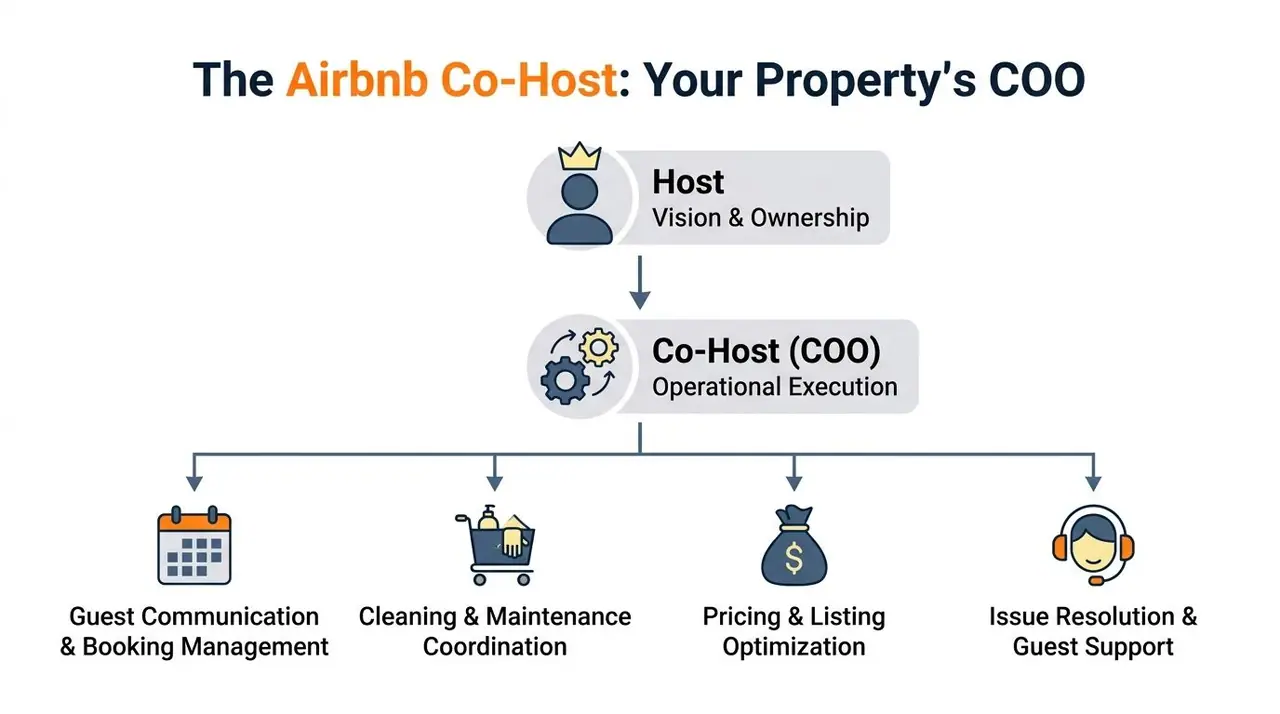
Airbnb's own co-host setup allows different permission levels for different responsibilities, including access tied to messaging, calendar functions, listing updates, or broader account tasks, as outlined in Airbnb's co-host help documentation. That matters more than many new hosts realize. Poor access decisions create avoidable problems. Too much access too early can expose pricing, payouts, and listing settings before trust is earned. Too little access leaves the co-host chasing you for every small change.
The work usually falls into three buckets
The first bucket is guest-facing work. This covers inquiry replies, pre-booking questions, check-in instructions, in-stay issue handling, and review follow-up after checkout. If guests are messaging at 10:30 p.m. because they cannot find the lockbox, this is the part of the job you are handing over.
The second bucket is operations. Here, a strong co-host proves their value. They coordinate cleaners, track supplies, confirm linen turns, catch maintenance issues early, and make sure the property is reset the same way every time. Hosts often underestimate how much of co-hosting is process control, not hospitality.
A reliable cleaning handoff is the foundation of that process. If you're still building that part, it helps to study what dependable vacation rental cleaning services include, because cleaning quality often decides whether the co-host relationship feels organized or constantly reactive.
The third bucket is performance work. This includes adjusting the listing, tightening house rules, refining guest instructions, improving photo order, and spotting repeat complaints before they become a pattern. A co-host who can only answer messages is support. A co-host who can identify weak points in the operation is much more useful over a full season.
Practical rule: Hire for one bucket first, then expand responsibility after a trial period if execution is consistent.
Permissions and safeguards matter more than most hosts think
A co-host agreement goes wrong faster when the scope is vague and the platform access is broad. Match access to the tasks.
Use a setup like this:
- Listing editor access for photo changes, copy updates, and amenity edits
- Calendar and messaging access for communication, reservation coordination, and check-in support
- Full access only after the co-host has shown they can run daily operations without creating cleanup work for the owner
This is also where technical skill vetting matters. Ask the co-host what they would do inside the platform if a guest wants to change dates, if a cleaner reports damage between stays, or if a same-day booking comes in before the unit is ready. Experienced operators answer with steps. Inexperienced ones answer with generalities.
Good co-hosts do much more than reply to guests. They protect response time, keep turnovers on track, and reduce the number of small failures that turn into bad reviews. The safest partnerships start with a narrow scope, a short trial period, and access levels that fit the job.
Co-Host vs Property Manager Understanding the Key Differences
Some hosts use these terms interchangeably. That's a mistake. They may overlap in what they do, but the working relationship is usually very different.
The real difference is control
A traditional property manager often operates like a service company with its own systems, its own staff, and its own decision cadence. A co-host usually works more like a partner attached to your listing, your account, and your preferences.
That distinction changes almost everything. A co-host relationship is often more customizable. You can hire for messaging only, operations only, or full-service support. With a larger management company, the package is more likely to be standardized.
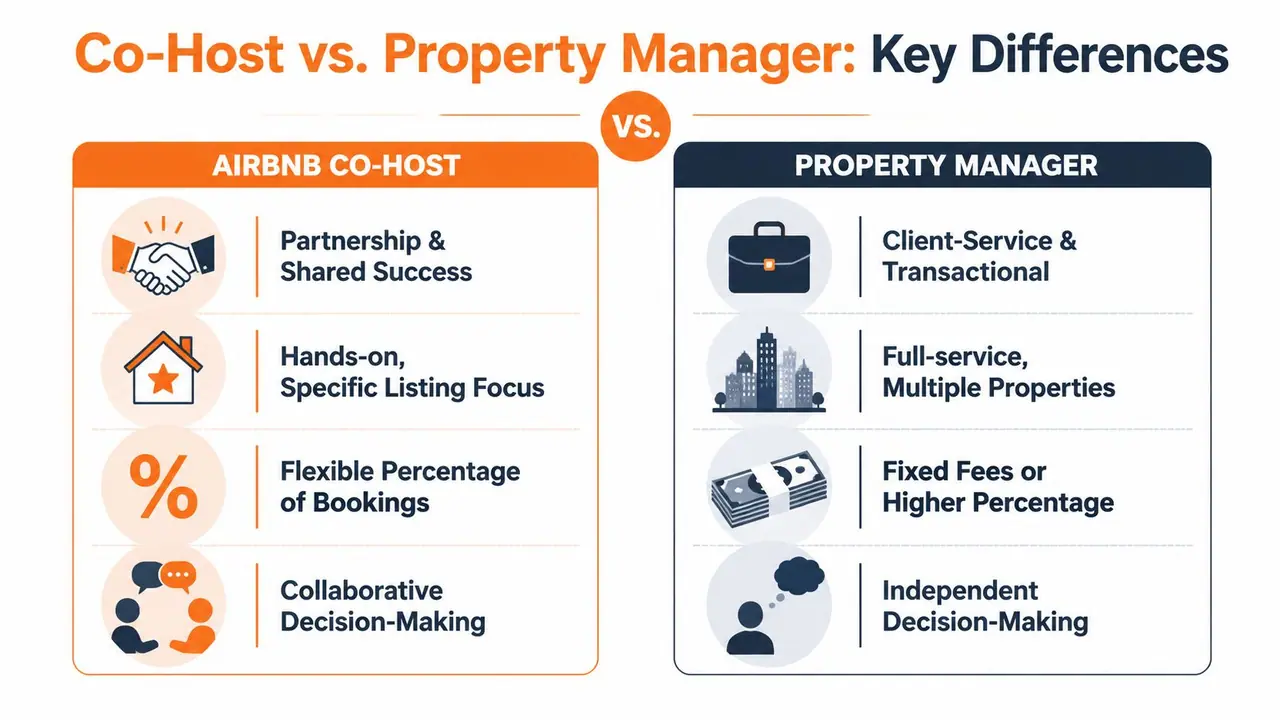
Here's the practical comparison most owners care about:
- Co-host usually means more direct communication with the person doing the work
- Property manager usually means more structure, but sometimes more layers between you and the operation
- Co-host tends to fit owners who want collaboration
- Property manager tends to fit owners who want a more hands-off vendor arrangement
That doesn't mean one is always better. It means the right choice depends on how much control you want to keep.
Performance and fit are not the same thing
Airbnb's own release gives co-hosts a strong performance case. According to Airbnb's announcement of the Co-Host Network and its early performance data, co-hosts on the network average a 4.86-star guest rating, compared with 4.62 stars for large management firms, and 73% of co-hosts have Superhost status.
Those numbers support what many experienced hosts already suspect. Smaller, local operators often handle guest nuance better than larger firms.
But performance averages don't remove the need for diligence. A skilled co-host with poor boundaries can still be a bad fit. A polished management company with rigid systems can still frustrate an owner who wants visibility and flexibility.
A good operator solves your property's problems. A bad one creates new layers between you and the truth.
If you're comparing options, look beyond reviews and commission rates. Look at account ownership, response style, local presence, and how they handle mistakes. If you want a reminder of how oversight failures can spiral, this report on fraud allegations against property managers is worth reading for the governance lesson alone.
The Financials of Co-Hosting Fee Models and Contracts
A host hires a co-host at a low percentage, feels relieved for two weeks, then ends up answering midnight guest messages, approving every refund, and chasing cleaners anyway. That is the expensive version of "cheap."
The first question is not just what a co-host charges. It is what the fee covers, how decisions get made, and how fast you can end the arrangement if performance slips.
What the fee covers
Co-host pricing usually falls into a few familiar bands, but the percentage only means something when it is tied to a defined scope. A lower fee can be fair for guest messaging and calendar oversight. A higher fee can also be fair if the co-host handles turnovers, vendor coordination, maintenance calls, pricing updates, and guest issues without constant owner involvement.
Hosts often compare percentages and miss the labor behind them. A co-host who only replies to inquiries is a different service from one who manages the operating rhythm of the property.
Common Airbnb Co-Host Fee Structures
| Service Level | Typical Fee Range | Common Responsibilities |
|---|---|---|
| Light support | 10 to 20% | Guest messaging, calendar oversight, basic reservation coordination |
| Full service without cleaning | 10 to 20% | Messaging, pricing updates, issue coordination, vendor communication |
| Full service with cleaning | 20 to 30% plus cleaning fees | Guest support, cleaning coordination, turnovers, maintenance responses, day-to-day operations |
Those ranges are common in the market, but they should never stand alone. Two co-hosts can quote the same percentage and deliver very different levels of coverage, response speed, and owner involvement.
That is why smart owners price the contract, not just the commission.
A formal agreement matters more than a polished pitch. If you need a starting point for the legal side, review these practical notes on vacation rental contract terms for hosts and operators before you hand over access.
The contract terms that prevent expensive mistakes
Fee structure matters. Bad contract structure costs more.
The weak point in many co-host agreements is not the commission. It is the lack of exit terms, account control, and operating boundaries. This comes up often in host discussions. In this video on contract rigidity and try-out periods, an experienced host warns against getting locked into a long agreement before the working relationship is proven.
That advice holds up in practice. I would rather pay a slightly higher fee to a co-host on a 60 or 90 day trial than sign a one-year agreement with someone I have never seen handle a bad guest, a missed clean, or a plumbing issue on a holiday weekend.
Your agreement should spell out:
- Who owns the Airbnb account, so listing control never becomes a hostage situation
- What the co-host can approve without asking, including refunds, maintenance spend, discounts, and vendor dispatch
- What reports you receive and how often, especially on payouts, occupancy, pricing changes, and guest issues
- How either side can exit, including notice period, offboarding steps, and transfer of passwords, vendor contacts, and documentation
- Whether there is a trial period, with a clear review point and a simple way to end the arrangement if execution is weak
One more safeguard gets overlooked. Vet technical skill before you agree on money.
A co-host should be able to explain how they handle channel settings, pricing tools, calendar sync issues, message templates, access permissions, and turnover coordination software. If they cannot walk through their workflow clearly, the handoff will be messy no matter how reasonable the percentage sounds.
If the co-host wants to run the listing through their account instead of yours, slow down.
The cleanest setup is simple. You own the listing and the primary account. The co-host operates through defined permissions, documented processes, and a contract that includes an exit path. That protects the revenue, the reviews, and your ability to replace the operator without rebuilding the business from scratch.
How to Find and Hire the Right Airbnb Co-Host
The hiring process is where most hosts get lazy. They pick the person who sounds confident, answers fast, and knows the right Airbnb vocabulary.
That's not enough.
Where to look first
Airbnb made the search easier in late 2024. According to this summary of Airbnb's Co-Host Network launch and reach, the network launched with 100,000 Airbnb listings using co-hosts, covers 10 countries, and includes over 10,000 verified co-hosts. The same source notes that co-hosts must meet standards including a 4.8-star guest rating, a minimum stay history, and a cancellation rate under 3%.
That makes Airbnb's own network a sensible first stop. You're at least looking at people who cleared a baseline.
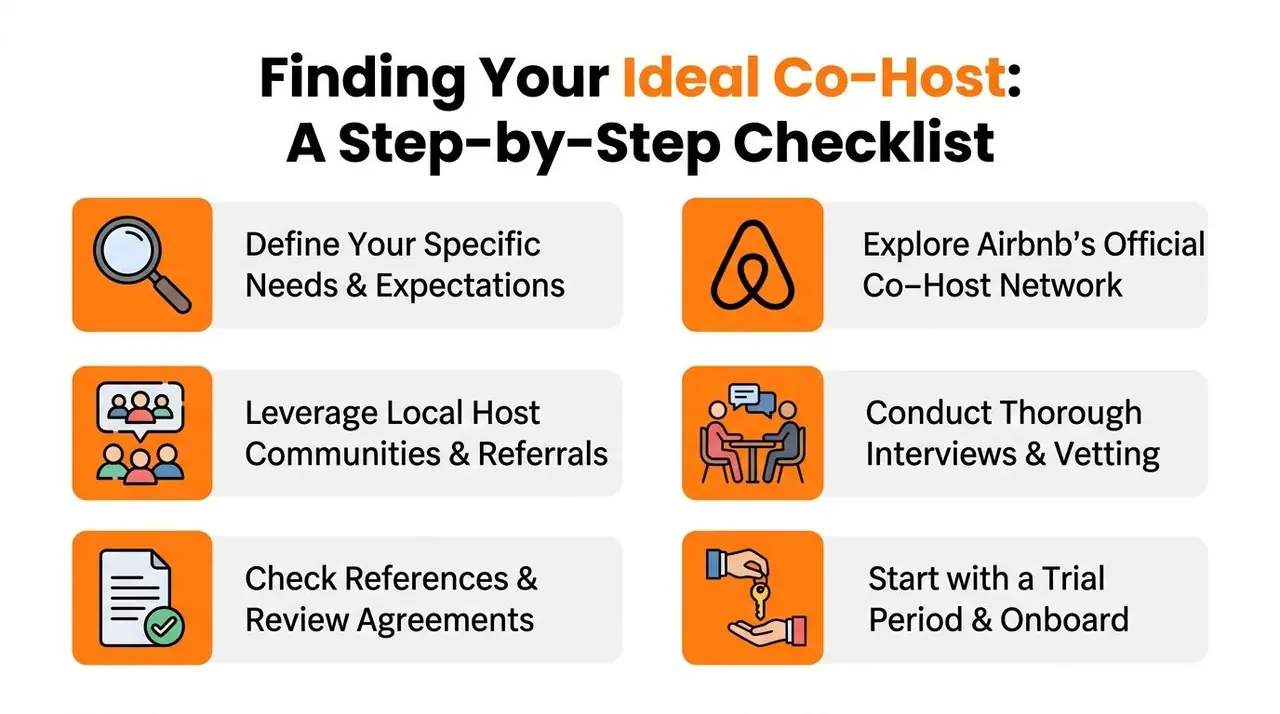
You should also look locally. Good candidates often come from host communities, cleaner referrals, maintenance contacts, and operators already active in your market. If you're entering the space from the operator side, this guide on how to start an Airbnb without owning property is useful background because it shows how many people approach co-hosting as an operating business.
Interview for scenarios, not charm
Here's the hard truth. Many co-hosts are good at selling calm. Fewer are good at handling physical problems.
A strong Reddit discussion among hosts argues that 90% of co-hosting failures stem from unresponsive agents who cannot fix physical issues quickly, and recommends asking blunt diagnostic questions like “What happens when a guest is brain-dead and cannot open the door?” as a way to test real-world problem solving in this host discussion on questions to ask a co-host.
That advice is crude, but useful. You need to test execution under pressure.
Ask scenario questions like these:
- Lockout at night
“A guest is locked out at 10 PM. Walk me through your exact steps.” - Internet failure
“Wi-Fi drops during a guest stay. What can you verify remotely, and when do you dispatch someone?” - Cleaner no-show
“Your cleaner cancels on a turnover morning. What's your backup plan?” - Water leak
“A guest sends a video of water under the sink. What do you do in the first fifteen minutes?”
Look for specifics. Names of backup vendors. Clear decision thresholds. Familiarity with smart locks, breaker panels, internet reboots, and basic troubleshooting. If the answer is mostly about “keeping the guest calm,” keep interviewing.
A helpful overview of the role is below, but don't stop at theory.
A simple onboarding sequence
Once you pick someone, don't dump the whole operation on them in one day.
Use a staged handoff:
- Shadow week
Let them observe messages, turnover timing, vendor habits, and your current weak points. - Limited permissions first
Give messaging or calendar access before full operational control. - Test one emergency path
Run a mock lockout, a mock cleaner issue, or a mock maintenance escalation. - Review after the first guest cycle
Check what they handled well and where friction showed up.
That first month tells you far more than the interview.
How to Become a Successful Co-Host
If you want to become one of the Airbnb co-hosts owners trust, start by dropping the idea that this is mostly about being friendly and replying fast. Those matter. They aren't enough.
Hospitality is only half the job
A successful co-host needs judgment. Owners are handing you a live business with guest expectations, property risk, and thin margins for error.
That means you need to get comfortable with more than messaging. You need to understand turnover flow, vendor reliability, listing accuracy, review protection, and when an issue needs escalation instead of reassurance.
The operators who last tend to do a few things well:
- They communicate clearly with both owners and guests, without flooding either side with noise
- They think in systems so the same problem doesn't happen three times
- They know the local market including cleaner availability, handyman reliability, and emergency logistics
- They document decisions because memory is not a management system
Good co-hosts don't just answer messages. They reduce operational chaos.
Professional standards are strict for a reason
If you want to qualify for Airbnb's network or hold yourself to a similar standard, the bar is not casual. According to Hostfully's guide on co-host eligibility benchmarks and operational standards, a co-host must maintain an average rating of 4.8 or higher, keep cancellation rates below 3%, and host at least 10 stays over the past 12 months to remain eligible. The same guide notes that strong operations require metrics like response times under 1 hour and high cleanliness scores.
Those benchmarks are useful even if you never join the network. They tell you what professional co-hosting looks like.
If you're just starting, build a small track record first. Help a friend or family member with one listing. Document your process. Keep a portfolio of before-and-after listing improvements, guest review themes, and the systems you put in place.
Then pitch like an operator, not a dreamer. Tell owners what you own, what you don't, how you communicate, when you escalate, and how you'd handle a failed lock, a missed clean, or a mid-stay complaint. That level of clarity wins trust faster than polished branding.
Essential Tools and Workflows for Co-Host Collaboration
Even strong partnerships fall apart when the workflow lives in random texts, memory, and screenshots. If the host and co-host don't share one operating rhythm, small issues stack up fast.
Good partnerships run on shared systems
The best setup is boring. That's a compliment.
Guest communication should have one clear home. Task tracking should have one clear home. Vendor updates should have one clear home. When everything is scattered, the host assumes the co-host is handling it, and the co-host assumes the cleaner or handyman already saw the message.
A practical stack usually includes:
- Messaging and notes in one channel so decisions don't disappear in text threads
- Task tracking for maintenance, restocking, and turnovers
- Shared documentation for check-in instructions, appliance quirks, vendor contacts, and house rules
- A software layer for portfolio ops if you're managing multiple listings and need a stronger system than spreadsheets. This overview of affordable property management software is a useful place to compare categories and trade-offs.
The point isn't to build a fancy tech stack. The point is to remove ambiguity.
The workflow that prevents repeated guest questions
Most guest support volume comes from the same small cluster of questions. Wi-Fi. Parking. Thermostat. Check-out steps. Trash. Hot tub. Lock instructions. Appliance confusion.
If those answers live only in your head or in old message templates, the co-host becomes a human search engine. That's a waste of attention.
A better workflow looks like this:
- Write one canonical answer for each recurring question
- Store it in one guest-facing guide
- Make the co-host responsible for keeping it current
- Review support messages monthly and add whatever guests keep asking

That workflow does two things. It cuts repetitive support, and it makes service quality less dependent on one person's memory.
For host and co-host collaboration, I'd also define three recurring check-ins:
- Weekly review of upcoming reservations, pending maintenance, and supply needs
- Post-incident recap after any guest complaint or operational failure
- Monthly performance review focused on review themes, recurring questions, and owner decisions waiting in limbo
The smoother the system, the less your co-host needs to improvise.
That's the goal. Not zero problems. Faster resolution, cleaner handoffs, and fewer avoidable mistakes.
Is a Co-Host the Right Move For Your Airbnb Business
A co-host is the right move when you no longer want to be the bottleneck in your own operation. That might mean you're tired of being on call all the time, or you're ready to treat the listing like a business instead of a side project you manage between other commitments.
But hiring one only works if you treat it like an operating partnership. The right setup has three parts. A clear contract, a co-host who has proven they can solve real on-site problems, and shared systems that keep both sides aligned.
If you skip any of those, the arrangement gets shaky fast. If you get them right, a co-host can help you protect reviews, reduce stress, and make the property easier to scale.
The best hosts don't hand over responsibility blindly. They hand over defined responsibilities, keep ownership where it belongs, and build the relationship so it can succeed or end cleanly.
If you want fewer repetitive guest questions and a cleaner handoff between host and co-host, ScanStay is worth a look. It gives guests one simple digital welcome book for Wi-Fi, check-in details, house rules, local recommendations, and upsells, which helps cut support noise and keeps your operating information in one place.