What Is a Rental Management Group? a Host's Guide for 2026
What is a rental management group and how does it differ from a property manager? Our guide explains services, pricing, and how to choose the right one.
You start with one listing. Then two. Then a third property comes online, and the work changes shape.
The first stage feels manageable because you're still close to every task. You answer guest messages yourself. You know which cleaner prefers text, which handyman reliably shows up, and which lock occasionally sticks. You can hold the whole operation in your head.
Then the portfolio grows and the cracks show. A guest asks for the Wi-Fi code while another reports a drain issue. A cleaner needs approval for extra laundry. A same-day turnover runs late. A pricing update gets missed because you're handling arrivals. What used to feel like hosting now feels like running dispatch, customer support, maintenance coordination, and revenue management at the same time.
That tipping point is where many owners start searching for a rental management group. The problem is that the term gets used loosely. Sometimes it means a local company. Sometimes it means a bundle of services. Sometimes it's just a brand name on a website with very little detail behind it.
That ambiguity matters, because if you're trying to scale, you don't need vague promises. You need an operating model that can absorb more properties without lowering service quality, hurting occupancy, or burning you out.
Table of Contents
- From Host to Overwhelmed CEO
- What Is a Rental Management Group Exactly
- Typical Services and Common Pricing Models
- Management Group vs Property Manager vs Co-Host
- Building Your Own Rental Management Operation
- How to Select the Right Management Group
- Frequently Asked Questions
From Host to Overwhelmed CEO
Most short-term rental operators don't plan to become operators. They plan to become better hosts.
That works until volume turns every small task into a queue. At three to five properties, the issue usually isn't any single disaster. It's the accumulation of routine work. Guest messaging becomes constant. Turnovers need tighter coordination. Vendor follow-up becomes daily. One missed handoff can throw off the whole week.
When the side business stops behaving like one
A lot of hosts reach the same point. Revenue may still look healthy, but the owner's time gets shredded into small interruptions. Morning starts with check-out questions. Midday is cleaner coordination. Evening is pricing review, maintenance follow-up, and guest support. Nights and weekends stop feeling separate from the business.
The shift is psychological as much as operational. You're no longer doing occasional hospitality work. You're carrying an active service system with moving parts, deadlines, and customer expectations.
The warning sign isn't just being busy. It's when the business depends on your memory more than your process.
That's when owners begin looking outward. Some hire a co-host. Some find a local manager. Some try to stitch together freelancers, software, and vendors. Others search for a rental management group without being fully sure what that means.
Why this isn't a niche problem
The reason this question keeps surfacing is simple. Property management is already a large, professionalized business category. One industry projection says the U.S. property management industry will reach $139.9 billion in 2026, with roughly 340,000 businesses operating in the sector according to IBISWorld's U.S. property management industry outlook.
That scale matters because it tells you something practical. The challenge you're facing isn't a personal productivity problem. It's a real operations problem that large numbers of owners and managers have had to solve.
A strong rental management group solves that problem by replacing heroic effort with repeatable structure. A weak one just adds another layer of emails.
What Is a Rental Management Group Exactly
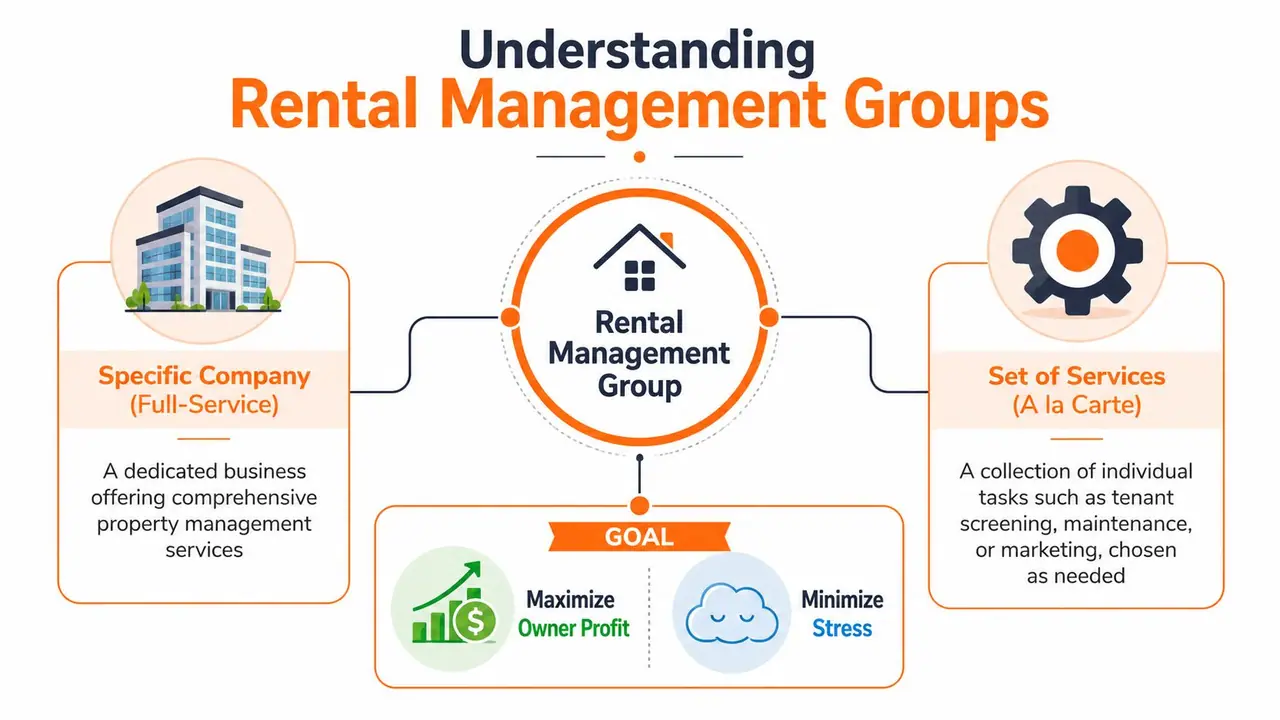
A rental management group is best understood as an operating model. It isn't just a person who helps with bookings, and it isn't just a website selling management services.
Similar to a restaurant group, individual locations may have their own staff and local quirks, but the group handles the systems that make scale possible: standards, reporting, vendor relationships, training, pricing logic, and brand consistency. Rental operations work the same way.
Why the term confuses owners
Part of the confusion comes from search behavior. The phrase can point to a specific company name or to the broader property-management category, and many search results are brand pages with very little operational detail. That's why owners often leave those searches without a clear answer about scope, systems, or fit, as noted in this discussion of the term's ambiguity.
That confusion creates bad decisions. Owners compare unlike things. They treat a booking helper, a solo manager, and a full-service operating company as if they're interchangeable. They aren't.
What a real group looks like
A true group has centralized control where it counts and local execution where it matters. That usually includes:
- Standard operating procedures: The group doesn't improvise every check-in, turnover, or maintenance issue.
- Shared vendor management: Cleaners, maintenance teams, inspectors, and support staff work within defined expectations.
- Unified reporting: Owners can see the business through the same metrics across properties.
- Portfolio thinking: Decisions get made at the portfolio level, not just unit by unit.
- Brand discipline: Listings, guest communication, and service standards feel consistent.
The difference is structural. A service provider completes tasks. A management group designs the system those tasks live inside.
Practical rule: If the company can't explain how it handles communication flow, maintenance escalation, and performance review across multiple properties, it's probably not operating like a group.
That distinction matters whether you're hiring one or building one. If you define the term too loosely, you'll accept marketing language in place of operating competence.
Typical Services and Common Pricing Models
A rental management group earns its fee through operating control. The question is not whether it can answer messages or schedule cleanings. The question is whether it can run revenue, service, maintenance, and reporting as one system without losing handoffs.
That matters because this term gets used too loosely. Some companies sell a list of tasks. A real group owns the workflow those tasks sit inside. In practice, that means one booking or tenancy can move from inquiry to arrival, stay, turnover, repair follow-up, payout review, and owner reporting without confusion about who is responsible at each step.
ManageCasa's explanation of rental management workflows is useful here because it frames the work as an operating process, not a menu of disconnected services.
The service stack that actually matters
In a functioning group, services usually fall into four operating lanes:
- Revenue and listing control: pricing, listing quality, calendar rules, channel distribution, and booking restrictions
- Guest or resident communication: inquiry response, screening where relevant, check-in details, in-stay issue handling, and review or renewal follow-up
- Turnover and maintenance operations: cleaning schedules, inspections, restocking, repair dispatch, vendor follow-through, and status tracking
- Finance and compliance administration: payout reconciliation, owner statements, bill approval, lease or house-rule enforcement, and documentation
The trade-offs show up between those lanes. Push occupancy too hard without enough turnover capacity and service quality drops. Let maintenance tickets sit in text messages instead of a tracked system and small issues turn into refunds, bad reviews, or larger repairs. Send owner statements late and the relationship gets harder to keep, even if bookings are strong.
That is why I look for handoff discipline before I look at the service list.
One practical test works well. Follow a single reservation or lease through the entire cycle and ask who owns each step, what system records it, and how exceptions get escalated. Owners comparing providers can also review this guide to vacation property management responsibilities and systems to see how the operating pieces fit together.
How pricing models shape behavior
Pricing is not just a cost line. It tells you what the operator is being paid to prioritize.
The three structures you will see most often are:
- Percentage-based management fees: usually tied to collected rent or booking revenue. This aligns the operator with top-line performance, but owners need clear definitions for what the fee includes.
- Flat monthly fees: easier to budget and sometimes a better fit for stable properties. The downside is weaker incentive alignment when revenue rises or falls.
- Hybrid pricing: a base management fee plus separate charges for leasing, maintenance coordination, after-hours calls, inspections, or revenue management.
None of these models is automatically better. A percentage fee can look aligned and still become expensive if every operational task carries an extra charge. A flat fee can protect margin for the owner and still produce poor execution if the group is understaffed. Hybrid models can work well for mixed portfolios, but only if the add-ons are defined in writing.
The useful question is simple: what behavior does this fee structure reward?
A good operator should be able to answer that clearly. If they cannot explain what is included, what triggers extra charges, how vendor markups are handled, and how reporting is delivered, the pricing model is not the main problem. The operating model is.
Management Group vs Property Manager vs Co-Host
These models get blended together all the time, and that causes expensive hiring mistakes. Owners bring in a co-host when they need operating depth. Or they hire a traditional manager when they really need a portfolio system. Or they sign with a booking-focused agency that doesn't want responsibility for on-the-ground execution.
Rental Management Models Compared
| Model | Typical Scope | Best For | Common Pricing |
|---|---|---|---|
| Rental management group | Centralized operations across multiple properties, with systems for communication, vendors, reporting, maintenance, and revenue oversight | Owners with a growing portfolio who need consistency and scale | Usually a management fee tied to revenue or rent, sometimes with hybrid add-ons |
| Traditional property manager | Day-to-day oversight of one property or a smaller local portfolio, often with stronger emphasis on leases, collections, and maintenance administration | Long-term rental owners who want local management without building their own process | Commonly a percentage-based fee or a monthly management charge |
| Co-host | Guest-facing help, light coordination, check-ins, messaging, and local support | Single-property hosts or owners who still want hands-on control | Usually a share of booking revenue or a negotiated service fee |
| Booking-focused rental agency | Marketing, listing exposure, distribution, and reservation generation, with limited operational accountability | Owners who already have operations covered but want more bookings | Commission or booking-related fee structure |
Where owners make the wrong choice
The easiest mistake is hiring for relief instead of hiring for fit. Relief is emotional. Fit is operational.
A co-host can be excellent when the owner still controls the business and just needs help with guest communication or turnover coordination. But co-hosting usually breaks down when vendor management, reporting, and maintenance oversight start spreading across multiple properties.
A traditional property manager can be the right answer for residential rentals where lease administration, rent collection, and compliance are the main job. If you're exploring more hands-off ways to enter the space, this article on starting an Airbnb without owning property shows why the operating model matters as much as the property itself.
Hiring the wrong model doesn't usually fail on day one. It fails in the handoffs. Nobody knows who owns pricing, no one closes the maintenance loop, and the owner becomes the default escalation path again.
A rental management group earns its keep when complexity rises. If your business has enough moving parts that standardization matters, a loose arrangement won't hold for long.
Building Your Own Rental Management Operation
Some owners don't want to hire a group. They want to become one.
That can work well, but only if you stop thinking like a host and start building like an operator. The core shift is this: every repeated task needs a documented owner, a defined trigger, and a visible outcome.

Start with legal structure and authority
If you're managing properties for others, informal arrangements won't protect you for long. You need the right legal entity, written agreements, payment flows, and local compliance review before you scale the portfolio.
Property management isn't just communication and scheduling. California's Department of Real Estate describes the role as establishing rental schedules, merchandising space, collecting rent, supervising repairs and maintenance schedules, and handling related compliance, contractor verification, and payroll systems in many contexts, as outlined in the California DRE property management reference guide. The main lesson is operational breadth. This work touches money, contracts, vendors, and legal exposure.
Build operating rules before you add people
Most early-stage operators hire too soon and document too late. That creates dependency on whichever cleaner, assistant, or coordinator happens to know the history.
Start by writing SOPs for the moments that break most often:
- Arrival issues: Late check-in, smart-lock problems, parking confusion, missing access info
- Turnover control: Cleaner checklists, damage documentation, supply restock, escalation timing
- Maintenance triage: What counts as emergency, who approves spend, who updates the guest or owner
- Owner reporting: What gets sent, how often, and who reviews exceptions
The most important operating rule is the link between pricing and service readiness. Rent-setting or nightly-rate strategy can't live in isolation from maintenance responsiveness. If you push rates aggressively but can't support fast issue resolution, you create vacancy risk, review drag, and retention problems. If you overbuild maintenance response without pricing discipline, income gets squeezed.
Use technology to reduce repeat work
A strong stack doesn't replace management. It removes avoidable repetition.
Most growing operators need, at minimum, a PMS, channel management, messaging automation, task coordination, and guest information delivery. If you're evaluating systems, this overview of affordable property management software options is a useful starting point for comparing how the pieces fit together.
Video can help when you're designing repeatable guest communication and property instructions:
Don't overcomplicate the stack early. What matters is that your tools support one source of truth for tasks, one standard for communication, and one clear audit trail when something goes wrong.
How to Select the Right Management Group
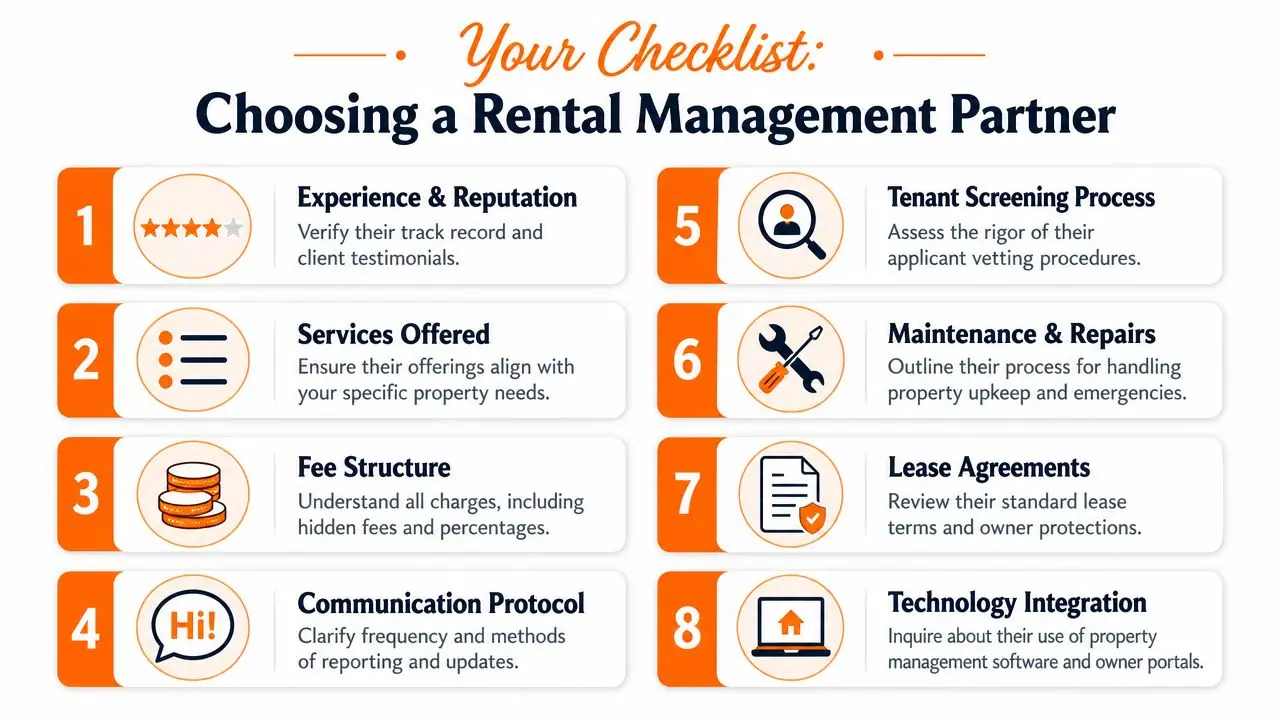
Selection gets easier once you stop treating a rental management group like a vague vendor category. The term gets used loosely. Some companies are sales-first leasing shops, some are individual property managers with light admin support, and some are actual operating groups with systems that can absorb volume without losing control.
That distinction matters during due diligence.
A good group should explain how work moves through the business. Who owns the handoff from inquiry to booking, from booking to check-in, from maintenance issue to resolution, and from month-end close to owner reporting. If the answers stay at the level of "we communicate well" or "we handle everything," keep pushing.
Questions That Expose Operational Reality
Ask for evidence, not reassurance.
- How do you report performance to owners? Ask to see an actual report with commentary, not just a dashboard screenshot.
- Which operating metrics do you review every month? Strong teams can answer immediately and explain what actions those numbers trigger.
- How do you handle after-hours maintenance? Look for an escalation path, response standard, and vendor process.
- Who can approve repairs, and what are the spending limits? Approval authority should be documented before a problem happens.
- What software runs your daily operation? A scattered mix of texts, calls, and memory usually breaks under scale.
- How do you keep communication consistent across properties and team members? This shows whether service quality depends on one strong employee or an actual operating standard.
- What happens when something falls outside the normal workflow? Good groups have exception handling. Weak ones improvise every time.
A polished website will not tell you whether the company can handle a fully booked Friday, a same-day repair, a chargeback dispute, and an owner asking why revenue missed forecast.
What to verify before you sign
This part is less about charm and more about inspection. Ask for sample documents. Read the management agreement closely. Test how specific the company is when discussing staffing, escalation, and controls.
Three areas usually separate disciplined groups from fragile ones.
First, check reporting quality. Owner statements should be easy to read, tied to actual operating activity, and supported by a clear review process for exceptions or unusual charges.
Second, check process ownership. If turnovers, pricing changes, repair follow-up, and guest issue resolution all seem to float between different people, accountability will drift the same way.
Third, check bench strength. If every answer leads back to one founder, one market lead, or one superstar coordinator, the operation has key-person risk.
Red flags you should take seriously
Some problems show up fast. Others only become obvious after a few months of missed handoffs and unclear billing.
Watch for these:
- Vague scope: They say they manage everything but cannot define who owns inspections, vendor follow-up, pricing updates, or guest recovery.
- Blurry pricing: The base fee sounds clean until extra charges show up for onboarding, inspections, emergency coordination, lease-up work, or vendor markup.
- No sample documentation: If they cannot produce checklists, reports, approval rules, or incident logs, the operation probably lives in staff memory.
- No discussion of controls: Good operators talk about approvals, audit trails, and service standards. Weak ones talk only about responsiveness.
- Overreliance on one person: A business that depends on one operator usually struggles when portfolio size increases or that person leaves.
The best groups often sound a little boring. That is usually a good sign. Clear roles, documented workflows, and consistent reporting protect assets better than a charismatic sales call ever will.
Frequently Asked Questions
Do rental management groups need a license?
Sometimes yes, sometimes no. It depends on location, lease structure, and which activities the company performs. If a group is handling rent collection, leasing activity, contracts, or regulated real estate functions, licensing rules may apply. Owners shouldn't guess. Ask exactly which activities the group performs and have local counsel or a qualified licensing authority confirm the requirements.
What contract terms matter most?
Don't focus only on headline fees. Read termination clauses, notice periods, repair authorization rules, exclusivity language, owner-use restrictions, and who controls listings, photos, and guest data if the relationship ends. Good contracts reduce friction because everyone knows what happens when performance slips or ownership plans change.
Will a management group increase my net revenue?
Sometimes, but that's the wrong expectation to treat as automatic. A strong group can improve execution, reduce mistakes, tighten communication, and protect occupancy or collection. But fees, maintenance discipline, and service standards all affect the result. Ultimately, the test is whether the group runs the property better than you can run it yourself at your current scale.
If you want one simple filter, use this: hire a group only if it removes operational load and improves control. If it does one without the other, keep looking.
If you're trying to run a cleaner, more scalable short-term rental operation, ScanStay helps replace scattered guest messages and paper house manuals with a digital welcome book guests can open instantly from a QR code. It's a practical way to standardize property information, reduce repetitive questions, and create a more professional guest experience across one unit or an entire portfolio.