Booking vs Expedia: A Host-Focused Guide for 2026
Booking vs Expedia: Which platform is better for hosts? This 2026 guide breaks down fees, guest quality, tools, and payment policies to help you choose.
You're probably looking at two tabs right now. One has Booking.com's setup flow. The other has Expedia Partner Central. Both promise reach, both can fill nights, and both can become a daily source of friction if they don't match the way you run your property.
That's the part most comparisons miss. Hosts don't live inside a spreadsheet. You live inside calendars, payment timing, guest messages, review disputes, no-show edge cases, and the awkward moment when a guest expects hotel-style flexibility from a short-term rental that can't offer it. The question in Booking vs Expedia isn't which logo is bigger. It's which platform creates the least operational drag for the kind of stay you sell.
I've seen hosts choose an OTA based on a headline commission discussion, then regret it once the first few reservations come in. Suddenly the issue isn't visibility. It's payout timing, mismatched expectations, weak guest communication, or support that feels fine until something goes wrong on check-in day.
Table of Contents
- The Host's Dilemma Choosing an OTA Partner
- Market Power and Hidden Business Models
- Fees Commissions and Payment Policies Compared
- Guest Demographics and Booking Patterns
- Host Tools Support and Integrations
- Listing Optimization and Reputation Management
- The Verdict Building Your OTA Strategy
- Frequently Asked Questions for Hosts
The Host's Dilemma Choosing an OTA Partner
It is 9:40 p.m. A guest messages that they are arriving late, another reservation needs a date change, and your weekend occupancy still has gaps. In that moment, the primary question is not which OTA is bigger. It is which one creates bookings your team can handle profitably.
Small hosts often start with demand. Multi-unit operators usually start with workload. Both are looking at the same problem from different angles, because an OTA is not just a marketing channel. It shapes payment flow, guest communication, cancellation risk, and how many manual fixes your staff handles in a week.
That difference shows up fast.
A city apartment chasing short booking windows may do well on a channel that produces volume and review velocity. A vacation rental built around longer stays, family travel, or package demand may perform better on a channel tied more closely to the broader trip plan. The wrong choice does not just reduce revenue. It creates extra support tickets, more calendar friction, and more time spent cleaning up preventable issues.
OTA performance is not only about how many reservations arrive. It is about how many arrive cleanly, pay out predictably, and stay manageable from booking to check-out.
Hosts often compare Booking.com and Expedia as if they solve the same problem in the same way. They do not. One can feel faster, noisier, and more demanding day to day. The other can feel more structured, but sometimes less flexible and less dynamic on pure listing momentum. Those differences affect response workload, payment control, guest expectations, and how much trust your team places in each reservation before the guest even arrives.
Early comparison table for hosts
| Factor | Booking.com | Expedia |
|---|---|---|
| Company structure | Part of Booking Holdings | Part of Expedia Group |
| Network effect for hosts | Often feels stronger on visibility and review accumulation | Often benefits from ecosystem demand tied to broader trip shopping |
| Inventory breadth | Very large global accommodation supply | Large travel marketplace with stronger cross-sell exposure across brands |
| Review environment | Heavy review volume can help good operators gain traction faster | Review volume may build more gradually depending on property type and market |
| Day-to-day operational feel | Fast pace, broad reach, more edge cases to manage well | More standardized guest journey in many cases, with trade-offs in flexibility |
| Best fit | Hosts who want reach, frequent demand, and can handle tighter operational discipline | Hosts who benefit from package-oriented demand and a more ecosystem-driven booking path |
The practical decision is rarely either-or forever. Many experienced hosts use both, then adjust inventory, pricing, and rules based on which platform brings cleaner revenue, lower support load, and fewer payment surprises. That is the standard worth using. Not headline visibility alone, but how each booking behaves once it lands in your PMS or inbox.
Market Power and Hidden Business Models
A host sees this difference on a bad day first. A guest wants to change dates at 9 p.m., your front desk needs a clean answer, and the reservation path determines whether your team can solve it in two minutes or spend half an hour chasing approval through an OTA workflow.
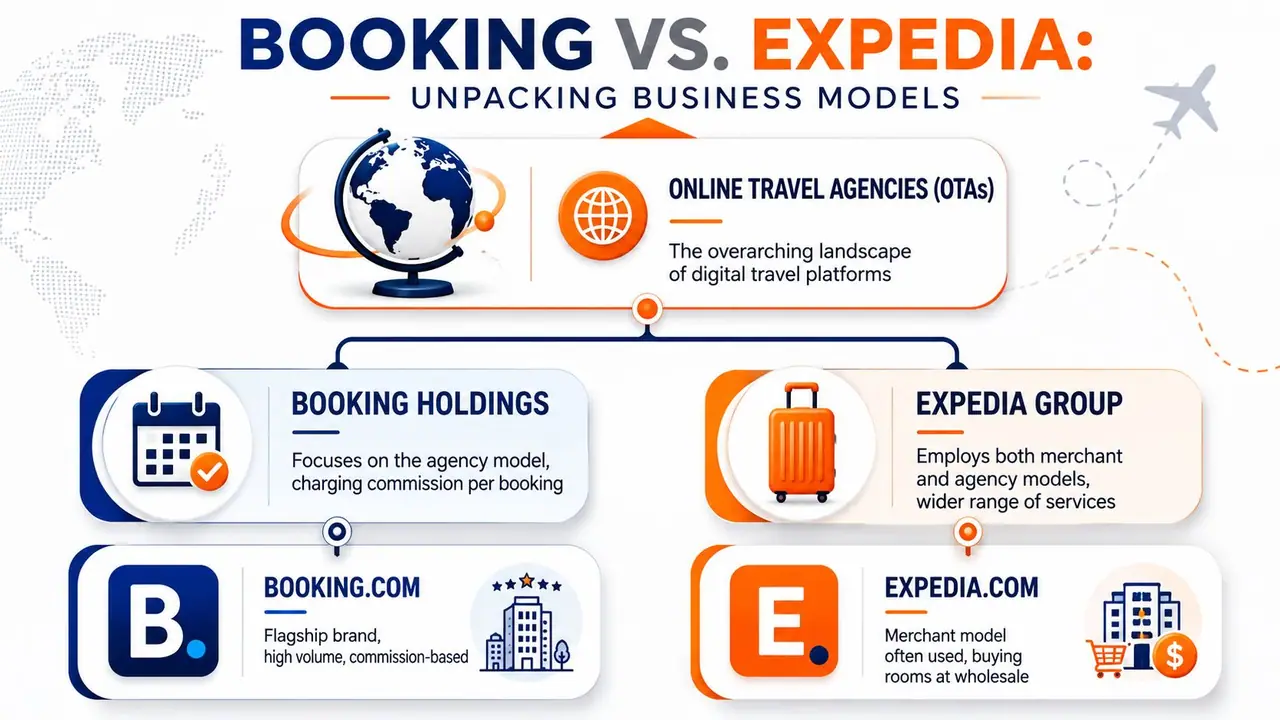
Booking.com and Expedia both deliver scale, but they do not sit in the booking flow the same way. That matters more than brand size. It affects who controls the money, who controls the guest communication, and who your staff needs to contact when something goes wrong.
Why the business model shows up in daily operations
The cleanest way to evaluate these platforms is to stop treating them as simple demand sources. They are operating systems layered on top of your property.
A useful breakdown from Digital Biz Models' analysis of OTA business models explains the broader distinction. One model gives the platform a tighter role in the transaction itself. The other leans more toward distribution and aggregation. In practice, hosts feel that difference in four places.
- Changes and cancellations: The more the OTA sits inside the transaction, the less freedom your team usually has to fix a reservation on the spot.
- Refund ownership: Staff need to know whether they can authorize a solution directly or whether the guest has to go back through the platform.
- Guest messaging: Guests often contact the property expecting direct help, even when the OTA still controls the booking terms.
- Rate and package pressure: Expedia's ecosystem is often tied more closely to bundled travel demand, while Booking.com often behaves like a high-volume accommodation marketplace first.
That last point gets overlooked. Expedia does not just sell rooms. It sells trips. That can be useful in markets where flights, cars, and packages drive demand, but it also means your room can become one component inside a larger purchase the guest barely separates from the platform. Booking.com usually feels closer to pure accommodation distribution, which can create faster booking velocity but also a wider mix of guest types and edge cases.
For operators, the daily trade-off is simple. Booking.com often feels faster and more exposed. Expedia often feels more structured and more mediated.
Neither model is automatically better.
A city apartment manager with same-day turns may prefer the channel that creates fewer modification layers and clearer guest communication. A resort or destination stay can benefit from Expedia's trip-shopping environment, especially if package demand brings in guests who were not searching for the property directly. The right answer depends on what your team handles well under pressure.
What this means for hosts
Market power matters because bigger platforms shape guest expectations. Business model matters because it shapes your workload. Those are related, but they are not the same decision.
Hosts lose money when they judge an OTA only by visibility and ignore transaction design. If a platform sends strong volume but creates constant exceptions, slow amendments, and unclear payment responsibility, that cost shows up in payroll, review risk, and front-desk fatigue. If a platform sends slightly less volume but cleaner bookings, many teams will run more profitably on it.
The useful test is operational, not theoretical. Check which channel produces reservations your staff can understand quickly, modify with less friction, and reconcile without hunting through support threads. That is where the hidden business model stops being hidden.
Fees Commissions and Payment Policies Compared
A reservation comes in at 9:12 p.m. Housekeeping is already assigned. At 9:26 p.m., the guest asks to change dates. By the next morning, your team is checking whether the OTA collected payment, whether a virtual card will still match the new stay value, and who is responsible for the refund difference. That is the core fee conversation.
Commission matters. Daily cash handling matters more once you are managing payroll, owner statements, damage deposits, and cancellation exceptions at scale.
Side by side payment reality
| Area | Booking.com | Expedia |
|---|---|---|
| Core financial trade-off | More flexibility in how payment collection and property policies are set up | More standardized payment handling in many setups |
| Cash flow consideration | Often better for hosts who want tighter control over collection timing and guest charges | Often better for teams that want a platform-managed payout rhythm |
| Reconciliation workload | Ranges from clean to messy depending on Payments by Booking setup, virtual cards, and PMS mapping | Often more consistent, but still creates work when itinerary changes or package bookings affect accounting |
| Refund friction | Usually easier when policy ownership is clear, harder when payment method and policy setup do not match | Often slower because the OTA sits in the middle of the refund conversation |
| Best fit | Operators who want control and can handle exceptions well | Teams that value standardization and accept less flexibility |
The table is broad on purpose. OTA payment terms change by market, contract, property type, and integration. The same channel can feel manageable in one setup and expensive in another once finance and operations start dealing with real bookings.
What actually changes your margin
Start with five checks before you compare headline commission:
Who takes the guest payment?
This decides who handles failed cards, chargebacks, no-shows, and incidental collections.How fast do funds clear?
Payout timing affects payroll, cleaner pay runs, owner distributions, and how much cash buffer you need.What happens when a booking changes after confirmation?
Date edits, partial cancellations, and shortened stays create the most finance noise. They also expose weak PMS mappings fast.How do discounts hit the final payout?
Mobile rates, preferred-program visibility boosts, package discounts, and sponsored promotions can lower net ADR more than hosts expect.How many exceptions need manual review?
Every unmatched virtual card, payout shortfall, and refund discrepancy costs staff time.
Small operators often tolerate more payment variation because one person can keep the logic in their head. Larger teams cannot. They need repeatable rules, clean exports, and fewer exceptions.
Booking.com versus Expedia in the back office
Booking.com usually gives hosts more room to choose how they want to handle payment, policies, and guest-side collection. That control can help if your team is disciplined and your PMS accounting is configured correctly. It can also create inconsistency across listings if different units, managers, or legacy settings use different payment rules.
Expedia often feels more controlled from the platform side. Some operators prefer that because it reduces policy drift across the portfolio. The trade-off is that changes, refunds, and special cases can take longer to resolve because more of the transaction sits inside Expedia's process rather than yours.
Neither model is cheaper by default.
The better model is the one your staff can reconcile without opening three dashboards and a support case. If you want a clearer view of channel-level net revenue, payout timing, and booking quality by source, use vacation rental analytics that break down OTA performance before you commit more inventory.
What works in practice
What works:
- Map the payment flow before launch. Your bookkeeper should be able to explain every step from reservation to payout to refund.
- Test one property first. A live pilot exposes more than any onboarding call.
- Write internal rules for cancellations and changes. Guest messaging, front desk actions, and finance handling should match.
- Audit net payout, not just booked revenue. The gap between the two is where channel costs hide.
What does not work:
- Choosing based on commission alone
- Assuming OTA-collected payments remove accounting work
- Running promotions without checking the post-discount payout
- Letting each property use different payment settings without controls
The healthy channel mix is not always the one with the lowest visible fee. It is the one that sends demand your team can process cleanly, collect reliably, and reconcile without draining hours out of every week.
Guest Demographics and Booking Patterns
Friday at 6 p.m., two reservations hit at once. One guest booked a city apartment for tomorrow and messages immediately about self check-in, luggage storage, and whether early arrival is possible. The other booked a resort unit for next month as part of a broader trip and asks about parking, pool hours, and how far the property is from local attractions. Both bookings fill nights. They do not create the same work.
That difference shows up every day in operations.
Booking.com usually sends a broader mix of travelers. In practice, that often means more international guests, more short stays, more last-minute demand, and more bookings driven by price, reviews, and flexible policies. Hosts who depend on urban demand, shoulder-season occupancy, or weekday fills often feel that pattern quickly.
Expedia often behaves differently. The booking is more likely to sit inside a planned trip, especially in leisure markets where guests are comparing flight, hotel, car rental, and destination convenience at the same time. Those guests can arrive with clearer travel dates and a more fixed itinerary, but they also tend to judge the stay as one part of the overall trip, not a standalone purchase.
For hosts, the question is not which audience sounds better. It is which audience your team handles better.
A Booking.com-heavy property usually needs fast response habits, tight availability controls, strong review momentum, and a listing that answers practical questions before the guest asks them. Check-in instructions, bed setup, cancellation terms, and arrival logistics need to be easy to scan. If they are vague, conversion drops and pre-arrival messaging volume climbs.
An Expedia-heavy property often benefits from a different setup. The listing has to support trip planning. Parking, family fit, beach or attraction access, transit, breakfast, and on-site amenities matter because guests are often evaluating the whole stay in the context of a destination plan. Good copy helps, but operational clarity helps more.
Here is the pattern I see most often:
- Booking.com tends to reward speed and flexibility. Short lead times, policy clarity, and review recency matter more.
- Expedia tends to reward trip-fit. Destination appeal, amenity packaging, and convenience signals matter more.
- Booking.com can create more edge-case communication. Late arrivals, special requests, and same-week changes show up more often for many hosts.
- Expedia can produce more expectation management around the full trip. Guests may compare your property against the broader package experience they booked around it.
That affects staffing. It affects messaging load. It affects how often your team spends time explaining basics that should have been clear in the listing.
If you want to compare these patterns against your own properties, track lead time, length of stay, cancellation rate, and message volume by channel in one dashboard. This vacation rental analytics breakdown for hosts and managers is a useful starting point if you want to see which OTA brings profitable bookings and which one creates extra work.
Support expectations matter here too. A guest base that books faster and asks more pre-arrival questions puts pressure on response time. Teams using automation for FAQs, arrival details, and service recovery can reduce that load. Halo AI's guide to customer service is worth reviewing if your front desk or guest experience team is stretched.
A full calendar can still be a bad month. The stronger channel is the one that sends guests your property can host well, your staff can support without friction, and your margins can absorb.
Host Tools Support and Integrations
A platform can look strong on paper and still wear your team out. That usually comes down to two things. The first is the host dashboard. The second is what happens when you need help fast.
Booking.com's Extranet and Expedia Partner Central both do the job, but they don't feel the same in daily use. Some hosts prefer one because it exposes more controls. Others prefer the other because it feels more structured. There isn't a universal winner. There is only the better fit for your workflow.
Dashboard experience and daily management
Extranet often rewards hosts who are willing to get into the details. That's useful if you like adjusting policies, room setups, availability rules, and promotions with a high level of control. The downside is that more control can mean more places to make mistakes.
Partner Central often feels more guided. That can help teams who want a cleaner operating rhythm. The trade-off is that “cleaner” sometimes means less freedom in edge cases.
What matters most is whether your team can answer these questions quickly:
- Can we update restrictions without hunting through menus?
- Can we verify payment status without switching systems?
- Can a new staff member learn the platform without constant supervision?
If the answer is no, the platform becomes expensive even when bookings are strong.
Support quality matters more during exceptions
Hosts rarely judge support on an ordinary day. They judge it when a guest can't access the property, when a reservation detail is wrong, or when a cancellation dispute turns urgent.
That's why internal process matters as much as platform support. Teams that rely on canned replies and scattered notes struggle more, especially across multiple OTAs. If you're tightening response workflows, Halo AI's guide to customer service is useful because it focuses on how support systems reduce repetitive communication and speed up issue handling.
For operators scaling across channels, software choice matters too. A channel manager or PMS should reduce duplicate work, not add another dashboard nobody trusts. If you're reviewing your stack, affordable property management software for growing portfolios is a sensible place to compare what helps versus what just adds features.
Integrations separate hobby hosting from real operations
The more listings you manage, the less this becomes a “which OTA is better” question and the more it becomes a systems question.
Look for:
- Reliable calendar sync: Double bookings destroy trust fast.
- Consistent message handling: OTA inboxes are manageable at one property and painful at scale.
- Reservation data quality: You need booking details to land cleanly in your PMS, not half-complete.
Good integrations don't save time once. They save time every day, in small ways your team stops noticing.
A host with one listing can survive imperfect tooling. A manager with a portfolio can't.
Listing Optimization and Reputation Management
Most hosts spend too much time tweaking headlines and not enough time improving conversion signals. On these platforms, the strongest listings usually aren't the cleverest. They're the clearest.
Start with the listing basics. Your first photos should answer three questions immediately: what the place feels like, who it suits, and why the guest should trust it. Then your copy should remove hesitation. Parking. Check-in method. Bed setup. Noise reality. Stairs. Pet rules. Don't make guests dig.
Why Booking.com reviews change the game
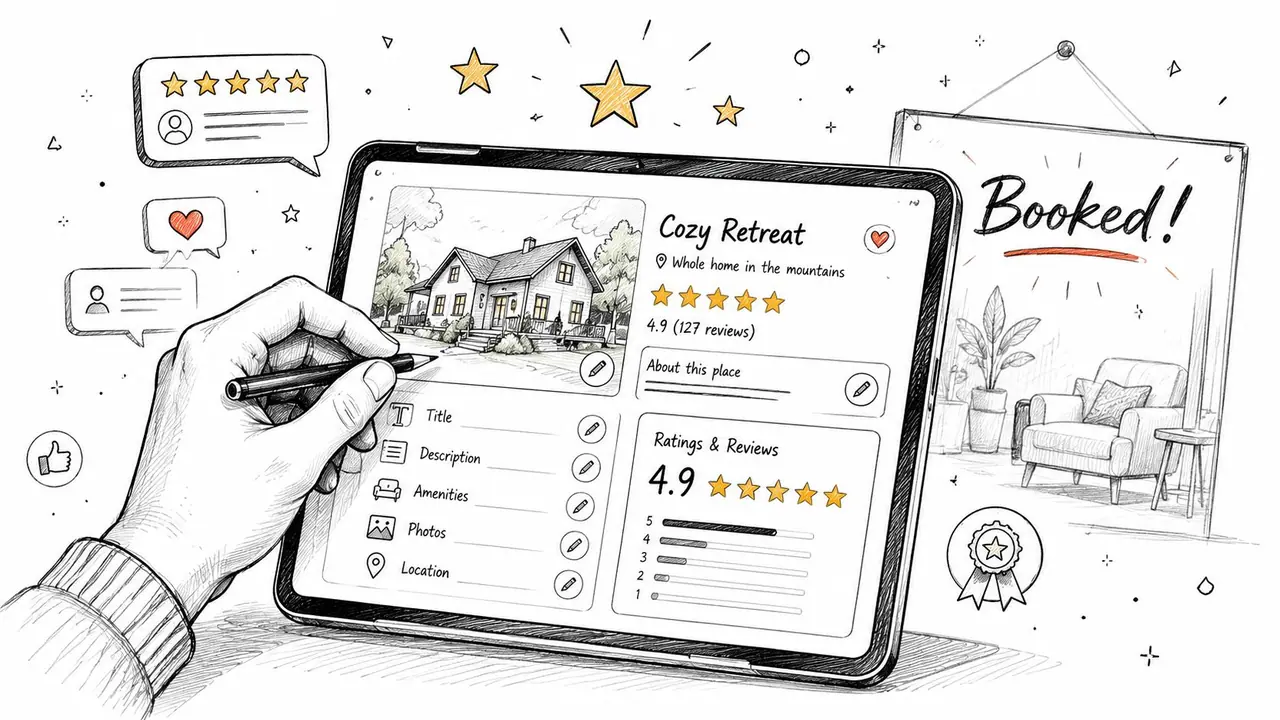
Booking.com has a major advantage in review volume. It generates approximately 39% of all global hotel reviews, while Expedia generates about 5%, creating an 8:1 ratio, according to DoNotStay's comparison of Booking.com and Expedia review ecosystems. For hosts, that means social proof usually compounds faster on Booking.com.
That matters because reviews don't just reassure guests. They also sharpen your operating decisions. If three recent guests mention unclear parking directions, that's not a branding problem. It's an instruction problem.
Practical optimization moves that work
- Lead with your strongest conversion photo: Don't open with a close-up of decor. Open with the space guests are choosing.
- Write for objections, not adjectives: “Self check-in after 4 PM” beats “perfect for modern travelers.”
- Match amenity settings to reality: If the listing promises something ambiguously, support tickets will fill the gap.
- Reply to reviews with operational intent: Future guests read them, but your team should also mine them for recurring friction.
If you need a broader framework for handling feedback across platforms, managing online reviews for businesses is worth a read because it treats reviews as an operating system, not a vanity metric.
A lot of the same discipline also applies across channels. If you're refining listing content and trying to improve conversion generally, practical ways to increase Airbnb bookings can help you tighten your photo order, descriptions, and trust signals without overcomplicating the listing.
Reputation management is mostly pre-arrival management
Most bad reviews begin before check-in. They start with unmet expectations.
Use your OTA messaging to confirm the details that most often cause disappointment:
- Arrival instructions
- What's included and what isn't
- Any non-obvious rules
- What to do if plans change
This walkthrough is useful if you want to tighten the basics before adjusting pricing or promotions:
Better reviews usually come from clearer setup, not better apologies.
On Booking.com, faster review accumulation means small fixes can show up in your reputation sooner. On Expedia, every review tends to carry more weight because the pool is smaller. Either way, consistency beats hacks.
The Verdict Building Your OTA Strategy
Most hosts shouldn't ask “Which platform is best?” They should ask “Which platform fits my property, my team, and my guest type with the least friction?”
Here's the short version.
Use Booking.com when reach is the main priority
Choose Booking.com first if you run city stays, guesthouses, or inventory that benefits from broad global exposure. It usually makes sense when you want stronger listing momentum, wider traveler reach, and faster social proof.
It's also a practical fit if your operation can handle faster booking pace and more varied guest profiles.
Lean into Expedia when trip context matters
Expedia can be the better priority when your stay is part of a larger vacation decision. Resort areas, family destinations, and properties that benefit from bundled travel behavior often fit well here.
If your team prefers a more standardized channel rhythm, that can matter just as much as demand.
For many hosts, the smart answer is both
Using both channels works well when you have clean systems. It doesn't work well when your team is already stretched thin.
The long-term opportunity isn't just filling nights. It's creating a path from OTA guest to repeat direct guest. OTAs often operate under rate parity, but hosts can still offer fenced perks like free breakfast, late checkout, or added flexibility to direct bookers, as explained in this OTA explainer on direct booking perks and parity. That's one of the few reliable ways to reduce dependence on high-friction channels over time.
A practical distribution strategy often looks like this:
- Use OTAs for discovery
- Use your guest experience to earn repeat business
- Use direct perks to make the next stay more attractive
If you also market beyond OTA search, it helps to think in channel terms instead of platform terms. Call Loop's travel agency advertising tips are useful here because they frame promotion around audience fit and message clarity, not just spending more.
The best OTA strategy is rarely loyalty to one platform. It's disciplined use of each one for what it does well.
Frequently Asked Questions for Hosts
Can I list on both Booking.com and Expedia at the same time
Yes, and many hosts do. The issue isn't whether you can. It's whether your calendars, rates, and restrictions stay synchronized well enough to avoid double bookings and messy manual corrections.
Do I need a channel manager
If you manage more than one property, or even one property across multiple OTAs, a channel manager usually becomes worth it fast. Manual updates are workable until the day they aren't. One missed date change can create hours of cleanup.
Does rate parity mean I can't offer a better direct deal
Not exactly. You may need to keep the public room rate aligned, but you can often package value differently through fenced perks. Think late checkout, breakfast, parking help, or better flexibility. The direct offer doesn't always need to be cheaper to be better.
Which platform is better for last-minute occupancy
That depends on your market and listing quality. In practice, hosts often find that broad-visibility channels help more with short-notice gaps, while package-oriented demand can be less reactive. The only reliable answer is the one in your own booking history.
Which one is easier to manage
For a single property, either can work. For a portfolio, the easier platform is the one that fits your PMS, your team habits, and your support process.
If you want OTA guests to have a smoother arrival, ask fewer repetitive questions, and become more likely to book direct next time, ScanStay helps you deliver one clean guest experience across every channel. It replaces paper binders and scattered messages with a mobile-friendly digital welcome book, gives guests a simple QR code for everything they need, and helps hosts present direct-booking perks in a polished way after the OTA stay is already won.