Hiring an Airbnb Property Manager: The Complete 2026 Guide
Is an Airbnb property manager worth it? This guide covers fees, responsibilities, and provides a hiring checklist to help you decide and find the best manager.
Your phone keeps buzzing. A guest can't find the Wi-Fi password. The cleaner says the last checkout ran late. Someone wants an early check-in. Someone else says the coffee machine stopped working. Meanwhile, you're supposed to be at dinner, at work, or asleep.
That's the point where many hosts realize they don't own a passive income asset. They've built themselves a second job.
A lot of profitable short-term rentals reach this stage. The issue isn't that the property is failing. It's that success creates operational drag. More bookings mean more messaging, more turnovers, more maintenance coordination, more review management, and less margin for mistakes. If you're planning to grow beyond a single easy-to-reach unit, hiring an Airbnb property manager becomes less about convenience and more about operating discipline.
That matters in a market this large. The global short-term vacation rental market was valued at $149.2 billion in 2025 and is projected to reach $362.4 billion by 2033, with a projected 11.8% CAGR according to Grand View Research's short-term vacation rental market report. Bigger market, more listings, more competition. Hosts who run loosely usually feel that pressure first.
If you're still deciding whether to keep self-managing or hand operations over, this guide to Airbnb hosting basics is a useful starting point. But if you're already getting traction and feel the business pulling you into daily operations, the question isn't “Should I pay a manager?” It's “Will this manager produce a return I can verify?”
Table of Contents
- Introduction Is Your Airbnb Becoming a Second Job
- What an Airbnb Property Manager Actually Does
- Understanding Property Management Fee Structures
- Co-Hosting vs Professional Property Management
- When Should You Hire a Property Manager
- Your Hiring Checklist and Key Interview Questions
- Reduce Workload and Boost Revenue with Smart Tools
- Conclusion Making the Right Choice for Your Property
Introduction Is Your Airbnb Becoming a Second Job
A new multi-property host usually hits the same wall in stages.
First, the work feels manageable. One listing, a few messages, a cleaner you trust, a notes app full of check-in instructions. Then occupancy improves. Weekend stays stack up. Guests start asking the same questions at all hours. A minor maintenance issue turns into a same-day problem because another arrival is already on the calendar.
That's when the hosting business stops being casual.
An Airbnb property manager steps in when the owner can no longer rely on memory, goodwill, and improvisation. If you're coordinating cleaners from your phone, answering guest messages between meetings, and hoping nothing breaks on a back-to-back turnover day, you're already operating with too little slack. The stress isn't just personal. It affects reviews, response speed, pricing discipline, and owner profit.
Practical rule: If your rental only works when you are constantly available, you don't have a system yet. You have a dependency.
That's why professional management has become a scaling decision, not just a rescue move. In a larger, faster-moving STR market, the hosts who stay profitable are usually the ones who separate ownership from daily execution. Some do it by building an internal team. Most do it by hiring outside help.
The hard part is that the term “Airbnb property manager” covers a wide range of operators. Some run sharp systems. Some mostly answer messages and mark up vendor invoices. Some are worth every dollar. Some undermine margin.
The rest of this guide is built around that reality. Not just what managers do, but how to tell whether their fee is justified by measurable results.
What an Airbnb Property Manager Actually Does
A real Airbnb property manager doesn't just “handle guests.” They run the property across revenue, hospitality, logistics, compliance, and owner reporting. If they do only one of those well, you still end up doing cleanup somewhere else.
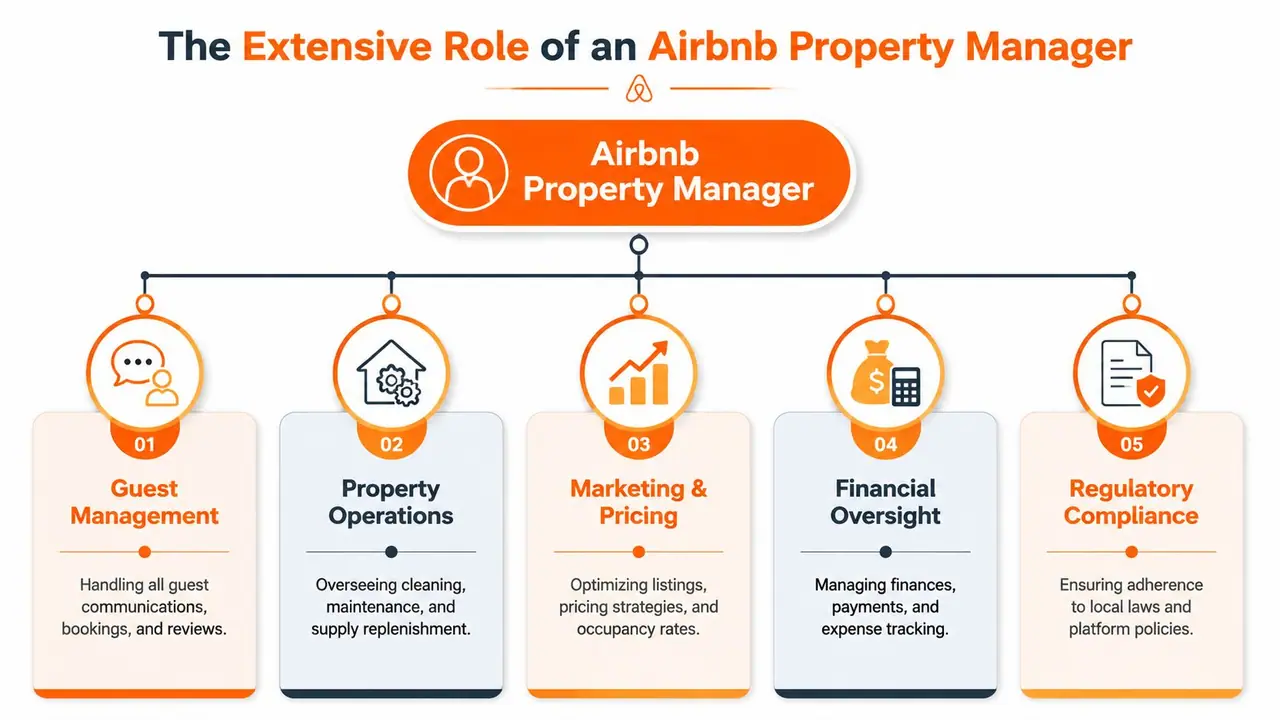
Revenue work that affects booking quality
The best managers start before the guest even books. They shape the listing, set the rate strategy, adjust minimum stays, monitor calendar gaps, and keep the property positioned correctly against local competition. Good pricing isn't just “charge more on weekends.” It's constant adjustment based on pace, demand, and booking window.
They also protect listing quality. That includes photos, title, amenities setup, and copy that filters in the right guests instead of just chasing raw inquiry volume.
A serious manager should be able to explain:
- How they price using dynamic pricing tools and local benchmarks
- How they optimize listings when conversion is weak
- How they measure performance by property type, not by portfolio averages
Guest operations that protect reviews
Many owners underestimate the workload. Guests don't experience your spreadsheet, your margin target, or your vendor issues. They experience response time, clarity, cleanliness, check-in simplicity, and how fast someone fixes problems.
Airbnb's one million-plus Superhosts collectively earned $23 billion in one year, and Superhosts earned 64% more on average than regular hosts according to Key Data Dashboard's Airbnb growth analysis. That's the clearest financial argument for operational excellence. Better hosting standards don't just feel professional. They pay.
The manager's job is to prevent avoidable friction. Most bad reviews start with small failures that weren't handled fast enough.
Strong managers build repeatable guest processes for pre-arrival instructions, check-in support, issue escalation, review handling, and post-stay follow-up. Weak ones rely on ad hoc texting and apologizing after the fact.
Maintenance compliance and owner reporting
Operations are where a manager either earns trust or burns it.
Turnovers need to happen on time. Cleaners need checklists. Supply restocking needs controls. Repairs need approval rules. Safety items need routine checks. For owners with multiple homes, inconsistency proves costly. One missed turnover photo, one unreported leak, one rushed cleaner, and your “hands-off” setup starts costing more than self-management.
For preventive upkeep, I often recommend owners review a structured resource like this ultimate home upkeep checklist. Not because a manager should outsource thinking to a checklist, but because homes used like hotels degrade faster than owner-occupied homes. Preventive routines reduce emergency spend and review damage.
A professional manager should also provide clean financial visibility. At minimum, owners should know what was booked, what was spent, what was approved, and what operational issues need attention. If reporting is vague, the management relationship usually gets worse over time.
Understanding Property Management Fee Structures
A manager quotes 25%. On paper, that sounds expensive. In practice, the right question is whether that 25% buys more net income, fewer owner hours, and fewer preventable mistakes than you can get on your own.
That is the transparency problem with short-term rental management. Plenty of managers can explain their fee structure. Fewer can show why their fee improves the business.
How managers usually charge
Most Airbnb property managers use three pricing models. The label matters less than the scope, approval rules, and how expenses are handled after you sign.
| Fee Model | Typical Cost | Best For | Key Consideration |
|---|---|---|---|
| Commission-based | A percentage of booking revenue, often in the range many full-service STR managers discuss publicly, such as in this breakdown of vacation rental management pricing from Hostfully | Owners who want the manager tied to top-line performance | You need a line-by-line list of what is included versus billed separately |
| Fixed-rate | Flat monthly or per-service pricing | Stable properties with predictable workload | Budgeting is easier, but the manager may have less upside tied to revenue growth |
| Hybrid | Base fee plus commission or separate operational charges | Owners who want partial support with defined extras | The contract needs clear boundaries or small charges pile up fast |
Commission pricing is common because it sounds aligned. Sometimes it is. Sometimes it is just a high percentage attached to a weak operation.
A commission model works best when the manager controls pricing, listing quality, guest communication, turnover standards, and vendor response times. If you still approve every repair, chase cleaners, and step in for guest issues, you are paying a premium without getting full operating coverage.
Fixed-rate pricing can make sense for simple units, long average stays, or owners who keep pricing and owner decisions in-house. Hybrid models can also work, especially for hosts building systems across multiple units. For operators exploring portfolio growth without owning every asset, this guide on how to start an Airbnb without owning property gives useful context on where partial management structures fit.
Judge the fee by ROI, not by the headline percentage
A 15% fee can be overpriced. A 30% fee can be justified.
The difference is measurable return.
If a manager raises occupancy by improving listing quality and response speed, increases average daily rate through tighter pricing controls, reduces refunds through better guest communication, and prevents sloppy turnover problems that lead to bad reviews, a higher fee may leave you with more money at the end of the month. If none of that happens, even a low fee is expensive.
Ask for evidence in four areas:
Performance on comparable properties
Ask for examples from similar homes in your market, not a luxury cabin two states away. Bedroom count, location, seasonality, and guest profile all matter.Operational improvements tied to money
Better review scores matter because they protect conversion. Faster issue resolution matters because it reduces refunds and keeps small problems from becoming expensive ones.Clear owner reporting
Request a sample monthly statement. You should be able to see management fees, cleaning pass-throughs, maintenance charges, and any markup on vendor work.Scope and exception handling Ask what happens when a guest breaks a smart lock, stains linens, checks out late, or causes a same-day turnover delay. In such situations, cheap contracts often become expensive ones.
Here is the practical test I use with owners. Estimate what the manager should improve over a six-month period: revenue, review score, response times, issue resolution, and owner hours saved. Then compare that gain against the full management cost, including add-ons, maintenance coordination fees, and any contract lock-in. If the manager cannot explain that math, the quote is incomplete.
Owner lens: Judge the fee on net income, time saved, and operational control. Percentage alone tells you very little.
A manager does not earn their fee by being busy. They earn it by producing a better result than your current system.
Co-Hosting vs Professional Property Management
A lot of owners use these terms interchangeably. They shouldn't.
A co-host is usually a task partner. A professional manager is an operating company. That distinction matters once the property starts behaving like a business instead of a side project.
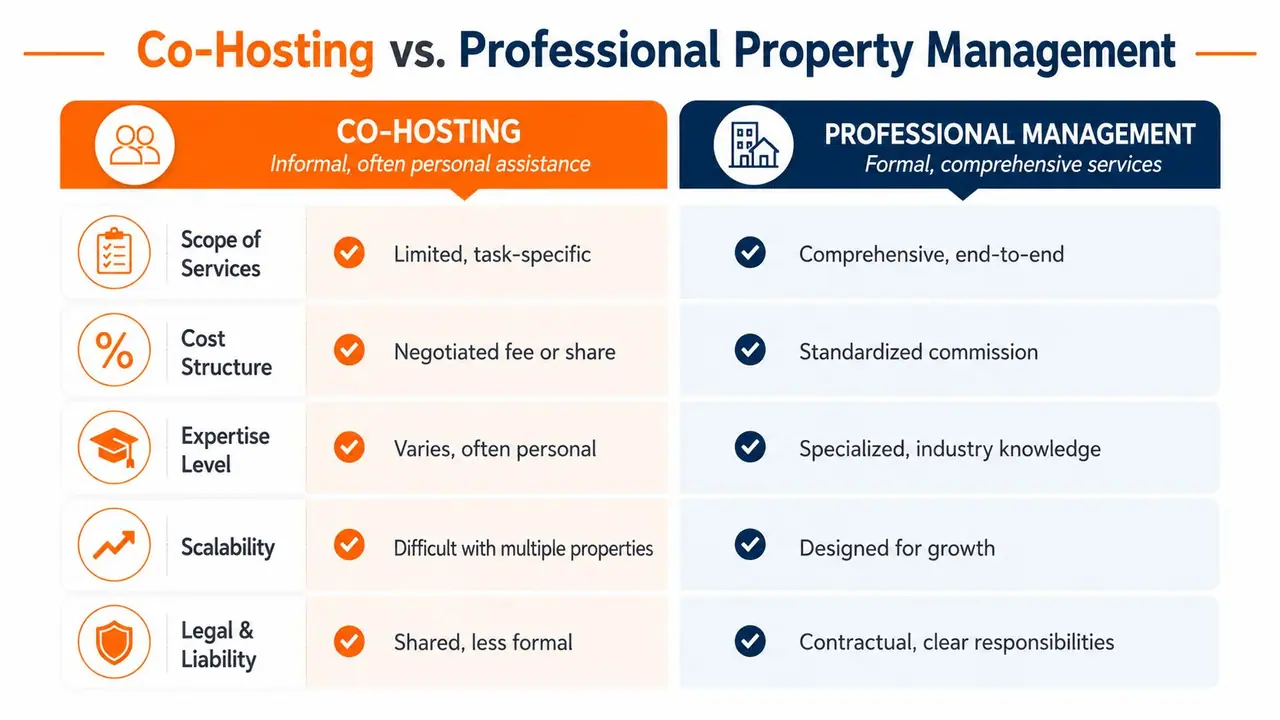
Where co-hosting works well
Co-hosting fits owners who still want meaningful control. Maybe you want help with guest messaging, turnovers, and local handoffs, but you still handle pricing, owner decisions, supply standards, and vendor approvals.
That can work well if:
- You live nearby and can still step in when needed
- You only have a small portfolio and complexity is limited
- You want flexibility rather than a formal full-service contract
A solid co-host can be a good bridge between self-management and professional outsourcing. For hosts exploring lean portfolio growth, this guide on starting an Airbnb without owning property gives useful context on how operators build systems before taking on more units.
Here's a practical walkthrough that helps frame the decision from another angle:
Where professional management wins
Professional management becomes the better option when you need reliability, documentation, and scale. That usually means multiple listings, remote ownership, stricter compliance needs, or a simple lack of time.
The biggest differences aren't cosmetic. They show up in how the work gets done.
| Decision Area | Co-Hosting | Professional Management |
|---|---|---|
| Control | Owner usually stays close to daily decisions | Owner delegates most operational decisions within contract limits |
| Service scope | Often limited or customized informally | Usually structured across guest, ops, pricing, and reporting |
| Accountability | Personal trust matters heavily | Contract, processes, and business systems matter more |
| Scalability | Can get messy as properties increase | Better fit for standardized multi-unit operations |
If you want to preserve a hobby-style hosting experience, co-hosting can work. If you want the property to perform consistently without your daily involvement, a professional manager is usually the cleaner answer.
When Should You Hire a Property Manager
This decision is rarely about one dramatic moment. It's usually a pattern. You start noticing that the business only runs smoothly when you're constantly available.
That's the signal.
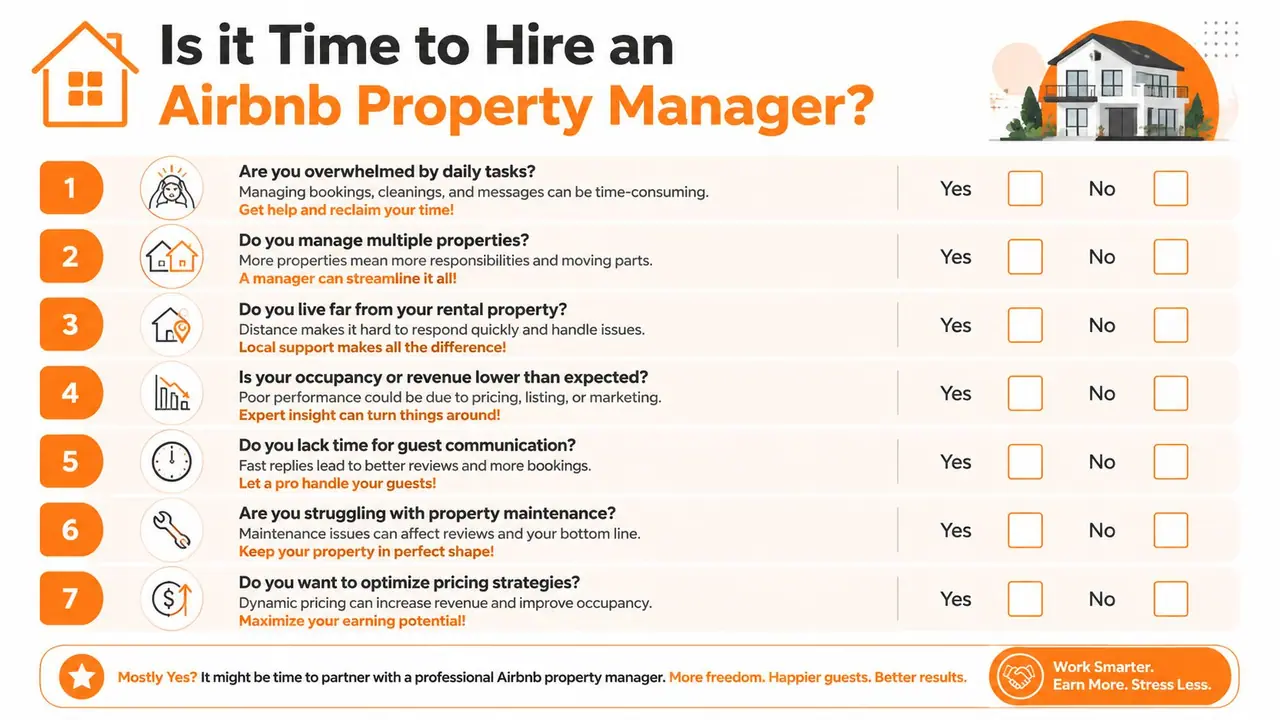
The yes hire signals
If several of these sound familiar, you're likely past the point where DIY hosting is efficient:
- You manage multiple properties and each new listing adds coordination load faster than it adds clarity.
- You live far from the rental and every small issue turns into a vendor call, a favor, or a stressful delay.
- Guest communication keeps interrupting your day because inquiries, check-ins, and support requests don't respect business hours.
- Maintenance has become reactive instead of planned. You're solving problems after guests notice them.
- Revenue feels soft and you don't know why because pricing, calendar settings, and listing presentation aren't reviewed systematically.
- You want the income without the operating role and you're honest that you no longer want to be on-call.
Owners often struggle here because they think hiring help means “giving up control.” Usually it means replacing informal control with actual process. That's often an upgrade.
For a broader mindset on deciding what to do yourself versus what to delegate, The Green Advantage insights on DIY or hiring a pro are useful. The core lesson applies well to STRs. Tasks that look cheaper to keep in-house often become expensive when they pull your time into repeated low-value work.
If you're the backup plan for every task, you're still the manager whether you admit it or not.
When waiting still makes sense
You don't need a manager just because hosting is busy.
It can still make sense to self-manage if you have one nearby property, enjoy the hospitality side, and have dependable cleaners and vendors already in place. It can also make sense if you're still learning your market and want firsthand understanding before handing over pricing and guest operations.
What doesn't make sense is pretending you're choosing self-management when you are trapped in it. If the business is expanding and your systems aren't, the handoff point is getting closer.
Your Hiring Checklist and Key Interview Questions
The wrong manager usually sounds good in the first call. They talk about “maximizing revenue,” “taking stress off your plate,” and “handling everything.” None of that tells you whether they're competent.
The hiring process gets sharper when you evaluate them like an operator, not like a service vendor.
How to vet beyond the sales pitch
Start with their live footprint, not their homepage.
Look at active listings they manage. Read recent reviews. Check whether the tone is consistent across properties. Pay attention to cleanliness complaints, check-in friction, and repeated mentions of slow communication. Those comments tell you more than a brochure ever will.
Then review the contract with a pencil, not optimism.
Use this short checklist:
Service scope
What exactly is included in the management fee? Messaging, pricing, turnovers, inspections, maintenance coordination, owner reporting, permit handling?Expense controls
What can they approve without you? How are repair decisions documented? Is there a markup on vendor work?Termination terms
Can you exit cleanly if performance drops, or are you trapped in a long notice period with operational friction?Data access
Do you keep access to listing accounts, reviews, guest history, and performance reporting?Communication cadence
How often will they report issues, discuss strategy, and review results with you?
Interview questions that reveal real competence
Good managers track numbers because they run repeatable systems. Weak managers avoid specifics and talk in generalities.
Avantio notes that top managers should be able to discuss RevPAR, ADR, and Occupancy Rate for comparable properties, and that owners should ask directly for those figures when vetting candidates in their guide to Airbnb performance metrics.
Ask questions like these:
- What are your average RevPAR, ADR, and Occupancy Rate for properties comparable to mine in this area?
- How do you adjust pricing when booking pace slows?
- What's your process for handling a negative review and preventing repeat issues?
- How do you verify cleans between stays?
- Who handles guest issues after hours, and is that team in-house or outsourced?
- How do you manage owner approvals for repairs and replacements?
- What does your monthly owner report include?
- What would you change in my listing first, and why?
A manager who can't discuss property performance in metrics usually isn't managing from data. They're managing from habit.
Also ask for references from owners with similar homes, not just any owner in their portfolio. A beach house, urban studio, and large family cabin don't behave the same way operationally.
The goal isn't to find the friendliest pitch. It's to find the manager whose systems hold up when the property is busy, a guest is upset, and the cleaner is running behind.
Reduce Workload and Boost Revenue with Smart Tools
Software will not save a bad operation. It will make a good one easier to run and easier to measure.
That distinction matters if you are comparing self-management to hiring an Airbnb property manager. A manager fee looks more reasonable when the manager is supported by systems that reduce labor, prevent missed steps, and improve booking performance. Without that infrastructure, you may be paying a percentage for work that could have been handled with a better operating stack.

What good automation changes
The first breakdown in a growing portfolio is usually consistency. Check-in instructions live in message threads. Cleaners text updates in one app, maintenance uses another, and guests keep asking the same five questions. Owners often blame staff, but the root issue is usually poor system design.
Zeevou explains in its guide to scaling Airbnb property management that operators need centralized workflows as they grow, especially across guest communication and day-to-day operations. That is the right lens for evaluating tools. The question is not whether a platform has a long feature list. The question is whether it removes repeatable work without creating more oversight for you.
The most useful tools usually fall into a few categories:
- Channel managers and PMS platforms to sync calendars, rates, reservations, and team workflows across listings
- Dynamic pricing tools to adjust rates based on demand, pace, seasonality, and local competition
- Messaging automation to send scheduled pre-arrival, in-stay, and checkout communication
- Task and turnover software to assign cleans, flag delays, and document completion
- Smart locks, noise monitors, and device controls to reduce access issues and protect the property
- Digital guest guides to centralize house rules, Wi-Fi, parking, appliance instructions, and local recommendations
Where the ROI shows up
A tool is worth paying for if it saves labor, protects revenue, or gives you cleaner reporting. In practice, that might mean fewer late-night lockout calls, faster cleaner dispatch when a guest checks out early, or tighter pricing during a compression weekend.
Digital guest guides are one useful example, not the whole system. They help cut repetitive messages and reduce check-in confusion, which matters because guest communication is one of the easiest places for labor costs to pile up. If your manager claims strong service but your team still answers the same parking and Wi-Fi questions every day, the fee is covering preventable work.
For owners building that stack, this breakdown of affordable property management software for short-term rentals is a practical place to compare categories and costs.
The broader point is simple. Judge tools the same way you should judge a manager. Look for measurable return. If a system reduces support volume, shortens vacancy gaps, improves review consistency, or lowers coordination time between guests and staff, it is doing its job. If it only adds another subscription and another dashboard, it is overhead.
Conclusion Making the Right Choice for Your Property
Hiring an Airbnb property manager isn't about escaping work. It's about deciding who should own operations, how performance will be measured, and whether the fee creates a return.
Some owners need a co-host. Some need a full-service manager. Some should keep self-managing until their systems improve. The right answer depends on your time, distance from the property, appetite for control, and ability to verify results. If you remember one thing, make it this: don't buy management based on promises. Buy it based on process, transparency, and measurable operating strength.
If you want to reduce repetitive guest questions, centralize check-in details, and create a cleaner operating experience for both self-managed rentals and professionally managed portfolios, ScanStay gives you a simple digital welcome book that helps guests get what they need without another late-night message to you or your team.