Airbnb Banned in NYC? Your 2026 Survival Guide
Is airbnb banned in nyc? Our 2026 guide explains Local Law 18, what's legal, how to register, penalties, and how hosts can survive.
No, Airbnb isn't fully banned in NYC. But since Local Law 18 began being enforced on September 5, 2023, the city has pushed the market into a narrow legal lane, and listings fell from roughly 22,000 in August 2023 to about 6,841 by September 5, 2023.
If you're a host staring at a once-profitable listing and wondering whether the business is over, that's indeed the answer. The old playbook is over for most operators. What still works in New York now is a lot more specific, a lot less passive, and much less forgiving if you get the details wrong.
Most owners don't need more headlines about the "Airbnb banned in NYC" debate. They need a practical decision: keep fighting for a compliant short stay model, or pivot into a rental format the city still allows and guests still want. In NYC, survival usually comes down to making that call early, then operating like a professional instead of hoping the platform will sort it out for you.
Table of Contents
- Your Guide to Navigating NYC's New STR Rules
- The Story Behind NYCs Short Term Rental Crackdown
- Understanding Local Law 18 What Is Now Prohibited
- The Host Registration Process Explained
- Strategic Pivots From Short Term to Mid Term Rentals
- Your Action Plan for Hosting in NYC
Your Guide to Navigating NYC's New STR Rules
If you're still asking whether Airbnb is banned in NYC, you're probably in one of three situations. Your listing disappeared from search, your building or lease suddenly matters more than your photos, or you've realized your old entire-home setup doesn't fit the city's rules anymore.
The key mistake I see is hosts treating this like a temporary platform issue. It isn't. New York changed the business model itself. For under-30-day stays, the question isn't whether demand exists. It's whether your exact setup qualifies under a strict registration and occupancy framework.
That means your first job is diagnosis, not marketing.
Use this article as a decision filter:
- Check your model first: If you relied on renting an entire apartment while living elsewhere, your issue isn't pricing or occupancy. It's legality.
- Separate legal hosting from old hosting: NYC still allows some short stays, but only in a narrow host-present format.
- Treat registration as a gate, not a formality: If the city won't clear your setup, the platform can't "leave your listing up" in any meaningful way.
- Build a backup model early: Hosts who wait until bookings dry up usually lose time, cash flow, and an advantage.
A lot of owners also need to rethink how they define success. In the old market, many people optimized for short booking windows, tourist turnover, and weekend pricing. In the current market, stable revenue may come from fewer turnovers, longer stays, and a more operationally polished guest experience.
For a broader operating foundation, this short-term rental guide for hosts and managers is a useful companion. It helps frame the operational side of hosting, which matters even more now that New York leaves less room for error.
Practical rule: If your property can't pass a compliance reality check on paper, don't spend another week trying to fix it with better listing copy.
The Story Behind NYCs Short Term Rental Crackdown
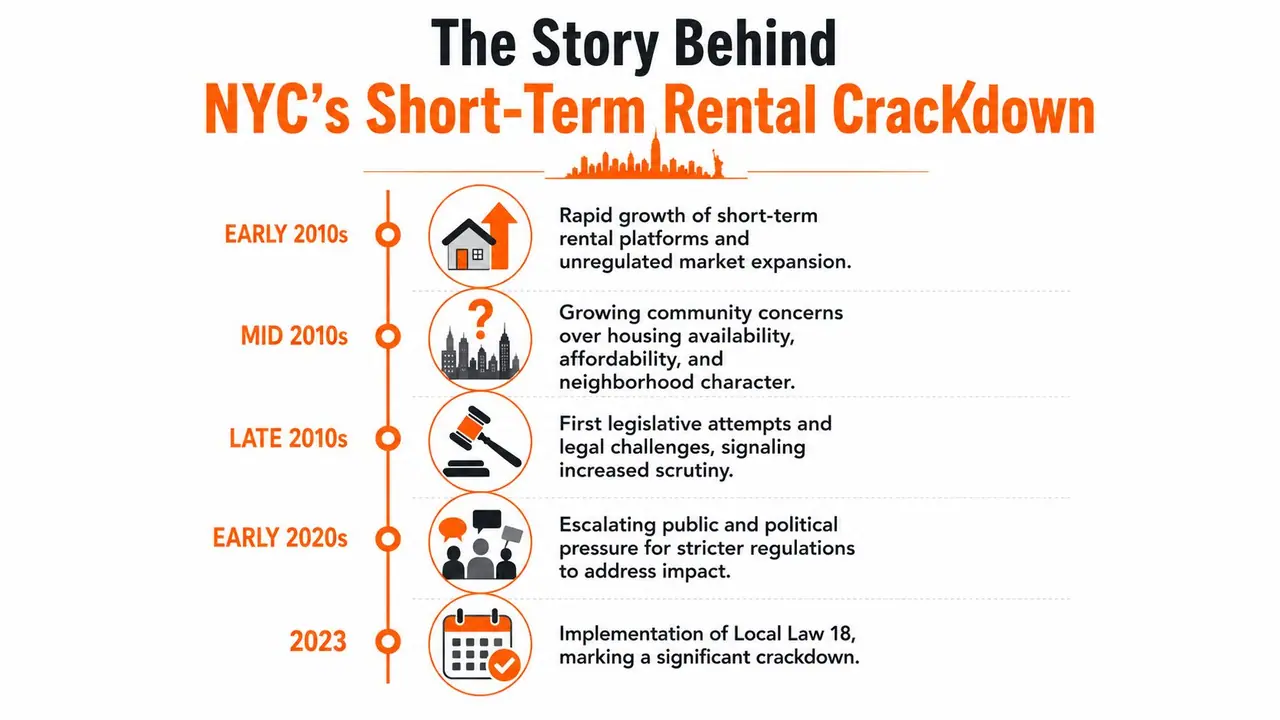
This didn't come out of nowhere. New York spent years moving toward a tougher position because city officials, housing advocates, and many residents believed short-term rentals were pulling regular housing into a shadow hotel market.
Why the city stopped treating STR growth as harmless
The housing backdrop mattered. The New York City Comptroller's Office report on Airbnb and housing pressure documented that between 2011 and 2017 the city lost nearly 183,000 affordable rental units charging under $1,000 per month. That same report notes a 2015 finding by then New York Attorney General Eric Schneiderman that about 72% of Airbnb listings in the city appeared to violate existing short-term-rental rules.
Those two facts shaped the politics. Officials weren't looking at home sharing as a side hustle anymore. They were looking at residential apartments being used like quasi-hotels in a city already under housing strain.
From a host's perspective, that history matters because it explains why the city doesn't approach enforcement casually. The rules weren't written to tidy up the market. They were written to reduce a type of inventory the city believed was harming long-term housing supply.
Why enforcement became the real turning point
A lot of hosts misunderstood the timeline. The law was enacted on January 9, 2022, but the market shock came when enforcement started. That's when platforms had to stop acting like neutral bulletin boards and start acting like gatekeepers.
Once New York forced registration and verification into the booking flow, the supply picture changed fast. That wasn't just a policy headline. It was a structural reset.
The reason this crackdown feels permanent is simple. The city tied legality to payment processing, not just listing behavior.
That distinction matters. In many cities, operators can test the edge of enforcement for a while. In New York, the city made the transaction itself part of the compliance system.
Hosts who understand that history usually make better decisions. They stop waiting for a return to the old market and start asking better questions:
| Question | Why it matters now |
|---|---|
| Is my current model politically aligned with city goals? | If not, don't expect looser treatment. |
| Can I prove primary residence and legal use? | Documentation now drives viability. |
| Is this property better suited to longer stays? | Many NYC units now perform better under a different model. |
Understanding Local Law 18 What Is Now Prohibited
A host rents out a full apartment for a long weekend, leaves the city, and assumes the old playbook still works. In NYC, that setup is the problem.
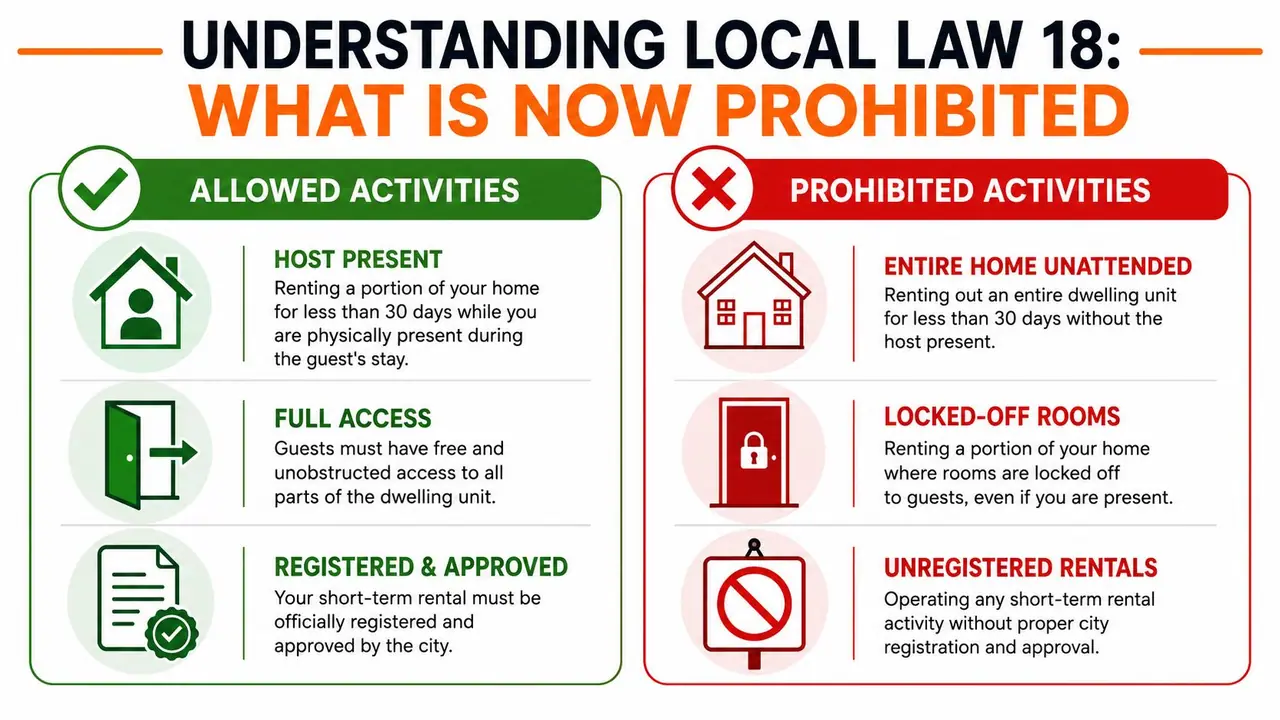
Under Local Law 18, the city did not ban every short stay. It shut down the version of hosting that operated like a private hotel. The rule set is narrow for stays under 30 days, and the practical question is simple. Are you sharing your primary residence while you are there, or are you turning over a whole unit to guests?
According to the NYC Mayor's Office of Special Enforcement short-term rental rules, a legal booking under 30 days generally requires the host to be present during the stay, limits occupancy to two guests, and does not allow booking an entire apartment in a Class A multiple dwelling for short-term use.
What a legal short stay looks like
The legal version is much tighter than many hosts expect. You live in the unit as your primary residence. You stay there while the guest is there. The guest has access to the home without being sealed off in a separate, self-contained space that operates like an unlicensed hotel room.
That last point trips people up. A layout can look fine on a listing and still create risk if it functions like an independent unit behind locked doors. If an inspector, platform reviewer, or building staff member sees a setup designed for unattended turnover, the host's intentions will not matter much.
I have seen hosts lose time and money by focusing on the platform instead of the use. Airbnb, Vrbo, and Booking.com are only distribution channels. The city is judging how the apartment is occupied.
A practical reference helps:
| Allowed | Prohibited |
|---|---|
| Host lives in the unit as a primary resident | Host rents a pied-a-terre, investment unit, or other non-primary residence |
| Host remains present during stays under 30 days | Guests occupy the full apartment without the host present |
| Booking matches the building's legal use and city rules | Apartment is set up or marketed like a self-serve hotel suite |
| Guest access is open within the shared home | Locked-off configuration creates a separate short-term unit |
What usually creates violations
Violations often come from operators treating enforcement as a gray area when the city treats it as a use issue.
These are the assumptions that cause the most trouble:
- "I only host once in a while." Frequency does not legalize a prohibited setup.
- "My listing is still live." A live listing is not proof that the use is lawful.
- "I stay there part of the year." Primary residence is a real standard, not a loose claim.
- "I can just block off part of the apartment." If it works like a separate guest unit, you have a problem.
The city also expects hosts to handle guest records carefully. Short stays and 30-plus-day rentals both create documentation risk, which is why a guest registration process for rental properties matters even when the booking itself is legal.
Later in the section, it's worth seeing how the city frames the basic distinctions in plain visual form.
A simple allowed versus prohibited view
The cleanest way to read Local Law 18 is by operating model.
If your revenue depends on handing over an entire NYC apartment to visitors for under 30 days while you sleep somewhere else, that model is effectively off the table. Hosts who accept that early usually make better business decisions. They stop trying to rescue an illegal setup and start evaluating whether the unit can perform as a compliant 30-plus-day rental.
That shift is not a consolation prize. For many owners, it is the only version of the business that can be systemized, insured correctly, and run without constant enforcement risk. The hosts who survive in NYC now are the ones who treat longer stays as a real operating model, not a temporary fallback.
The Host Registration Process Explained
A lot of NYC hosts hit the same wall here. They assume the hard part was understanding Local Law 18, then find out the true filter is whether their property and paperwork can survive review.
What the city is actually checking
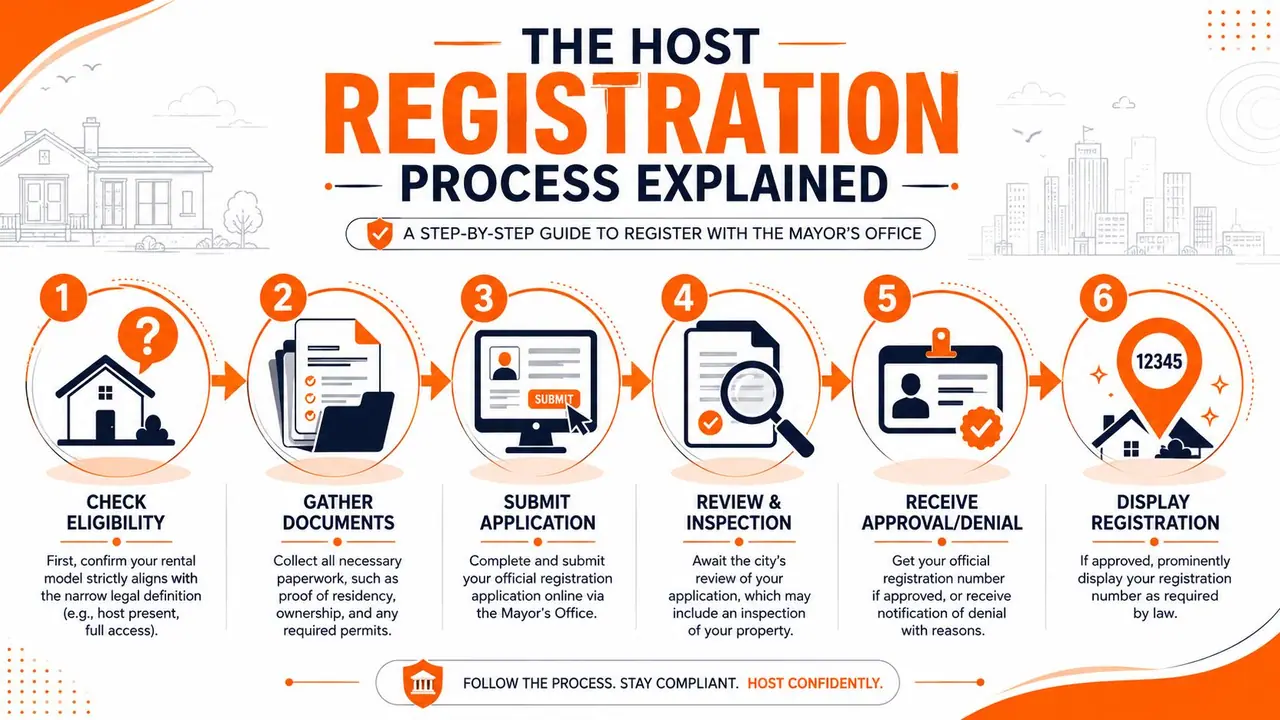
The Mayor's Office of Special Enforcement runs a registration system that listing platforms have to respect. Airbnb, Vrbo, and Booking.com cannot process a short-term booking for a New York City listing unless it carries a valid registration number, according to the NYC Office of Special Enforcement's short-term rental registration rules.
That review goes well beyond a basic form. The city is checking whether the listing matches the legal use of the unit, whether the building type allows the arrangement, whether the host's living setup fits the rules, and whether the documents all point to the same facts. In practice, weak applications often fall apart at this stage. A listing can look fine on a platform and still fail because the lease, ID, residence records, or apartment setup tell a different story.
The filing also costs money. The city requires a fee and supporting documents, including proof of identity and records tied to the home and occupancy, as outlined on the official host registration application page from NYC OSE.
Why many applications stall or fail
The city publishes registration outcomes, and the pattern is clear in the NYC short-term rental registration data page. A meaningful share of applications are denied or sent back, which matches what operators have seen on the ground.
The common mistake is treating registration like a paperwork problem instead of a property problem.
If the unit is in the wrong building class, if the host is not living there as required, if the space functions like a separate guest suite, or if the lease blocks the use, a polished application will not rescue it. All the portal does is expose the mismatch faster.
Field note: The applications that hold up usually tell one clear story across every document, every building rule, and the actual living arrangement inside the apartment.
How to approach registration without wasting time
Review the deal the way a compliance officer would, before you pay the fee.
Confirm the residence facts
Make sure the home is your actual primary residence and that your records support that claim.Read the building documents closely
Check the lease, condo or co-op rules, house rules, and any written owner restrictions. A host can meet city rules and still get blocked by the building.Walk the unit as a regulator would
Separate-entry privacy, lockoffs, blocked interior access, or a setup designed around the host being away can create problems fast.Clean up the file set
Names, addresses, unit numbers, and dates need to match across every document. Small inconsistencies create avoidable delays.Fix your intake process
Good records matter during legal short stays and matter even more if you pivot into month-long occupancy. A tighter guest registration process for rental properties helps keep identity, stay terms, and occupancy records organized.
For many owners, this review ends with a hard but useful answer. The apartment is either a realistic fit for legal host-present short stays, or it is better suited to a 30-plus-day model that can be run more predictably, documented more cleanly, and built into a real business instead of a constant compliance fight.
Strategic Pivots From Short Term to Mid Term Rentals
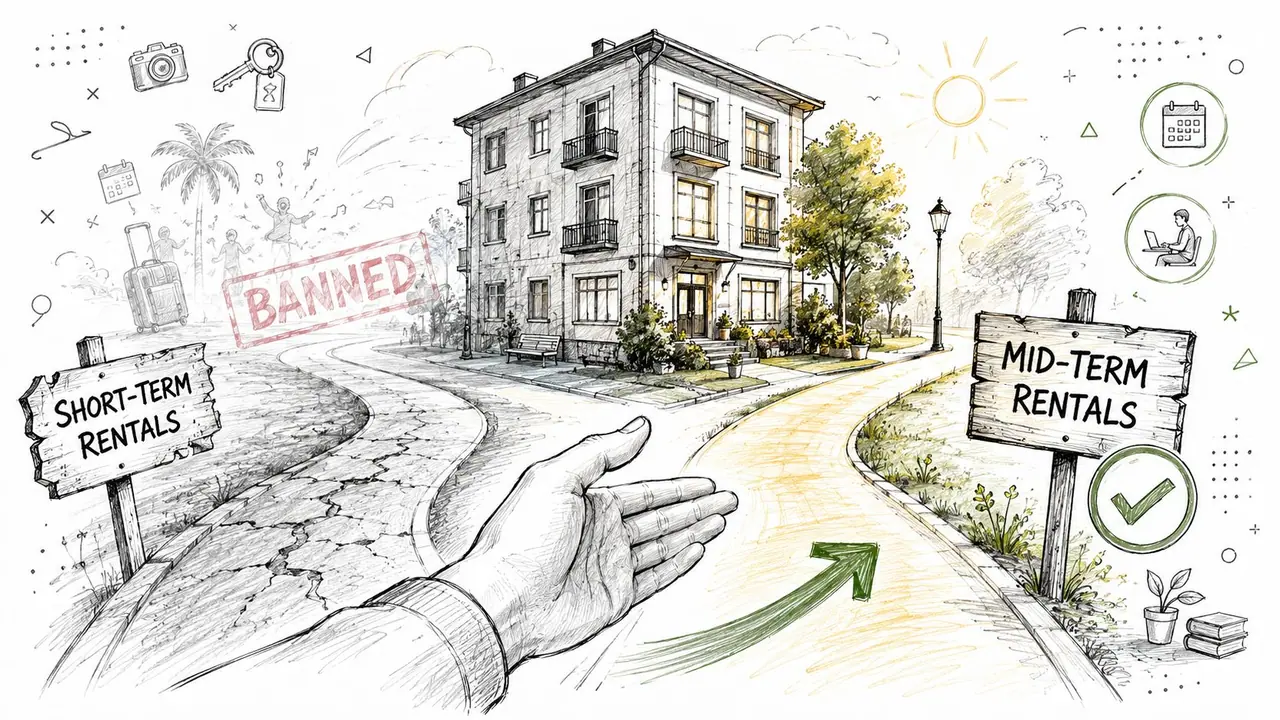
For most NYC hosts, the best move isn't to force a shrinking short-stay model. It's to pivot into 30-day-plus rentals and run them well enough that the revenue holds up.
The reason is straightforward. The crackdown creates an opportunity for hosts to move to 30-day+ stays, which are exempt from Local Law 18, and NYC's median rent sits around $3,700, according to this practical look at alternatives to the NYC Airbnb ban.
Why 30 plus days is the cleanest pivot
This isn't a consolation prize. It's a different product.
A guest staying for a month or more doesn't shop the way a weekend tourist does. They care less about novelty and more about friction. They want a place that works on day three, day twelve, and day twenty-seven. That means reliable Wi-Fi, practical storage, kitchen usability, laundry access, clear building instructions, and communication that feels organized rather than charmingly improvised.
The operators who adapt fastest usually target guests with a real reason to stay longer. Think relocation clients, visiting professionals, graduate students, temporary project teams, or people between leases. These guests often value predictability more than flashy styling.
How to package a mid term stay like a real product
Most hosts underprice or undersell mid-term inventory because they list it like a standard Airbnb and stop there. That's a mistake. Longer stays need a clearer offer.
The following tends to work better:
Bundle useful services, not gimmicks
Offer optional cleaning, fresh linen drops, restocking help, or local errand support. A month-long guest often pays for convenience if it's presented clearly.Write the listing around living, not vacationing
Lead with workspace quality, transit access, kitchen function, natural light, quiet hours, and building logistics.Standardize check-in and house information
Mid-term guests hate hunting through message threads for Wi-Fi, trash rules, or mailbox instructions. Put information in one place and make it easy to access.Think in stay experience phases
Arrival needs clarity. Week one needs support. Mid-stay needs light-touch service. Departure needs a simple process.
One overlooked advantage of this model is that it can be more operationally sane. Fewer turnovers usually mean fewer emergency cleanings, fewer key handoff issues, and fewer late-night "how do I turn on the heat?" messages. But only if you professionalize the handoff.
A 30-day guest doesn't want a vacation rental with extra nights. They want a temporary home that runs like a small hospitality product.
If you're exploring creative structures around unit economics and control, this piece on rent arbitrage for Airbnb operators is worth reading with caution and context. In NYC, the legal and lease side matters before the spreadsheet does.
What doesn't work in the pivot
The hosts who struggle usually do one of three things.
First, they keep the apartment furnished for two-night tourist turnover, then wonder why month-long guests don't convert. Tiny luggage racks, no dresser space, weak cookware, and decorative furniture are all friction points.
Second, they market to everyone. That creates vague listings. Mid-term guests respond better to a property that clearly fits a use case.
Third, they ignore service design. A longer booking doesn't excuse a lower standard. It changes the standard. The basics need to be sharper, calmer, and easier to use.
A good pivot isn't "switching to monthly." It's rebuilding the offer so the guest can picture living there without daily confusion.
Your Action Plan for Hosting in NYC
The hosts who stay profitable in New York now are the ones who stop negotiating with reality. They audit the asset, choose a legal model, and run that model cleanly.
A practical decision checklist
Start with a blunt self-audit:
- Does the current listing depend on renting an entire unit for under 30 days? If yes, treat that model as nonviable.
- Do you live in the property as your primary residence? If the answer is shaky, don't build your business around a short-stay exception.
- Can the unit work well for month-plus guests? Check storage, kitchen setup, work surface, laundry, lighting, and building access.
- Are your building rules and lease terms aligned? If they're not, fix that before you touch pricing or distribution.
- Do your operations feel professional? Longer stays still require polished communication, cleaning standards, and in-stay support.
Then choose one path. Either pursue compliant registration because your setup properly fits, or pivot hard into a mid-term model and stop wasting energy on an old format that no longer matches the city.
Where strong operators still win
The old NYC hosting playbook rewarded hustle. The current one rewards discipline.
That means fewer assumptions and better systems. Clean turnovers matter more because month-long guests notice maintenance drift. Messaging matters more because these guests are living, not visiting. If you're revisiting your housekeeping process, this guide to Airbnb cleaning standards for 5-star reviews is a practical benchmark for setting a more consistent guest experience.
A resilient NYC rental business now looks less like a casual side hustle and more like a small hospitality operation with legal awareness. That's not bad news for everyone. It usually favors the hosts who document well, communicate clearly, and build a stay experience people can trust for more than a weekend.
The market didn't disappear. It narrowed. For adaptable hosts, that's still workable.
If you want to make any NYC rental model easier to run, ScanStay helps you replace scattered messages and paper binders with one mobile-friendly digital welcome book. Guests scan a QR code to get check-in details, Wi-Fi, house rules, local recommendations, and optional upsells in one place, which is especially useful when you're managing longer stays and want fewer repetitive questions.