Airbnb Host Insurance: A Complete Coverage Guide for 2026
Airbnb host insurance explained. Learn what AirCover covers, where it falls short, third-party policy types, costs, claims, and a host checklist.
Most hosts think Airbnb host insurance is a single thing. It isn't. Airbnb's own protection is claims-based, time-sensitive, and partial, and in a public analysis of 20,000+ bookings, only 0.71% triggered a damage claim while Airbnb approved 56.75% of the claimed amount in that dataset, which is a very different story from “full coverage” (claim statistics analysis).
That's the part most hosts miss. AirCover helps, but it doesn't turn Airbnb into your insurer for every loss, every dispute, or every furnishing problem. If you want to protect a furnished short-term rental like a real business, you need to know exactly where Airbnb stops and where your own policy has to start.
Table of Contents
- Why Airbnb Host Insurance Is Not What Most Hosts Think It Is
- What AirCover Covers for Hosts
- Where AirCover Stops and Your Risk Starts
- The Four Types of Third-Party Short-Term Rental Policies
- What Short-Term Rental Insurance Costs
- How to Choose and Buy the Right Policy
- Filing a Claim the Right Way
- Host Insurance Checklist and Common Misconceptions
Why Airbnb Host Insurance Is Not What Most Hosts Think It Is
Airbnb's protection language sounds wider than the actual coverage. It is narrower, and claim results show why hosts should treat it that way. A host can take a significant hit and still walk away with a partial payout, a denial, or a missed deadline, which is why airbnb host insurance cannot be treated like a single safety net.
The right way to think about it
Airbnb's setup is platform protection, not a replacement for a policy you buy yourself. The company offers host-side liability coverage, damage protection, and earnings-related protection in some cases, but those pieces do not work like a commercial policy written around your property, inventory, and operating model (Airbnb host liability insurance; Airbnb host protection framework).
Practical rule: If the loss came from a guest injury, guest damage, or another covered event, Airbnb may help. If the loss involves ordinary property risk, late discovery, missing contents, or a coverage dispute, your own policy does the work.
That is the shift hosts need to make. Stop asking whether you need extra insurance because you host on Airbnb. Ask which parts of your risk sit inside Airbnb's protection and which parts stay on you. That question leads to better policy choices, cleaner claims, and fewer ugly surprises when payout time arrives.
What this article uses as working definitions
When I say Airbnb protection, I mean the host-facing coverage built into the platform. When I say third-party policy, I mean a policy or endorsement from an insurer outside Airbnb that covers property, liability, income, or a mix of those risks. When I say coverage gap, I mean the place where Airbnb's protection ends and your exposure begins.
That distinction matters because short-term rental hosting has long exposed a gap in ordinary homeowners insurance. Airbnb added host-facing liability protection and later expanded the program into AirCover, and industry reporting continues to warn that standard home insurance often does not properly cover commercial short-term rental activity. The claim statistics cited elsewhere in this article also point to a harder reality, claims are filed often enough, and approvals are not automatic. If you own furnished inventory, manage multiple listings, or host in a market where insurers price short-term rental risk separately, you are not buying extra peace of mind. You are buying the policy that matches the job.
What AirCover Covers for Hosts
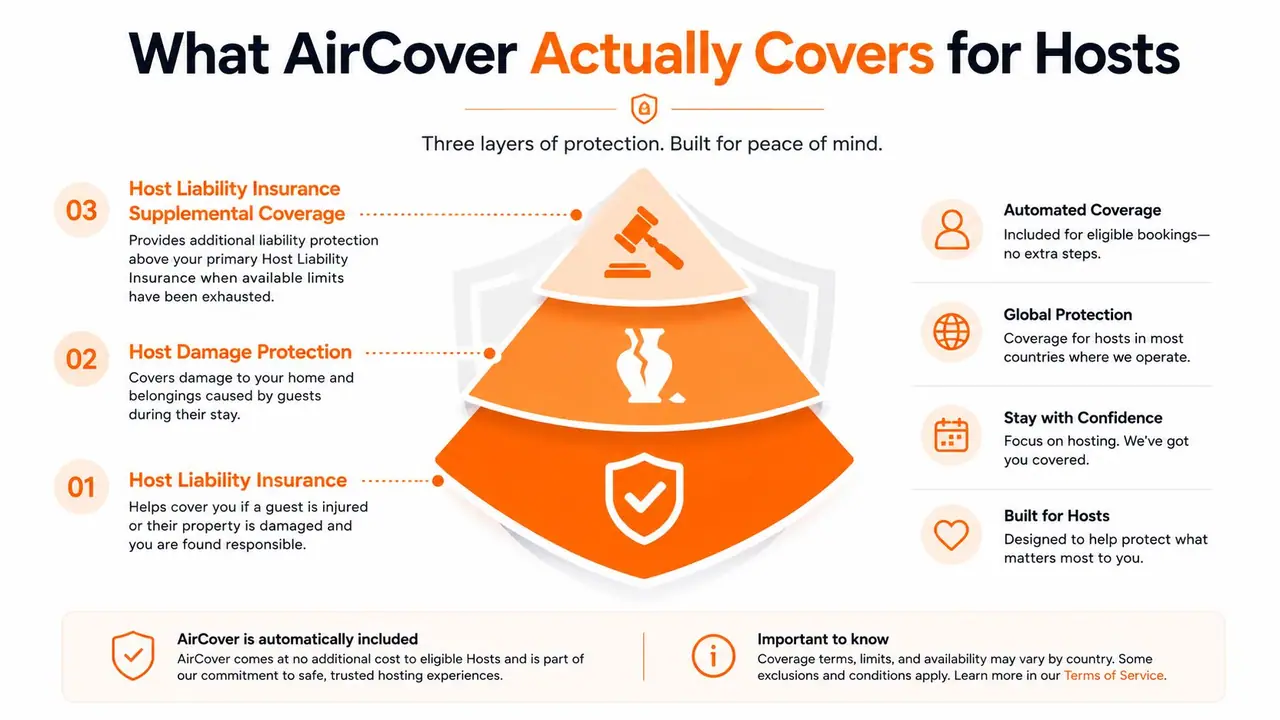
AirCover is layered protection, and hosts need to separate those layers before judging whether they are enough. The main host-facing pieces are Host Liability Insurance, Host Damage Protection, and earnings-related protection that can apply in some listing situations (Airbnb help center; Airbnb Host Liability Insurance).
Liability is about legal responsibility, not every bad thing that happens
Airbnb says Host Liability Insurance is included at no extra cost and provides $1,000,000 USD total limit per Airbnb Stay. It covers a host's legal liability for bodily injury or property damage to guests or others during an Airbnb stay, but it is not property insurance for the host's own home or belongings (Airbnb Host Liability Insurance).
That matters in a slippery-floor injury, a guest lawsuit, or a claim that a visitor's property was damaged because you were legally responsible. It does not mean Airbnb writes a check every time a guest breaks a lamp.
Damage protection sits on a different layer
Airbnb's host protection framework also includes up to $3 million USD in damage protection per stay under AirCover, and Airbnb says hosts must file a claim within 14 days of checkout or before the next guest checks in, whichever comes first. That deadline is the kind of detail hosts ignore until it burns them.
A broken television, a torn sofa, or a smashed table may fall into this layer if the claim is filed correctly and on time. The coverage is still claims-based, which means the process, the documentation, and the timing matter as much as the damage itself.
Earnings protection is separate from property repair
Airbnb has also introduced earnings-related protection in some markets for hosts whose stays are interrupted by qualifying events, but that is not the same thing as replacing a damaged rental or reimbursing a stolen item (Airbnb earnings protection announcement). It is a narrow tool for specific income disruption scenarios.
If you run a furnished rental as a business, think in layers. Liability covers legal fault. Damage protection addresses guest-caused property damage. Income protection, where available, addresses interrupted hosting. None of those automatically equals a complete operating policy for your listing.
Where AirCover Stops and Your Risk Starts
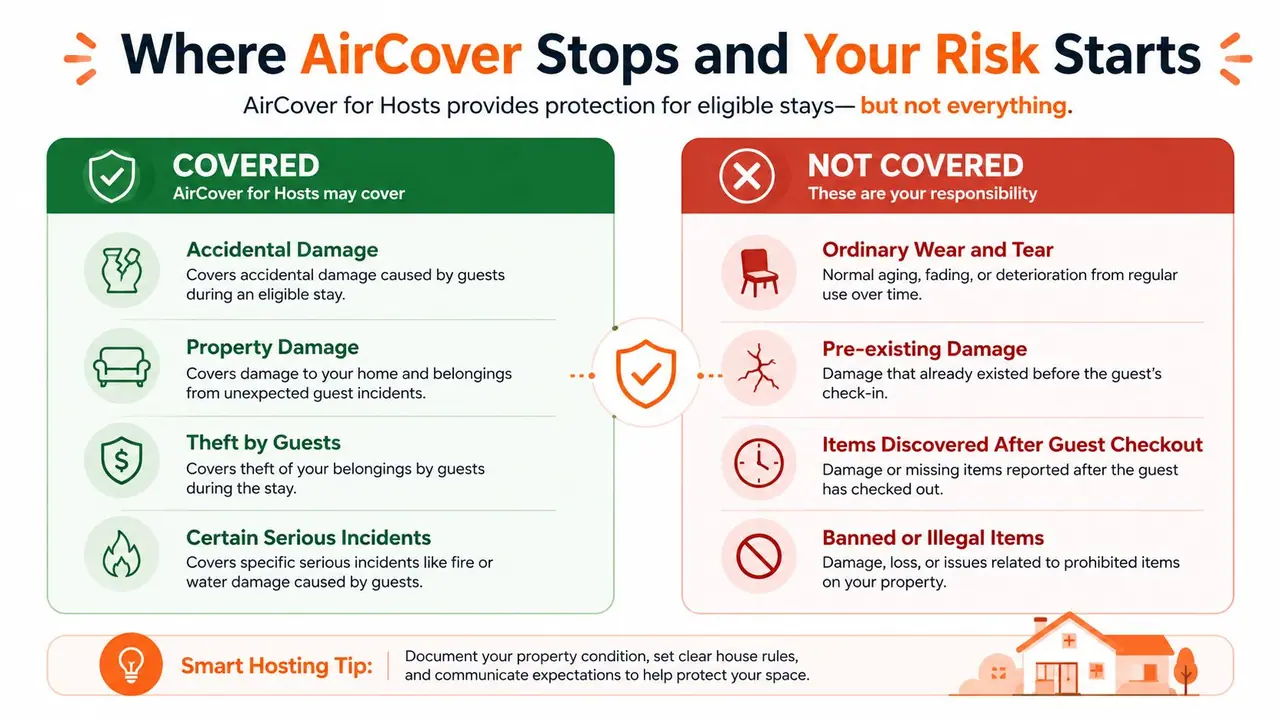
The bad claims are the ones that look simple until checkout is over. AirCover gives you a starting point, but it stops where documentation gets messy, timing slips, or the loss sits outside Airbnb's narrow claims process.
The coverage cliff is real
Airbnb's own help pages make the filing window clear, and that deadline is where a lot of hosts get cut off (Airbnb help center). If you wait too long after checkout, or you let the next guest arrive before you file, you are no longer dealing with a clean claim. You are dealing with a self-inflicted loss.
As noted in the coverage overview, the 14-day filing window and the 56.75% approval rate create real risk for hosts. That is a point often missed. AirCover is not a blanket promise, it is a claims process with a narrow path from damage to payout.
The common gaps hosts trip over
Direct answer: If the damage shows up late, gets argued as wear and tear, or disappears from the unit after the guest is gone, you are in the danger zone.
Those are the claims that turn ugly fast. Ordinary wear and tear is not a covered loss. Missing items are hard to prove without clean records. Damage found after checkout can turn into a timing fight, and that fight usually goes against the host when the paperwork is weak. Business-use furnishings are another weak point, because a lot of standard homeowners coverage is built for personal use, not short-term rental operations (industry guide on Airbnb host insurance gaps; Airbnb help center).
That is why hosts with furnished listings need a digital inventory and solid check-in and check-out records before they ever file. If you cannot show what was there, what changed, and when it changed, the claim gets easier to deny.
What Airbnb doesn't turn into a simple payout
Airbnb's protection is built around liability and defined damage claims, not around replacing every item in a rental at full value. If you run a place with artwork, specialty furniture, electronics, or a high-turnover setup, the real question is not whether the platform has a protection layer. The question is where the loss falls, and whether your own policy is built for short-term rental exposure.
If you want a clean outside comparison while you shop, use compare rental host insurance. Treat it as a buying tool, not a promise. Policy language decides the claim, and the cheap policy is the one that fails when the loss hits.
The Four Types of Third-Party Short-Term Rental Policies
Third-party coverage only works when you match the policy to the risk. Hosts should be looking at four categories, not one. Each one solves a different problem, and buying the wrong one leaves the gap open.
| Policy Type | What It Covers | Main Gap It Fills | Typical Limit |
|---|---|---|---|
| Short-term rental liability policy | Guest injury, third-party property damage, legal defense | Fault-based claims outside Airbnb's platform coverage | Varies by carrier |
| Property and contents policy | Furnishings, appliances, electronics, and rental contents | Damage to your own stuff, not just guest liability | Varies by carrier |
| Loss-of-income rider | Income interruption from covered events | Rental revenue loss when you can't host | Varies by carrier |
| Endorsement to a homeowners policy | Adds or adapts coverage for STR use | Homes that need a retrofit instead of a separate policy | Varies by carrier |
Liability, property, income, endorsement
A short-term rental liability policy is for a guest injury or third-party claim that lands on your desk, not Airbnb's. Occurrence-based liability matters because you want the trigger tied to the event, not to when someone remembers to sue.
A property and contents policy is for the stuff inside the unit. For furnished rentals, compare replacement cost with actual cash value. Replacement cost is what most hosts want. Actual cash value cuts you down for age and depreciation, which is a bad trade when you are buying chairs, linens, TVs, and kitchen gear for guests.
A loss-of-income rider helps when a covered event knocks the listing offline and the revenue stops. It is not a substitute for reserves, but it can keep a property from bleeding cash after a covered loss.
What to ask before you buy
You need the underwriting language, not the marketing headline. Ask whether the policy specifically allows short-term rental activity, whether it covers business-use furnishings, and whether the carrier treats your rental as a personal home with a rental endorsement or as an actual commercial exposure. The answer changes the price, and the claim outcome.
If you want a different perspective on how operators structure ownership and risk, this guide on LLCs for Airbnb is worth a read. The legal wrapper does not replace insurance, but it changes how hosts think about liability and asset separation.
If you want a clean outside comparison while you shop, use compare rental host insurance. Treat it as a buying tool, not a promise. Policy language decides the claim, and the cheap policy is the one that fails when the loss hits.
Third-party short-term rental coverage at a glance
A clean policy comparison should tell you, in plain English, what each policy pays for and what it leaves out.
- Liability policy: Covers guest injury and third-party claims, fills the gap between platform liability and your own exposure.
- Contents policy: Covers the furniture, electronics, and consumables you bought for the listing, fills the gap where homeowners insurance usually falls short.
- Income rider: Covers lost rental income after a covered event, fills the gap when the property is intact but unusable.
- Endorsement: Modifies an existing homeowners policy to acknowledge STR use, fills the gap when you do not need a separate standalone policy.
Buy the policy that matches your business model, not the one with the lowest premium on the first quote.
What Short-Term Rental Insurance Costs
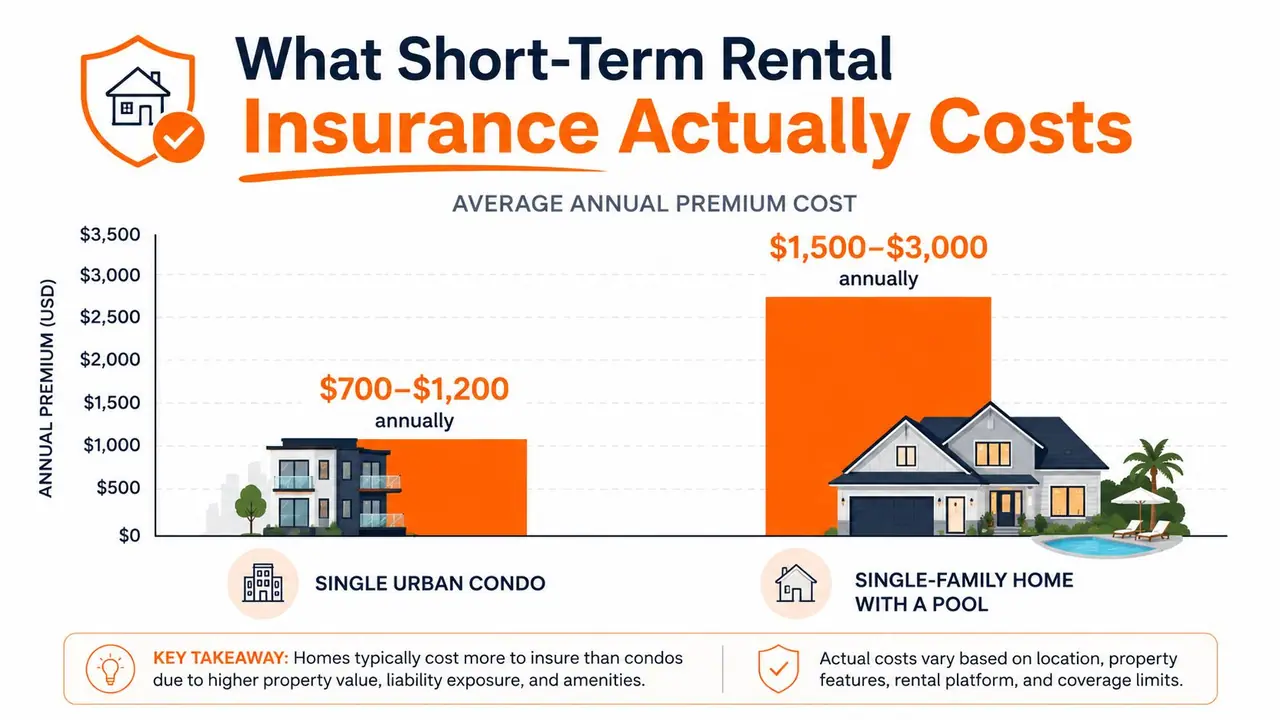
Cheap coverage is usually cheap for a reason. Premiums track the property type, location, claims history, and the amount of risk an insurer thinks each booking brings into the building. A condo in a dense urban market and a single-family home with a pool do not price the same, because they do not fail the same way.
Budget by property type, not by wishful thinking
The benchmark is straightforward. A single urban condo may run $700-$1,200 annually, while a single-family home with a pool may run $1,500-$3,000 annually. That spread makes sense. The more guests, features, and liability triggers you add, the more the policy costs.
On a monthly basis, the condo usually looks like a modest operating line, while the pool home becomes a heavier one. If you run multiple listings, insurance belongs in the same budget bucket as cleaning, consumables, and maintenance. Treating it as an afterthought is how hosts end up underinsured.
What pushes the price up
Location matters. So does square footage, the quality and age of the contents, and whether the listing includes higher-risk amenities such as a pool, hot tub, or EV charger. Claims history also affects underwriting, because carriers price behavior as much as they price property.
Budget rule: The more “hotel-like” the listing feels, the more likely you are to need real STR-specific underwriting instead of a homeowner's policy with crossed fingers.
Add-ons can surprise first-time buyers. Umbrella coverage, earthquake riders, flood coverage, and contents floaters for high-value items all cost extra when they are available. If your unit has designer furniture or equipment you would hate to replace out of pocket, do not assume the base policy handles it.
LLCs for Airbnb matter here because ownership structure changes how hosts think about liability and asset separation. The legal wrapper does not replace insurance, but it can shape what you buy and how you hold the risk.
The smart move is to price the full stack, not the sticker price of the cheapest policy. A lower premium that leaves out the risk you carry becomes expensive the moment a claim lands.
How to Choose and Buy the Right Policy
Buying the right policy starts with six blunt questions. Do not ask a broker for “best Airbnb insurance.” Ask for a policy that fits your exact risk profile, then read the wording that controls the payout. The sales pitch does not pay claims, the policy language does.
Start with the six questions that matter
- What does my homeowners policy exclude? If the carrier excludes STR activity, a later claim will not be rescued by goodwill.
- How often do I host? Frequent rental activity needs to be underwritten as an ongoing exposure, not treated like a one-off spare-room arrangement.
- What is my contents replacement value? If the place is furnished like a boutique hotel, the contents limit has to reflect that reality.
- Do I use cleaners, co-hosts, or contractors? Extra hands can create extra liability, and you need to know who is covered and how.
- What liability exposure exists beyond the property? Parking, stairs, pools, decks, and shared amenities all widen the risk.
- How much lost income can I tolerate? If one covered loss would squeeze your cash flow, you need a stronger income layer.
Each answer points to a different mix of liability coverage, contents coverage, and endorsements. Skip this step and you will buy the wrong policy.
Ask for the right documents and wording
A serious broker should show you the declarations page, exclusions, and any STR endorsement language before you bind coverage. Ask whether the policy is written for short-term rental use, whether liability is occurrence-based, and whether contents are reimbursed at replacement cost.
Airbnb's own help pages on host protections and claims timing show the platform has its own rules, and those rules do not replace a private policy. The practical lesson is simple. Read the forms, not the marketing. If the wording does not clearly cover guest-caused damage, loss of income, and the way your property is used, it is the wrong policy for the job. For hosts holding the property in an LLC, property ownership structure for Airbnb hosts can shape how you buy coverage, but the insurance still has to match the risk itself.
Buy through a broker who understands vacation rentals
Generalist agents often sell a homeowners policy and hope it behaves like STR insurance. That is a bad bet. You want a broker who already places short-term rental risks in your state and knows how carriers treat furnished turnover, guest liability, and contents claims.
If the quote comes back with vague language, walk away. The policy should read like it was written for a rental business, not a primary residence that happens to have strangers sleeping in it.
Filing a Claim the Right Way
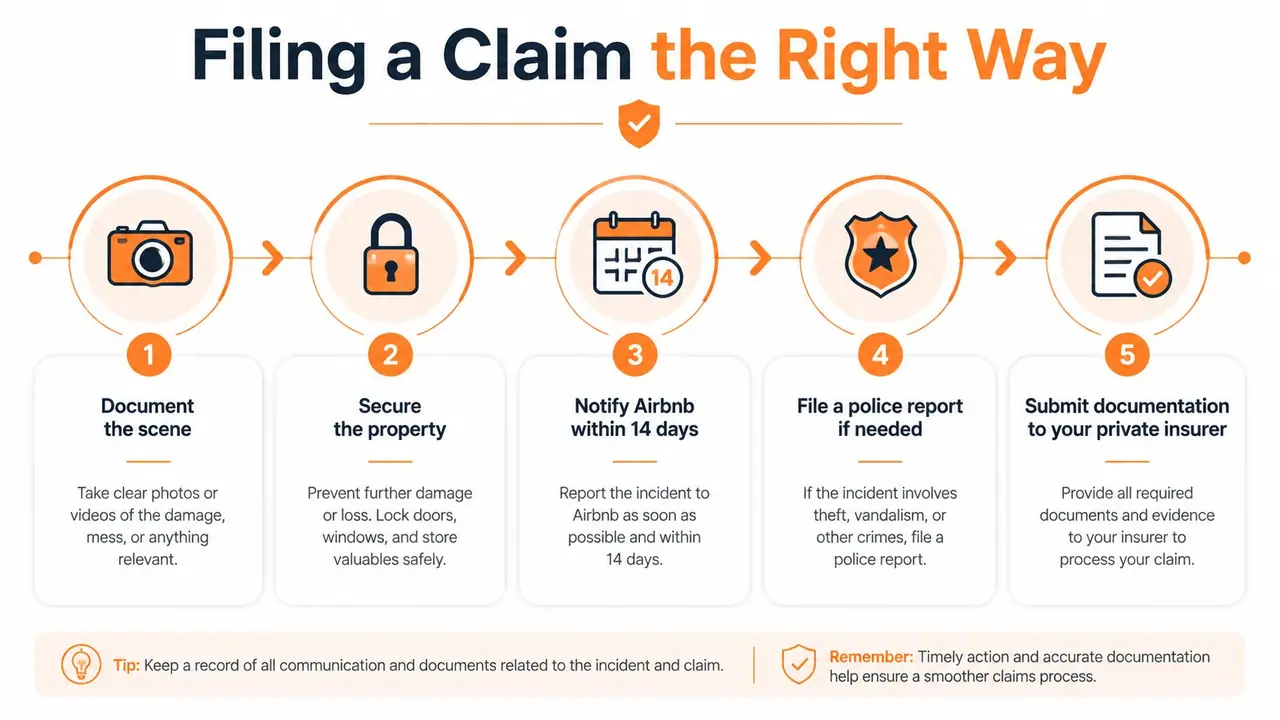
Claims fail most often because hosts wait too long, clean too fast, or document too little. A good policy still needs proof. If you want money back, the scene, the timeline, and the paperwork have to be airtight.
The first hours matter
Document the scene before anything moves. Take wide shots, close-ups, and video, then secure the property so the damage does not spread. If theft is suspected, call local authorities and get the report started.
After that, separate the platform claim from the private-insurer claim. Airbnb has its own timing rules, and your insurer may want a different package of evidence. Do not mix the two into one sloppy email thread.
Build the evidence file before you ever need it
Keep these records on hand:
- Check-in records: Prove who arrived and when.
- Signed house rules: Show the guest agreed to property use terms.
- Mid-stay cleaning photos: Help show condition between turnovers.
- Post-checkout walkthrough video: Capture what changed after departure.
- Dated inventory photos: Prove what items were in the unit before the stay.
Keep your hands off the scene until you have shot it. A wiped-down surface is a lost argument.
That checklist matters most when damage is discovered late or the guest disputes it. Those are the cases where insurers and platform reviewers start asking who can prove what, not who feels wronged.
If you want stronger booking records and cleaner turnover documentation, vacation rental contracts are worth tightening up before the next guest arrives. Good paperwork will not stop damage, but it gives you a stronger claim file when the damage shows up.
Know when layered claims are possible
Sometimes Airbnb's damage protection and your own contents policy can both apply to the same incident. That does not mean you double-dip. It means you document the loss once, then send it to the right coverage layers in the right order.
Handle it like a business. Write down what happened, preserve the proof, and do not negotiate informally with the guest outside the platform if the claim belongs in a formal process.
Host Insurance Checklist and Common Misconceptions
Good insurance management is boring on purpose. Review the risk, check the wording, update the records, and do not wait for a loss to discover that your policy was written for a different kind of property.
The annual checklist I'd use
- Refresh the risk profile: Recheck the listing type, guest count, amenities, and turnover pattern.
- Review homeowners exclusions: Confirm the policy language still addresses short-term rental use.
- Quote at least two STR-specific carriers: Compare exclusions, not just premiums.
- Document contents with dated photos: Keep a current visual inventory of furniture, electronics, and décor.
- Update after major furnishing changes: New sofa, new TV, new hot tub, new risk.
- Store claim-ready records: Keep turnover photos, house rules, and check-in data in one place.
- Keep the operating side organized: If you want a tighter record trail, follow a complete Airbnb host checklist and keep your turnover process consistent.
If you run multiple properties, build this into your annual operating rhythm. If you wait until renewal week to think about it, you are already behind.
Five misconceptions that cost hosts money
- AirCover is full coverage. It is a platform protection with limits, deadlines, and exclusions, and those limits show up fast once a claim hits the queue.
- My homeowners policy covers STR activity. Often it does not, and that gap is exactly why dedicated STR insurance exists.
- One policy fits every market. A condo, a pool home, and a multi-unit portfolio do not need the same setup.
- The cheapest quote is the best value. Usually it is the quote that excludes the thing you were trying to insure.
- Digital records do not matter until a claim. They matter before you host, because they decide what you can prove later.
If you only do one thing this week, pull your declarations page, check the exclusions, and compare that language against how you use the property. That single step will tell you more than a year of guessing ever will.
The claims side is harsher than the marketing. Airbnb-host claim data shared in public reviews has pointed to a low claim rate and only modest approval on average, which means the platform does not pay every time a host expects it to. The coverage cliff is real, and it starts where the listing protection ends and your own policy has to pick up the loss. That is why the right third-party policy matters more than the brand name on the reservation page.
Map each gap to the right policy. Wear and tear, theft, guest-caused damage, liability, and business interruption do not all live under the same roof, and they do not all respond the same way. A good short-term rental policy should match the property type, the guest exposure, and the claims history you are building. Buy for the loss you can prove, not the loss you hope never happens.
Handle your files like a claim adjuster will read them. Keep the policy declarations, renewal notes, photos, and guest records together, because scattered paperwork slows down payment and gives insurers room to push back.